
AI Agents & Automation
Browsing page 146 of AI Frameworks & Infra in AI Agents & Automation. Sorted by confidence score — our independent quality rating.

fedlearner
Fedlearner is a multi-party collaborative machine learning framework designed to enable joint modeling of data distributed across various institutions. This open-source tool, developed by Bytedance, focuses on secure data sharing and analysis for machine learning applications. It supports collaborative AI development without centralizing sensitive data, making it suitable for scenarios requiring privacy preservation and data governance. The framework is built with Python, TypeScript, and Go, indicating a robust and versatile technical foundation for developers looking to implement federated learning solutions.

AI Product Engineer
AI Product Engineer (AIPE) is an interactive learning platform designed to master AI product development. Through engaging quests and hands-on experience, users can learn to build agentic AI systems and production-ready AI software. The platform emphasizes a code-first approach, providing tutorials and a community for aspiring AI product engineers. Users earn XP and level up their skills with Quackster the DuckTyper, making the learning process gamified and engaging. AIPE also hosts live events, such as discussions on the AI Cluster and its role in agentic AI, offering insights into industry-relevant tools and frameworks like Apify's AI Cluster.
PiML-Toolbox
PiML-Toolbox (Python Interpretable Machine Learning) is a comprehensive Python toolbox designed for the development and diagnostics of interpretable machine learning models. It offers both low-code interfaces and high-code APIs, supporting a growing list of inherently interpretable ML models such as GLM, GAM, Tree, FIGS, XGB1, XGB2, EBM, GAMI-Net, and ReLU-DNN. The toolbox facilitates various outcome testing, including accuracy, explainability (PFI, PDP, ALE, LIME, SHAP), fairness, weak spot identification, overfitting detection, reliability assessment, robustness, and resilience evaluation. PiML-Toolbox aims to empower model developers and validators with tools for transparent, interpretable, and robust machine learning, particularly in high-stakes regulatory settings.
CS TECH Ai
CS TECH Ai delivers high-impact technology solutions across Geospatial, AI, and Digital Transformation domains. The company specializes in providing services such as GIS, remote sensing, and digital twin services for infrastructure, water, energy, and natural resource management. Additionally, CS TECH Ai offers product and manufacturing engineering solutions for the mobility sector, covering design, validation, industrial automation, and electrification. Their AI-enabled platforms facilitate intelligent decision-making through IoT integration, automation, and 3D reality capture, supporting scalable enterprise operations across diverse sectors. With 27 years of experience, CS TECH Ai focuses on sustainability and integrates global technologies to meet customer needs effectively.

DIGITRELL
DIGITRELL is a leading IT service and consulting company dedicated to helping businesses leverage technology for digital transformation and improved customer experiences. They combine real-world approaches with smart digital tools to enable organizations to adapt to technological changes and stay competitive. Their vision is to drive innovation through transformative IT services, helping businesses achieve long-term success. DIGITRELL offers strategic partnerships, industry insights, scalable solutions, an innovation mindset, operational excellence, and a customer-centric approach to deliver impactful and personalized solutions.
R1-V
R1-V is an open-source project focused on enhancing the super generalization ability of Vision Language Models (VLM) with minimal computational cost. It aims to improve the perception and reasoning capabilities of VLMs through reinforcement learning. The project provides new VLM-RL environments, a comprehensive training codebase, and research papers. R1-V supports various models like Qwen2-VL and Qwen2.5-VL, and offers training datasets for tasks such as item counting and geometry reasoning. It also includes evaluation scripts for benchmarks like SuperClevr and GEOQA, making it a valuable resource for researchers and developers in the VLM domain.
Scrapling
Scrapling is a powerful and adaptive web scraping framework designed for both single requests and full-scale, concurrent crawls. It features an intelligent parser that learns from website changes, automatically relocating elements when pages update, ensuring data extraction remains robust. The framework includes advanced fetchers capable of bypassing anti-bot systems like Cloudflare Turnstile and offers full browser automation. Scrapling supports multi-session crawls with pause/resume functionality, automatic proxy rotation, and real-time streaming of scraped items. It also integrates AI capabilities through an MCP server for assisted web scraping, optimizing data extraction and reducing token usage for AI models. Built for performance, it boasts high speed, memory efficiency, and battle-tested architecture with extensive test coverage.
TensorFlowASR
TensorFlowASR is an open-source toolkit for automatic speech recognition (ASR) built on TensorFlow 2. It provides implementations of various advanced ASR architectures, including DeepSpeech2, Jasper, RNN Transducer, ContextNet, and Conformer. A key feature is the ability to convert these models to TFLite, which significantly reduces memory and computation requirements, making them suitable for deployment on devices with limited resources. The framework supports multiple languages, including English and Vietnamese, and offers functionalities for feature extraction and augmentations. It's designed for developers and researchers looking to build, train, and deploy high-performance speech recognition systems.
TALENT
TALENT is a comprehensive, open-source toolkit and benchmark designed to enhance model performance on tabular data. It integrates a wide array of advanced deep learning models (over 35), classical algorithms (more than 10), and efficient hyperparameter tuning capabilities. The platform boasts an extensive collection of 300 diverse tabular datasets, covering various task types, size distributions, and domains. TALENT offers robust preprocessing features for normalization and encoding, supports diverse metrics, and is highly customizable, allowing users to easily add new datasets and methods. It caters to both novice and expert data scientists seeking to optimize learning from tabular datasets.
taipy
Taipy is a Python library designed for data scientists and machine learning engineers to create production-ready data and AI-driven web applications without needing to learn new languages. It simplifies the development process by delegating complexities to Taipy, allowing users to focus on data and AI algorithms. Key functionalities include user interface generation, data integration, pipeline orchestration, what-if analysis, scenario management, authentication, roles, user management, and cron jobs. The Taipy Ecosystem also offers Taipy Designer, Taipy Studio, predefined templates, and data platform integration, alongside tools for production operations like command-line interface, deployment scripts, version management, data migration, telemetry, and monitoring.

GreenM
GreenM specializes in deploying private AI solutions tailored for healthcare organizations, focusing on HIPAA/GDPR compliance and data security. Their services include an AI Launchpad for rapid prototype development within 6 weeks, a Private AI Foundation for secure infrastructure, and Unified Health Data solutions to create AI-ready data layers. GreenM integrates AI directly into existing clinical workflows, such as EHR systems, without replacing current platforms, and offers agentic AI systems for documentation, triage, and operational tasks. They cater to a wide range of healthcare providers, from specialty clinics to hospitals, ensuring AI operates within the client's private cloud or on-premise environment, maintaining full control over sensitive data.
TensorFlow-Lite-Object-Detection-on-Android-and-Raspberry-Pi
This GitHub repository offers a comprehensive tutorial for training, converting, and running TensorFlow Lite object detection models on various edge devices, including Android phones and the Raspberry Pi. It guides users through the process of creating custom TensorFlow Object Detection models, optimizing them for TensorFlow Lite, and deploying them for real-time applications. The tutorial provides Python code for performing object detection on images, videos, web streams, or webcam feeds. It also highlights the benefits of using Google Colab for training, offering a free GPU-enabled virtual machine, and includes step-by-step setup guides for different devices. The resource emphasizes faster inference times and reduced processing power requirements compared to standard TensorFlow models.
TextGAN-PyTorch
TextGAN-PyTorch is a comprehensive PyTorch framework designed for Generative Adversarial Networks (GANs) based text generation models. It supports both general and category-specific text generation, making it a versatile tool for researchers and developers. The framework serves as a benchmarking platform, facilitating the evaluation and comparison of various GAN-based text generation models. It is particularly beneficial for those familiar with PyTorch, enabling them to quickly engage with the text generation field. The repository includes implementations of several prominent models like SeqGAN, LeakGAN, and RelGAN, along with detailed instructions for setup and usage, including real data experiments and visualization tools.
VectorHub
VectorHub is a free and open-source learning platform designed for individuals ranging from software developers to senior ML architects who are keen on integrating vector retrieval into their machine learning stack. The platform offers practical resources to help users create Minimum Viable Products (MVPs) with easy-to-follow learning materials. It also assists in solving use case-specific challenges related to vector retrieval, enabling users to confidently take their MVPs to production. Additionally, VectorHub provides insights into various vendors in the space, helping users select the solutions that best fit their needs. A notable tool offered by VectorHub is the Vector DB Comparison, which outlines and verifies the feature sets of different Vector Database solutions.
Infiswift Technologies
Infiswift Technologies specializes in providing custom AI solutions for enterprise clients, particularly COOs and manufacturing leaders. Their approach is engineering-first and anti-hype, focusing on delivering practical, measurable results rather than just buzzwords. They offer consulting, design, and engineering services to create tailored AI implementations that integrate with existing data and workflows. Infiswift's expertise is rooted in industrial environments, translating raw data into actionable intelligence for sectors like manufacturing, energy, and heavy industry. They emphasize embedding themselves in client operations to ensure seamless integration and maximum ROI, avoiding generic, off-the-shelf solutions.
UFO
UFO³ (Unified Framework for Orchestration) is a powerful open-source framework developed by Microsoft, designed for weaving digital agent galaxies. It facilitates the creation and orchestration of intelligent agents across multiple devices and heterogeneous platforms. The framework introduces Galaxy, a multi-device orchestration system built on principles like declarative decomposition into dynamic DAGs, continuous result-driven graph evolution, and heterogeneous, asynchronous, and safe orchestration. It utilizes a Unified Agent Interaction Protocol (AIP) for secure communication and offers template-driven MCP-empowered device agents for rapid development. UFO³ supports complex multi-step automation, cross-device collaboration, and DAG-based task orchestration, making it suitable for advanced AI agent development and deployment.
VLM2Vec
VLM2Vec is an open-source project from TIGER-AI-Lab, providing a unified framework for training and evaluating powerful multimodal embeddings across diverse visual formats, including images, videos, and visual documents. It introduces MMEB-V2, a comprehensive benchmark with 78 tasks designed to systematically evaluate embedding models across these modalities. VLM2Vec-V2 sets a new state-of-the-art, outperforming strong baselines. The tool supports easy configuration of training and evaluation using YAML files and allows for easy extension with new datasets. It is built on state-of-the-art Vision-Language Models like Qwen2-VL, using instruction-guided contrastive training to produce fixed-dimensional embeddings for various inputs.
Geekflare Connect
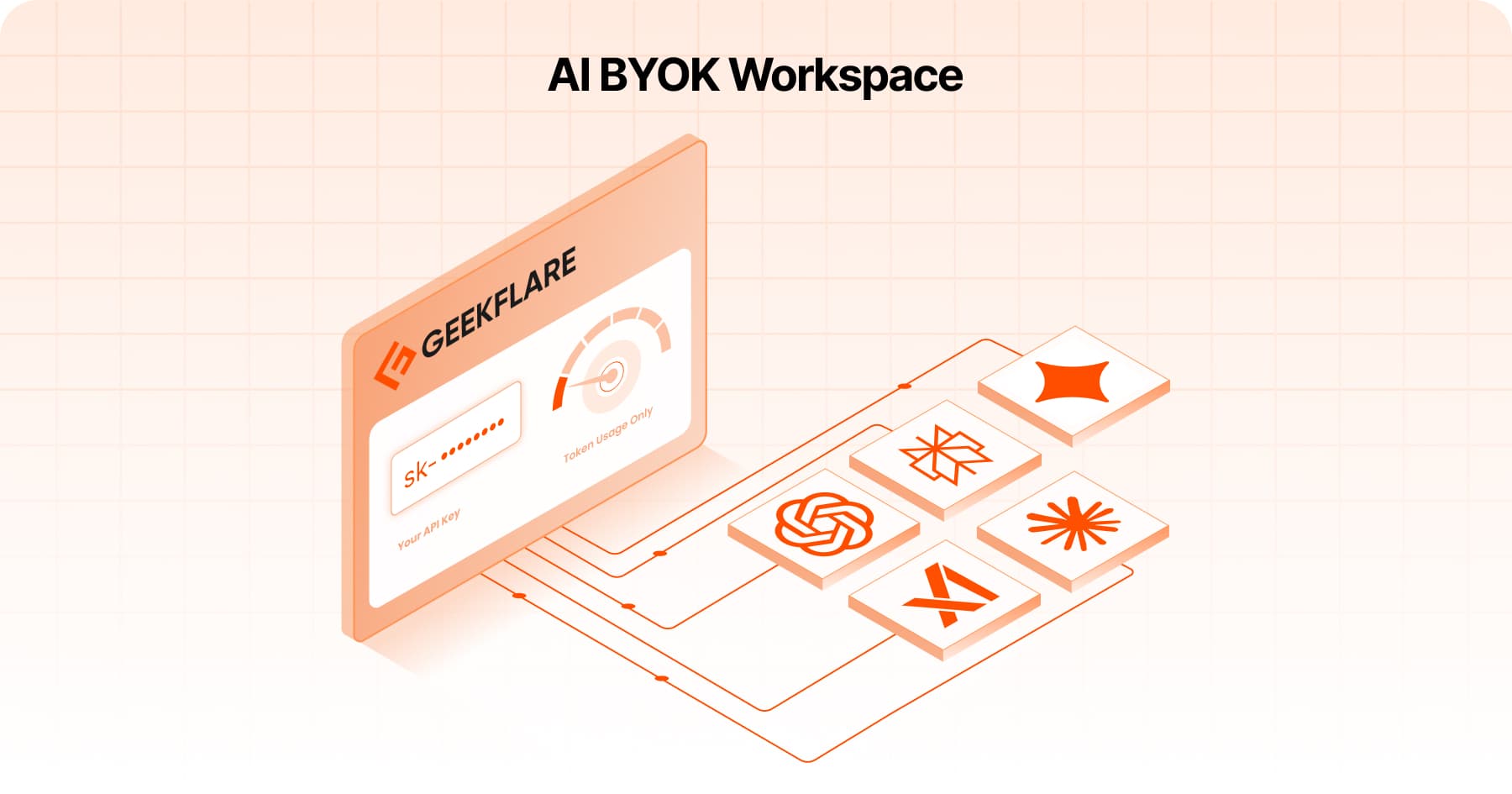
Geekflare Connect offers a secure Bring Your Own Key (BYOK) AI workspace designed for teams to collaborate efficiently with various AI models. Users can connect their own API keys from providers like OpenAI, Google, and Anthropic, enabling side-by-side comparison of model responses and secure prompt sharing. The platform provides a unified interface to access over 35 AI models, organize chats into projects, and perform deep research by querying reasoning AI models and Google Search simultaneously. It includes features for shared prompt libraries, user roles, permission controls, and in-depth usage analytics and cost tracking, aiming to significantly reduce AI expenses by up to 65% through a consumption-based model.
mindspore
MindSpore is a new open-source deep learning training/inference framework designed for mobile, edge, and cloud scenarios. It provides a friendly development experience and efficient execution for data scientists and algorithmic engineers. The framework offers native support for Ascend AI processors and software-hardware co-optimization. A key differentiator is its automatic differentiation based on Source Transformation (ST), which supports complex control flow and enables static compilation optimization for great performance. MindSpore also features automatic parallelization, combining data, model, and hybrid parallelism to automatically select optimal distributed training strategies. It supports installation via pip, source code compilation, and Docker images across various hardware platforms including Ascend, GPU, and CPU.

WEBSENSA
WEBSENSA is an AI services company specializing in rapid AI implementation, promising production-ready solutions within 30 days through a proven 3-step process: diagnosis, tailored offer, and go-live. They offer a suite of AI products including Voicebot AI for automating customer service, Knowledge Chat for transforming company documents into interactive knowledge bases, and Enterprise AI for growing organizations needing access to advanced AI tools and tailored models. WEBSENSA also provides AI Workshops for strategic skill development and proNote Research for analyzing research recordings. They serve various industries such as Manufacturing & Utilities, Banks & Financial Institutions, and Law & Legal Services, focusing on delivering immediate value and measurable business results.
Arabic Tokenizer Arena
Arabic Tokenizer Arena is a specialized platform designed for in-depth analysis of Arabic text tokenization. Users can input their own Arabic text or select from pre-made samples, then choose one or more tokenizers to observe how they split the text. The tool offers comprehensive metrics such as token count, fertility, and Out-Of-Vocabulary (OOV) rate, providing valuable insights into the tokenization process. Additionally, it generates visual representations to help users understand the tokenization results more intuitively. This tool is particularly useful for researchers, developers, and linguists working with Arabic language processing, offering a robust environment for comparing and evaluating different tokenization strategies.
CoAdapter
CoAdapter is an AI tool hosted on Hugging Face Spaces, focusing on model adaptation and transfer learning. It is built using Gradio, making it accessible for users to interact with. The tool operates under the OpenRAIL license, indicating its open-source nature and community-driven development. While the live website currently shows a runtime error during model downloading, suggesting it may be under maintenance or experiencing issues, its core purpose is to facilitate advanced AI model manipulation. Users interested in experimenting with or developing upon existing AI models for specific applications would find CoAdapter relevant.
EmbeddingGemma Tuning Lab
EmbeddingGemma Tuning Lab is a web-based interface built using the Gradio framework, designed for fine-tuning EmbeddingGemma models. This application enables users to customize the EmbeddingGemma model to better understand their personal tastes and specific data. It provides a platform to adapt the model for various applications, such as mood reading or other personalized tasks. The tool is hosted on Hugging Face Spaces, making it accessible through a web browser for multiple users to interact simultaneously. It offers a practical way for developers and data scientists to tailor pre-trained models to their unique requirements.
GPU Poor LLM Arena
GPU Poor LLM Arena is a platform designed for the comparison and evaluation of compact language models, specifically those with up to 14 billion parameters. It offers a battle arena format where users can input a text prompt and receive side-by-side answers from two different language models. This setup facilitates direct comparison, allowing users to vote for the better reply and contribute to a community-driven ranking. The tool is ideal for researchers, developers, and enthusiasts interested in understanding the practical performance of smaller, more resource-efficient AI models without requiring extensive GPU resources. It provides insights into the capabilities of frugal AI options.