
AI Agents & Automation
Browsing page 155 of AI Frameworks & Infra in AI Agents & Automation. Sorted by confidence score — our independent quality rating.

skope-rules
Skope-rules is a Python machine learning module built on top of scikit-learn, designed for learning logical and interpretable rules. Its primary goal is to "scope" a target class by detecting instances with high precision. This tool offers a balance between the interpretability of a Decision Tree and the predictive power of a Random Forest. It extracts rules from tree ensembles, leveraging fast algorithms like bagged decision trees or gradient boosting. The package provides methods to compute predictions using the most precise rules and is particularly useful for understanding and explaining complex model decisions in explainable AI applications. It requires Python (>= 2.7 or >= 3.3), NumPy, SciPy, Pandas, and Scikit-Learn.
Consilium MCP Server
Consilium MCP Server is a Multi-AI Expert Consensus Platform designed to enable users to conduct comprehensive, research-driven discussions with multiple expert AI models. Users can input specific queries, and the application leverages web searches and academic research to gather relevant information. This platform aims to facilitate consensus among diverse AI agents, providing a robust environment for exploring complex topics. It supports various models, including Mistral and SambaNova, and is implemented as a Gradio application, making it accessible for interactive use. The tool is ideal for those seeking to harness the collective intelligence of multiple AI experts for advanced research and problem-solving.
VRP-RL
VRP-RL is an open-source project that leverages reinforcement learning to tackle complex combinatorial optimization problems such as the Vehicle Routing Problem (VRP) and the Traveling Salesman Problem (TSP). Developed by OptMLGroup, this tool provides a robust framework for researchers and developers to implement, train, and evaluate reinforcement learning models for route optimization. It is built using TensorFlow and includes all necessary dependencies like NumPy and tqdm. Users can easily run the code for both training and inference, with options to specify GPU usage, model directories, and inference types (batch or single mode). The project also logs all results, making it suitable for experimental research and performance analysis in the field of operational research and artificial intelligence.
ScouterAI
ScouterAI is an AI agent designed for detailed image analysis and object detection. Leveraging over 9000 vision models from the Hugging Face Hub, it allows users to upload images and submit requests for comprehensive visual insights. The application identifies and classifies objects within the images, then annotates them with precise bounding boxes and labels. This tool is particularly useful for exploring and experimenting with a vast array of vision models, making it valuable for AI research and development. Although the live website currently shows a runtime error, its intended functionality focuses on advanced image processing capabilities.
Scaling test-time compute
Scaling test-time compute is a Hugging Face Space designed for exploring and comparing different search methods for generating candidate answers to text-based problems, such as math questions. Users can input a text problem, and the tool provides options to select from various smart search methods, including best-of-N, beam search, and diverse verifier tree search. This functionality allows researchers and developers to evaluate the effectiveness of different computational strategies in generating multiple potential solutions, making it a valuable resource for AI research and experimentation in areas like natural language processing and problem-solving. The tool is hosted on Hugging Face, indicating its focus on open-source AI development and community collaboration.
StarCoder2
StarCoder2 is a code generation tool developed by Hugging Face and its collaborators, designed to assist developers in creating code snippets across 101 different programming languages. Users can input a code prompt and the application will generate relevant code. The tool provides adjustable parameters such as 'temperature' to control the creativity of the generated code and 'length' to determine the size of the output, offering flexibility for various coding needs. While the tool aims to be a valuable assistant for software development tasks, the live website currently indicates a runtime error related to authorization, suggesting potential access issues or ongoing development.
deep-rl-tensorflow
deep-rl-tensorflow offers a TensorFlow implementation of several key deep reinforcement learning papers, making advanced algorithms accessible for research and development. This open-source project includes implementations of foundational works such as 'Playing Atari with Deep Reinforcement Learning' and 'Human-Level Control through Deep Reinforcement Learning,' alongside more recent advancements like Double Q-learning and Dueling Network Architectures. It also features in-progress implementations for Prioritized Experience Replay, Deep Exploration via Bootstrapped DQN, Asynchronous Methods for Deep Reinforcement Learning, and Continuous Deep Q-Learning with Model-based Acceleration. The tool provides clear usage instructions for training models with different network configurations and environments, making it a valuable resource for researchers and engineers working on reinforcement learning projects using TensorFlow.
Streamlit Docker Template
Streamlit Docker Template provides a streamlined solution for deploying Streamlit applications within Docker containers. This tool is designed to help users create reproducible and portable environments, ensuring consistency across different deployment stages. By containerizing Streamlit apps, it simplifies the process of packaging and running web applications built with Streamlit. This template is particularly useful for developers and data scientists who want to share their interactive data analysis and machine learning models as web applications, offering a robust and isolated execution environment. It abstracts away much of the complexity associated with environment setup, allowing users to focus on their application logic.
StyleGAN3 Anime Face Generation (exp001)
StyleGAN3 Anime Face Generation (exp001) is an AI tool hosted on Hugging Face Spaces, designed for creating anime-style faces. Users can interact with the model by adjusting parameters such as seed, truncation, and transformation settings to influence the randomness and specific characteristics of the generated images. This allows for exploration of the StyleGAN3 model's capabilities in producing synthetic anime characters. However, at the time of this description, the application is experiencing a runtime error due to a private repository storage limit being reached by the creator, preventing the model from loading and functioning correctly. This issue currently impacts the tool's usability.
StyleGAN3 Anime Face Generation (exp002)
StyleGAN3 Anime Face Generation (exp002) is a Hugging Face Space that allows users to generate unique anime-style faces. This tool leverages the capabilities of StyleGAN3 models to produce synthetic anime characters. Users can customize various parameters, including seed for random generation, truncation for controlling style diversity, and position and rotation to fine-tune the facial output. The platform provides an interactive interface to experiment with these settings, making it accessible for exploring different anime aesthetics. While the current live website indicates a build error, the intended functionality is to provide a creative outlet for generating diverse anime face images.
SpecVQGAN_Neural_Audio_Codec
SpecVQGAN_Neural_Audio_Codec is an AI audio codec tool available as a Hugging Face Space. It focuses on neural audio processing and compression, offering a platform for users to experiment with advanced audio encoding techniques. While the live website currently indicates a runtime error due to hardware capacity issues, the tool's purpose is to provide a space for exploring SpecVQGAN models in the context of audio. It is suitable for researchers and developers interested in the cutting edge of audio technology and machine learning applications in sound.
SwarmOne
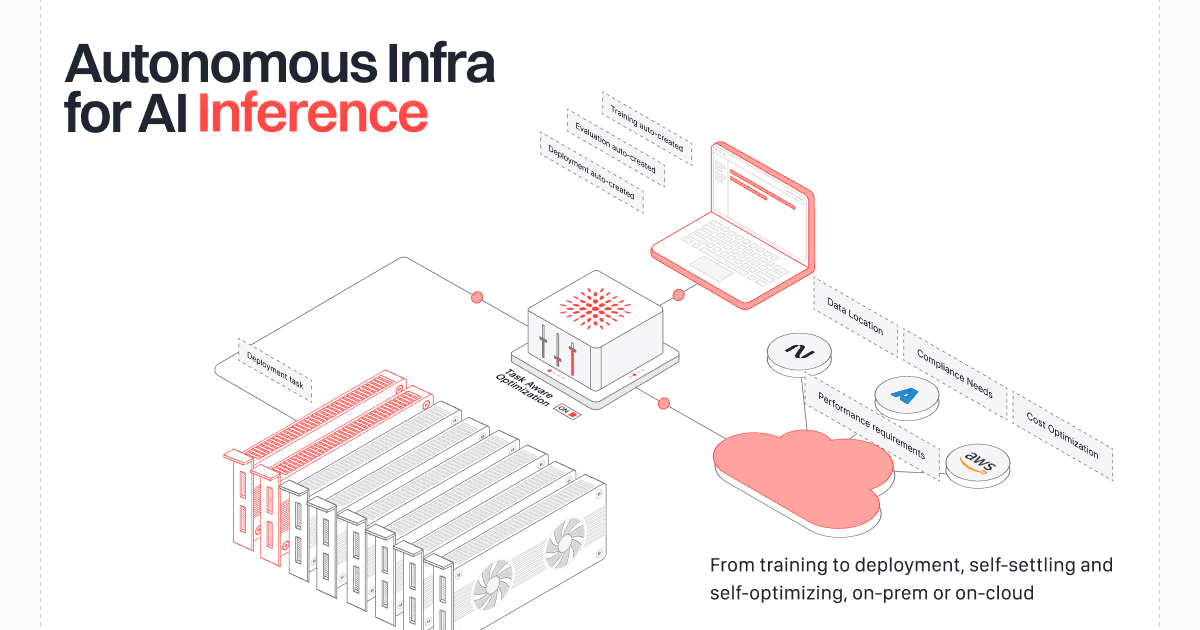
SwarmOne is an autonomous infrastructure platform designed for AI inference, training, and evaluation workloads. It offers a unique scheduler that dynamically disaggregates prefill and decode, orchestrates heterogeneous GPU clusters (NVIDIA, AMD, Intel, Groq, and more), and rebalances in real time to achieve over 90% utilization. The platform features SLO-driven autoscaling, enforcing defined latency, throughput, or cost targets by instantly provisioning GPUs when latency drifts and scaling compute to zero when traffic drops. SwarmOne aims to reduce costs by up to 80% through dynamic disaggregation, multi-node orchestration, and multi-cloud arbitrage, routing to the cheapest capable hardware. It supports a full AI lifecycle from training to deployment with zero DevOps/MLOps required, making it ideal for engineering teams at global enterprises.
Talk to Smolagents
Talk to Smolagents is an AI tool designed to help users find remote coworking places through voice commands. Utilizing a FastRTC Voice Agent with smolagents, users can speak their location and receive a list of suitable coworking spots. The tool bases its recommendations on reviews, ratings, and location data, aiming to provide relevant options quickly. Currently hosted on Hugging Face Spaces, it offers a demonstration of voice-activated AI agent capabilities for practical applications like location-based services. While the current live status indicates a runtime error, the underlying concept focuses on interactive voice interfaces for information retrieval.
Synthio Stable Audio Open
Synthio Stable Audio Open is a free, open-source tool available on Hugging Face that enables users to generate custom audio files using text prompts. Leveraging the Stable Audio Open model from the Synthio paper, this application allows for the creation of high-quality synthetic audio at a 44.1kHz sample rate. Users can specify the duration, number of steps, and CFG scale to fine-tune their audio output. While the current live website indicates a configuration error, the tool's core functionality is designed for AI-driven audio content creation and research, making it suitable for educational purposes, exploring AI functionalities, and automating audio-related tasks.
TraceMind AI
TraceMind AI provides a comprehensive platform for evaluating AI agents, offering detailed metrics and insights into their performance. Users can effectively filter and compare different agent runs, gaining a clear understanding of their behavior and efficiency. The tool features performance charts for visual analysis and allows users to ask specific questions about traces, facilitating deeper understanding and debugging. Powered by MCP intelligence, TraceMind AI is designed to help developers and researchers assess and optimize their AI agents, ensuring robust and reliable operation. It is available as a Hugging Face Space, making it accessible for immediate use and experimentation.
TraceMind MCP Server
TraceMind MCP Server is designed for evaluating AI agents, offering a robust platform to analyze their performance data. Users can input various data sources, including leaderboard repositories, trace IDs, or specific model information, to gain intelligent insights into agent behavior and effectiveness. The tool leverages Gemini 2.5 Flash for agent assessment, ensuring advanced analytical capabilities. Hosted on Hugging Face Spaces, it provides an accessible environment for developers and researchers to monitor and understand the performance of their AI agents, facilitating iterative improvements and informed decision-making in AI development.
Turkish Mmlu Leaderboard
The Turkish Mmlu Leaderboard is a platform designed to display and manage results for the Turkish MMLU (Massive Multitask Language Understanding) dataset. It provides a user-friendly interface where individuals can submit AI models, request evaluations, and view the scores of various models. This tool is particularly useful for researchers, developers, and data scientists working with Turkish language models, enabling them to benchmark and compare performance effectively. Hosted on Hugging Face, it offers a centralized location for tracking progress and identifying top-performing models in Turkish MMLU tasks.

HyperbeeAI
HyperbeeAI is building a new foundation for AI inference, designed for speed, efficiency, and scale. The platform delivers optimized engines for a wide range of applications, from low-power IoT devices to massive cloud servers. It aims to solve the challenge of inference that limits AI scale, especially as multimodal applications gain momentum. HyperbeeAI's technology redefines neural computation to achieve unprecedented scalability, resulting in truly multimodal AI engines capable of processing text, images, and video in real time. This enables the next wave of advanced AI applications.
VideoLLaMA3-Image
VideoLLaMA3-Image is an AI tool designed for processing images and text inputs to produce detailed descriptive or analytical responses. This Hugging Face Space application leverages frontier foundation models for advanced video understanding, allowing users to explore and test AI models for video analysis. While the current live website indicates a runtime error, its intended functionality is to provide insights and answers based on visual and textual data, making it valuable for research and development in AI and video processing. The tool is developed by Xin Li and is available under an Apache 2.0 license.
VideoMind 2B
VideoMind 2B is an AI tool designed for temporal-grounded video reasoning. Users can upload a video and ask questions about its content. The system employs a sophisticated process that involves planning tasks, identifying relevant moments within the video, verifying details, and subsequently generating comprehensive answers. This capability makes it particularly useful for in-depth video analysis where understanding the sequence and timing of events is crucial. The tool leverages a Chain-of-LoRA Agent architecture, indicating an advanced approach to AI-driven video understanding. It is hosted on Hugging Face Spaces, suggesting accessibility and a focus on research or development applications.
Unit 1 Certification - AI Agent Fundamentals
Unit 1 Certification - AI Agent Fundamentals is a Hugging Face Space designed to guide users to a new quiz application for obtaining course certificates. This tool serves as a redirect, providing a clear message and a direct link to the updated platform where users can complete their certification process. It is part of the Hugging Face Agents Course and is intended for individuals looking to validate their understanding of AI agent fundamentals. The application itself does not require any user input, simply displaying the necessary information to access the certification quiz.
Unicl Image Recognition Demo
Unicl Image Recognition Demo is an AI tool designed to showcase image recognition functionalities. Users can upload various images to the platform and observe the AI's predictions regarding the content within those images. This tool serves as a practical demonstration for understanding how AI models interpret visual data. It is particularly useful for individuals involved in research, development, or educational pursuits within the field of computer vision, offering a hands-on experience with image classification and analysis.
Uniformer_video_demo
Uniformer_video_demo is an AI tool designed to showcase video analysis capabilities. Hosted on Hugging Face Spaces, it provides a platform where users can upload video files and observe the AI's processing and interpretation of the content. This demonstration tool is particularly useful for individuals involved in research, development, or educational pursuits related to video understanding and computer vision. While the current live website indicates a runtime error, suggesting it may not be fully operational at this moment, its intended purpose is to offer a practical insight into how AI can analyze and extract information from video footage.
Video Classification UCF101 Subset
Video Classification UCF101 Subset is an AI tool designed for video content analysis, specifically utilizing the UCF101 dataset. This tool enables users to explore and classify videos, making it valuable for tasks such as action recognition and the training of AI models. While the live website indicates a runtime error and scheduling failure due to insufficient hardware capacity, suggesting it may not be fully operational at the moment, its intended purpose is to provide a platform for researchers and developers to work with video classification tasks. The tool is hosted on Hugging Face Spaces, indicating a focus on community and accessibility for machine learning applications.