
AI Agents & Automation
Browsing page 43 of AI Frameworks & Infra in AI Agents & Automation. Sorted by confidence score — our independent quality rating.

AfterQuery
AfterQuery operates as an applied research lab dedicated to advancing foundation model development by curating specialized data solutions. The company addresses the challenge of suboptimal data solutions in AI research by transforming expert knowledge and real-world decision-making into structured training data. AfterQuery's methodology involves capturing how experts think, including their reasoning, decisions, tradeoffs, and context, which is then used to build datasets. Their data offerings include Supervised Fine-Tuning (SFT) with prompt-response pairs and chain-of-thought reasoning, Reinforcement Learning with expert-designed prompts and grading frameworks, Agent Environments for training and evaluating agents in real workflows, and Computer Use Trajectories demonstrating human interactions with software. This approach aims to improve model performance beyond outputs, focusing on enabling models to learn from expert reasoning.

Elevance Labs
Elevance Labs specializes in creating intelligent digital experiences through end-to-end MVP development and AI integration. They assist businesses in innovating and scaling with confidence by offering comprehensive AI solutions. Their services extend to cloud-native enterprise migration and app development, providing a full suite of digital transformation capabilities. Elevance Labs aims to empower organizations to leverage artificial intelligence effectively, ensuring their digital products are robust, scalable, and aligned with their strategic goals. The company focuses on delivering solutions that drive efficiency and foster growth in a rapidly evolving technological landscape.

Delfox
Delfox is an AI-first company that leverages expertise in reinforcement learning and autonomous systems to drive innovation and performance for businesses. They provide end-to-end support, from strategic diagnostics to the implementation of AI solutions. Their services include custom AI development for defense, security, and industry, deployment of AI engineers, and the creation of autonomous decision-making capabilities for drones. Delfox also offers strategic AI consulting to help organizations identify opportunities and build roadmaps. Their proprietary Realmind platform allows users to train, test, and deploy AI models in real-time, utilizing technologies such as generative AI, machine learning, NLP, and computer vision.

llmsherpa
llmsherpa provides strategic APIs designed to accelerate large language model (LLM) use cases, particularly focusing on document processing. Its core offering, LayoutPDFReader, addresses the common challenge of parsing PDFs by extracting hierarchical layout information such as sections, paragraphs, tables, and lists. This enables smart chunking of text, which is crucial for LLM applications like retrieval augmented generation (RAG) by preserving contextual information and optimizing for limited context windows. The tool supports various file formats including DOCX, PPTX, HTML, TXT, and XML, and includes built-in OCR support. The back-end service is open-sourced, allowing users to self-host their own servers for private and customized deployments.
PydanticAI
PydanticAI is a Python agent framework designed to facilitate the rapid and reliable development of production-grade AI applications and workflows using Generative AI. Inspired by FastAPI's ergonomic design, it aims to bring a similar development experience to GenAI. The framework is model-agnostic, supporting a wide array of LLMs and providers including OpenAI, Anthropic, and Google Gemini, among others. Key features include seamless observability with Pydantic Logfire for real-time debugging and performance monitoring, full type-safety for enhanced auto-completion and error detection, and powerful evaluation capabilities. PydanticAI is extensible by design, allowing agents to be built from composable capabilities and defined entirely in YAML/JSON, with support for human-in-the-loop tool approval and durable execution for reliable, long-running workflows.
RasaGPT
RasaGPT is the first headless LLM chatbot platform built on top of Rasa and Langchain, offering a comprehensive solution for developing advanced conversational AI. It serves as a boilerplate and reference implementation for integrating Rasa with LLM libraries like Langchain for indexing, retrieval, and context injection. The platform includes features such as document upload and "training" via FastAPI, automatic document versioning and re-training, and customizable async endpoints. It supports multi-tenancy, session management, and metadata handling between Rasa and custom backends. RasaGPT also integrates with Telegram, with easy options to extend to Slack, WhatsApp, and other platforms, and includes PGAdmin for database browsing and ngrok for secure webhook access.

GooseAi
GooseAI offers a fully managed NLP-as-a-Service solution delivered via API, designed to help users stop overpaying for AI infrastructure. It provides access to various large language models, including GPT-Neo, GPT-J, Fairseq, and GPT-NeoX, enabling fast generation speeds for classic NLP use cases like text completion and generation. The service boasts feature parity with industry-standard APIs, making migration easy by changing just one line of code. GooseAI's pricing model is transparent and usage-based, charging solely for generated tokens, which can lead to significant cost savings compared to competitors. It also includes an AI Playground for experimentation and offers a credit system for API usage.
RAG-FiT
RAG-FiT is an open-source library developed by IntelLabs designed to significantly improve Large Language Models' (LLMs) ability to utilize external information within Retrieval-Augmented Generation (RAG) tasks. This framework facilitates fine-tuning models on specially created RAG-augmented datasets. It offers comprehensive support for the entire RAG workflow, including dataset creation, model training using parameter-efficient fine-tuning (PEFT), inference, and performance evaluation with RAG-specific metrics. The library is modular and highly customizable through configuration files, allowing for fast prototyping and experimentation across various RAG settings. It supports integration with external tools and frameworks for information retrieval and prompt generation, making it a versatile solution for developers and researchers working with RAG.

Outter
Outter provides a powerful AI engine designed to integrate high-impact AI features into products without lengthy development cycles. It offers a plug-and-play yet fully tailored solution, enabling businesses to automate workflows, boost metrics, and achieve ROI quickly. Key offerings include co-pilots and chatbots for streamlined UX, recommendations and matching based on user behavior, and content generation and transformation. Outter also provides bespoke AI solutions tailored to unique business needs, all while ensuring data privacy with Outter Shield™, which prevents AI models from retaining, sharing, or learning from user data. The platform is built for small and medium tech products, promising implementation in weeks rather than months.
ChainML
ChainML is an AI research and development company dedicated to shaping a better future powered by AI agents. They are the creators of Council Analytics, a generative AI-powered platform for conversational analytics, which enables effortless and secure integration of talk-to-data capabilities into software products via API. This platform builds upon their open-source Council framework, designed for production-grade AI agents. Council unlocks the full potential of LLMs like GPT-4, Llama 2, and Claude 2 for business, providing advanced control and scalable oversight for agents across various commercial use cases, from marketing to analytics and code generation. ChainML is also developing an AI Agent Protocol, a Web3-enabled execution and utilization layer for AI Agents, aiming to establish a decentralized ecosystem for AI agents with micropayments and account abstraction.
Qwen3
Qwen3 is a comprehensive large language model series developed by the Qwen team at Alibaba Cloud, building on previous iterations like QwQ and Qwen2.5. It offers a range of models, including dense and Mixture-of-Expert (MoE) architectures, with sizes from 0.6B to 235B-A22B. Key features include significant enhancements in general capabilities such as instruction following, logical reasoning, mathematics, science, coding, and tool usage. Qwen3 also boasts superior human preference alignment for creative writing and multi-turn dialogues, and strong agent capabilities for integration with external tools. It supports over 100 languages and dialects, and offers flexible deployment options with frameworks like Transformers, llama.cpp, and Ollama, making it suitable for various development and research applications.
TrieDatum Inc
TrieDatum Inc, founded in 2020 and headquartered in North Carolina, is a boutique AI consultancy focused on helping global enterprises move beyond stalled pilots to production-grade AI solutions with measurable business impact. They design and engineer modern data platforms and trusted Generative AI applications that are accurate, explainable, and built to scale. By grounding AI in verifiable enterprise knowledge through a Semantic Layer, TrieDatum directly addresses the industry’s hallucination challenge while enabling AI systems to reason over connected, trusted data. Their services include Data Engineering, Generative AI Enablement, Advanced Analytics, and AI-Enabled Migrations, leveraging expertise in platforms like Databricks, Snowflake, Tableau, PowerBI, and major cloud providers. They utilize AI-accelerated engineering tools and frameworks like LangChain and DSPy to automate processes and ensure reliable, enterprise-ready outcomes.
Milk Infrastructure
Milk Infrastructure provides an AI-powered solution for deploying, managing, and scaling production-grade Kubernetes clusters across any cloud provider or on-premises. It aims to abstract infrastructure complexities, allowing developers to deploy services without extensive DevOps experience. The platform uses AI to write infrastructure as code, dynamically scaling resources and integrating with GitHub for automated CI/CD. This approach significantly reduces cloud costs by optimizing resource allocation. Milk Infrastructure supports various service types, including repos as a service, cron-jobs, and workers, and ensures production-grade, secure, and SOC2 compliant clusters. It offers a seamless developer experience with built-in CI/CD, one-click production clones, and minimal costs.
Hobglobin
Hobglobin specializes in delivering AI agents tailored for heavy industry sectors such as mining, energy, and infrastructure. The platform focuses on deploying production-ready AI solutions that effectively process complex documents and automate critical operational workflows. By integrating advanced AI capabilities, Hobglobin aims to provide measurable results and enhance efficiency within these demanding environments. Its solutions are designed to streamline operations, improve decision-making, and drive tangible business outcomes for industrial clients.

Robotics Institute Germany
The Robotics Institute Germany (RIG) serves as a central hub connecting leading experts and talents across science, academia, and industry to drive innovation in AI-powered robotics. Supported by the Federal Ministry of Research, Technology and Space, RIG focuses on five major areas: research, education, infrastructure, benchmarking, and transfer & industry. It aims to increase international visibility, attract top talent, and accelerate progress in the field. RIG fosters collaborative research through national centers and clusters, develops talent programs from student to doctoral levels, and pools technical resources like software and physical/virtual laboratories. The institute also develops benchmarks and organizes competitions to make robotic research comparable and promotes strong dialogue between science and industry to accelerate commercialization.

mindit.io
mindit.io is an AI-driven data and product engineering partner that helps enterprises achieve new levels of success through custom AI solutions and data-driven insights. They serve a wide range of industries including retail, banking, financial services, healthcare, and manufacturing. With over 250 specialists, mindit.io offers expertise in artificial intelligence, machine learning, data & analytics, enterprise applications, product engineering, and integration solutions. Their services cover the entire development lifecycle, from initial concepts to ongoing maintenance and support, ensuring secure and reliable software performance. They focus on transforming concepts into impactful products and unlocking business potential through automation.

Yunometa
Yunometa is a technology company specializing in bridging the gap between operational excellence and cutting-edge digital transformation. They offer a comprehensive suite of solutions including process audits, IoT solutions for machine performance, blockchain workflow management systems for enhanced traceability, and AI-powered demand forecasting for precise insights. Yunometa aims to revolutionize operations by identifying inefficiencies, predicting maintenance needs, streamlining administrative tasks, and optimizing inventory. Their services are designed to reduce costs, increase revenue, and enhance client experiences across various industries, particularly within supply chain management.
Blu Artificial Intelligence
Blu Artificial Intelligence provides comprehensive AI consulting services, guiding businesses through AI and digital transformation. Their offerings include corporate education to empower teams with AI knowledge, AI audit services to assess readiness, and bespoke strategy consulting to identify impactful AI solutions. They also specialize in designing, building, and implementing AI and digital systems, alongside offering AI certification and generative AI tools for productivity. Blu Digital serves diverse industries such such as finance, manufacturing, energy, healthcare, retail, academia, and hospitality, helping them unlock investment insights, optimize operations, personalize experiences, and enhance patient care.

Micropsi Industries
Micropsi Industries provides MIRAI, an AI-powered computer vision software designed to enhance the capabilities of industrial robots. This system allows robots to reliably handle variance in production environments, including changes in position, shape, color, lighting, and background. MIRAI tackles automation challenges that are not viable with traditional systems, performing effectively even with reflective and transparent objects. It is fast and easy to deploy and adapt to process updates, requiring no CAD data, camera calibration, controlled light, or visual-feature predefinition. MIRAI adapts a robot’s path in changing conditions, deals with dust, dirt, and grime, and tracks moving objects in real time, offering a robust and precise solution for industrial automation.

Neuralk AI
Neuralk AI offers a powerful tabular foundation model designed for enterprise predictions, delivering instant and highly accurate results on structured data. It eliminates the need for traditional training and pipeline setup, making it significantly faster and less resource-intensive than conventional machine learning approaches like XGBoost or AutoML. The platform is pretrained on billions of tabular datasets, enabling it to understand complex patterns in rows and columns. Users can send their data and receive predictions in seconds via a single API call, supporting classification and regression tasks on up to 50 million rows with mixed data types. Neuralk AI is built for production, offering enterprise-grade security where data is processed in memory and never stored, ensuring compliance and data privacy.

enqAI
enqAI offers a suite of decentralized and uncensored AI tools, initially featuring NoiseGPT for text-to-speech and Eridu, a language model. The platform was founded on the principle of providing unrestricted AI alternatives after mainstream platforms began imposing limitations. While initially focused on developing its own models, enqAI is now shifting its focus to building application-layer products that leverage uncensored AI for real-world impact. Examples include prediction markets and personalized peptide recommendations. The core mission remains to unshackle AI from gatekeepers and provide permissionless, open-source solutions for creators and developers.
LibreChat
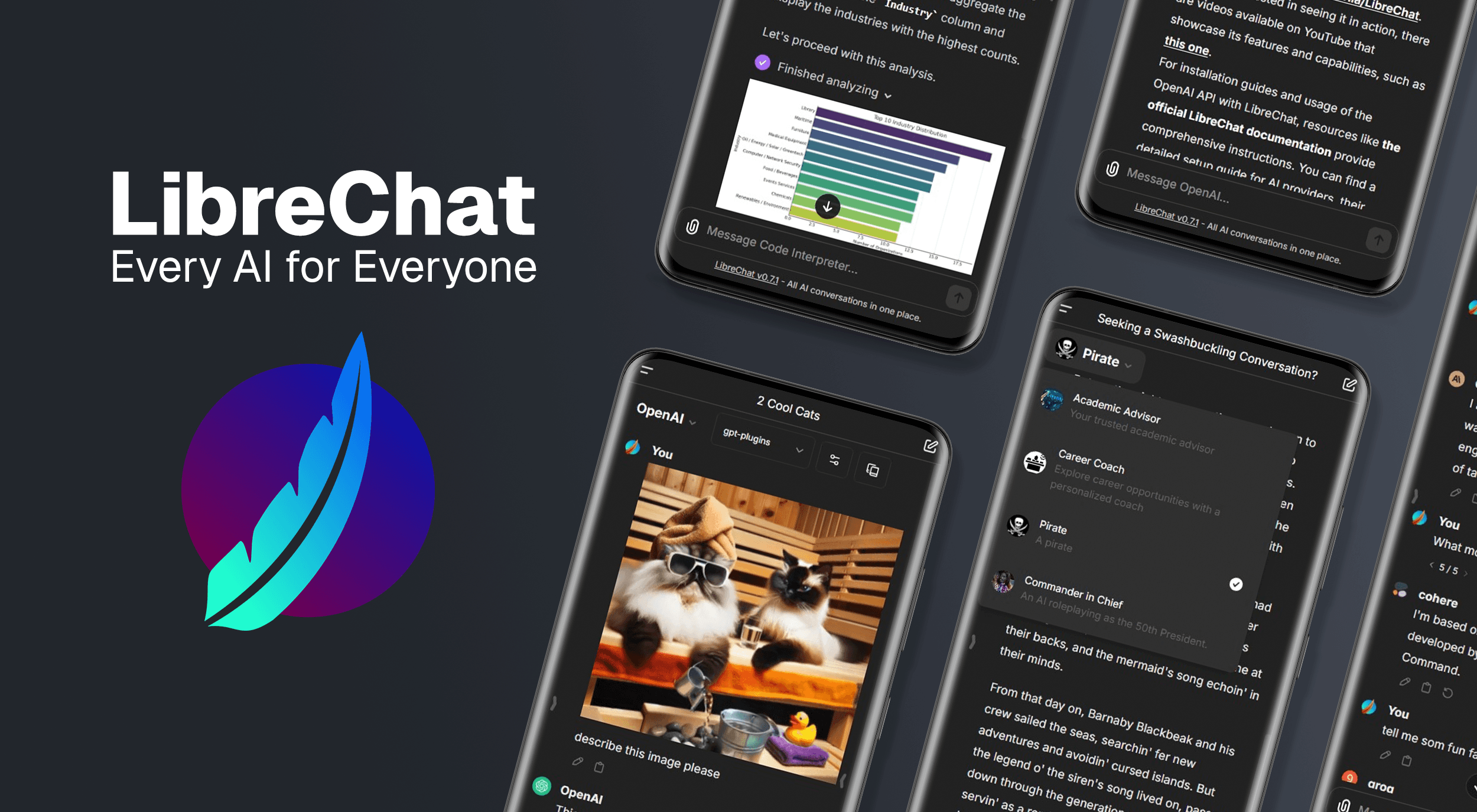
LibreChat is a comprehensive open-source AI platform designed to consolidate all your AI conversations into one unified and highly customizable interface. It supports a wide array of AI models, including Anthropic, AWS, OpenAI, and Azure, allowing users to switch between them seamlessly. Key features include advanced agents with file handling and API actions, a secure code interpreter for multiple languages, and the ability to generate artifacts like React code and Mermaid diagrams. LibreChat also offers persistent memory across conversations, live web search capabilities, and robust authentication options like SSO. It's built for self-hosting, giving users full control over their AI interactions and data.
Flux Labs Light
Flux Labs Light is an AI tool designed for generating images from text prompts, offering a flexible platform for creative exploration. Users can fine-tune their output by customizing image size, style, and randomness. The application supports multiple languages and provides advanced options for detailed adjustments. It leverages the flux lora model via an Inference API, making it suitable for experimenting with AI image generation techniques. The tool is available under an MIT license, promoting open access and use for various projects, from digital art creation to AI research.
Radiant Labs
Radiant Labs is an applied AI research lab dedicated to advancing the frontier of multi-agent software. They provide tools and frameworks, such as Polaris Docs, to help developers build and manage agentic AI systems. The platform supports core concepts like systems, resources, graphs, plugins, and agents, and offers examples for building ReAct CLI agents. Developers can leverage features like tool calling, tracing, sessions, persistence, and an HTTP API. Radiant Labs also guides building custom tools and plugins, testing agents, and handling advanced topics like APIs, hooks, middleware, context hierarchies, error handling, and retries, making it a comprehensive resource for multi-agent AI development.