
AI Agents & Automation
Browsing page 41 of AI tools for General-Purpose Agents in AI Agents & Automation. Sorted by confidence score — our independent quality rating.
NinjaTools
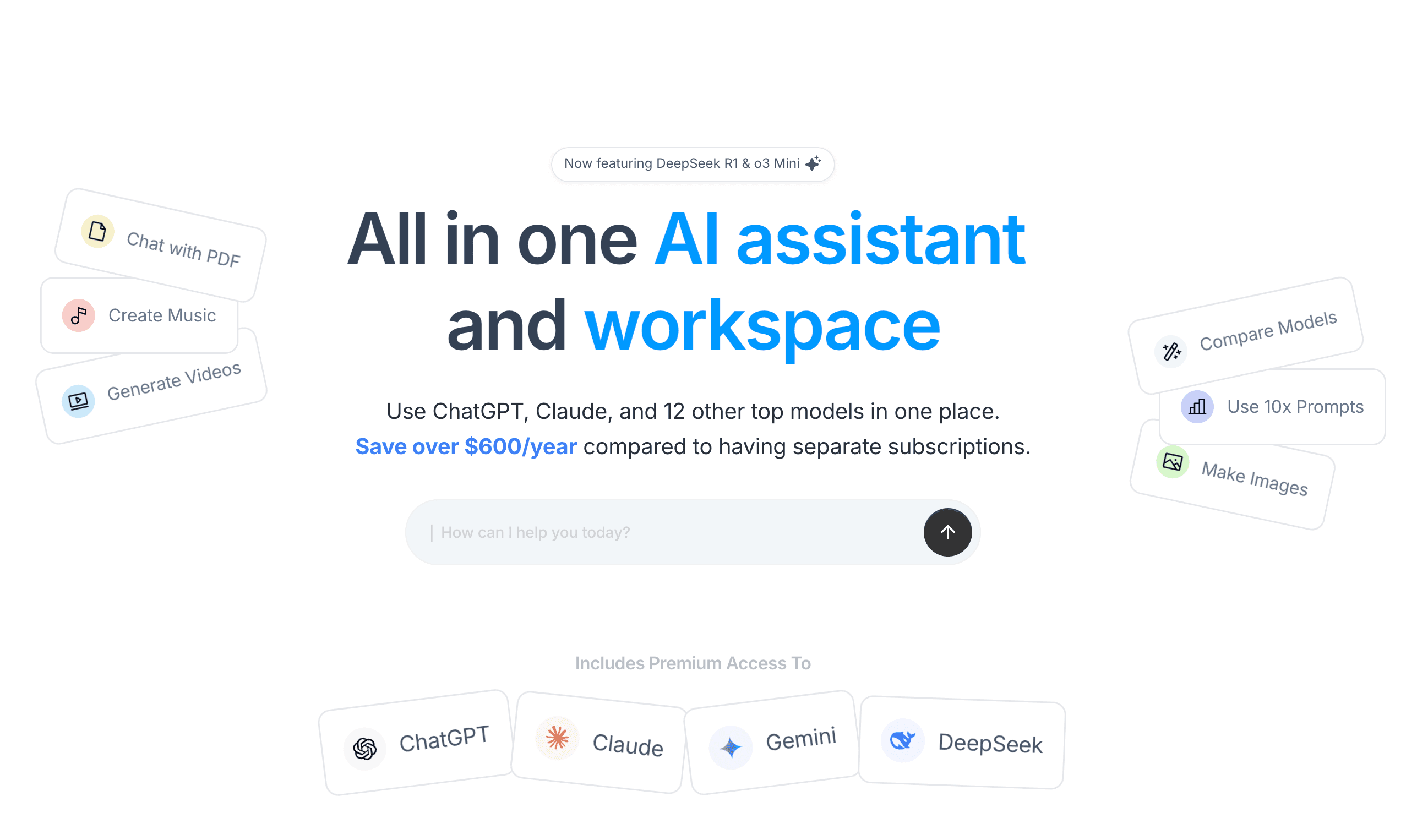
NinjaTools provides an integrated AI workspace, consolidating various AI functionalities into a single platform. It allows users to create images, engage with multiple AI models for chat, and analyze documents. The platform also features an AI Playground, PDF processing, and video generation capabilities, all accessible through a single subscription. This comprehensive suite aims to streamline workflows by offering a diverse range of AI tools for different professional needs within one unified environment.

agent
Xata Agent is an open-source AI agent designed to act as an expert in PostgreSQL database management. It continuously monitors your database, identifies the root causes of performance issues, and proactively suggests fixes and improvements. Functioning like an AI-powered Site Reliability Engineer (SRE), it can watch logs and metrics, suggest configuration tuning, troubleshoot common problems like high CPU or memory usage, and make indexing recommendations. The agent is extensible, allowing for custom tools and playbooks, and supports multiple LLM models from OpenAI, Anthropic, and Deepseek. It can notify users via Slack and is available for self-hosting via Docker images, with a cloud version also in development.
agentic-context-engine
Agentic Context Engine (ACE) is an open-source framework designed to make AI agents learn from experience, preventing them from repeating mistakes and improving performance over time. It features a 'Skillbook' that collects and refines strategies, managed by specialized roles: an Agent executes tasks, a Reflector analyzes execution traces for insights, and a SkillManager curates the Skillbook. A key innovation is the Recursive Reflector, which uses Python code in a sandboxed environment to programmatically search for patterns and isolate errors. ACE integrates with over 100 LLM providers via LiteLLM and offers various runners for different use cases, including browser automation and LangChain integration. It has demonstrated significant improvements in consistency and token reduction in benchmarks.
baserow
Baserow is a secure, open-source, no-code platform designed for building databases, applications, automations, and AI agents. Trusted by over 150,000 users, it provides enterprise-grade security with GDPR, HIPAA, and SOC 2 Type II compliance. Users can choose between cloud and self-hosted deployments for full data control. The platform features a built-in AI Assistant that enables natural language database and workflow creation, empowering teams to structure data, automate processes, build internal tools, and create custom dashboards. Baserow is fully extensible, API-first, and integrates seamlessly with existing tools, offering a powerful alternative to proprietary solutions like Airtable.
BricksLLM
BricksLLM is a cloud-native AI gateway written in Go, providing enterprise-level infrastructure for LLM production use cases. It offers native support for OpenAI, Azure OpenAI, Anthropic, and vLLM, as well as custom deployments and open-source LLMs. Key features include PII detection and masking, rate limiting, cost control and analytics, request analytics, caching, retries, and failover. It also provides model and endpoint access control, Datadog integration, and logging with privacy control. A managed version with a dashboard is available, making it easier to interact with and deploy in production environments.
awesome-ai-dev-platform-opensource
awesome-ai-dev-platform-opensource is the first unified, open-source platform designed for end-to-end AI development and workflow automation. It is modular, interconnected, and built for custom AI, leveraging the Modular Component Protocol (MCP) and decentralized resources. The platform enables users to build and deploy custom AI models, automate AI workflows, and monetize every step of the process. Key features include a Data Engine for crawling, curation, and automated large-scale labeling, low-code AI workflow automation, distributed parallel training with MoE support, and decentralized marketplaces for compute and models. It also offers an MCP Integration Layer for connecting with third-party environments and dev platforms, making it a comprehensive solution for AI engineers and dev teams.
BibiGPT-v1
BibiGPT-v1 is an AI-powered tool designed to effortlessly summarize audio and video content from various sources. It supports popular platforms such as YouTube, Bilibili, Twitter, TikTok, Dropbox, Google Drive, and local files, as well as websites, podcasts, meetings, and lectures. Users can generate one-click AI summaries and engage in chat interactions with the learning content. This tool aims to be an efficient AI learning assistant, helping users quickly extract key information and insights from diverse media. It also offers a browser extension for enhanced accessibility and supports free trials, making it a valuable resource for students, content creators, and anyone looking to streamline their learning process.
DeepSeek-V2
DeepSeek-V2 is a powerful Mixture-of-Experts (MoE) language model designed for both economical training and efficient inference. It boasts 236 billion total parameters, with 21 billion activated per token, making it significantly more efficient than previous models. Key architectural innovations include Multi-head Latent Attention (MLA) for efficient inference by eliminating KV cache bottlenecks, and the DeepSeekMoE architecture for cost-effective training. The model is pretrained on an extensive 8.1 trillion token corpus and further refined through Supervised Fine-Tuning (SFT) and Reinforcement Learning (RL). DeepSeek-V2 is available for download on HuggingFace and offers an OpenAI-compatible API, making it accessible for developers and researchers to integrate into their applications.
elasticsearch-learning-to-rank
The elasticsearch-learning-to-rank plugin leverages machine learning to significantly enhance search relevance within Elasticsearch. It provides functionalities to store features, which are essentially Elasticsearch query templates, directly within Elasticsearch. Users can also log feature scores, which are crucial for creating training datasets for offline model development. The plugin supports storing various ranking models, including linear, XGBoost, or RankLib models, that utilize the previously stored features. Ultimately, it ranks search results based on these sophisticated models, leading to more accurate and relevant outcomes. This open-source tool is used by organizations like Wikimedia Foundation and Snagajob to power their search capabilities.
ENAS-pytorch
ENAS-pytorch offers a PyTorch implementation of "Efficient Neural Architecture Search via Parameters Sharing," a method designed to drastically cut down the computational resources (GPU-hours) needed for Neural Architecture Search (NAS). This is achieved by enabling parameter sharing among various models that function as subgraphs within a larger computational graph. The tool has demonstrated state-of-the-art performance in Penn Treebank language modeling. It supports discovering recurrent cells for RNNs and is in progress for CNN architecture and convolutional cell design. Users can train ENAS for different network types and datasets, including custom text and image datasets, and visualize training details with TensorBoard.
droidrun
droidrun is a powerful framework designed to automate Android and iOS devices using natural language commands, acting as an LLM-agnostic mobile agent. It allows users to control mobile devices through an easy-to-use CLI and an extendable Python API for custom automations. Key features include support for multiple LLM providers like OpenAI, Anthropic, Gemini, Ollama, and DeepSeek, as well as advanced planning capabilities for multi-step tasks. The tool also offers screenshot analysis for visual understanding of the device and execution tracing with Arize Phoenix. It's ideal for automated UI testing, creating guided workflows, automating repetitive mobile tasks, and remote assistance.
hpc-ops
HPC-Ops is a production-grade, high-performance, and easy-to-use operator library specifically designed for Large Language Model (LLM) inference. Developed by the Tencent Hunyuan AI Infra team, it features deeply optimized kernels tailored for NVIDIA H20 GPUs, achieving up to 2.22x speedup compared to baselines. This library is proven in large-scale production inference within Tencent and offers a clean API for seamless integration into popular inference frameworks like vLLM and SGLang. It supports multiple data types, including BF16 and FP8 with various quantization schemes, and provides hands-on examples for building state-of-the-art kernels using CuTe and CUTLASS.
mcp-go
mcp-go is a Go implementation of the Model Context Protocol (MCP), designed to facilitate seamless integration between Large Language Model (LLM) applications and external data sources and tools. It acts as a standardized way to connect LLMs with various resources, enabling the creation of sophisticated AI-powered IDEs and custom AI workflows. The tool handles complex protocol details and server management, allowing developers to focus on building robust tools and resources. Key features include a high-level interface for faster development, minimal boilerplate for building MCP servers, and a comprehensive implementation of the core MCP specification. It supports both synchronous and asynchronous tool execution, including task-augmented tools for long-running operations, and allows for limiting concurrent tasks to prevent resource exhaustion.
Medusa
Medusa is an open-source framework designed to accelerate Large Language Model (LLM) generation by employing multiple decoding heads. It addresses common pain points of other acceleration techniques, such as the need for a good draft model, system complexity, and inefficiency with sampling-based generation. Medusa adds extra 'heads' to LLMs to predict multiple future tokens simultaneously, combining these options with a tree-based attention mechanism for faster decoding. The framework supports both Medusa-1 (training only new heads) and Medusa-2 (full-model training with a special recipe), and includes self-distillation for fine-tuned LLMs without original training data. It offers significant speedups, particularly for single-GPU inference with a batch size of 1.
marketingskills
marketingskills is an open-source collection of AI agent skills specifically designed for marketing tasks. It caters to technical marketers and founders who leverage AI coding agents for various marketing functions, including conversion rate optimization (CRO), copywriting, search engine optimization (SEO), analytics, and growth engineering. The tool is compatible with Claude Code, OpenAI Codex, Cursor, Windsurf, and other agents supporting the Agent Skills spec. It emphasizes a modular approach where skills build upon a core product-marketing-context, ensuring agents understand product, audience, and positioning before executing tasks. Contributions are welcomed, and it offers multiple installation options for flexibility.
metarank
Metarank is an open-source, low-code machine learning service designed for real-time personalization of search results, articles, listings, and recommendations. It allows users to integrate customer signals like clicks and purchases into the ranking process to optimize for maximum click-through rates. The platform tracks visitor profiles, enabling search results to adapt to user actions in real-time. Metarank supports advanced ranking systems, including semantic search using LLMs, traditional collaborative filtering, and Learning-to-Rank. It is optimized for low reranking latency, processing large result sets within 10-20ms, and scales horizontally as a stateless cloud-native service. Metarank also offers automatic feature generation, model retraining, and A/B testing capabilities.
lotti
Lotti is an open-source, AI-powered digital assistant designed for privacy-conscious users. It functions as a personal context manager, helping you capture, organize, and understand your work and life through AI-enhanced task management, audio recordings, and intelligent summaries. A key differentiator is its commitment to data privacy, with all information stored locally on your devices. Users have complete control over their data and can configure AI providers per category, choosing between cloud-based options like OpenAI, Anthropic, and Google Gemini, or local inference with Ollama for 100% offline capabilities. It supports comprehensive tracking of tasks, audio, time, journal entries, habits, and health data, offering features like smart summaries, audio transcription, context recaps, and intelligent checklists.
symbiotic-ai
Symbiotic AI offers a unique approach to AI agents, focusing on persistent memory and cognitive extension. It's a reference implementation designed to improve thinking loops by helping users maintain context, commitments, and current direction across AI sessions. The system uses a small set of markdown files (SOUL.md, USER.md, AGENTS.md, NOW.md) to store agent personality, user profile, operational protocols, and current state, respectively. This allows the AI to get smarter over time by accumulating real context about the user, rather than relying solely on AI model improvements. It challenges users, remembers patterns, acts on tasks like writing code or researching, and evolves with personalized insights based on user interactions.
.png&w=3840&q=75)
Theta
Theta specializes in creating bespoke AI agents by translating real-world workspaces into simulation environments. These environments train agents to master specific tools, leverage relevant context, and handle complex, multi-turn interactions, much like a human workforce. Theta works with frontier labs and enterprises to develop custom environments based on first-party data and human expert data, ensuring the AI understands constraints, goals, and tools unique to a business. This approach allows for the deployment of highly specialized agents capable of tasks ranging from financial forecasting and contract redlining to debugging code and processing invoices, delivering tailored and measurable results in weeks.
xLAM
xLAM is a comprehensive platform offering a family of Large Action Models (LAMs) designed to enhance AI agent systems. It aggregates agent trajectories from diverse environments, standardizing them into a consistent format for optimized agent training. The platform includes various models, such as Llama-xLAM-2-70b-fc-r and xLAM-2-1b-fc-r, which are fine-tuned for broad agentic capabilities and specialized function calling tasks. xLAM also provides ActionStudio, a lightweight framework for agentic data and training, and APIGen-MT for multi-turn data generation. The models are compatible with VLLM, FastChat, and Transformers-based inference frameworks, making them suitable for researchers and developers looking to deploy and interact with advanced AI agents.
WrenAI
WrenAI is an open-source Generative Business Intelligence (GenBI) agent designed to help users ask database questions in plain English and receive accurate SQL, charts, and BI insights. A key differentiator is its semantic layer (MDL), which encodes business definitions to ensure LLM outputs are grounded and trustworthy, preventing misinterpretations of metrics like "revenue" or "active user." It supports over 12 data sources, including PostgreSQL, BigQuery, Snowflake, and MySQL, and is compatible with any LLM provider, from OpenAI and Claude to self-hosted Ollama. WrenAI can be self-hosted via Docker or accessed through Wren AI Cloud, offering flexibility for different user needs. It also provides an API for embedding query and chart generation into custom applications.
PUNKU.AI
PUNKU.AI is an AI agent platform designed to help businesses create, improve, and manage autonomous AI workers. It enables users to describe workflows in plain English, eliminating the need for coding, and get AI agents operational in as little as 15 minutes. The platform supports over 1,000 integrations, allowing for comprehensive automation across various business functions. PUNKU.AI is trusted by over 200 businesses and offers features like self-improving agents, custom components, and dedicated support. It is SOC 2 Type II and GDPR compliant, ensuring data security and privacy. Pricing plans cater to different business needs, from individual innovators to large enterprises, with a 14-day money-back guarantee.
activeagent
ActiveAgent is a Rails framework designed to integrate AI capabilities into applications using Agent Oriented Programming. It provides a structured approach for developers to build AI-powered applications, treating agents as controllers within the Rails framework. This methodology promotes modularity, reusability, and scalability, simplifying the development of complex AI-driven applications with existing Ruby code. ActiveAgent supports multiple generation providers like OpenAI, Anthropic, Ollama, and RubyLLM, and includes features such as action-based design, ERB templates for prompts, real-time streaming with ActionCable, tool/function calling, context management for conversation history, and structured output with JSON schemas. It enables use cases like data extraction, language translation, and tool-assisted actions.

agemo
Agemo is an AI software development and research company focused on creating reliable, cutting-edge, and democratized AI systems. Their mission is to build a future where intelligent automation is accessible to everyone. One of their key offerings is CodeWords, an AI reasoning system specifically designed for software development. This platform aims to help businesses automate complex workflows by leveraging AI agents, allowing users to build custom logic and add interfaces for tailored solutions. Agemo is dedicated to transforming ideas into robust, production-ready AI solutions, making advanced AI capabilities more widely available.