
AI Agents & Automation
Browsing page 82 of AI tools for General-Purpose Agents in AI Agents & Automation. Sorted by confidence score — our independent quality rating.

Marr Labs
Marr Labs offers an AI operating layer designed for regulated industries like Healthcare, Financial Services, Insurance, and Banking & Lending. It automates voice, messaging, and workflow with compliance built-in, not bolted on. Key features include compliant voice automation for inbound and outbound customer engagement, document intelligence for automated intake and extraction, and intelligent workflow orchestration for multi-step processes. The platform ensures real-time compliance enforcement, adapting to regulatory changes. It integrates with existing infrastructure like Salesforce, HubSpot, and core systems of record, providing real-time dashboards for operational insights and improved customer experience.
ReMind
ReMind is an AI memory agent designed to capture, index, and summarize your digital activities directly on your device. It records screenshots, audio, and other digital interactions, then transcribes text from captured screenshots. Utilizing advanced AI models and vector databases, ReMind indexes this information, provides detailed summaries of daily activities, and allows users to interact with the application via a chat interface to query their digital history. This tool is ideal for individuals seeking to effortlessly manage and recall their digital footprint, offering a personalized and local artificial memory solution.

Distyl
Distyl AI partners with world institutions to rearchitect their systems for abundant intelligence from AI, ensuring human agency and control. Unlike traditional approaches, Distyl designs and deploys production AI systems that rebuild decisioning infrastructure, encoding expertise and scaling reasoning. Their approach focuses on delivering measurable impact in weeks, boasting a 100% production success rate compared to an industry average of 95% failure. Distyl's systems feature SME Cockpits for human expertise, self-evolving capabilities for continuous adaptation, and a Context Model that provides real-world business understanding for AI decisions. They have deployed production AI in Fortune 500 operations across telecom, healthcare, manufacturing, insurance, and retail.
alpaca-electron
Alpaca Electron is designed to make running local large language models (LLMs) like Alpaca and Vicuna accessible to everyone, eliminating the need for complex command-line operations or compilation. It leverages llama.cpp as its backend, ensuring efficiency and compatibility with CPU-only systems, making it usable without expensive graphics cards. The tool supports Windows, MacOS, and Linux, and includes features like context memory, chat history, and Docker integration. Users can download pre-built installers and easily load their preferred Alpaca models to start chatting. While it currently supports Windows primarily, it aims for broader platform compatibility, offering a straightforward solution for local LLM interaction.
OmAgent
OmAgent is a Python library designed to simplify the development of multimodal language agents. It abstracts away complex engineering challenges such as worker orchestration, task queues, and node optimization, providing a straightforward interface for defining agents. The library supports various multimodal interactions, including native integration with VLM models, real-time APIs, computer vision models, and mobile device connections. This enables developers and researchers to build agents that can process and reason over diverse inputs like text, images, video, and audio. OmAgent also offers a flexible agent architecture with a graph-based workflow orchestration engine and multiple memory types for contextual reasoning. It includes state-of-the-art unimodal and multimodal agent algorithms like ReAct, CoT, and SC-CoT, and supports local model deployment via Ollama or LocalAI, alongside a fully distributed architecture with custom scaling options.
Waveye
Waveye specializes in AI-driven imaging radars, delivering ultra high-resolution Lightweight Imaging Radar (LIR) technology with deeply-integrated radar AI. This advanced perception system is designed to enable robust autonomy at scale across multiple industries. Key performance indicators include a native angular resolution of 0.5 / 0.9 in azimuth and elevation, a wide 160-degree field of view in azimuth and 40 degrees in elevation, and an operating range exceeding 200 meters. The technology is capable of over 5000 detections in typical urban scenes, making it suitable for demanding applications. Waveye's solutions are particularly relevant for off-road autonomy, robotics, and automotive sectors, providing enhanced object detection and environmental understanding.
Pandachat
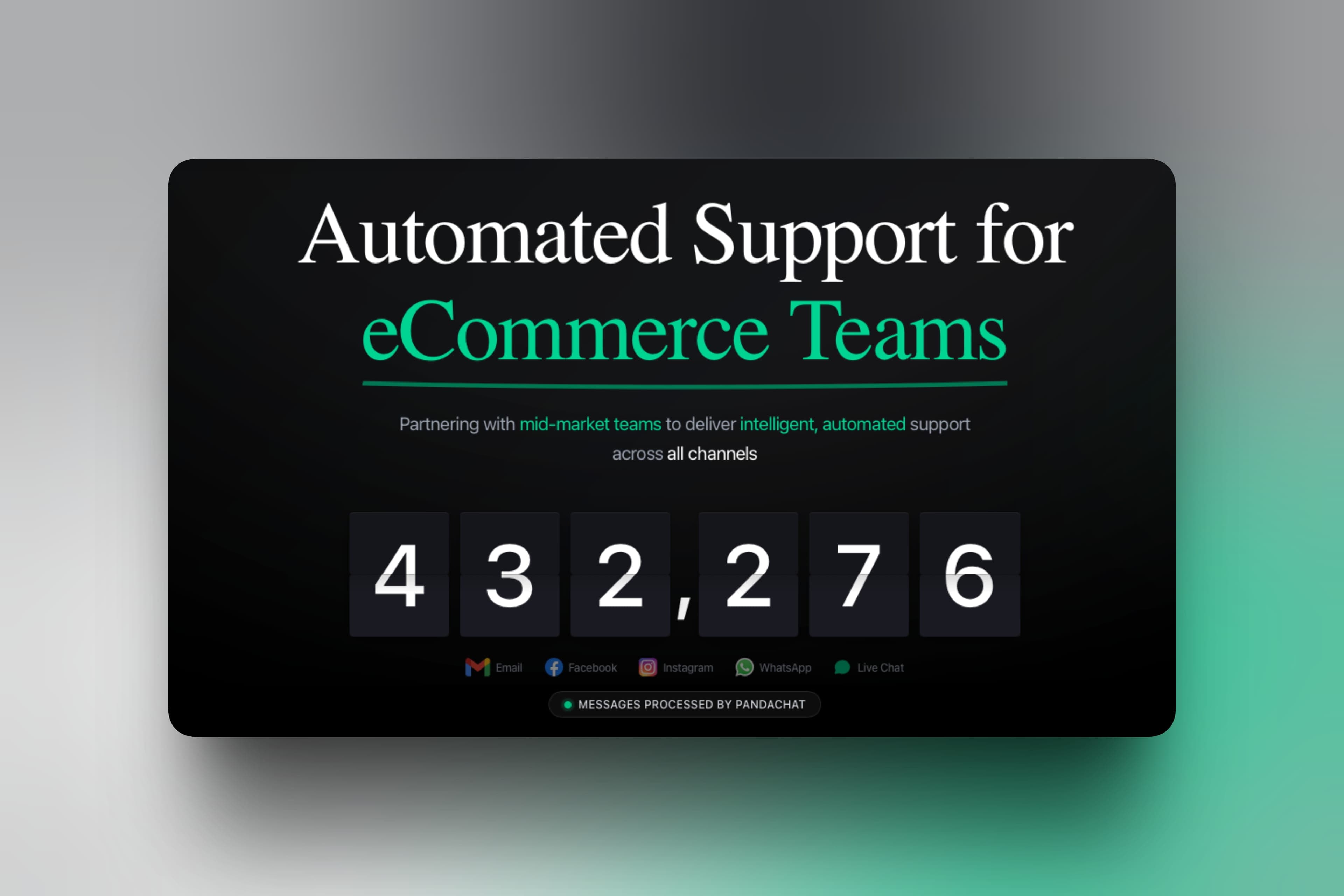
PandaChat automates customer support for mid-market eCommerce teams by integrating directly with their existing systems like Shopify, Magento, ERP, CRM, and WMS. Its Panda IQ reasoning engine analyzes incoming tickets, identifies the correct resolution using data from all connected systems, and automatically resolves routine questions. This frees up human agents to focus on more complex cases. PandaChat supports various channels including email, social media, and messaging apps, providing instant and accurate responses. The platform aims to reduce manual email tickets by up to 75% and social media workload by up to 90%, leading to lower support costs and happier customers. It offers premium partnership with integration, workflow guidance, and continuous improvement.

Wobby
Wobby equips teams with AI Analysts that deliver business-ready insights directly from data warehouses. It translates natural language queries into trusted SQL, allowing business users to ask questions and receive answers, charts, and summaries instantly in platforms like Slack and Teams. The tool integrates with existing data catalogs for semantic understanding and provides full control for data teams to set rules, sign off query templates, and track usage. Wobby emphasizes a zero-copy, enterprise architecture, ensuring data remains secure in its original location. It also features continuous improvement through memory and feedback, refining approved queries into smarter templates over time. Governance features include built-in validation, version control, and role-based access.
DI-drive
DI-drive is an open-source Decision Intelligence Platform specifically designed for Autonomous Driving simulation. It provides a unified entry point to apply Decision Intelligence across various driving simulation suits, supporting different simulators, datasets, and cases. The platform is built on DI-engine, a Reinforcement Learning platform, and currently integrates with popular simulators like Carla and MetaDrive. DI-drive enables users to run Imitation Learning, Reinforcement Learning, and GAIL experiments, offering a comprehensive environment for developing and evaluating autonomous driving policies. It includes a Model Zoo with pre-trained models and a Casezoo for scenario-based training and testing, making it a robust tool for advanced research and development in autonomous driving.
Aisera
Aisera is an AI agent platform designed to deliver transformative work experiences, boost employee productivity, and reduce operational costs for enterprises. It features a unified AI agent platform that goes beyond simple assistance to provide autonomous execution, automate tasks, deliver answers, and transform workflows. Key components include Agent Composer for creating custom AI agents, Aisera Unify for integrating best-of-breed agents and tools, and Aisera Assistant and Agent Assist for executing complex, cross-domain actions. The platform also offers TRAPS (Trusted, Responsible, Auditable, Private, Security) for reliability and observability, and analytics for continuous learning and improvement. Aisera supports various domains and departments, including IT, HR, finance, sales, customer service, and procurement, across numerous industries.
inGen Dynamics Inc.
InGen Dynamics Inc. is at the forefront of robotics and AI, developing a comprehensive suite of AI-powered robotics platforms and automation systems. Their mission is to enhance human lives by providing intelligent solutions across diverse sectors such as healthcare, education, security, and eldercare. The company's core innovation is the Origami AI Platform, a hardware-agnostic, edge-native, multimodal intelligence layer that powers all its products. This platform enables knowledge transfer across different robots, making each deployment smarter. InGen Dynamics offers products like Sentinel Prime for enterprise security, Aido for service robotics, and Fari for eldercare, demonstrating a phased approach to product development from tabletop devices to advanced humanoid robotics.
CfC
CfC (Closed-form Continuous-time Neural Networks) is an open-source library providing implementations of powerful sequential liquid neural information processing units. It offers various versions of CfC models in both TensorFlow 2.x and PyTorch. The library includes training scripts for different datasets such as Physionet 2012, XOR, IMDB, and Walker2d, adapting code from established research. CfC is designed for AI researchers and developers working with continuous-time models and liquid neural networks, offering flexibility with flags to run minimal versions, use LTC, or mix with LSTM for gradient handling.

Dataworkz
Dataworkz builds purpose-built AI agents designed to automate workflows in finance, data, and engineering for banking, financial services, and insurance sectors. These intelligent AI coworkers, such as ClAIrence for invoice reconciliation, SparkAI for natural-language Spark jobs, and LineAIge for bespoke pipeline lineage, integrate with existing data and systems to deliver accurate results. The platform emphasizes reliability, measurability, and production readiness, with features like SOC2 Type II compliance and VPC deployment. Dataworkz aims to significantly reduce manual effort and time spent on repetitive tasks, enabling teams to focus on higher-value work.
Twin
Twin is an AI company builder that empowers users to create autonomous AI agents using natural language, eliminating the need for coding. These agents can connect to any API, automate browser actions like a human, and run on a schedule or trigger from webhooks, emails, or messages. The platform allows users to brainstorm and refine ideas into working agents, creating integrations in real-time. It's designed for individuals and businesses looking to automate workflows, find clients, manage jobs, and streamline various operational tasks, offering a no-code solution for agent deployment and community sharing.
Newelle
Newelle is an open-source AI virtual assistant designed for advanced customization and flexible AI model integration. Users can tailor the application with a wide range of settings and choose from multiple AI models and providers, including the ability to download and run local models using Llama.cpp or Ollama. It supports extensions for added functionality, skills from platforms like Claude and Codex, and tools via MCP servers. Key features include voice support with wakeword detection, a call mode for real-time AI interaction, long-term memory for conversations, and the ability to chat with documents and perform web searches. Newelle also offers terminal command execution, dynamic context management, file permissions, scheduled tasks, a profile manager, and a built-in file manager with AI assistance. It supports rich formatting (Markdown and LaTeX), multichat, chat branching, and chat editing, allowing for a highly personalized and efficient virtual assistant experience.
Explorium MCP Playground
Explorium MCP Playground is a powerful AI Agents & Automation tool designed to connect AI agents with a vast repository of live B2B data. It enables users to interact with business data through a chat interface to find, research, and prioritize accounts and contacts. The platform supports various use cases, including building pipelines for outbound sales teams, generating custom signals and attributes, creating ideal customer profiles (ICP), identifying look-alike companies and individuals, and scoring prospects. Explorium provides access to over 150 million company profiles via a unified API and MCP, acting as a best-in-class data aggregator that harmonizes data from hundreds of sources. This allows agent developers and builders to create high-performance GTM agents and solve complex data challenges.
Autobrains Technologies
Autobrains Technologies offers a new kind of AI technology, dubbed "Thinking AI" or "Agentic AI," to redefine affordable autonomous driving. Their solutions are designed to be scalable, run on minimal compute, and handle complex edge cases by evaluating context and anticipating future events. The core technology, AD 3.0, shifts from traditional 'seeing' to 'thinking' for robust and economically viable ADAS and automated driving systems, suitable for both robotaxis and mass-market vehicles. Autobrains also provides an "Air2Road" system for centimeter-level accurate localization by matching aerial and ground views, enhancing safety and performance.
Talus Network
Talus Network is a decentralized AI automation protocol designed to power the autonomous AI economy. It provides the foundational infrastructure for developing, deploying, and managing autonomous AI Agents and multi-agent systems. Unlike centralized competitors, Talus leverages blockchain technology for enhanced verifiability and resiliency, while outsourcing execution to service providers for optimal performance and cost-efficiency. The platform offers Talus Vision, a user-friendly drag-and-drop interface for creating and deploying agent workflows, similar to n8n or Zapier. Built on Sui using Move and Rust, Talus supports high-throughput architecture, enabling AI agents to execute complex, multi-step workflows with sub-second finality and predictable costs for both developers and users.
supabase-mcp
The supabase-mcp tool facilitates seamless integration between Supabase projects and AI assistants by implementing the Model Context Protocol (MCP). This protocol standardizes how Large Language Models (LLMs) communicate with Supabase, enabling AI assistants to directly interact with and perform tasks within Supabase projects. This capability is crucial for developers looking to build intelligent applications that leverage the robust backend services of Supabase with the advanced reasoning and data processing of AI. By providing a structured communication layer, supabase-mcp simplifies the development of AI-powered features, allowing for more efficient data handling, task automation, and dynamic application responses based on real-time data from Supabase.
Anything V3.0
Anything V3.0 is an AI application hosted on Hugging Face Spaces by akhaliq. The tool is currently non-functional, displaying a runtime error related to an unexpected keyword argument in its `DPMSolverMultistepScheduler` initialization. This indicates a potential issue with its underlying code or dependencies. As a result, its intended capabilities, such as content generation or educational assistance, are not accessible at this time. The project is open source, allowing community members to inspect and potentially contribute to its resolution.
bnb-my-repo
bnb-my-repo is a Hugging Face Space designed to simplify the process of quantizing AI models. Users can select a model from Hugging Face, apply desired quantization settings, and then upload the reduced-size model directly to their personal Hugging Face account. This tool is particularly useful for developers and researchers looking to optimize model performance and reduce storage requirements without extensive manual configuration. It provides a straightforward interface for managing and deploying quantized models within the Hugging Face ecosystem.
Catch Me If You Can
Catch Me If You Can is an AI tool hosted on Hugging Face Spaces, designed for real-time text generation. Users can input sentences, and the application will continue the text, providing completions in real-time. This tool is ideal for those looking to experiment with AI-driven text generation and explore the capabilities of language models in a straightforward manner. Its simple interface allows for quick interaction, making it accessible for various text-based tasks, from creative writing prompts to basic content generation.
chatglm2 6b int4
chatglm2 6b int4 is an AI chatbot built on the Gradio platform, designed for research and general conversational interactions. This tool provides a free and accessible way to engage with an AI model, making it suitable for users interested in exploring AI capabilities without cost. While the live website indicates a runtime error, the intention is to offer a functional chatbot experience. Its design as a Hugging Face Space suggests an open and community-driven approach to AI development and accessibility.
gnina
gnina is a powerful open-source molecular docking program that leverages deep learning, specifically convolutional neural networks (CNNs), for enhanced scoring and optimization of ligands. As a fork of smina and AutoDock Vina, it builds upon established methodologies while integrating modern AI techniques to improve accuracy and efficiency in drug discovery and computational chemistry. Key functionalities include docking ligands to receptor binding sites, performing flexible sidechain docking, whole protein docking, and various CNN scoring options (rescore, refinement, all). It supports different empirical scoring functions like Vinardo and allows for covalent docking. gnina is designed for technical users, providing extensive command-line options for precise control over docking parameters, minimization, and CNN model selection.