
AI Agents & Automation
Browsing page 156 of AI Agents & Automation. Sorted by confidence score — our independent quality rating.

Wave
Wave is a comprehensive AI note taker and meeting transcription application designed to capture, transcribe, and summarize audio from various sources. It supports meetings, phone calls, lectures, and general conversations, making it ideal for professionals and students alike. The tool operates across a wide range of devices including iPhone, Android, Mac, Windows, and Apple Watch, with automatic syncing across all platforms. Wave offers highly accurate transcriptions in 76 languages, with automatic speaker identification and the ability to translate between languages. Users can customize summary formats, add notes and photos during recording, and import existing audio files, YouTube videos, or PDFs. It also integrates with popular meeting platforms like Zoom, Google Meet, and Microsoft Teams, and offers a Developer API for advanced workflows.

databend
Databend is an open-source enterprise data warehouse built in Rust, offering a unified architecture for analytics, search, AI, and Python sandbox environments. It provides core capabilities such as large-scale analytics, vector search, full-text search, and auto schema evolution. Databend is agent-ready, featuring sandbox UDFs for agent logic, SQL for orchestration, transactions for reliability, and branching for safe experimentation on production data. Its architecture supports flexible agent orchestration with a control plane for resource scheduling, an execution plane for SQL orchestration, and a compute plane for isolated sandbox workers. Databend is cloud-native, elastic, and compatible with S3, Azure, and GCS, making it suitable for enterprise-scale AI workloads.
Keras Chatbot Battle
Keras Chatbot Battle provides a platform for users to interact with and evaluate various chatbot models. Hosted on Hugging Face Spaces, this tool enables direct comparison of different AI chatbots. Users can type messages and choose which chatbot, or both, should generate a response. This interactive environment is valuable for understanding the nuances of different conversational AI models, making it suitable for research, educational purposes, and developers looking to test and refine Keras-based chatbot models. The tool's primary function is to facilitate direct engagement and comparison, offering insights into chatbot performance and conversational capabilities.
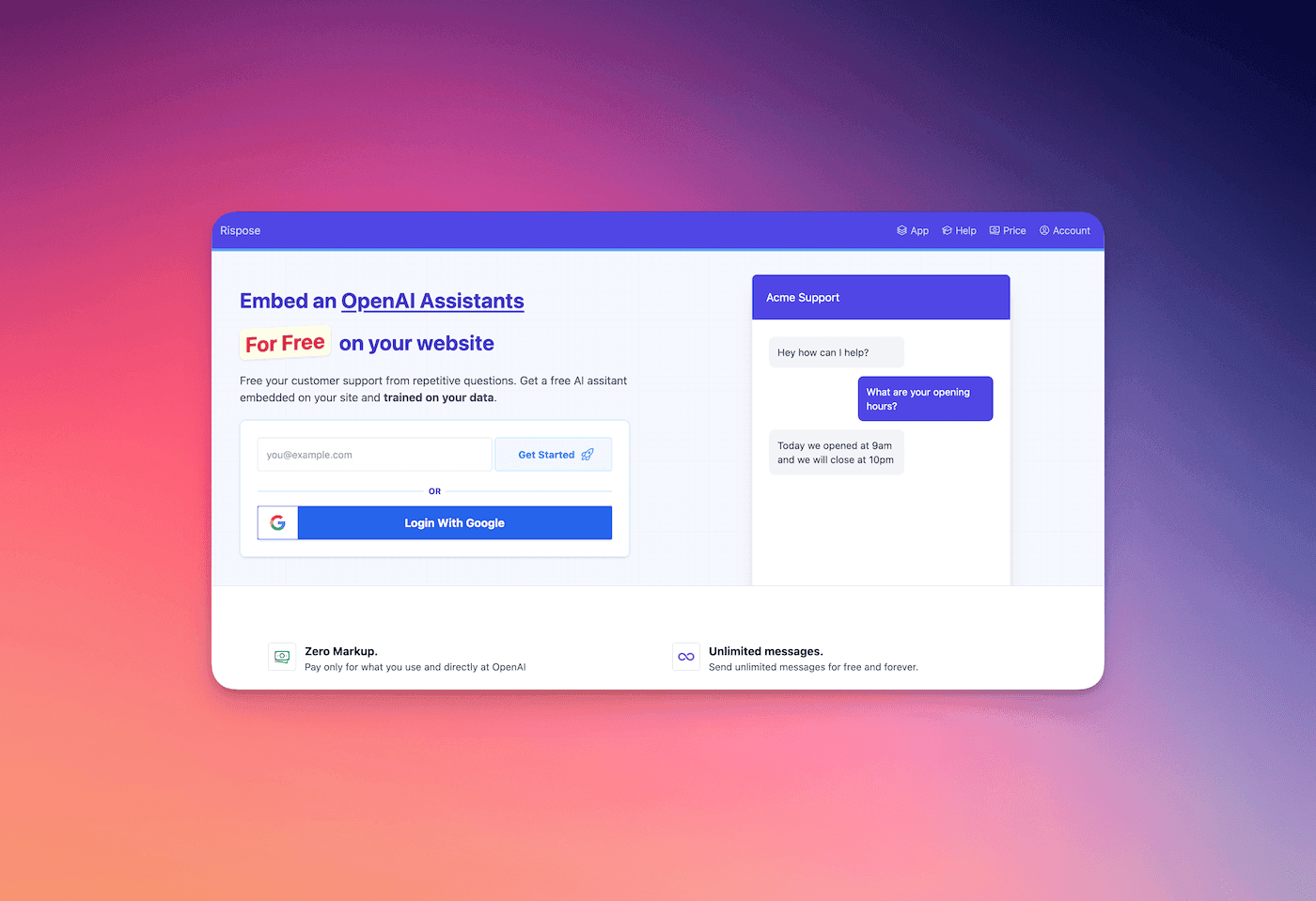
Unfetch
Rispose, formerly Unfetch, is an AI Agents & Automation tool designed to help businesses build and embed custom AI agents directly onto their websites or platforms. It enables automation of support, sales, and customer engagement through AI-powered assistants. Users can train their agents with up to 1,000 files, including PDFs, documents, and text files, and customize their behavior with specific instructions to match brand voice. The platform integrates with popular services like Shopify, WordPress, Notion, Wix, and Webflow. Rispose offers detailed history and metrics to track agent performance, understand user interactions, and facilitate continuous improvement. It provides a seamless and budget-friendly solution for integrating LLMs into existing web applications.
CosyVoice
CosyVoice is an advanced text-to-speech (TTS) system built on large language models (LLM), offering comprehensive capabilities for voice generation. It excels in zero-shot multilingual speech synthesis, covering 9 common languages and over 18 Chinese dialects/accents, alongside multi-lingual/cross-lingual zero-shot voice cloning. The tool prioritizes content consistency, speaker similarity, and prosody naturalness, surpassing previous versions. Key features include pronunciation inpainting for Chinese Pinyin and English CMU phonemes, robust text normalization, and bi-streaming support for low-latency audio output. CosyVoice also provides instruct support for controlling language, dialect, emotion, speed, and volume, making it suitable for production use and advanced users.
llama2-7b-chat-uncensored-ggml
llama2-7b-chat-uncensored-ggml is an AI chatbot built on the Llama2 7b model, offering uncensored conversational capabilities. This tool aims to provide users with an environment for unrestricted interactions, free from typical AI content filters. While the live website indicates a runtime error, suggesting the application is currently unavailable, its intended purpose is to facilitate open-ended discussions and content generation without the usual limitations found in many AI models. It is hosted on Hugging Face Spaces, indicating a community-driven or experimental nature.
Llama3 TenyxChat 70B
Llama3 TenyxChat 70B is a conversational AI model developed by Tenyx, hosted on Hugging Face Spaces. This tool leverages the Llama3 architecture to facilitate text generation and interactive chat experiences. While the live website indicates a runtime error, suggesting it may not be fully operational at the moment, its intended purpose is to serve as a powerful chatbot. It is suitable for developers and researchers looking to experiment with large language models, offering capabilities for content creation, educational assistance, and engaging interactions. The platform is part of the Hugging Face ecosystem, providing access to various ML resources and community support.
Llama 3.1 405B FP8
Llama 3.1 405B FP8 is an AI chatbot hosted on Hugging Face, providing an interactive platform to engage with the Llama-3.1-405B language model. Users can easily interact with a friendly AI assistant by typing messages and receiving text-based responses. A key feature of this tool is the ability to customize the assistant's behavior and control the length of its responses, offering a tailored conversational experience. The chat system maintains conversation history, allowing for more coherent and context-aware interactions. This tool is ideal for exploring the capabilities of large language models and experimenting with AI-driven conversations.
LLaMa 2 70b Chat Hf With EasyLLM
LLaMa 2 70b Chat Hf With EasyLLM is an AI chatbot built upon the powerful LLaMa 2 70b language model, designed for conversational AI interactions. This tool is hosted on Hugging Face Spaces, leveraging the EasyLLM framework to provide a simplified interface for users. While the specific functionalities beyond basic chat are not detailed, its foundation on a large language model suggests capabilities for understanding and generating human-like text. The tool's current status indicates it is paused, requiring users to contact the author for reactivation, which implies a community-driven or experimental nature.
Llama 3 Karamaru V1
Llama 3 Karamaru V1 is an innovative AI chatbot developed by Sakana AI, designed to engage users in a unique linguistic and cultural experience. This tool takes modern Japanese questions and responds in the distinctive style of classical Japanese, reflecting the worldview of the Edo period. Hosted on Hugging Face Spaces, it offers a fascinating way to explore historical Japanese language and culture through conversational AI. The chatbot is ideal for those interested in Japanese history, linguistics, or simply looking for a novel interactive experience with AI.
docs-mcp-server
Grounded Docs MCP Server is an open-source solution designed to prevent AI hallucinations and outdated knowledge by offering a personal, always-current documentation index for AI coding assistants. It can fetch official documentation from websites, GitHub, npm, PyPI, and local files, ensuring your AI queries the exact version you are using. This tool supports a wide range of file formats including HTML, Markdown, PDF, Office documents, and over 90 source code languages. It runs entirely on your machine, keeping your code private and secure. Compatible with any MCP-compatible client like Claude, Cline, and Gemini CLI, it offers both a command-line interface for agents and scripts, and a long-running server with a web UI for easy management.
dolly
Dolly is an instruction-following large language model developed by Databricks, trained on the Databricks Machine Learning Platform. It is based on EleutherAI’s Pythia-12b and fine-tuned on a ~15K record instruction corpus generated by Databricks employees. Dolly is licensed for commercial use and excels in capability domains such as brainstorming, classification, closed QA, generation, information extraction, open QA, and summarization. While not a state-of-the-art model, it demonstrates surprisingly high-quality instruction following. The model is available on Hugging Face as databricks/dolly-v2-12b and can be deployed and trained on various GPU instances, including A100, A10, and V100, with specific configurations for optimal performance.
deepnlp
DeepNLP is an open-source deep learning NLP pipeline built on Tensorflow, offering a unique AI App Store. This platform aims to be the 'Yelp' of AI services, enabling users to write genuine reviews, provide ratings, and share human evaluations and prompts for detailed aspects of AI services like ChatGPT, Gemini, and Midjourney. Users can upload screenshots of conversations or generated images to illustrate their reviews. The platform supports multi-aspect ratings, allowing users to evaluate correctness, helpfulness, and interestingness, along with customized aspects like image clarity or grammar. It covers over 30 categories, including AI Image Generators, AI Assistants, AI for various industries, and robotics, making it a comprehensive resource for discovering and assessing AI tools from a user's perspective.
DiffiT
DiffiT (Diffusion Vision Transformers) is a generative AI model that merges the strengths of diffusion models with Vision Transformers (ViTs). This innovative approach introduces Time-dependent Multihead Self Attention (TMSA), enabling precise control over the denoising process at each timestep. DiffiT has demonstrated state-of-the-art performance in class-conditional ImageNet generation across various resolutions, notably achieving an FID score of 1.73 on ImageNet-256. The official PyTorch implementation is available, along with pretrained model checkpoints and scripts for sampling images and computing FID scores, allowing users to reproduce the reported results.
Trillo Inc.
Trillo AI is an innovative platform designed to transform business requirements into full software blueprints, including detailed specifications, designs, and production-ready application code. Unlike traditional AI code generators, Trillo AI employs a multi-agent architecture with 16+ specialized agents that mirror expert team workflows, breaking down the specification process into reviewable steps. This human-in-the-loop approach allows users to comment on and regenerate any step's output, maintaining full control and ensuring accuracy. It excels in generating complex enterprise applications, providing 50-80% of the application code directly from the blueprint, which can be used as a working prototype or a solid starting point for development. The platform significantly reduces the time for specification and design from weeks to hours, fostering collaboration among architects, analysts, designers, project managers, and developers.
Browser Use
Browser Use is a leading AI company offering an open-source browser automation platform trusted by Fortune 500 companies. Its flagship product, the BU Agent, allows any application to autonomously browse, reason about, and extract structured data from websites via a single API call. The platform leverages proprietary stealth browser infrastructure and custom-trained models, powering web automation for both large enterprises and AI startups. Key features include undetectable browsers with anti-detect capabilities and 195+ country proxies, as well as purpose-built LLMs for browser automation. It also offers a cloud platform for managing tasks, browsers, and sessions, alongside an open-source library for easy integration.
Factory Process Monitoring Agent
The Factory Process Monitoring Agent is a sophisticated AI tool designed to control industrial automation systems through the application of large language models (LLMs). This repository offers comprehensive details and video demonstrations accompanying research on this innovative approach. It showcases a refined system design with extensive testing and model fine-tuning, including supervised fine-tuning (SFT) of open-source models like Llama-3 and Qwen2, as well as OpenAI's GPT-4o. The tool evaluates LLM performance in both routine processes following standard operating procedures (SOPs) and autonomous responses to unexpected events, highlighting the potential for customizing general LLMs for specialized automation equipment control. This research builds upon previous work in autonomous systems and flexible modular production enhanced with LLM agents.
Notebook Digitizer
Notebook Digitizer is an AI-powered tool designed to bridge the gap between analog and digital note-taking. It allows users to scan handwritten notes from physical notebooks and convert them into digital text using AI-powered transcription. This process helps users maintain the tactile experience of writing by hand while gaining the convenience of digital storage, searchability, and easy access. The platform enables scanning multiple pages in one go and provides instant access to the digitized and transcribed notes, making it ideal for those who prefer handwriting but need efficient digital organization.
FastEdit
FastEdit is a specialized tool designed for efficiently editing large language models (LLMs) by injecting new and customized factual knowledge. It supports a range of popular models including GPT-J, LLaMA, LLaMA-2, BLOOM, Falcon, Baichuan, and InternLM. The tool utilizes the Rank-One Model Editing (ROME) algorithm to achieve rapid modifications, often within 10 seconds. Developers can prepare JSON files with prompts, subjects, and target information to update model predictions. FastEdit is particularly useful for correcting outdated information or customizing model responses without extensive retraining, offering a streamlined approach to model maintenance and adaptation.
AI Technologies
AI Technologies is an Italian company specializing in designing and implementing advanced enterprise solutions powered by Artificial Intelligence and Machine Learning. They assist businesses in migrating from traditional operational models to data-driven frameworks, focusing on strategic areas such as customer management, transaction processing, IT security, and optimization. A key offering is their scalable and context-sensitive Virtual Assistant for Customer Care, which has successfully reduced customer service workload by 90% for millions of users. This solution integrates deeply with customer data to manage user requests efficiently, with off-script conversations routed to relevant departments for resolution, ensuring comprehensive customer support.
Amplify
Amplify develops advanced AI Assistants specifically designed for the media world, aiming to revolutionize how media companies operate in the digital age. Their product suite includes Seiri, an all-in-one AI Assistant for extracting metadata, cataloging media, recognizing faces, categorizing content, generating summaries, and detecting objects. GeNews is their generative AI tool for storytelling, helping journalists create compelling video stories faster by automatically selecting visuals and assembling timelines. SeiriVoice offers real-time transcription, translation, and dubbing for multimedia content, enhancing efficiency and accuracy in multiple languages. Amplify focuses on optimizing traditional workflows from ingest to distribution, providing cutting-edge technologies and expertise to empower businesses in the media and entertainment industry.
genai-processors
GenAI Processors is a lightweight Python library designed for building modular, asynchronous, and composable AI pipelines, specifically for generative AI applications. It addresses the fragmentation of LLM APIs by providing a unified content model, simple composable Python classes called Processors, and built-in asynchronous streaming capabilities. The library allows developers to create custom processors, chain them together, or parallelize them to build sophisticated data flows and agentic behaviors. Key features include rich content handling with `ProcessorPart` for various content types, integration with GenAI API for model calls, and utilities for stream management. It's built on Python's `asyncio` framework to orchestrate concurrent tasks, making it ideal for real-time applications.

Grably
Grably is a multi-modal human interaction data research company specializing in providing high-quality conversational and interaction datasets for AI development. They offer a wide range of data applications, including large-scale multilingual and multimodal datasets for LLM pretraining, low-resource language modeling, and multimodal model training. Grably also provides specialized datasets for embodied AI, robotics, long-form video analysis, audio/speech understanding, code intelligence, and scientific/technical domain modeling. Their process involves defining critical human activities, capturing synchronized multi-signal data, structuring it with precise annotation, and scaling to diverse populations. They also offer custom dataset design and delivery tailored to specific research, legal, and infrastructure requirements.
G-Retriever
G-Retriever is an open-source framework designed for retrieval-augmented generation (RAG) in the context of textual graph understanding and question answering. It is the official implementation of a NeurIPS 2024 paper and combines the strengths of Graph Neural Networks (GNNs), Large Language Models (LLMs), and RAG. The tool is applicable to multiple real-world scenarios, including scene graph understanding, common sense reasoning, and knowledge graph reasoning. G-Retriever can be fine-tuned to enhance graph understanding through soft prompting, offering flexibility for researchers and developers working with complex textual data structures.