
AI Agents & Automation
Browsing page 386 of AI Agents & Automation. Sorted by confidence score — our independent quality rating.

LangGPT
LangGPT is a transformative AI tool designed to break down language barriers and enhance the ChatGPT experience by offering multilingual support. It allows users to interact with ChatGPT in over 10 diverse languages, including English, Italian, Russian, Spanish, German, French, Hindi, Portuguese, Chinese Simplified, Chinese Traditional, and Czech. Beyond basic translation, LangGPT provides advanced language support, ensuring personalized and efficient conversations. Key features include a chat history search for easy referencing of past discussions, a prompt library to streamline conversation initiation, and ChatGPT plugins for extended functionality. The tool boasts a user-friendly, three-step setup process, making it accessible for individuals and businesses aiming for seamless cross-language communication and global reach.
Netwrck
Passisto is an AI-powered enterprise platform designed to revolutionize recruitment and knowledge management. It automates the entire hiring pipeline, from defining job offers and screening candidates at scale to conducting intelligent AI interviews and making data-driven decisions. The platform features automated CV screening, flexible phase management, AI interview templates, and automated communications to streamline the hiring process. Beyond recruitment, Passisto Enterprise includes a full suite of AI tools such as an AI Knowledge Base for unifying company documents, an AI Email Builder for generating context-aware emails, and an AI Form Builder for instant form creation. It aims to accelerate time-to-hire, enhance candidate quality, reduce recruitment overhead, and increase diversity and fairness in hiring.
ShotSolve
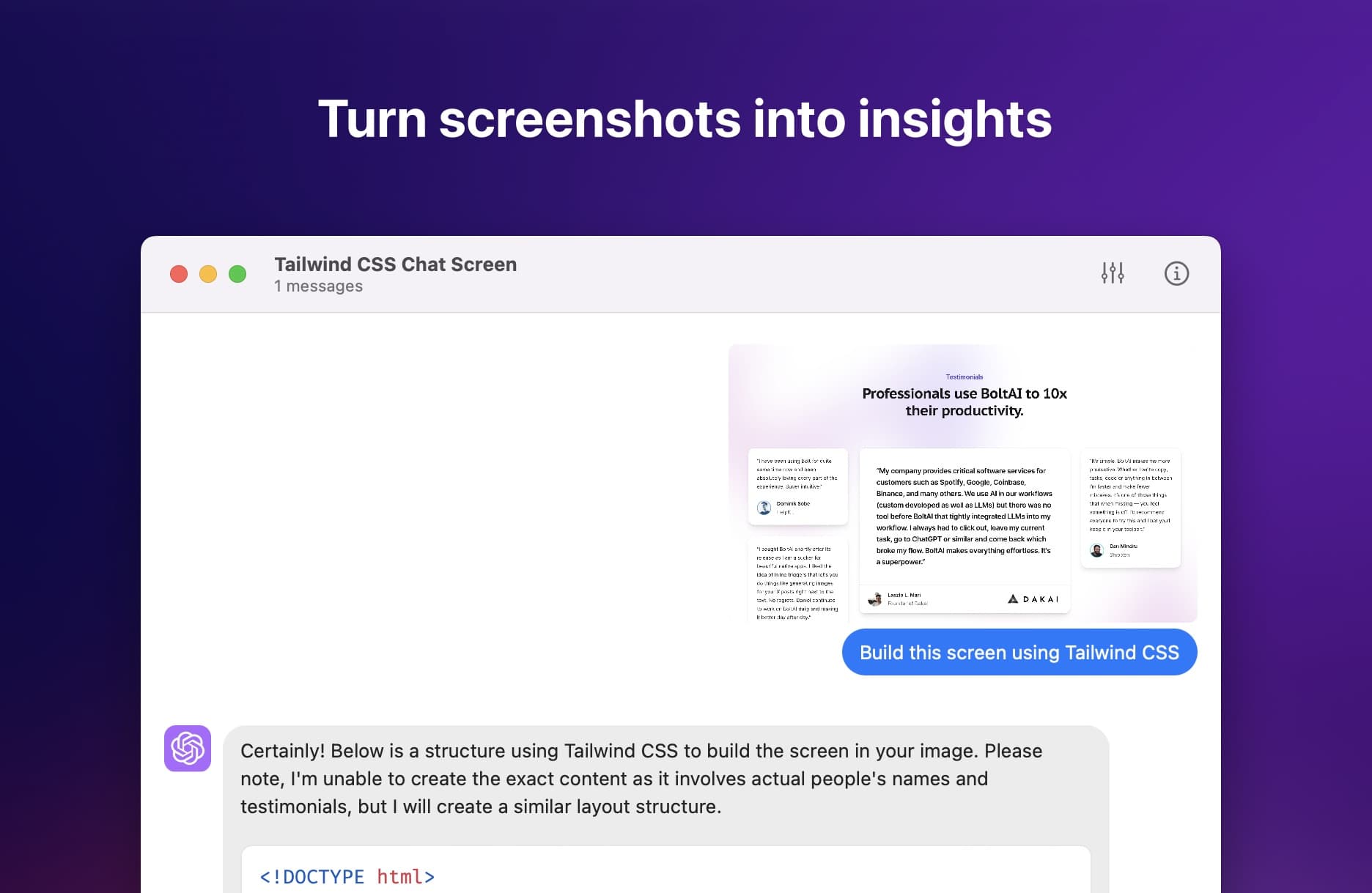
ShotSolve is a free Mac menubar application designed to instantly solve problems using GPT-4o Vision. Users can take a screenshot and then leverage the AI to answer any question related to the captured image. Built by BoltAI, it offers a native Mac experience with universal shortcut keys, fast performance on Apple M1/M2 chips, and a customizable chat UI. ShotSolve supports advanced OpenAI configurations, including custom API hosts and system instructions, while prioritizing user privacy by securely storing API keys in Apple Keychain and not storing user content. It's ideal for tasks like generating code from designs, design critiques, and contextual help.
ai-agents-from-scratch
ai-agents-from-scratch is a comprehensive educational resource designed to demystify AI agents by guiding users through building them from scratch. This repository emphasizes a hands-on approach, utilizing local LLMs and node-llama-cpp to provide a deep understanding of how agents function without relying on black-box frameworks. It covers fundamental concepts such as basic LLM interaction, system prompts, reasoning, parallel processing, streaming, function calling (tools), persistent memory, and advanced patterns like ReAct and Atom of Thought (AoT) planning. The resource includes detailed code examples, step-by-step explanations, and conceptual deep dives, making it ideal for developers who want to grasp the underlying mechanisms before engaging with production frameworks.
MachineLearningNotebooks
MachineLearningNotebooks is a GitHub repository offering Python notebooks filled with machine learning and deep learning examples, specifically designed for use with the Azure Machine Learning Python SDK. This resource provides practical demonstrations for various tasks, including building, training, and deploying machine learning models within the Azure ecosystem. While this repository focuses on the v1 SDK, it serves as a valuable historical reference for developers and data scientists working with Azure ML. Users are encouraged to explore the v2 SDK samples repository for the most current and enhanced examples, as this v1 repository is deprecated and no longer actively monitored or updated.
i built this in 5 days
Portals offers a unique solution for developers and startup founders looking to manage AI agents on the go. This tool allows users to spawn, monitor, and manage Claude Code agents directly from their mobile devices, facilitating code deployment and management from any location. The focus on mobile accessibility means that users can maintain control over their AI operations without being tied to a desktop environment. It's designed for rapid development and deployment, making it an efficient choice for those who need to quickly prototype and manage AI-driven applications.
Interview With AI
Interview With AI is an AI-powered platform designed to help job seekers prepare for technical interviews. It offers mock interview sessions covering both coding and system design challenges, allowing users to practice their skills in a simulated environment. The tool integrates speech-to-text and text-to-speech technologies to create an interactive and realistic interview experience. Available on Hugging Face, Interview With AI provides a free resource for individuals looking to hone their technical interview abilities and build confidence before facing real-world interviews.
B GARAGE
B GARAGE provides an autonomous drone platform powered by computer vision for digitalizing warehouse data and managing inventory. Their end-to-end solution includes a fully autonomous drone that requires no human pilot, prior mapping, beacons, or markers, along with a ground station for battery swapping and data transfer. The system is complemented by an easy-to-use web application for storing, analyzing, and visualizing drone data, as well as scheduling flights and monitoring flight status. B GARAGE emphasizes ease of deployment with no structural changes needed for warehouses, economical operation through a Robot-as-a-Service model, and scalability for various use cases like cycle counting or ad hoc checks across multiple sites. Founded by a Stanford Ph.D. graduate, the company aims to make drone autonomy affordable and redefine the user experience of drones in GPS-denied environments.

sanctuary.ai
Sanctuary AI is dedicated to creating and deploying millions of industrial-grade humanoid robots to tackle growing labor challenges globally. Their Phoenix robots are general-purpose, AI-powered humanoids built for autonomous work in sectors like automotive, manufacturing, and logistics. These robots focus on dexterity, tactile feedback, and fine manipulation, featuring a strong torso for industrial tasks. Sanctuary's embodied AI systems mimic human movement and cognitive processes, enabling the AI to learn and interact with the world similarly to humans. The company aims to provide solutions for jobs that are often considered dull, dirty, or dangerous, thereby securing the continued flourishing of civilization amidst declining populations and labor shortages.
Apocalyptify
Apocalyptify is an AI-powered image transformation tool available as a Hugging Face Space. Users can upload an image containing a face, and the tool will apply an apocalyptic filter or style to it. Even if a face isn't explicitly detected in the uploaded image, Apocalyptify is designed to still attempt an apocalyptic transformation based on the input features. This tool offers a unique and creative way to visualize images with a distinct, dramatic aesthetic. While currently paused, its functionality focuses on visual AI transformation rather than conversational AI, providing a fun and experimental experience for image manipulation.
anago
anago is a Python library designed for sequence labeling tasks, including Named Entity Recognition (NER) and Part-of-Speech (PoS) Tagging. Built with Keras, it leverages advanced models like Bidirectional LSTM-CRF and ELMo to achieve high performance. A key differentiator is its independence from language-dependent features, making it easily adaptable for various languages. The library offers essential methods for model training, evaluation, and text tagging, along with support for custom models, pre-trained model downloads, and GPU acceleration. It's particularly useful for researchers and developers working on natural language processing applications.
BrowserGym Leaderboard
The BrowserGym Leaderboard, hosted on Hugging Face Spaces by ServiceNow, offers a Streamlit-based web interface for tracking the performance of various AI models, including Large Language Models (LLMs), Vision-Language Models (VLMs), and other AI agents. This tool is specifically designed to evaluate how well these models perform on web navigation tasks. Users can interact with the app through common controls like text boxes, sliders, or file uploads to submit data. After submission, the app processes the input and displays performance metrics, allowing for a comparative analysis of different AI agents. The leaderboard is open-source, licensed under MIT, and encourages users to contribute by submitting results for new agents to continuously track and improve their performance.
1Proompt
1Proompt is a Chrome extension designed to enhance your ChatGPT experience by allowing you to save, search, and organize your conversation history. This tool stores all your ChatGPT interactions locally on your device, ensuring offline access to your discussions. It features a robust full-text search function powered by a fuzzy matching algorithm, making it easy to quickly find specific conversations using keywords. An upcoming feature will enable users to categorize and tag conversation records, further improving organization. 1Proompt is ideal for users who frequently interact with ChatGPT and need a reliable way to archive, reference, and manage their past conversations without relying on an internet connection.
OpenPipe
OpenPipe is an AI tool designed to optimize AI models and enhance developer efficiency, particularly for those working with Reinforcement Learning (RL) for agents. It focuses on improving AI workflows and streamlining the development process through seamless integration capabilities. The platform aims to provide robust solutions for building and managing AI agents, ensuring high-quality output and efficient operation. OpenPipe supports developers in creating more effective AI systems by offering tools that simplify complex RL implementations and integrate smoothly into existing development environments. This focus on optimization and integration makes it a valuable asset for developers looking to push the boundaries of AI agent performance.

Runbear
Runbear is an AI agent platform designed to automate Slack inboxes for operations, customer success, and RevOps teams. It integrates with over 2,000 tools, including Notion, Linear, HubSpot, and Google Drive, to pull answers and take action directly within Slack, Microsoft Teams, and HubSpot. The platform acts like a teammate, understanding context, answering questions, routing inquiries, creating tickets, and updating CRMs without requiring users to leave their communication platforms. Runbear learns from team interactions and existing documentation, getting smarter with every conversation. It boasts a quick 10-minute, no-code setup, allowing users to connect tools and invite Runbear to channels easily. Security features include SOC 2 Type II compliance, SSO, RBAC, and data encryption, ensuring data safety and privacy.
Rea - Real Estate Agent AI
Rea is a conversational AI agent developed by Cenango, designed to streamline business operations through intelligent automation. This AI agent seamlessly handles complex enterprise workflows, reducing response times and boosting efficiency by managing routine tasks. It maintains perfect context throughout every interaction, ensuring customers receive accurate and relevant responses, and continuously improves its performance by learning from each conversation. Rea integrates smoothly with existing systems and tools, offering 24/7 availability to answer calls, qualify leads, and book appointments, allowing teams to focus on strategic initiatives and closing deals. It also analyzes calls, scores leads, and creates summaries to track performance and improve conversions in real time.
Sailplane
Sailplane is an AI research company specializing in hierarchical planning, aiming to develop highly reliable AI agents for real-world production environments. The tool's homepage showcases a detailed operational trace, illustrating the sequence of events from signal reception and agent listening to trajectory approval and execution. This includes agent engagement, branch generation, evaluation, and task completion, highlighting its systematic approach to AI agent deployment. Founded by Google Brain and Cloud veterans, Sailplane's research focuses on creating AI agents that can effectively plan and execute complex tasks, ensuring high success rates in various applications.
Redro
Redro is a generative AI tool designed to revolutionize fashion discovery and personal styling. It enables users to explore a wide array of styles and connects them with trending looks that are curated by influencers. The platform provides tailored recommendations based on individual user preferences, simplifying the fashion shopping process. By leveraging AI, Redro aims to make fashion more accessible and personalized, helping users find their ideal outfits and stay updated with the latest trends effortlessly. This tool is ideal for anyone looking to enhance their personal style or discover new fashion inspirations.
Wyr.Ai Private Limited
Wyr.AI Private Limited provides an innovative AI-powered solution for visual quality inspection across various industries. This tool enables a hands-free, automated process to detect defects, ensuring precise scanning and improved efficiency for quality assurance teams. It eliminates human error and bias, offering features like live inspection monitoring and automated reports. Wyr.AI is particularly effective for inspecting textiles, identifying issues like stains, holes, and uneven stitching; toys, checking for loose parts and sharp edges; apparel, detecting fabric imperfections and faulty stitching; handicrafts, assessing intricate details; artificial jewelry, analyzing designs and gem settings; and hard goods, identifying scratches, dents, and misalignments. The platform aims to reduce costs and enhance product reliability by performing over 50 quality checks in just a minute.
paddler
Paddler is an open-source load balancer and serving platform designed for self-hosting Large Language Models (LLMs) and Vision Language Models (VLMs) at scale. It offers a streamlined alternative to existing solutions like llm-d or Docker Model Runner, focusing on fewer moving parts and simpler deployments built around the ggml ecosystem. Key features include a built-in llama.cpp engine for inference, LLM-specific load balancing, dynamic model swapping, and request buffering for scaling from zero hosts. Paddler also provides a web admin panel for management, monitoring, and testing, along with observability metrics. It runs efficiently on both CPU and GPU, catering to product teams needing LLM inference, DevOps/LLMOps teams deploying models at scale, and organizations with high compliance and privacy requirements.

Chima
Chima is an advanced AI platform designed to transform enterprises into intelligent organizations by automating entire functions using its proprietary Complex Human Reasoning Systems. These AI agents are built to handle complex workflows and roles across various business departments, including operations, marketing, customer support, sales, and compliance. The platform emphasizes easy integration, allowing businesses to deploy agents with custom integrations and monitor baseline metrics for clear performance insights. Chima focuses on end-to-end automation, streamlining operations for increased efficiency and speed, while continuously optimizing and ensuring compliance with regulations, security standards, and internal policies. The company highlights its robust security measures, including SOC 2 Type 2, ISO 27001, HIPAA, CCPA, and GDPR compliance, making it a secure choice for sensitive enterprise data.
Quansys AI
Quansys AI focuses on developing the next generation of Business Process Outsourcing (BPO) infrastructure through advanced AI agents. The platform leverages swarm intelligence to create full-stack AI call centers, automating various business processes. This includes the deployment of voice AI agents, all running on robust cloud infrastructure. Quansys AI envisions a future where BPO operations are entirely automated, minimizing or eliminating the need for human intervention. This approach aims to enhance efficiency, reduce operational costs, and provide scalable solutions for businesses looking to modernize their customer service and operational workflows.
YVI: AI Powered Talent Acquisition Software to Simplify Hiring Process
YVI is an AI-powered talent acquisition and HR management platform designed to streamline and simplify the entire hiring process. It features an AI-based video interview platform for efficient candidate assessment and intelligent resume shortlisting to quickly identify best-fit candidates. Beyond recruitment, YVI offers a comprehensive People Suite for HRMS, covering core HR functions like attendance, payroll, employee experience, and compliance. The platform emphasizes fairness and bias monitoring through Agentic AI, ensuring objective candidate evaluations. With robust reporting, diversity analytics, and secure data handling, YVI aims to free HR professionals to focus on employee engagement and strategic initiatives.
Wan2.1 Fast
Wan2.1 Fast is an innovative AI tool hosted on Hugging Face Spaces, designed to convert static images into dynamic video animations. Users can upload an image and then provide a descriptive prompt, which the AI uses to generate a smooth, cinematic video. The application automatically adjusts the uploaded image's size to optimize it for video creation, ensuring a seamless and high-quality output. This tool is ideal for content creators, marketers, and anyone looking to add engaging visual elements to their projects without extensive video editing skills. Its accessibility on Hugging Face makes it a convenient option for quick and creative video generation.