
AI Agents & Automation
Browsing page 54 of RAG & Document AI in AI Agents & Automation. Sorted by confidence score — our independent quality rating.

Neferdata
Neferdata is an AI-powered tool designed for efficient and cost-effective information extraction from diverse document formats. It streamlines the process of gathering critical data, making it easier to manage and analyze large volumes of information. Beyond extraction, Neferdata facilitates advanced knowledge searching within extensive document pools, allowing users to quickly pinpoint relevant insights. A key feature of Neferdata is its ability to merge data from different sources, which significantly reduces manual labor and accelerates operational workflows. This comprehensive approach to data handling helps businesses improve data quality, enhance decision-making, and achieve greater operational efficiency by automating tedious data preparation tasks.
PDFParsersPlayground
PDFParsersPlayground is a tool hosted on Hugging Face that facilitates the conversion of PDF documents into Markdown format. It leverages various open-source parsers to perform this conversion, offering a platform for users to experiment with different parsing techniques. Designed for developers and researchers, this tool provides a straightforward way to process PDFs and extract their content into a more structured, editable format. While the Space is currently paused, its intent is to offer a free and accessible environment for exploring PDF parsing capabilities, making it valuable for those working with document analysis and data extraction.
OpenOCR Demo
OpenOCR Demo is an AI-powered Optical Character Recognition (OCR) system designed to efficiently extract text from various image types. Users can upload images containing either printed or handwritten text, and the tool will process them to return the recognized words. This capability makes it useful for tasks such as digitizing documents, automating data entry from scanned materials, or converting images into machine-readable text for further processing. The system aims to provide a quick and straightforward method for text extraction, making it accessible for individuals needing to convert visual text into editable formats. Its open-source nature, as indicated by its GitHub homepage, suggests a focus on transparency and community-driven development.
Question Answering from PDFs
Question Answering from PDFs is an AI-powered tool hosted on Hugging Face Spaces, designed to extract information from PDF documents. Users can upload any PDF file and then pose questions directly to the document's content. The application intelligently processes the PDF, identifies relevant sections, and generates answers based on the information found within the document. This capability makes it highly useful for tasks such as research, education, and efficient information retrieval, allowing users to quickly pinpoint specific details without manually sifting through lengthy documents. While the current live version shows a runtime error, its intended functionality is to provide a seamless question-answering experience for PDF-based information.
Qari Arabic OCR
Qari Arabic OCR is an AI-powered tool designed to accurately extract text from Arabic-language images and documents. Hosted on Hugging Face Spaces, it provides users with the flexibility to choose between two distinct OCR models to best suit their specific needs, ensuring optimal text recognition. Users can upload a photo of an Arabic document, and the application will process it to read and convert the text into a machine-readable format. The extracted text is then displayed in a convenient textbox, allowing for easy copying and further use. This tool is particularly useful for digitizing historical documents, processing various Arabic texts, and streamlining workflows that involve converting physical Arabic content into digital data.
Semantic Similarity with BERT
Semantic Similarity with BERT is an AI tool designed to analyze the relatedness of different pieces of text using the powerful BERT model. This tool is particularly valuable for researchers and developers in the field of Natural Language Processing (NLP) who need to quantify the semantic similarity between sentences or documents. It provides a practical application of BERT's capabilities in understanding context and meaning, making it a useful resource for academic research, experimental development, and educational purposes. The tool is offered for free, making advanced semantic analysis accessible to a wider audience interested in exploring and implementing BERT-based solutions.
Table Structure Recognition Demo
Table Structure Recognition Demo is an AI-powered application designed to automate the process of extracting data from tables within images. Users can upload an image containing a table, and the tool will identify the table, analyze its structure, and extract the embedded text. The output is provided both as an image with the detected table highlighted and as a structured CSV file, making it easy to integrate the extracted data into other systems or for further analysis. This tool is particularly useful for converting visual table data into a machine-readable format, streamlining data processing workflows.
Turkish Tokenizer
Turkish Tokenizer is a specialized tool designed for the morphological tokenization of Turkish text. Hosted on Hugging Face Spaces, this application allows users to input any Turkish text and receive a detailed breakdown of its individual words and their morphological components. This process is crucial for natural language processing (NLP) tasks, as it provides a foundational understanding of the text's structure. By revealing how text is divided, the tool aids in preprocessing data for linguistic analysis, machine translation, and other AI applications that require a deep understanding of Turkish grammar and word formation. It offers a straightforward interface for easy use.
Trocr Scene Text Recognition
Trocr Scene Text Recognition is an AI-powered tool hosted on Hugging Face Spaces, designed for optical character recognition (OCR). It allows users to upload images that contain text and then processes them to extract and convert the visual text into a readable digital format. This tool is particularly useful for tasks requiring the digitization of text from various scenes or documents. Its intuitive interface, typical of Hugging Face Spaces, enables quick interaction, making it accessible for anyone needing to extract text from images without complex setups. Users can experiment with their own images or utilize provided examples to understand its capabilities.
DeepPath
DeepPath is an open-source reinforcement learning framework designed for reasoning in large-scale knowledge graphs. It employs a policy-based agent with continuous states derived from knowledge graph embeddings, allowing it to navigate and sample promising relations to extend its paths within a knowledge graph vector-space. A key differentiator is its reward function, which considers accuracy, diversity, and efficiency in its reasoning process. The tool has been shown to outperform path-ranking based algorithms and other knowledge graph embedding methods on datasets like Freebase and Never-Ending Language Learning. It provides scripts for finding reasoning paths, evaluating fact prediction, and assessing link prediction, making it a valuable resource for researchers and developers in the field of knowledge graph analysis.

SwiftScan AI Document Scanner
SwiftScan AI Document Scanner is an iOS mobile application designed to convert your device into a powerful scanning tool. It excels at capturing high-quality images of documents and QR codes, then leveraging artificial intelligence to enhance their utility. Users can translate scanned text into various languages, summarize lengthy content for quick understanding, or generate detailed reports based on the document's information. The app supports easy creation of PDF or JPG scans, which can then be conveniently shared via email, fax, or integrated cloud services, streamlining document management and accessibility for mobile users.

Cerebro
Cerebro is an AI-powered knowledge management tool designed to elevate thinking by seamlessly organizing, connecting, and amplifying ideas. It addresses information overload by allowing users to save content from videos, articles, and PDFs, which are then transformed into searchable and actionable knowledge. Users can ask natural language questions to instantly get precise answers from their content, powered by Cerebro's AI, Nova. The tool automatically analyzes content, captures key insights, and highlights important information, acting like a brilliant assistant. It also helps users see hidden connections between their ideas, fostering a growing knowledge network. Cerebro aims to help users process more information, miss less, and make better connections across their content, ultimately transforming long-form media into clear, actionable insights.
MindHalo
MindHalo is an intelligent study companion exclusively for macOS, designed to help students master their textbooks using local AI. Users can upload PDF textbooks and other documents, transforming them into an intelligent, searchable study database. The AI tutor provides answers grounded in the user's materials, citing specific pages for accuracy. It also generates study guides, flashcards, and practice quizzes from any chapter with a single click. MindHalo operates 100% locally on Apple Silicon Macs, ensuring privacy and fast performance without cloud dependency or data fees. It offers a gamified learning experience with coins and streaks, and is free to start with an optional Pro upgrade for unlimited access.
RAT-retrieval-augmented-thinking
RAT (Retrieval Augmented Thinking) is a powerful open-source tool designed to improve AI responses by utilizing DeepSeek's advanced reasoning capabilities. It guides other AI models through a structured thinking process, leading to more thoughtful, contextually aware, and reliable answers. The tool employs a two-stage approach: a Reasoning Stage where DeepSeek generates detailed analysis for each query, and a Response Stage where OpenRouter models use this reasoning context to provide informed answers. Key features include flexibility to choose various OpenRouter models, visibility into the AI's thinking process, and maintenance of conversation context for coherent interactions. It also offers a specialized Claude-specific version that leverages Anthropic's message prefilling for enhanced coherence.
videocr
videocr is an open-source Python tool designed to extract hardcoded (burned-in) subtitles directly from video files. Utilizing the Tesseract OCR engine, it processes video frames to identify and convert subtitle text into a standard SRT format. The tool offers flexibility with language support, allowing extraction in almost any language Tesseract supports, including multi-language combinations. Users can define confidence thresholds for word predictions and similarity thresholds for merging subtitle lines, ensuring accurate and clean output. It also supports extracting subtitles from specific video clips and can process either the bottom half or the full frame for OCR, depending on subtitle placement. The process is CPU intensive, with performance scaling with the number of CPU cores.
Aspect-Based-Sentiment-Analysis
Aspect-Based-Sentiment-Analysis is an open-source Python package designed to classify the sentiment of potentially long texts concerning various aspects. A key differentiator is its support for explainable machine learning, providing insights into model predictions to help users understand and infer the reliability of the decisions made. The package is standalone, scalable, and highly extensible, allowing users to build custom models tailored to their specific data. It leverages Transformer architecture and TensorFlow, offering a robust solution for sentiment analysis. The tool also includes a 'professor' component that supervises and explains model predictions, potentially dismissing suspicious outputs. It provides ready-to-use models for restaurant and laptop domains, with clear instructions for installation and usage via pip or conda.
Optible AI
Optible AI offers an advanced AI-powered platform designed to transform grant management for government departments and foundations. It automates workflows, significantly reducing review times by up to 90% through AI-driven assessment and allocation. The platform ensures fair, accurate, and consistent decisions at scale by screening applications faster and providing highly accurate eligibility screening. Key features include automated setup, real-time document validation to detect fraud, and AI-driven screening that processes thousands of applications in minutes. Optible AI also delivers 300x more data insights through detailed, customizable reports, enabling organizations to track progress, refine policies, and maximize their impact efficiently.
Totoy
Totoy specializes in integrating state-of-the-art AI solutions into existing business processes, focusing on measurable profitability and employee satisfaction. They offer a comprehensive approach starting with a free AI workshop, followed by an in-depth potential analysis where specialists spend a day on-site. The process culminates in AI evaluation and implementation, delivering systems that save time and money. Totoy's solutions are developed and hosted in the EU, ensuring compliance with GDPR and AI Act regulations. They address various use cases including document management, customer support, administration, controlling, quality control, and knowledge management, providing tailored AI agents and systems.
Klu
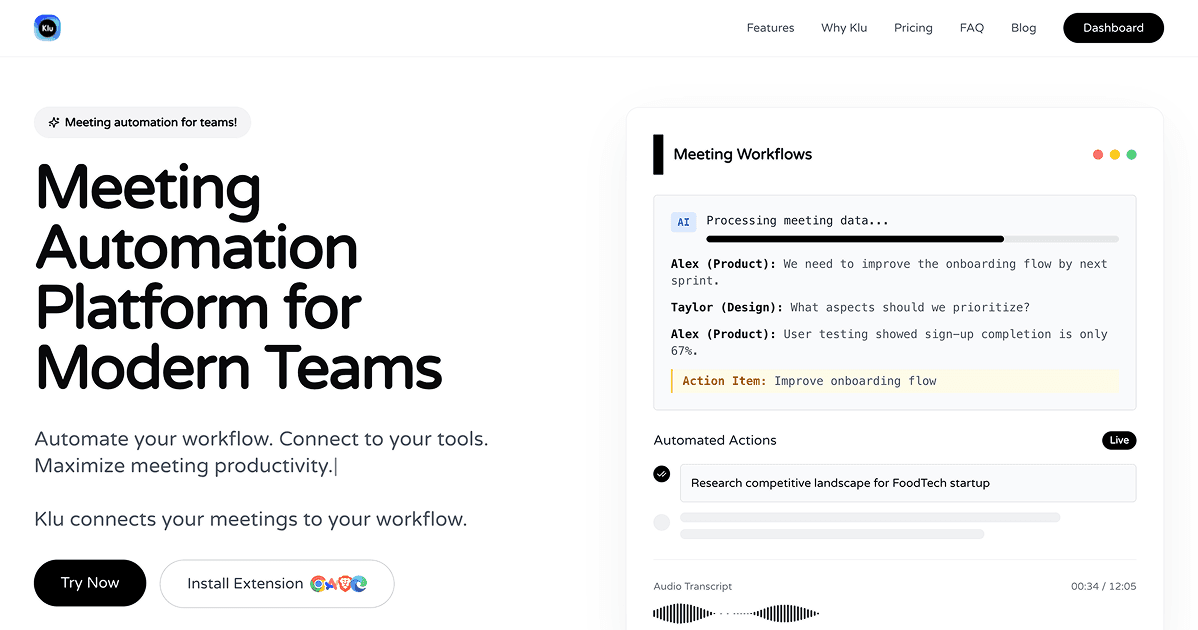
Klu is a meeting automation platform designed to enhance productivity for modern teams. It focuses on automating workflows and integrating with existing tools to streamline meeting management. The platform aims to help users take meeting notes with no effort, suggesting a focus on efficiency and ease of use. By connecting to various tools, Klu seeks to centralize meeting-related tasks and information, ultimately leading to more productive team interactions. Its core offering appears to be around simplifying the often-tedious aspects of meetings, allowing teams to concentrate on core discussions and decisions.
TextSnatcher
TextSnatcher is a desktop application for Linux that enables users to quickly and easily extract text from images. Utilizing Tesseract OCR 4.x, it performs optical character recognition operations in seconds, making it simple to digitize text from visual sources. Key features include multi-language support and the ability to copy text from images with a simple drag-and-paste action. This tool is ideal for anyone needing to extract information from screenshots, scanned documents, or other image-based content on a Linux system, streamlining the process of converting visual text into editable digital format.
Top2Vec
Top2Vec is an open-source Python library designed for advanced topic modeling and semantic search. It automatically detects topics within text data and generates jointly embedded topic, document, and word vectors. The library offers a 'classic' version for general topic modeling and a newer 'contextual' version that leverages contextual token embeddings to identify multiple topics per document and even detect topic segments within documents. This contextual approach provides a more nuanced understanding of complex texts. Key features include automatic topic number detection, hierarchical topic generation, keyword-based topic search, and document search by topic or keywords. Top2Vec eliminates the need for stop word lists, stemming, or lemmatization, and works effectively on short texts. It also supports various embedding models like Doc2Vec, Universal Sentence Encoder, and BERT Sentence Transformer for flexible deployment.
youtube-ai-extension
The youtube-ai-extension is an interactive YouTube extension built with React, Tailwind CSS, and Plasmo, integrating with the OpenAI API. It allows users to chat directly with YouTube videos in real-time, offering a unique interactive experience. Key functionalities include generating video summaries, asking questions, and receiving detailed explanations. The extension features a user-friendly interface seamlessly integrated into YouTube, supporting multiple languages and providing context-aware responses. While currently requiring a local installation and an OpenAI API key, a major update is planned for June 10, 2025, which will include new features, a streamlined installation process, and an official release on the Chrome Web Store. It's important to note that the extension currently works best with the old YouTube layout, requiring a tool like uBlock Origin to revert the layout.

Deeligence
Deeligence is an AI-powered platform designed to significantly accelerate due diligence and contract review processes, aiming to reduce human error and meet ambitious deadlines. It centralizes all due diligence projects and processes, providing a clear overview of progress. Key features include a Change Tracker for managing uploads and revisions, an AI Contract Screener that extracts over 100 contract fields with local law summaries, and an Early Warning System that uses agentic AI to identify and notify teams of red flags on day one. The tool also offers end-to-end solutions, data room agnosticism, team visibility, instant data import, one-touch reporting, and Q&A management, all while ensuring security and privacy with GDPR compliance and SOC-2/ISO 27001 in progress.
dgl-ke
dgl-ke is an open-source package designed for learning large-scale knowledge graph embeddings, built on top of the Deep Graph Library (DGL). It offers high performance, ease of use, and scalability, making it suitable for various machine learning tasks involving knowledge graphs. The package supports training knowledge graph embeddings using popular models like TransE, TransR, RESCAL, DistMult, ComplEx, and RotatE. Users can perform training on single machines (CPU/GPU) or distributed environments, evaluate pre-trained embeddings with link prediction tasks, and conduct inference for entity/relation linkage prediction or embedding similarity. DGL-KE is optimized for scale, capable of processing knowledge graphs with millions of nodes and billions of edges efficiently.