
Coding & Development
Browsing page 50 of AI tools for DevOps & Infrastructure in Coding & Development. Sorted by confidence score — our independent quality rating.

Ceremorphic, Inc.
Ceremorphic, Inc. specializes in developing quantum-inspired silicon systems designed to power energy-efficient AI supercomputing, in silico drug design, and reliable physical AI. Their core mission is to deliver carbon-neutral compute solutions through patented technologies such as hierarchical quantum-inspired machine learning processing, optical interconnects (Scale-X™), and multi-thread reliable application processors (ThreadArch®). The company offers solutions like Datacenter-in-Box™ and Biocenter-in-Box™, targeting applications in datacenter AI supercomputing, physical AI processors, life sciences, and automotive. Their innovative approach aims to provide exascale computing with significantly reduced energy consumption.
CURRUX Vision
CURRUX Vision develops autonomous AI systems designed for smart infrastructure, assisting cities, Departments of Transportation (DoTs), government agencies, and infrastructure developers. The platform enables monitoring, optimization, and monetization of complex infrastructure projects. Its systems operate both locally at the edge and in the cloud, leveraging existing CCTV, traffic controller, and sensor infrastructure. Key solutions include AI-enabled systems for intelligent transport, traffic violation detection and enforcement, and smart city applications. The technology utilizes advanced AI processors similar to those in autonomous cars, offering automated object detection, classification, tracking, self-learning, and predictive algorithms. CURRUX Vision also provides autonomous PTZ camera control for actions like area scans and data collection, and offers flexible deployment options including edge, hybrid edge/cloud, and full cloud processing.
CloudKitect Inc
CloudKitect Inc. offers a platform for enterprises to rapidly deploy and manage agentic AI solutions on AWS, ensuring full data control and compliance. The platform allows organizations to launch an AI command center within their private cloud in less than a day, integrating seamlessly with existing systems like email and databases. Users can build AI agents and workflows using an intuitive drag-and-drop canvas, with built-in governance and guardrails. CloudKitect provides distinct role-based experiences for users, builders, and administrators, ensuring tailored access and control. It supports various enterprise functions including finance, HR, compliance, legal, IT, and operations with pre-built agents and workflows, all aligned with NIST 800-53 and SOC 2 Type II standards.
Ceremorphic, Inc.
Ceremorphic, Inc. specializes in developing quantum-inspired silicon systems designed for energy-efficient AI supercomputing, in silico drug design, and reliable physical AI. Their core technologies include hierarchical machine learning processors (Flexmath™), energy-efficient optical interconnects (Scale-X™), and multi-thread reliable application processors (ThreadArch®). The company's mission is to deliver ubiquitous exascale computing with a focus on carbon-neutral compute, enabling more efficient drug discovery and high-performance AI processing with lower energy demands. Their solutions are applicable across datacenter AI supercomputing, physical AI processors, life sciences, and automotive sectors.
iris roads
iris roads offers an AI-powered solution for automating road patrolling and collecting roadway asset data. Utilizing specialized cameras, a flexible dashboard, and an app, the platform provides an end-to-end ecosystem for smart infrastructure management. It helps automate road and roadway asset maintenance, ensures compliance with critical standards, and protects communities through AI-driven insights. The solution prioritizes privacy with automated image redaction, delivers reliable first-party data, and is customizable to operational goals. iris roads aims to reduce operational costs by enabling timely and efficient execution of maintenance tasks, while also complying with regulatory standards. It is an award-winning infratech solution recognized for high-quality data and easy-to-use tools.
Hermes - Automated Asynchronous REST API Monitoring
Hermes offers automated asynchronous REST API monitoring, enabling users to efficiently track and manage their external API integrations. The tool allows for the validation of API configurations to ensure proper functionality and supports setting up periodic monitoring to continuously observe API responses. Users can retrieve monitored data in various modes, including summary, detailed, and full reports, providing flexibility in how they analyze API performance and behavior over time. Hosted on Hugging Face Spaces, Hermes is designed to simplify the process of API surveillance for developers and operations teams.

VOLTQUANT
VOLTQUANT is an AI-driven platform designed to accelerate infrastructure projects by transforming complex technical documents, drawings, and conversations into a living, searchable memory. It enables engineers to access instant project knowledge, generate automated reports, and perform in-depth document analysis. The tool aims to significantly reduce project costs by 30-50% and save engineers up to 5 hours daily. Key functionalities include answering project-specific queries from a personalized knowledge base, verifying vendor submittals with an optical and semantic engine, and automating document workflows with one-click tasks for technical documentation. VOLTQUANT emphasizes enterprise-grade security, compliant with GDPR and certified for ICO and SOC 2 Type 2.
Scaling test-time compute
Scaling test-time compute is a Hugging Face Space designed for exploring and comparing different search methods for generating candidate answers to text-based problems, such as math questions. Users can input a text problem, and the tool provides options to select from various smart search methods, including best-of-N, beam search, and diverse verifier tree search. This functionality allows researchers and developers to evaluate the effectiveness of different computational strategies in generating multiple potential solutions, making it a valuable resource for AI research and experimentation in areas like natural language processing and problem-solving. The tool is hosted on Hugging Face, indicating its focus on open-source AI development and community collaboration.
Streamlit Docker Template
Streamlit Docker Template provides a streamlined solution for deploying Streamlit applications within Docker containers. This tool is designed to help users create reproducible and portable environments, ensuring consistency across different deployment stages. By containerizing Streamlit apps, it simplifies the process of packaging and running web applications built with Streamlit. This template is particularly useful for developers and data scientists who want to share their interactive data analysis and machine learning models as web applications, offering a robust and isolated execution environment. It abstracts away much of the complexity associated with environment setup, allowing users to focus on their application logic.

LōD
LōD is a full-stack energy management platform designed for energy-intensive operations like Bitcoin mining, flexible data centers, and AI inference compute. It offers three layers of energy intelligence: data and insights into real-time operational and energy market data, a strategy engine to customize rules based on this data, and an execution layer to implement strategies on power infrastructure and IoT devices. The platform helps optimize energy efficiency, reduce emissions, and unlock new revenue streams by leveraging real-time grid signals. LōD is SOC 1 Type II and SOC 2 Type II compliant, ensuring accuracy, security, and reliability for financial reporting and data protection. It supports integration with various power meters, sensors, and all major ASIC models, and can run alongside existing software like Foreman.
SwarmOne
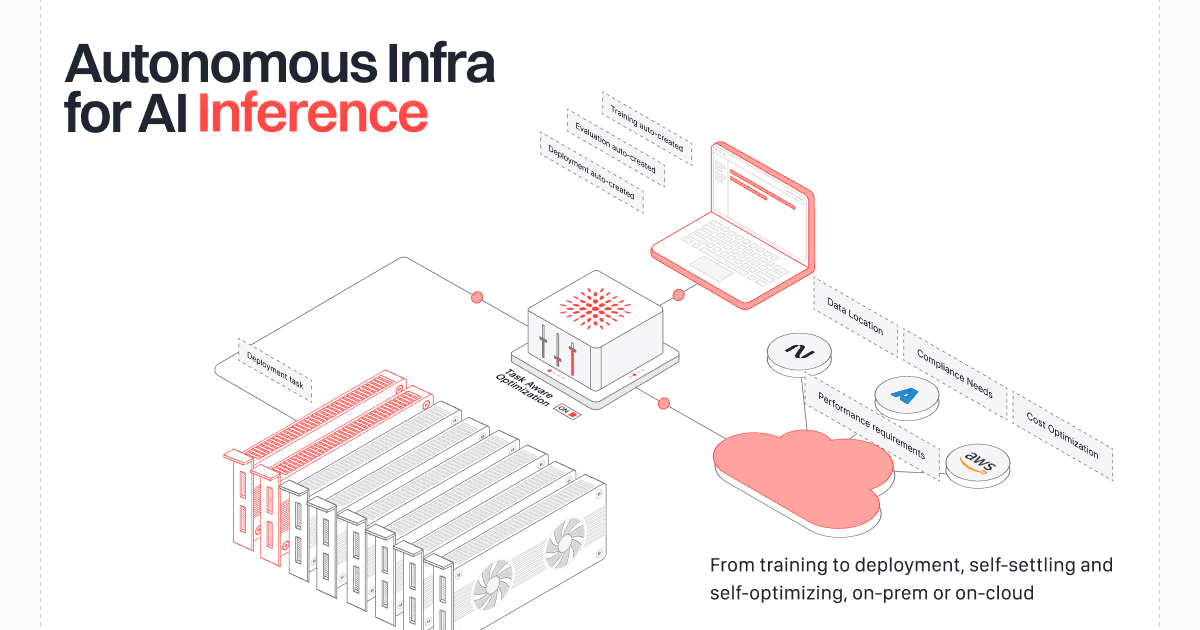
SwarmOne is an autonomous infrastructure platform designed for AI inference, training, and evaluation workloads. It offers a unique scheduler that dynamically disaggregates prefill and decode, orchestrates heterogeneous GPU clusters (NVIDIA, AMD, Intel, Groq, and more), and rebalances in real time to achieve over 90% utilization. The platform features SLO-driven autoscaling, enforcing defined latency, throughput, or cost targets by instantly provisioning GPUs when latency drifts and scaling compute to zero when traffic drops. SwarmOne aims to reduce costs by up to 80% through dynamic disaggregation, multi-node orchestration, and multi-cloud arbitrage, routing to the cheapest capable hardware. It supports a full AI lifecycle from training to deployment with zero DevOps/MLOps required, making it ideal for engineering teams at global enterprises.

HyperbeeAI
HyperbeeAI is building a new foundation for AI inference, designed for speed, efficiency, and scale. The platform delivers optimized engines for a wide range of applications, from low-power IoT devices to massive cloud servers. It aims to solve the challenge of inference that limits AI scale, especially as multimodal applications gain momentum. HyperbeeAI's technology redefines neural computation to achieve unprecedented scalability, resulting in truly multimodal AI engines capable of processing text, images, and video in real time. This enables the next wave of advanced AI applications.
SparkAI
SparkAI offers a unique solution for resolving AI edge cases, false positives, and other exceptions encountered live in production environments. By combining human mission specialists with ML-powered rapid decision tools, SparkAI delivers real-time resolutions directly to AI products via API. This allows companies to launch and scale automation products faster, even with imperfect AI, by ensuring confident decisions in uncertain situations. The platform handles all operational aspects, including hiring, training, and managing the human workforce, and offers infinite scalability to ramp up or down as needed. SparkAI integrates easily via REST API or Python SDK, providing a complete solution for managing edge cases and deriving deeper real-world insights.
VPTQ Demo
VPTQ Demo is a Hugging Face Space application designed for generating text with a highly compressed language model. It serves as a demonstration of Vector Post Training Quantization (VPTQ), a technique aimed at reducing the size of AI models while striving to maintain performance. Users can input text prompts and receive generated responses, exploring how quantization impacts model efficiency. The platform is hosted on Hugging Face, offering various pricing tiers for enhanced features, storage, and compute resources, including options for PRO accounts, team subscriptions, and enterprise solutions. It provides a practical environment for developers and researchers to experiment with compressed language models.

TokenTimer
TokenTimer is designed to help IT, DevOps, and security teams prevent outages caused by expiring credentials. It offers a centralized view of expirations across various platforms, including certificates, API keys, tokens, and licenses. The tool provides proactive alerts via automated reminders, helping users prevent service disruptions. TokenTimer focuses on tracking expiration metadata only, ensuring security and compliance by not accessing sensitive credential content. This makes it a valuable asset for maintaining operational continuity and reducing the risk of unexpected downtime due to expired digital assets.

Supertrace AI
Supertrace AI acts as an on-call AI NOC agent, designed to autonomously triage alerts, diagnose root causes, and resolve network incidents rapidly. It participates in every on-call rotation, investigating alerts in seconds, running just-in-time runbooks, and testing hypotheses for both novel and repeat incidents. The platform then recommends remediations with human-in-the-loop control. Supertrace AI is built for ISPs, MSPs, Enterprises, and Data Centers, helping them to reduce MTTR by 5x, cut NOC hours by 35%, and proactively fix issues. It offers features like correlated event detection, automated traces across various network protocols, and a vendor-agnostic approach, ensuring compatibility across all OEMs and topologies.

PanelRP
PanelRP offers a complete management solution for roleplay servers, supporting popular games such as FiveM, GTA RP, SAMP, Minecraft, and RedM. It provides a multi-tenant panel with custom domain support, enabling server administrators to manage players, staff, and server activities efficiently. Key features include advanced customization options for branding, modular features to activate only necessary modules, and tools for managing in-game data like player lists, jobs, and vehicles. PanelRP also offers specialized dashboards like Police MDT and Hospital MDT, along with public-facing sites for players such as real estate, classifieds, and government portals, making it a robust platform for professional RP server management.
sandbox-sdk
The Cloudflare Sandbox SDK allows developers to build secure, isolated code execution environments directly on Cloudflare's global edge network. It's designed for safely running untrusted code within isolated containers, offering capabilities such as executing commands, managing files, running background processes, and exposing services. This makes it ideal for a variety of applications including AI code execution, interactive development environments, data analysis platforms, and CI/CD systems that require secure code execution at the edge. The SDK supports Python and JavaScript execution with rich outputs, provides file system access, and includes Git integration for cloning repositories.
.png&w=3840&q=75)
Niyoto Technologies
Niyoto Technologies Pvt. Ltd. is a deep tech startup specializing in hardware and software solutions for the defense sector. They leverage a proprietary, state-of-the-art AI platform and custom-built hardware to address diverse problems. A winner of the iDEX Defence India Startup Challenge, Niyoto supports the “Make in India” initiative. Their key products include AI software for tunnel detection, landmine and IED detection with pinpoint accuracy, and buried object/crevasse detection in challenging environments like Himalayan glaciers. The platform features powerful AI, remote operation for operator safety, rapid data acquisition, intuitive UI, autonomous flying capabilities, non-destructive data acquisition, end-to-end encryption, and near real-time analytics. Niyoto also aims to develop dual-use technologies for applications beyond defense, such as utility mapping, underground pipe leakage detection, archaeological site mapping, and disaster relief operations.
sagemaker-training-toolkit
The SageMaker Training Toolkit facilitates the training of machine learning models directly within Docker containers, integrating seamlessly with Amazon SageMaker. This open-source library allows users to define custom training environments and scripts, ensuring consistent runtime and reliable training processes. It supports various configurations, including passing hyperparameters as script arguments and reading additional information via environment variables. Developers can easily install the toolkit into their Dockerfiles, specify entry points, and then use the SageMaker Python SDK to initiate training jobs, either locally or on SageMaker itself. The toolkit provides an `Environment` object to access critical training job details like hyperparameters, system characteristics, and filesystem locations, making it a robust solution for custom ML model development and deployment on AWS.
Megatron Memory Estimator
The Megatron Memory Estimator is a specialized tool designed to assist AI developers in optimizing the deployment and resource allocation for Megatron models. Hosted on Hugging Face, this application provides detailed breakdowns of GPU memory requirements based on user-configured parameters. Users can adjust settings such as the number of GPUs, batch size, and specific model architecture to get an accurate estimation. This functionality is crucial for planning model deployment efficiently and ensuring that adequate hardware resources are available, thereby preventing runtime issues and optimizing performance. The tool aims to simplify the complex process of memory management for large-scale AI models.
Open LLM Leaderboard Results PR Opener
The Open LLM Leaderboard Results PR Opener is a Hugging Face Space designed to automate the process of updating model cards with performance data from the Open LLM Leaderboard. Users provide their model ID or URL, and the tool then integrates the relevant leaderboard results directly into their model card and associated metadata. This functionality is crucial for developers and researchers working with open LLMs, as it simplifies the reporting and transparency of model performance. By automating the creation of pull requests for these updates, the tool helps maintain up-to-date and accurate model documentation on platforms like Hugging Face, contributing to the overall development and evaluation of open-source AI models.
Ubdroid AI
Ubdroid AI is an AI-powered platform designed to centralize, automate, and secure IT infrastructure. It provides comprehensive features for efficient IT management, enabling real-time data analysis and ensuring compliance with industry standards. The tool aims to streamline IT operations and enhance security through advanced automation and centralized control mechanisms. Beyond its core infrastructure management capabilities, Ubdroid AI also offers custom AI development and end-to-end delivery services, catering to specific organizational needs and helping businesses leverage AI for various operational improvements.
model-optimization
The TensorFlow Model Optimization Toolkit is a comprehensive suite of tools designed to optimize machine learning models for efficient deployment and execution. It supports popular frameworks like Keras and TensorFlow, offering techniques such as quantization and pruning for sparse weights. This toolkit is suitable for both novice and advanced users looking to improve model performance and reduce resource consumption. It provides stable Python APIs and extensive documentation, including tutorials and API references, available on the TensorFlow website. The project encourages community contributions and adheres to TensorFlow's code of conduct, with dedicated maintainers for subpackages like clustering, quantization, and sparsity.