
Coding & Development
Browsing page 176 of AI tools for Open Source & Models in Coding & Development. Sorted by confidence score — our independent quality rating.

DataSciencePython
DataSciencePython is a comprehensive GitHub repository designed for individuals interested in data science, natural language processing (NLP), and machine learning. It serves as a central hub for Python-based tutorials, offering a curated collection of resources. The repository organizes content into topic-wise lists, covering various aspects of machine learning and deep learning. Users can find tutorials, code examples, and relevant articles to enhance their understanding and practical skills in these fields.
logto
Logto provides a modern, open-source authentication and authorization infrastructure specifically designed for SaaS and AI applications. It eliminates the complexities of OIDC and OAuth 2.1, enabling developers to easily build secure, production-ready authentication systems. Key features include multi-tenancy, enterprise SSO, and RBAC, all ready to use without workarounds. Logto offers pre-built sign-in flows, customizable UIs, and SDKs for over 30 frameworks, ensuring broad integration capabilities. It fully supports OIDC, OAuth 2.1, and SAML, and works out-of-the-box for Model Context Protocol and agent-based AI architectures. Users can get started quickly with Logto Cloud for a fully managed experience, launch Logto OSS in GitPod, or set it up locally using Docker Compose or Node.js.
DigiHuman
DigiHuman is an open-source project designed for automatic 3D character animation, leveraging pose estimation and landmark generation techniques. It enables the creation of full-body and facial animations on 3D character models based on camera input. Developed with MediaPipe and Unity3D, MediaPipe generates 3D landmarks for the human body and face, while Unity3D renders the final animation after processing these landmarks. The system supports any 3D models with a Humanoid T-Pose rig and can animate multiple blendShapes for detailed facial expressions. Key features include exporting animations as video files, saving animation data for future use, and filtering MediaPipe outputs for smoother results. The project is a B.Sc thesis from Amirkabir University of Technology (AUT).
FL-bench
FL-bench is a comprehensive open-source benchmark dedicated to federated learning, providing a robust platform for researchers and developers to evaluate and compare different federated learning algorithms. It supports a wide array of methods, including traditional approaches like FedAvg, FedProx, and SCAFFOLD, as well as personalized FL methods such as pFedSim and FedPer. The benchmark also includes methods for FL domain generalization and differential privacy. Users can easily prepare environments, run experiments, and monitor results using visdom or tensorboard. FL-bench offers extensive customization options for FL methods, datasets, and models, making it a flexible tool for advancing federated learning research. It also supports parallel training via Ray for improved efficiency.
FxEmbed
FxEmbed is an open-source tool designed to significantly improve how X/Twitter and Bluesky content appears when embedded on other platforms such as Discord and Telegram. It addresses common embedding issues by enabling the display of multiple images, videos, polls, and translations, which are often lost in standard embeds. This tool is particularly useful for content creators and social media managers who want to ensure their social media posts are fully represented and engaging across various communication channels. FxEmbed offers a self-hosting guide and an API reference, providing flexibility for technical users to integrate and customize its functionality.
PokemonRedExperiments
PokemonRedExperiments is an open-source project dedicated to training reinforcement learning (RL) agents to play the classic game Pokemon Red. It offers a platform for researchers and enthusiasts to experiment with different RL algorithms and observe agent behavior within the game environment. The project includes updated and simplified V2 training scripts, which boast faster training times, reduced memory usage, and improved exploration rewards. A unique feature is the ability to stream training sessions to a shared global game map, allowing for collaborative observation and analysis. Users can also track progress locally via TensorBoard or integrate with Weights & Biases. The project provides detailed setup guides for various operating systems, including Windows, Linux, and MacOS, and supports both interactive play with pretrained models and full model training.
rllab
rllab is an open-source framework designed for the development and evaluation of reinforcement learning (RL) algorithms. It offers a comprehensive suite of tools and implementations for a wide range of continuous control tasks, along with several key RL algorithms such as REINFORCE, TRPO, and DDPG. The framework is fully compatible with OpenAI Gym, making it a robust platform for researchers and developers in the RL domain. While rllab itself is no longer under active development, its codebase has been adopted and is actively maintained under the name garage, which offers updated features like TensorFlow support, TensorBoard integration, and new algorithms like PPO.
BforeAI
BforeAI offers a preemptive cyber defense platform called PreCrime, designed to predict and block malicious campaigns before they can launch. The platform utilizes advanced behavioral AI to detect suspicious domain activity and infrastructure up to 18 days ahead of traditional threat intelligence providers, and even up to nine months in advance for some behaviors. PreCrime disrupts and blocks up to 75% of internet traffic related to threats like phishing, spoofing, impersonation, online fraud, and ransomware. It boasts over 98% top-level domain (TLD) coverage with a false positive rate of less than 0.05%. The system is 100% automated, providing 24/7 security checks and a dashboard for performance metrics. BforeAI integrates with existing threat intelligence systems via API and is compatible with EDR software like Microsoft Defender and CrowdStrike Falcon Insight, aiming to reduce dwell time and impact before malicious infrastructure causes harm.
pybullet-gym
pybullet-gym is an open-source project offering implementations of OpenAI Gym MuJoCo environments, specifically designed for use with the OpenAI Gym Reinforcement Learning Research Platform. This tool addresses the commercial barrier of MuJoCo, a physics engine requiring a license, by providing free alternatives built with BulletPhysics' Python wrapper, pybullet. It allows researchers to develop and compare reinforcement learning algorithms without licensing constraints. The repository includes various continuous control environments, such as InvertedPendulum, HalfCheetah, and Humanoid, with some featuring pretrained agents for benchmarking. It supports open research by making these environments accessible and integrates smoothly into the existing OpenAI Gym framework, offering a viable solution for those seeking to avoid commercial software dependencies in their RL studies.
AudioMuse-AI
AudioMuse-AI is an open-source, Dockerized environment designed for automatic playlist generation. It leverages sonic analysis on local audio files, utilizing advanced tools like Librosa and ONNX to understand the characteristics of your music. This allows users to create personalized playlists based on specific moods or occasions, entirely independent of external APIs. The tool supports integration with popular media servers such as Jellyfin, Navidrome, LMS, Lyrion, and Emby, making it a versatile solution for managing and enjoying your local music library with AI-driven curation.
PhotoLog
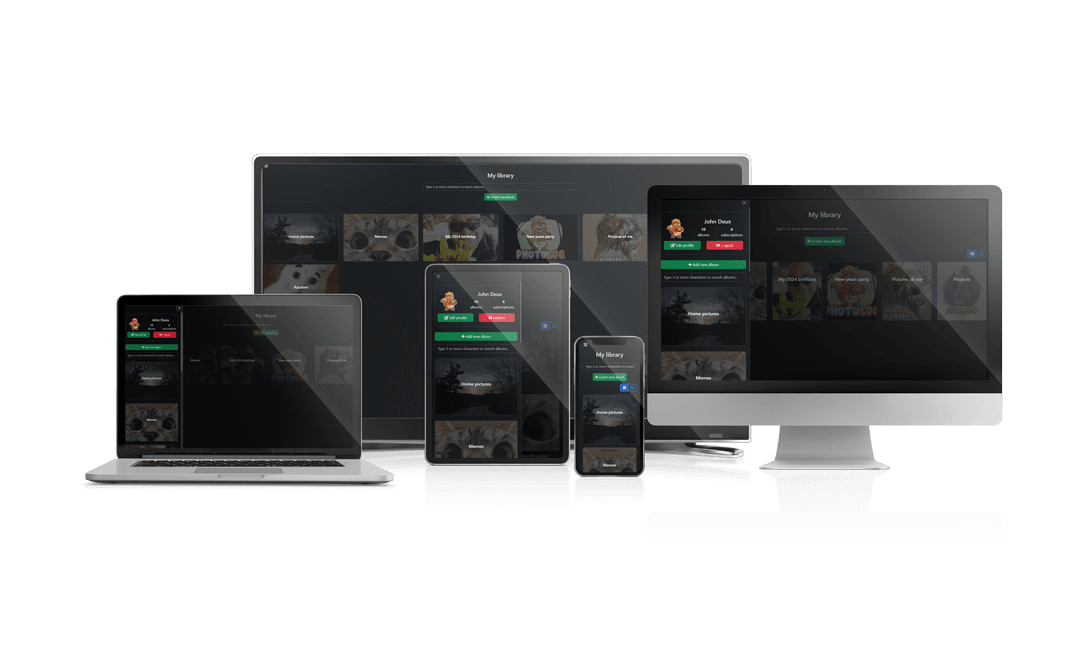
PhotoLog is a privacy-focused media storage solution designed to give users full control over their photos and videos. It features true client-side, end-to-end encryption, ensuring that all media is encrypted on the user's device before being uploaded, with no AI scanning or metadata scraping. Users can upload a wide range of media, including RAW images and 4K videos, without quality loss. The platform also includes a mini-website builder for creating private photo sites, QR code sharing, and collaborative albums. PhotoLog supports both managed cloud storage and the option to 'bring your own storage' using S3-compatible providers, offering flexibility and enhanced privacy. It explicitly states no AI training on user data and provides options for anonymous payment via crypto.
Map Diffusers
Map Diffusers is an AI tool available as a Hugging Face Space, created by sabman. While its intended functionalities are not currently accessible due to a runtime error, it is categorized as an AI application for content generation. The tool is hosted on the Hugging Face platform, suggesting it leverages machine learning models for its operations. Its current state indicates a technical issue preventing users from interacting with its features. The tool's presence on Hugging Face implies a focus on community-driven ML applications and potential for exploring AI capabilities.
async_deep_reinforce
async_deep_reinforce is an open-source implementation of asynchronous methods for deep reinforcement learning, specifically designed to reproduce the findings from Google DeepMind's influential paper, "Asynchronous Methods for Deep Reinforcement Learning." The tool focuses on the Asynchronous Advantage Actor-Critic (A3C) method, applying it to the classic "Atari Pong" game using TensorFlow. It provides implementations for both A3C-FF (Feed-Forward) and A3C-LSTM (Long Short-Term Memory) architectures. The project includes instructions for building a multi-thread ready version of the Arcade Learning Environment and details on how to train and visualize results. Performance benchmarks comparing GPU and CPU speeds for different A3C implementations are also provided, making it a valuable resource for researchers and developers in the field.
BotLibre
BotLibre is an open-source platform designed for building AI-powered chatbots and virtual agents. It offers functionalities for automating interactions across social media and live chat channels. The platform includes various components for web development, making it accessible for integration into existing web applications. At its core, BotLibre features an AI/NLP engine that powers the intelligence of the chatbots. It is particularly suited for developers and researchers who are looking for open-source solutions in the field of artificial intelligence.
lvgl
LVGL is a free and open-source UI library designed to create graphical user interfaces for any MCU, MPU, and display type. It is fully portable, written in C (C++ compatible), and has no external dependencies, making it easy to compile for a wide range of embedded targets. LVGL supports various display technologies like monochrome, ePaper, OLED, and TFT, and requires minimal resources (~100kB RAM, ~200–300kB flash for simple UIs). It includes over 30 built-in widgets, a flexible style system, and layout engines like Flexbox and Grid. The LVGL Pro Editor provides a complete toolkit for building, testing, sharing, and shipping embedded UIs faster, featuring an XML Editor, Online Viewer, CLI Tool, and Figma Plugin.
ClaraVerse
ClaraVerse provides an open-source, privacy-centric ecosystem intended as an alternative to commercial AI platforms such as ChatGPT and Claude. Its core functionality enables users to maintain full control over their large language models (LLMs), API keys, and computational resources. The platform is developed and supported by a community, for the community, and is accessible via desktop, iOS, and Android applications, emphasizing user autonomy and data privacy.
deepface
deepface is a lightweight, open-source Python library designed for advanced face recognition and facial attribute analysis. It integrates and wraps several state-of-the-art models like VGG-Face, FaceNet, and ArcFace, simplifying complex processes into single-line function calls. Users can perform face verification, recognition within a database, and detailed attribute analysis for age, gender, emotion, and race. The library also supports real-time video stream analysis, various face detection backends, and anti-spoofing. It offers flexible database integration options, including postgres, mongo, and vector databases, and can be used via a managed API or as a local Python package.
Reinforce
Reinforce is a comprehensive reinforcement learning algorithm package designed to help beginners understand how classic RL algorithms work in discrete observation spaces. It provides basic classes for modeling agent-environment interactions, including Transition, Episode, Experience, and Agent. The package features implementations of agents using SARSA, Q-learning, and SARSA(λ) algorithms. It also includes function approximators for Deep Reinforcement Learning. Reinforce offers two classic environments, GridWorld and PuckWorld, which are compatible with the Gym library. GridWorld supports various configurations like Windy Grid world and Cliff Walk, while PuckWorld provides a continuous observation state space for training agents with Deep Q-Learning Networks. The package also includes examples for understanding RL algorithms through dynamic programming.
geetRPCS
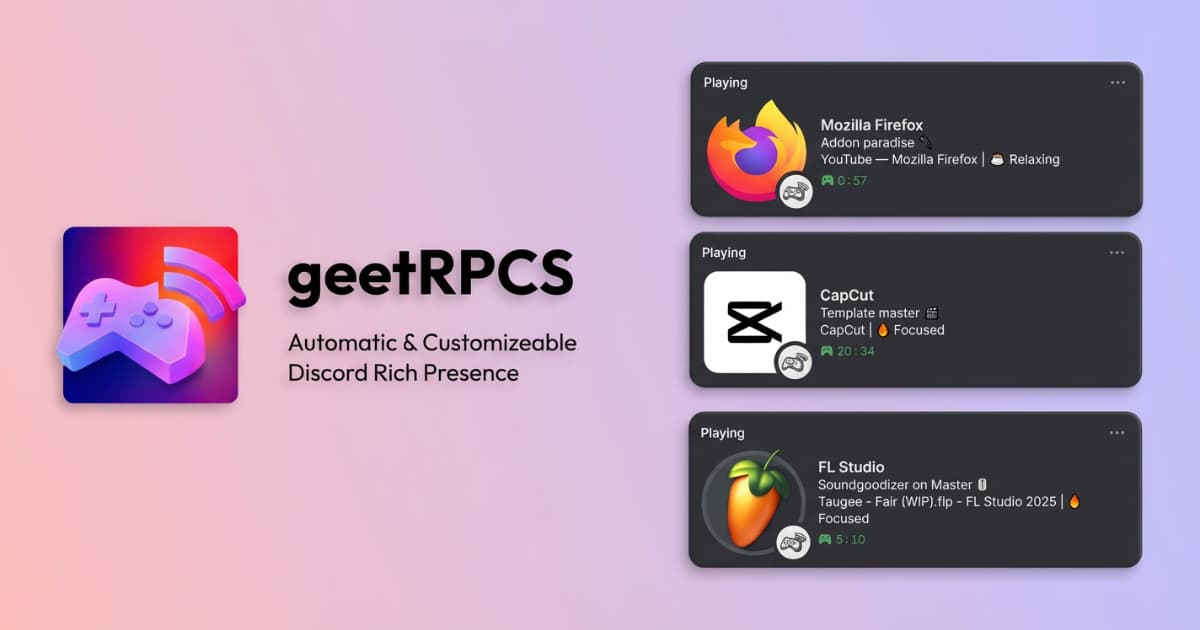
geetRPCS is a lightweight, open-source utility designed to automatically display your activity on Discord in real-time. It supports over 50 applications, including popular ones like FL Studio, DaVinci Resolve, and Chrome, ensuring your Discord status is always up-to-date. The tool boasts a low RAM footprint (5-30MB) and includes features such as silent auto-updates, a shortcut manager, and sticky presence to maintain your status even when switching apps. It also offers witty narratives, mouse energy detection, global hotkeys, and multi-language support across 23+ languages. geetRPCS is optimized for Windows 10 and 11, providing a hassle-free experience for users looking to enhance their Discord presence.
GPTS-Prompt-Collection
GPTS-Prompt-Collection is an open-source GitHub repository dedicated to gathering and organizing prompts for GPTS models. The collection is meticulously categorized into diverse domains such as writing, development, productivity, business, education, finance, health, marketing, sales, games, and design, making it easy for users to find relevant prompts. It features both manually collected prompts and AI-generated selections, including specific prompts for agents, tools, deep thinking, learning assistants, and more. The project is continuously updated, providing a dynamic resource for prompt engineers and AI enthusiasts looking to enhance their GPTS interactions.
ds
ds is an open-source project designed for experimental algorithmic trading using DeepSeek AI models. It enables users to develop and test trading strategies, focusing on the validation of ideas rather than commercial product development. The tool requires configuration with API keys for various exchanges, including Binance and OKX, to facilitate real-world trading simulations. While the core functionality revolves around DeepSeek integration, the project also explores incorporating market sentiment and technical indicators. Users are advised to exercise caution due to the experimental nature of the tool and the inherent risks associated with trading. The project provides setup instructions for Ubuntu servers and utilizes Python with Anaconda for environment management.
torch-rechub
Torch-RecHub is a comprehensive PyTorch framework designed for building and deploying recommendation systems with ease and efficiency. It features a modular design, allowing for easy integration of new models, datasets, and evaluation metrics. Leveraging PyTorch's capabilities, it supports GPU acceleration and Huawei Ascend NPU. The framework boasts a rich library of over 30 classic and cutting-edge recommendation algorithms, including Matching, Ranking, Multi-task, and Generative Recommendation models. It provides standardized pipelines for data loading, training, and evaluation, along with easy configuration via config files or command-line arguments. Reproducibility is a core design principle, and trained models can be exported to ONNX format for seamless production deployment. Additionally, it supports cross-engine data processing with PySpark and offers built-in integration for experiment visualization and tracking with WandB, SwanLab, and TensorBoardX.
tfjs-yolo-tiny
tfjs-yolo-tiny is an open-source tool that facilitates in-browser object detection using Tiny YOLO models, powered by Tensorflow.js. This library allows developers to integrate fast object detection capabilities directly into web applications, eliminating the need for server-side processing for basic object recognition tasks. While it currently focuses on Tiny YOLO models for efficiency, it provides a robust foundation for web-based AI applications. It's particularly useful for scenarios where real-time, client-side object detection is crucial, offering a lightweight solution for developers looking to embed AI vision features without complex backend infrastructure.
android-yolo
android-yolo provides the first implementation of YOLO for TensorFlow on an Android device, enabling real-time object detection. This open-source project is fully compatible with Android Studio and can be used out of the box. It is capable of detecting 20 classes of objects from the Pascal VOC dataset, including common items like cars, people, and animals. Developers can easily clone the repository, download the TensorFlow YOLO model, and run the project on their Android devices. While GPUs are not currently supported on Android, it achieves around two frames per second on decent devices. The project also offers a standalone APK for direct installation.