
Coding & Development
Browsing page 155 of AI tools for Coding & Development. Sorted by confidence score — our independent quality rating.
Line0
Line0 is an AI pair programmer designed specifically for backend developers, focusing on building Express.js backend services. It allows users to generate production-ready backend services rapidly by describing desired functionality in natural language. The tool features a unique "Tab to prompt" system for autocompletion and an "Enhance" function for more detailed instructions. Developers can edit their full project code directly within Line0's editor and organize features into separate chats for better AI results. It offers 2-way synchronization with GitHub, ensuring code is automatically synced to repositories and changes are pulled after each commit. Line0 also includes a built-in API client for testing newly generated APIs directly in the browser with hot-reloads and live database previews, eliminating the need for external tools like Postman.
Muon
Muon is an open-source optimizer specifically engineered for the hidden layers of neural networks. It aims to enhance the training process by optimizing these hidden weights, while other parameters like embeddings and classifier heads are handled by standard optimizers such as AdamW. The tool is based on research described in a dedicated thread and writeup, offering a specialized approach to neural network optimization. Muon has demonstrated notable accomplishments, including lowering the record for CIFAR-10 training, achieving GPT-2 (XL) performance with reduced compute costs, and improving training speed for GPT-2 (small) performance by a factor of 1.35x. It has been utilized by frontier labs like Kimi.ai for scaled LLM training and is particularly effective for training with large batch sizes.
nlp-with-ruby
nlp-with-ruby is a comprehensive, curated list of resources dedicated to practical natural language processing (NLP) using the Ruby programming language. This repository serves as a valuable hub for developers and researchers interested in computational linguistics, human language technology, and related fields such as Artificial Intelligence, Machine Learning, Information Retrieval, and Text Mining. It categorizes resources into various NLP pipeline subtasks, including language identification, segmentation, lexical processing (stemming, lemmatization), syntactic processing, semantic analysis, and high-level tasks like sentiment analysis and named entity recognition. The list also covers machine learning libraries, data visualization tools, OCR, text extraction, and language-aware string manipulation, making it an essential reference for anyone working with text data in Ruby.
Pulse Editor: Vibe Code & Automate
Palmos, also known as Pulse Editor, is an AI agent runtime designed to empower small to medium-sized businesses (SMBs) and solopreneurs. It transforms simple conversations into powerful, visual business automations, effectively replacing repetitive tasks with AI-powered workflows. Key functionalities include lead generation, efficient email handling, and content creation. The platform aims to help users build, ship, and evolve their AI agents, providing a comprehensive solution for automating various business processes. It focuses on making advanced AI capabilities accessible to users without extensive technical knowledge, enabling them to streamline operations and enhance productivity.
Accurate GGUF VRAM Calculator
Accurate GGUF VRAM Calculator is a specialized tool designed for AI developers and machine learning engineers working with GGUF models. It allows users to input a GGUF model URL, specify the number of GPU layers, context length, and cache type. The tool then downloads a small portion of the model file to read its metadata, providing an accurate estimation of the VRAM requirements. This functionality is crucial for optimizing resource allocation and ensuring efficient deployment of large language models, helping users make informed decisions about their hardware and configuration settings.
RytersBlock
RytersBlock is an AI-powered writing assistant designed to enhance creativity and streamline content creation. Utilizing GPT-3 and OpenAI's powerful API, the tool assists users in various writing tasks, from brainstorming initial ideas to crafting polished copy using different frameworks and techniques. Beyond text generation, RytersBlock can also generate syntax and formulas, and even create AI images, making it a versatile tool for content creators. Users can select content types, choose prompt styles, add descriptions, set tones, and include keywords to guide the AI's output. A free tier is available, offering 25 credits to explore its capabilities, with full features unlocked upon registration.
AtlasChat
AtlasChat is a conversational AI application designed for interactive chat experiences. Users can type messages and receive responses from an AI assistant, with the system leveraging chat history to maintain context throughout the conversation. This tool is built for efficient inference, utilizing the llama-cpp-python library. While AtlasChat-mini is a smaller version, a more powerful 9B version is also available on Hugging Face, offering enhanced capabilities for various tasks such as answering questions and generating content. It provides a straightforward platform for engaging with AI in a conversational format.
Blue Pencil Xl Free Demo
Blue Pencil Xl Free Demo is a Hugging Face Space that allows users to create images from text descriptions using the BluePencil XL model. This free demo provides options to customize the generated image by adjusting parameters such as size, style, and seed. Users can also provide an optional negative prompt to guide the image generation process away from undesired elements. A key feature is the ability to upscale the generated image for higher resolution, making it suitable for various applications. The tool is designed for ease of use, enabling quick experimentation with AI-powered image creation.
Bloom Demo
Bloom Demo is an AI chatbot demo available on Hugging Face, designed to showcase the capabilities of the Bloom language model. It provides a platform for users to interact directly with the Bloom model, allowing them to test its performance and explore its conversational AI features. While the current live website indicates a runtime error, suggesting the demo may be temporarily unavailable, its purpose is to offer a hands-on experience with a large language model. This tool is intended for those interested in understanding and experimenting with advanced AI language generation.
Visual Code AI: Copilot Studio
Visual Code AI: Copilot Studio is a comprehensive mobile code editor and AI development studio designed for Android devices. It integrates powerful AI assistance from Claude AI (Opus, Sonnet, Haiku) and Google Gemini models, offering intelligent code generation, debugging, and refactoring capabilities similar to GitHub Copilot. The app features a professional-grade code editor inspired by Visual Studio Code, complete with syntax highlighting, multi-tab editing, and a file explorer. Developers can manage projects, utilize integrated Git features for source control and GitHub integration, and use slash commands for efficient AI interaction. It supports a wide array of programming languages and includes a live preview for web projects, making it ideal for coding on the go.
ChatGLM2-VC-SadTalker
ChatGLM2-VC-SadTalker is an AI chatbot that combines voice cloning capabilities, making it suitable for both research purposes and general conversational interactions. The tool is built on Gradio, an open-source Python library for creating customizable UI components for machine learning models. It is licensed under MIT, indicating its open-source nature and accessibility for developers and researchers. While the current live website shows a runtime error, the underlying intention is to provide a platform for experimenting with advanced AI conversational agents that can also mimic voices.
CFG Zero Star
CFG Zero Star is a demonstration tool for the CFG-Zero* AI model, built as a Hugging Face Space. It enables users to generate both images and videos by simply providing a text prompt. The application provides flexibility through different model choices and allows for fine-tuning of output by adjusting parameters such as guidance scale and inference steps. This makes it a versatile platform for exploring the capabilities of the CFG-Zero* model and experimenting with AI-driven content creation. The tool is licensed under the Apache-2.0 license, promoting open access and collaboration within the AI community.
Idefics3
Idefics3 is an AI chatbot tool hosted on Hugging Face Spaces, designed for research and development in natural language processing and machine learning. Users can upload an image and provide a text prompt or question, and the application will generate a response that integrates both visual and textual information. This tool is particularly useful for experimenting with multimodal AI models that can understand and generate content based on diverse inputs. While currently paused, it offers a glimpse into advanced conversational AI capabilities.
I2VGen-XL
I2VGen-XL is an AI-powered tool designed for generating videos directly from image inputs. Hosted on Hugging Face Spaces, it offers a platform for users to experiment with video creation using artificial intelligence. The tool is currently experiencing runtime errors, indicating it may be under development or facing technical issues. Despite this, its core functionality aims to provide a solution for transforming static images into dynamic video content. It is particularly well-suited for individuals involved in research and development, allowing them to explore the capabilities of AI in video generation without significant cost barriers.
Cradl Ai
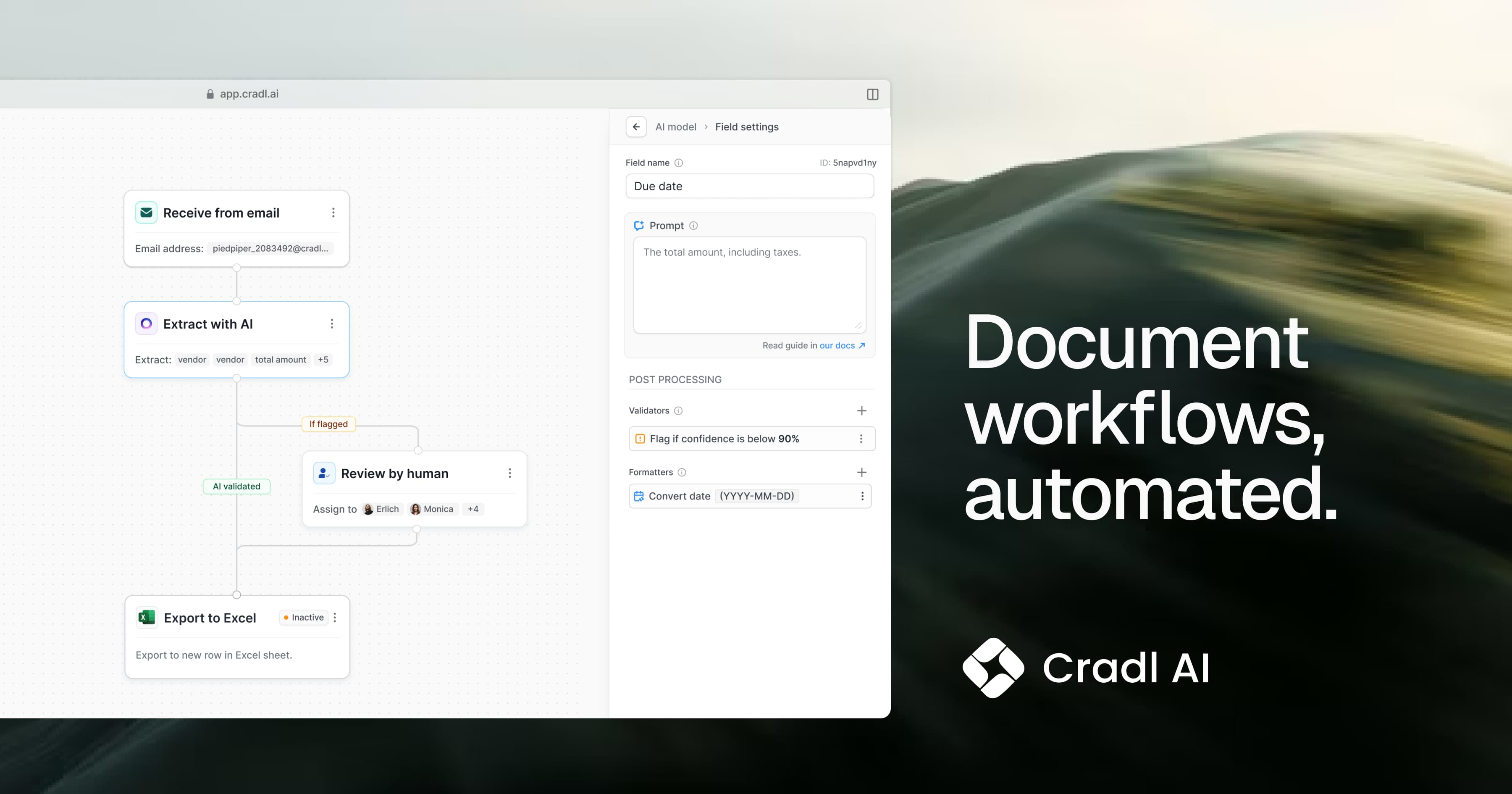
Cradl AI automates document workflows using AI agents, enabling businesses to turn unstructured document files into verified, structured data at scale. It offers a comprehensive platform for data extraction, validation with human-in-the-loop capabilities, and export to various workflows. Key features include fully customizable AI agents, anti-hallucination guardrails, and self-learning RAG technology that improves accuracy over time. The platform integrates seamlessly with automation tools like n8n, Power Automate, and Zapier, and provides an agent builder for visual automation logic design without coding. Cradl AI is built for production-ready document automation, offering enterprise-grade security, compliance, and role-based access controls.
ReviewForge
ReviewForge is an intelligent code review platform designed to automate and enhance the code review process using AI-powered insights. It aims to significantly improve code quality and save valuable developer time by automatically identifying potential issues and suggesting improvements. The platform streamlines the development workflow, allowing teams to deliver higher quality code more efficiently. By leveraging artificial intelligence, ReviewForge provides a robust solution for maintaining code standards, catching bugs early, and fostering a more productive development environment. It's built to integrate seamlessly into existing development pipelines, offering a smart way to ensure code integrity and accelerate project delivery.
opencommit
OpenCommit is a powerful AI tool designed to automate the generation of meaningful Git commit messages. It acts as a GPT wrapper for Git, supporting a wide range of LLM providers such as Claude, GPT, and local Ollama models. The tool aims to eliminate 'lame commits' by providing relevant and descriptive messages in seconds, significantly streamlining the development workflow. Users can install it as a CLI tool, configure API keys for their chosen LLM provider, and customize settings like emoji usage, model selection, and language. OpenCommit also offers advanced features like integration with @commitlint for adherence to specific commit message conventions and the ability to run locally with Ollama for enhanced privacy and control.
oh-my-opencode
oh-my-opencode, now known as oh-my-openagent, is an open-source agent harness designed to streamline and automate software development workflows. It orchestrates various AI models like Claude, GPT, Kimi, and Gemini, leveraging their specific strengths for tasks such as orchestration, reasoning, speed, and creativity. The tool introduces a powerful 'ultrawork' command that activates a full team of AI agents, ensuring tasks are completed without manual intervention. Key features include Discipline Agents (Sisyphus, Hephaestus, Prometheus) for planning and execution, IntentGate for accurate user intent analysis, Hash-Anchored Edit Tools for reliable code changes, and integrated LSP, AST-Grep, and Tmux for an IDE-like precision. It also offers built-in MCPs (web search, docs, GitHub search) and skill-embedded MCPs to optimize context usage, making it a comprehensive solution for advanced AI-driven development.
Doc Mcp
Doc Mcp is a specialized tool designed to facilitate Retrieval-Augmented Generation (RAG) on documentation hosted in GitHub repositories. Users can provide a GitHub URL, select specific markdown files, and the tool will generate vector embeddings from these files. This process effectively transforms the documentation into an accessible MCP (Model Context Protocol) server, making it queryable by AI agents. It's particularly useful for developers and teams who need to integrate their project documentation directly into AI workflows, allowing agents to intelligently retrieve and utilize information from their codebase's documentation.
ItaEval Leaderboard
The ItaEval Leaderboard is a specialized AI evaluation tool designed to assess and compare the performance of large language models (LLMs) specifically for Italian Natural Language Processing (NLP) tasks. Users can navigate the leaderboard to browse and filter benchmark results based on various criteria such as model type, size, and precision. This provides a clear and structured view of how different models perform, aiding researchers, developers, and practitioners in selecting the most suitable LLMs for their Italian language applications. While the current live website shows a runtime error, the intended functionality is to offer comprehensive performance data for Italian NLP models.
oracle
Oracle is an open-source AI code assistant designed to help developers when they are stuck, need code reviews, or are debugging. It intelligently bundles user prompts with relevant files, enabling AI models like GPT-5.4 Pro, Gemini 3 Pro, and Claude Sonnet 4.5 to provide highly contextual answers. The tool supports querying one or multiple models in a single run, offering flexibility for different tasks. It can operate via API keys or through an experimental browser mode that automates interactions with platforms like ChatGPT, even without API keys. Oracle also provides features for session management, follow-up runs, and detailed reports on file token usage, making it a comprehensive solution for AI-assisted development.

brainboard.co
Brainboard is an AI-driven platform designed to simplify cloud infrastructure management by allowing users to visually design, generate Terraform and OpenTofu code, and manage cloud infrastructure collaboratively. It supports multi-cloud environments including AWS, Azure, GCP, OCI, and Scaleway, providing a unified workspace. Key features include a smart cloud designer, GitOps workflow integration, drift detection and remediation, and AI-powered infrastructure generation. The platform helps standardize IaC, build self-serve models, and lower the learning curve for cloud operations. It also incorporates security and cost controls from the design stage, with integrations for tools like Infracost, Checkov, and Tfsec. Brainboard aims to eliminate the gap between designed, deployed, and production architectures, offering a robust solution for teams serious about infrastructure.
Mindmess
Mindmess is a collaborative note-taking tool that integrates with ChatGPT, designed to simplify the process of working with AI models. Users can set API keys directly for their current documents, enabling seamless interaction with services like GPT-4. The platform provides an intuitive interface for managing notes and includes specific commands, such as 'Run Merge Using GPT-4 8k', to facilitate advanced operations. This tool is particularly useful for developers and technical users who need to quickly prototype, test, or integrate AI capabilities into their documentation or projects without complex setups. Its focus on document-specific API key management streamlines workflows for AI-powered collaboration.
Manifold AI Learning
Manifold AI Learning provides comprehensive online programs designed to equip engineers with advanced AI skills. The platform focuses on Agentic AI, MLOps, and preparation for NVIDIA AI certifications. Courses are structured with practical projects, a supportive community, and mentorship from industry experts like Nachiketh Murthy. Offerings range from career accelerators for specific goals like interview prep or building production RAG systems, to a deep-dive Agentic AI Bootcamp for architecting and deploying multi-agent systems at scale. All courses include lifetime access and a 7-day money-back guarantee, catering to working software engineers with basic AI/ML familiarity.