
Coding & Development
Browsing page 267 of AI tools for Coding & Development. Sorted by confidence score — our independent quality rating.

subgen
Subgen is an open-source tool designed to automatically generate subtitles (.srt or .lrc) for audio and video files using the OpenAI Whisper model. It supports both transcription of non-English languages and translation into English. The tool seamlessly integrates with various media servers, including Plex, Emby, Jellyfin, Tautulli, and Bazarr, allowing for webhook-triggered subtitle generation when new media is added or played. Utilizing stable-ts and faster-whisper, Subgen supports both CPU and Nvidia GPU (CUDA) processing, offering flexibility for different hardware setups. It addresses the common issue of missing or out-of-sync subtitles, providing a local solution for highly accurate subtitle creation.
ruby-fann
ruby-fann is a Ruby Gem designed to interface with the FANN (Fast Artificial Neural Network) library, allowing Ruby and Rails developers to integrate neural network capabilities into their applications. This open-source library supports the implementation of both fully-connected and sparsely-connected artificial neural networks. It is lauded for its ease of use, versatility, and speed, with most of the heavy lifting performed natively. The gem provides functionalities for training neural networks with custom data, saving and loading trained networks, and implementing custom training procedures via callback methods, making it a robust solution for AI application development in Ruby environments.
SparkNet
SparkNet is an open-source framework designed for building and training distributed neural networks using Apache Spark. It allows users to leverage the power of Spark for scalable AI model development, particularly beneficial for handling large datasets. The framework provides functionalities for quick cluster setup on EC2, training models like Cifar and ImageNet, and installing SparkNet on existing Spark clusters. It supports GPU acceleration with CUDA and offers pre-built JavaCPP binaries for various platforms, making it a robust solution for data scientists and machine learning engineers working with distributed computing environments.
Show-1
Show-1 is an advanced open-source text-to-video generation model developed by Show Lab at the National University of Singapore. It uniquely combines pixel and latent diffusion models to create videos from textual descriptions. The tool provides access to various model weights, including a base model, an interpolation model, and super-resolution models, which can be downloaded from HuggingFace. Users can generate videos by running a Python script, with outputs saved in GIF format. Show-1 also offers a Gradio demo for local use and has been accepted to IJCV, highlighting its academic recognition. It is designed for researchers and developers interested in cutting-edge video synthesis.
sdupdates
sdupdates is a mega collection of resources and news specifically curated for Stable Diffusion enthusiasts, with a strong focus on AUTOMATIC1111's webui. This GitHub repository serves as a central hub for staying updated on the latest developments, models, and techniques within the Stable Diffusion ecosystem. It includes links to various resources such as new models like Stable Diffusion v2-1-unCLIP and Kandinsky 2.1, ControlNet updates, and text-to-video advancements. The repository also provides practical instructions for updating the webui on both Windows and Linux, and offers contact information for contributions or questions. It's an invaluable resource for anyone looking to deepen their understanding and practical application of Stable Diffusion.
Static-to-Dynamic-LLMEval
Static-to-Dynamic-LLMEval is the official GitHub repository for a paper detailing recent advances in large language model benchmarks, specifically focusing on data contamination. The project conducts an in-depth analysis of existing static-to-dynamic benchmarking methods designed to reduce data contamination risks. It examines methods that enhance static benchmarks, identifies their limitations, and highlights the critical gap in standardized criteria for evaluating dynamic benchmarks. The repository proposes optimal design principles for dynamic benchmarking and analyzes the limitations of current dynamic benchmarks, offering a comprehensive overview of advancements in data contamination research and guiding future efforts.
system-prompts-and-models-of-ai-tools
system-prompts-and-models-of-ai-tools is a comprehensive open-source GitHub repository that curates system prompts, internal tools, and AI models from a wide array of AI applications. This resource is invaluable for developers, researchers, and AI enthusiasts looking to understand the underlying mechanics and prompt engineering strategies of popular tools like Augment Code, Claude Code, Cursor, Devin AI, NotionAI, Perplexity, and many others. It provides a centralized location to explore how different AI systems are structured and prompted, fostering learning and innovation in the AI development community. The repository also highlights the importance of securing AI systems against prompt injection and extraction risks.
tabm
TabM is an official open-source repository for the paper "TabM: Advancing Tabular Deep Learning With Parameter-Efficient Ensembling" (ICLR 2025). It offers a PyTorch-based Python package for implementing the TabM model, along with layers and tools for constructing custom architectures that efficiently ensemble MLP-like models. The tool is designed to improve performance on challenging tabular benchmarks like TabReD and has been successfully applied in Kaggle competitions. TabM is noted for its efficiency, being faster than prior tabular deep learning methods and capable of handling large datasets up to 100M+ objects. It allows for parallel training and weight sharing among MLPs, leading to better runtime, memory efficiency, and task performance.
stanford_dl_ex
stanford_dl_ex is a repository offering programming exercises for the Stanford Unsupervised Feature Learning and Deep Learning Tutorial. It provides starter code designed to help users engage with and practice the concepts taught in the official Stanford tutorial, available at ufldl.stanford.edu/tutorial. This resource is particularly useful for individuals looking to deepen their understanding and practical application of deep learning principles through hands-on coding. The repository includes various modules covering different aspects of deep learning, such as convolutional neural networks (CNN), principal component analysis (PCA), and sparse autoencoders (STL). It serves as a valuable, free educational tool for students and researchers alike.
trainer
Kubeflow Trainer is a Kubernetes-native distributed AI platform designed for scalable large language model (LLM) fine-tuning and training of AI models. It supports various frameworks such as PyTorch, MLX, HuggingFace, DeepSpeed, JAX, and XGBoost. The platform integrates MPI into Kubernetes, facilitating efficient multi-node, multi-GPU distributed jobs across high-performance computing (HPC) clusters. This setup ensures high-throughput communication crucial for large-scale AI training requiring rapid synchronization between GPU nodes. Kubeflow Trainer also integrates with the Cloud Native AI ecosystem, including Kueue for topology-aware scheduling and multi-cluster job dispatching, and JobSet/LeaderWorkerSet for AI workload orchestration. It features a distributed data cache for zero-copy transfer of large-scale data directly to GPU nodes, optimizing memory efficiency and GPU utilization. AI practitioners can leverage the Kubeflow Python SDK to develop and fine-tune LLMs using the Trainer APIs: TrainJob and Runtimes.
TransformerEngine
Transformer Engine (TE) is an open-source library developed by NVIDIA for significantly accelerating Transformer models on NVIDIA GPUs. It achieves this by leveraging 8-bit and 4-bit floating point (FP8 and FP4) precision on Hopper, Ada, and Blackwell GPUs, including MXFP8 and NVFP4 formats on Blackwell. This results in improved performance and reduced memory utilization during both training and inference processes. TE provides highly optimized building blocks for popular Transformer architectures and an automatic mixed precision-like API that integrates seamlessly with existing framework-specific code. It also offers a framework-agnostic C++ API for broader integration, simplifying mixed-precision training for users by internally managing scaling factors.
treequest
TreeQuest is an open-source Python library designed for advanced tree search algorithms, particularly useful for scaling Large Language Model (LLM) inference. It offers a flexible API that allows for customizable node generation and scoring logic, making it adaptable to various applications. The library implements AB-MCTS-A (ABMCTS with Node Aggregation) and AB-MCTS-M (ABMCTS with Mixed Models) algorithms, as well as Multi-LLM AB-MCTS support. Key features include checkpointing and resuming searches, an ask-tell interface for batched sampling, and visualization utilities to render search trees. TreeQuest is ideal for developers and researchers working on optimizing LLM performance and exploring complex decision-making processes.
Trending-Deep-Learning
Trending-Deep-Learning is a GitHub repository that provides a curated list of the top 100 trending deep learning projects. This resource is updated regularly and sorts repositories based on the number of stars they gained on a specific day. It leverages the GitHub search API with a comprehensive query including terms like 'deep-learning', 'CNN', 'RNN', 'convolutional neural network', and 'recurrent neural network'. Repositories with 40,000 stars or more are excluded to focus on emerging trends. This tool is ideal for researchers, developers, and students looking to stay updated on the latest advancements and popular projects within the deep learning community, offering a quick overview of what's gaining traction.
Urban-Sound-Classification
Urban-Sound-Classification is an open-source deep learning project designed for the classification of urban sounds. It offers a comprehensive set of Jupyter notebooks demonstrating various neural network architectures, including feedforward, convolutional, and recurrent neural networks. The project is built using Python 3.5 (or above) and leverages popular libraries such as Tensorflow 2.x, Numpy, Matplotlib, and Librosa. It primarily uses the UrbanSound8k dataset for model training, with Google's AudioSet suggested as an alternative. This tool is ideal for researchers, students, and developers interested in deep learning applications for audio analysis and sound classification, providing a practical foundation for understanding and implementing these techniques.
Top-Deep-Learning
Top-Deep-Learning is an open-source project that compiles and ranks the top 200 deep learning GitHub repositories. The list is meticulously sorted by the number of stars each repository has received, offering a clear indicator of popularity and community engagement. This resource is invaluable for anyone looking to explore the most influential and actively developed projects within the deep learning domain. It is regularly updated to ensure the information remains current, reflecting the dynamic nature of deep learning research and development. The project's methodology involves querying the GitHub search API using terms like 'deep-learning', 'CNN', 'RNN', 'convolutional neural network', and 'recurrent neural network' to gather comprehensive results.
TensorKart
TensorKart is an open-source project that demonstrates self-driving capabilities within the classic game MarioKart 64, powered by Google's TensorFlow framework. Users can train a deep learning model by recording their own gameplay, which then learns to control the in-game kart. The model can generalize to new tracks even with a relatively small training dataset, as shown by its ability to drive on Royal Raceway after training on other tracks. The project provides scripts for recording gameplay samples, preparing training data, training the model with GPU acceleration (using cuDNN), and playing the game with the trained AI agent. It also includes features for overriding AI control with a joystick and outlines future work like reinforcement learning integration to improve performance based on lap times.
Qwen Edit Any Pose
Qwen Edit Any Pose is a specialized image generation tool hosted on Hugging Face Spaces, designed to modify the pose of a person in an image. Users can upload a reference picture of a person and a second image demonstrating the desired pose. The application then processes these inputs, optionally rewriting the prompt, and employs a fast diffusion model to create a new image where the subject from the first image adopts the pose from the second. This tool leverages the Qwen Edit 2511 Any Pose LoRA, making it efficient for generating new images with specific pose requirements. It's a practical solution for those needing to quickly adjust human poses in visual content.
text-generation-webui-colab
text-generation-webui-colab offers a convenient Gradio web user interface for deploying and interacting with Large Language Models (LLMs) directly within a Google Colab environment. This open-source project supports a wide range of LLMs, including popular models like Llama 2, Vicuna, Falcon, and Mistral, often with GPTQ 4-bit quantization for efficient use. It's particularly useful for researchers, developers, and enthusiasts who want to experiment with different LLMs without extensive local setup. The repository provides numerous Colab notebooks pre-configured for specific models, simplifying the process of getting started with text generation, instruction following, and other LLM-based tasks.
Aristiun
Aristiun is a unified AI security and compliance platform designed to help organizations build secure and certifiable systems. It features a Security Workbench that leverages AI for automated threat modeling, modern GRC (Governance, Risk, and Compliance), and comprehensive AI governance. The platform supports over 340 compliance frameworks, including SOC 2, ISO 27001, HIPAA, GDPR, DORA, EU AI Act, ISO 42001, and NIST AI RMF. Key capabilities include AI-powered threat identification, classification, and prioritization, real-time compliance scoring, automated evidence collection, and cross-framework control mapping. Aristiun aims to replace legacy spreadsheet-based compliance with an automated, continuous monitoring approach, ensuring AI systems comply with global regulations.
TimeSeries_Seq2Seq
TimeSeries_Seq2Seq is a GitHub repository offering a valuable collection of notebooks and code designed to facilitate the understanding and implementation of sequence-to-sequence (seq2seq) neural networks specifically for time series forecasting. The networks within this repository are built using popular deep learning frameworks, Keras and TensorFlow. It serves as a practical resource for data scientists and researchers looking to apply advanced neural network architectures to predict future values based on historical time-dependent data. The repository includes instructions for setting up the environment and working with the provided notebooks, making it accessible for those interested in hands-on learning and application of seq2seq models in time series analysis.
XZVoice
XZVoice is a free and open-source text-to-speech software designed for converting written text into spoken audio. It leverages the Aliyun speech synthesis engine to generate voices, providing a robust solution for various applications. The software is developed using modern web technologies including Electron, Vue, and ElementUI, making it a flexible and customizable tool. Users can integrate their own Aliyun AccessKeyId, AccessKeySecret, and appkey for personalized usage. Additionally, it supports the integration of online background music by allowing users to upload music packages to cloud storage like Qiniu Cloud. This makes XZVoice suitable for developers and content creators looking for a self-hosted and adaptable text-to-speech solution.
x-cmd
x-cmd is a comprehensive toolkit designed to empower AI agents and streamline command-line operations across various POSIX shells like bash, zsh, and ash. It features a Shell Standard Library with over 300 modules written in shell/awk, bringing modern capabilities to even minimal environments like BusyBox or Alpine. Beyond its core modules, x-cmd includes an On-Demand Package System, `pkg`, which provides access to over 600 curated modern CLI tools such as `jq`, `fzf`, and `ripgrep`, ensuring environment compatibility and minimizing dependencies. The tool is optimized for AI agents, allowing access to major AI providers like OpenAI, Gemini, and DeepSeek directly from the shell with a pure-shell agent under 2MB. Its design prioritizes flexibility, native system integration, and tool-chaining, making it ideal for scenarios where network latency and LLM throughput are critical.
xuance
XuanCe (玄策) is an open-source, comprehensive, and unified deep reinforcement learning (DRL) library designed to provide high-quality and easy-to-understand implementations of DRL algorithms. It aims to address the sensitivity of DRL algorithms to hyper-parameter tuning and unstable training processes by offering a robust and flexible framework. XuanCe is highly modularized, easy to install and use, and supports flexible model combinations. It includes abundant algorithms for various tasks, supporting both DRL and Multi-Agent Reinforcement Learning (MARL) tasks. The library boasts high compatibility across different deep learning backends (PyTorch, TensorFlow2, MindSpore), operating systems (Linux, Windows, MacOS), and hardware (CPU, GPU). Key features include fast running speed with parallel environments, distributed training with multi-GPUs, automatic hyperparameter tuning, and good visualization effects with TensorBoard or Weights & Biases.
Foxy Apps
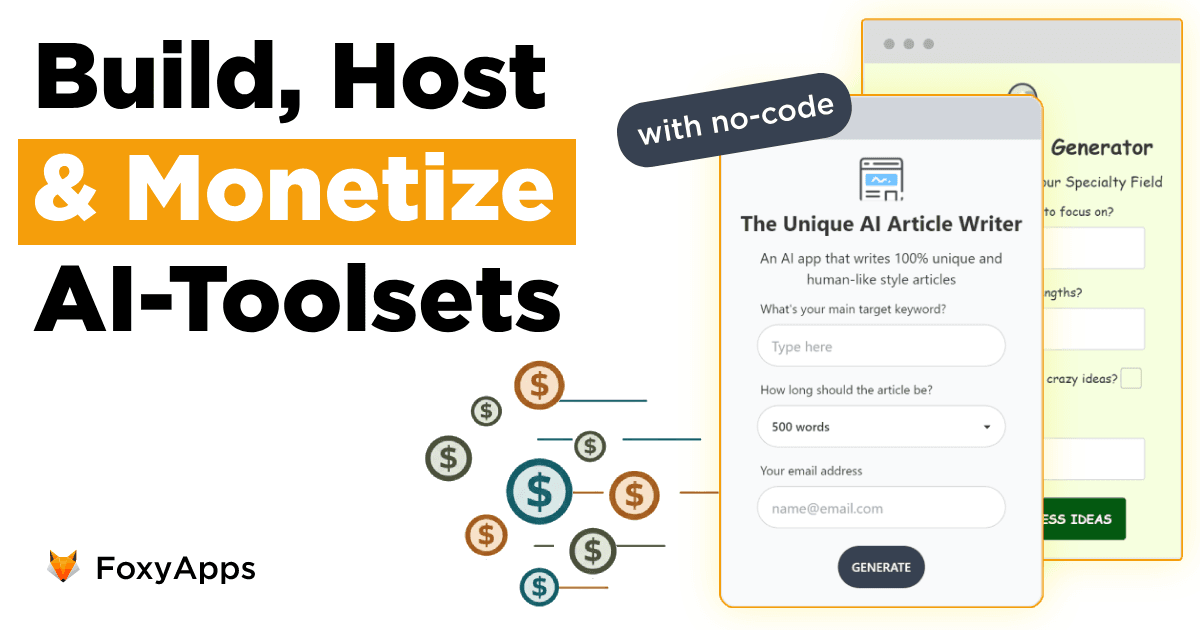
Foxy Apps provides a no-code platform for building, hosting, and monetizing AI toolsets. Users can create custom AI tools targeting niche audiences, choosing from various AI models and chaining multiple prompts. The platform offers a full white-label solution, allowing users to host their AI portals on custom domains with personalized branding. Monetization options include one-time payments, subscriptions, and credit-based systems, with Foxy Apps taking zero commission. It features over 200 templates, the ability to train AI on custom data from sources like Google Drive and Notion, and integrations for email automation and webhooks. Foxy Apps is designed for non-developers to launch micro SaaS businesses quickly.