
Coding & Development
Browsing page 378 of AI tools for Coding & Development. Sorted by confidence score — our independent quality rating.

Shap-E
Shap-E is an AI-powered tool that simplifies the creation of 3D models. It allows users to generate 3D shapes by providing either a short text description or by uploading an image. The application then builds a matching 3D model, which can be explored directly within the interface. This capability makes 3D content creation more accessible, removing the need for complex 3D modeling software. Once generated, models can be downloaded for use in other applications or projects, streamlining workflows for various creative and design tasks. Shap-E is available as a Hugging Face Space, offering an easy-to-use platform for experimentation and practical application.
SORA 3D
SORA 3D is an AI-powered tool designed for generating high-quality 3D models. Users can create detailed .GLB format models by providing either text descriptions or image inputs. This capability makes it a versatile solution for various creative and design workflows, allowing for rapid prototyping and asset creation. The tool is hosted on Hugging Face, indicating its accessibility within the AI community. While the current status shows the Space as paused, its core functionality aims to streamline the 3D modeling process, making advanced 3D creation more accessible to a broader audience, including those without extensive 3D design experience.
Sound AI SFX
Sound AI SFX is a text-to-audio AI tool hosted on Hugging Face that allows users to generate sound effects from simple text descriptions. This application transforms typed words into high-quality sound clips, providing a quick and efficient way to create audio assets. Users can optionally set the desired length of the sound clip and adjust how closely the generated audio follows the provided text prompt, offering a degree of customization. It is designed for ease of use, making it accessible for individuals who need to quickly produce specific sound effects without extensive audio production knowledge. The tool is available for free, making it an attractive option for content creators and developers looking for accessible sound generation.
SOVITS Voice Conversion | Overwatch 2
SOVITS Voice Conversion | Overwatch 2 is an AI-powered tool designed for voice conversion, specifically allowing users to transform their voice to mimic characters from the popular game Overwatch 2. Hosted on Hugging Face, this application provides a unique way for gamers and content creators to experiment with character voices. While the live website currently indicates a build error, the tool's intent is to offer an accessible platform for voice modulation, likely leveraging advanced AI models for realistic sound transformation. It aims to cater to individuals interested in creative audio projects or enhancing their gaming experience through personalized voice effects.
Starcoder Memorization
Starcoder Memorization is a tool hosted on Hugging Face designed to identify memorization issues within code. While its primary function is to analyze code for such instances, the current status indicates a runtime error, preventing its immediate use. The tool is provided by Mithril Security and is accessible via a Hugging Face Space. It is intended for users interested in code analysis, particularly in the context of large language models and code generation, to ensure originality and prevent unintended replication.
StarCoder2
StarCoder2 is a code generation tool developed by Hugging Face and its collaborators, designed to assist developers in creating code snippets across 101 different programming languages. Users can input a code prompt and the application will generate relevant code. The tool provides adjustable parameters such as 'temperature' to control the creativity of the generated code and 'length' to determine the size of the output, offering flexibility for various coding needs. While the tool aims to be a valuable assistant for software development tasks, the live website currently indicates a runtime error related to authorization, suggesting potential access issues or ongoing development.
deep-rl-tensorflow
deep-rl-tensorflow offers a TensorFlow implementation of several key deep reinforcement learning papers, making advanced algorithms accessible for research and development. This open-source project includes implementations of foundational works such as 'Playing Atari with Deep Reinforcement Learning' and 'Human-Level Control through Deep Reinforcement Learning,' alongside more recent advancements like Double Q-learning and Dueling Network Architectures. It also features in-progress implementations for Prioritized Experience Replay, Deep Exploration via Bootstrapped DQN, Asynchronous Methods for Deep Reinforcement Learning, and Continuous Deep Q-Learning with Model-based Acceleration. The tool provides clear usage instructions for training models with different network configurations and environments, making it a valuable resource for researchers and engineers working on reinforcement learning projects using TensorFlow.
Streamlit Docker Template
Streamlit Docker Template provides a streamlined solution for deploying Streamlit applications within Docker containers. This tool is designed to help users create reproducible and portable environments, ensuring consistency across different deployment stages. By containerizing Streamlit apps, it simplifies the process of packaging and running web applications built with Streamlit. This template is particularly useful for developers and data scientists who want to share their interactive data analysis and machine learning models as web applications, offering a robust and isolated execution environment. It abstracts away much of the complexity associated with environment setup, allowing users to focus on their application logic.
Streamlit Image Comparison
Streamlit Image Comparison is a web-based tool designed for visually comparing two images. Users can upload images directly or provide URLs, and the application will display them side-by-side with an interactive slider. This feature is particularly useful for identifying subtle differences between images, making it suitable for tasks such as quality control, A/B testing of visual assets, or analyzing the effects of image processing algorithms. The tool offers customization options, including the ability to adjust the slider's initial position, its width, and to add labels for the left and right images, enhancing the clarity and precision of the comparison process. It operates within a Streamlit application environment, providing a straightforward and accessible interface.

LōD
LōD is a full-stack energy management platform designed for energy-intensive operations like Bitcoin mining, flexible data centers, and AI inference compute. It offers three layers of energy intelligence: data and insights into real-time operational and energy market data, a strategy engine to customize rules based on this data, and an execution layer to implement strategies on power infrastructure and IoT devices. The platform helps optimize energy efficiency, reduce emissions, and unlock new revenue streams by leveraging real-time grid signals. LōD is SOC 1 Type II and SOC 2 Type II compliant, ensuring accuracy, security, and reliability for financial reporting and data protection. It supports integration with various power meters, sensors, and all major ASIC models, and can run alongside existing software like Foreman.
SpecVQGAN_Neural_Audio_Codec
SpecVQGAN_Neural_Audio_Codec is an AI audio codec tool available as a Hugging Face Space. It focuses on neural audio processing and compression, offering a platform for users to experiment with advanced audio encoding techniques. While the live website currently indicates a runtime error due to hardware capacity issues, the tool's purpose is to provide a space for exploring SpecVQGAN models in the context of audio. It is suitable for researchers and developers interested in the cutting edge of audio technology and machine learning applications in sound.
Speech To Image • Community pipeline
Speech To Image • Community pipeline is an AI tool designed to generate images from spoken words. Hosted as a Hugging Face Space by fffiloni, it allows users to create visual representations based on audio input. The tool is suitable for individuals looking to explore the intersection of speech and image generation. However, the current status indicates that the Space is paused, requiring users to contact the author to restart it before it can be used. This community pipeline offers a unique approach to content creation by translating auditory input into visual output.
ml-system-design-pattern
ml-system-design-pattern is an open-source GitHub repository dedicated to providing system design patterns for machine learning. It focuses on the practical aspects of deploying and managing ML systems in production, covering crucial areas such as training, serving, and operational patterns. The repository aims to explain these system patterns for designing robust machine learning infrastructures, rather than focusing on model development for accuracy. It is designed to be platform-agnostic, though most patterns can be implemented using Python, and assumes deployment on public clouds or Kubernetes clusters. The resource includes detailed patterns for various stages, including synchronous, asynchronous, and batch serving, as well as QA, training, and operation patterns, making it a valuable resource for ML engineers and architects.
Stablediffusionapi Mklan Xxx Nsfw Pony
Stablediffusionapi Mklan Xxx Nsfw Pony is an AI image generation tool hosted on Hugging Face Spaces, designed for generating explicit images. While the tool's live website currently displays a runtime error, indicating it is not operational, its intended purpose is to leverage stable diffusion models for creating NSFW content. The tool is presented as a free resource, catering to AI enthusiasts and creative professionals interested in exploring the capabilities of AI in generating adult-themed visuals. Despite the current technical issues, the project aims to provide a platform for advanced image synthesis.
mixture-of-experts
This repository offers a PyTorch re-implementation of "The Sparsely-Gated Mixture-of-Experts Layer" by Noam Shazeer et al., as detailed in their arXiv paper. It provides the core `MoE` layer, enabling developers and researchers to integrate sparsely-gated Mixture-of-Experts (MoE) models into their PyTorch projects. The implementation includes examples for training and evaluation with dummy inputs, as well as a CIFAR-10 dataset example. This tool is valuable for those looking to understand, replicate, or build upon the MoE architecture, offering a practical, open-source foundation for advanced neural network experimentation.
SwarmOne
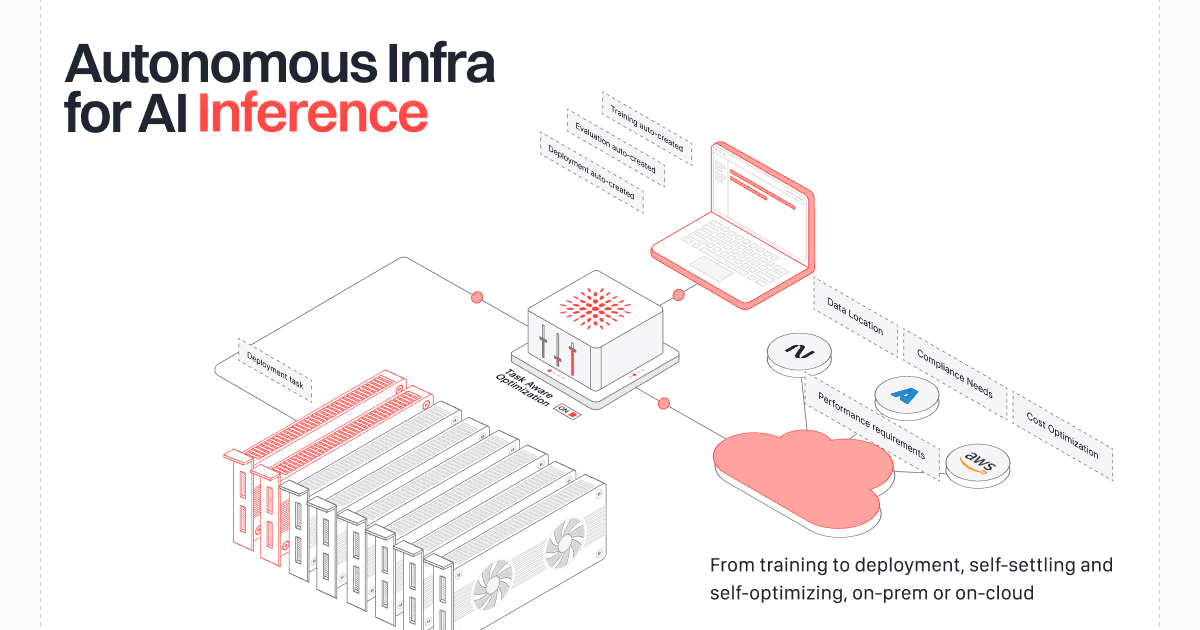
SwarmOne is an autonomous infrastructure platform designed for AI inference, training, and evaluation workloads. It offers a unique scheduler that dynamically disaggregates prefill and decode, orchestrates heterogeneous GPU clusters (NVIDIA, AMD, Intel, Groq, and more), and rebalances in real time to achieve over 90% utilization. The platform features SLO-driven autoscaling, enforcing defined latency, throughput, or cost targets by instantly provisioning GPUs when latency drifts and scaling compute to zero when traffic drops. SwarmOne aims to reduce costs by up to 80% through dynamic disaggregation, multi-node orchestration, and multi-cloud arbitrage, routing to the cheapest capable hardware. It supports a full AI lifecycle from training to deployment with zero DevOps/MLOps required, making it ideal for engineering teams at global enterprises.
SWE-Issue
SWE-Issue is a specialized tool designed for monitoring and analyzing the performance of software engineering assistants by tracking their GitHub issue statistics. It offers a sortable leaderboard that provides insights into the total number of issues, discussions, and resolution rates for various assistants. Users can leverage this platform to compare different AI tools, understand their efficiency in handling software development tasks, and identify top performers. The tool also allows for the submission of new assistants, expanding its database and utility for the software engineering community. Hosted on Hugging Face Spaces, SWE-Issue serves as a valuable resource for developers and researchers interested in the practical application and performance metrics of AI in software engineering.
AI-Optimizer
AI-Optimizer is a comprehensive deep reinforcement learning toolkit developed by TJU-DRL-LAB. It offers a wide array of algorithm libraries, spanning from model-free to model-based RL, and supports both single-agent and multi-agent reinforcement learning. The toolkit also includes a flexible and easy-to-use distributed training framework designed for efficient policy training. Key areas of focus include Multiagent Reinforcement Learning (MARL), Offline Reinforcement Learning (OffRL), Self-supervised Reinforcement Learning (SSRL), and Transfer and Multi-task Reinforcement Learning. It aims to address challenges like the curse of dimensionality, non-stationarity, and sample inefficiency in RL, providing solutions for researchers and practitioners alike.
Animate SVG V2
Animate SVG V2 is an AI-powered tool designed to simplify the animation of SVG graphics. Users can upload their existing SVG files to the platform, which then processes the input and generates an animated SVG output. This tool is particularly useful for creating dynamic web animations and interactive elements without requiring extensive animation skills. The application aims to provide a straightforward solution for transforming static SVG assets into engaging animated visuals, making it accessible for various creative and development projects. The tool is available as a Hugging Face Space, indicating its potential for free access and community-driven development.
Html
Html is an AI-powered tool hosted on Hugging Face that specializes in the modification and enhancement of NSFW images. Users can upload their content and leverage AI prompts, sliders, and various tools to customize body parts, introduce toys, alter poses, and change backgrounds. This functionality is particularly useful for content creators looking to generate unique and personalized material. The tool aims to assist in creating customized content suitable for monetization on platforms such as OnlyFans, providing a creative and efficient way to produce diverse visual content.
Synthio Stable Audio Open
Synthio Stable Audio Open is a free, open-source tool available on Hugging Face that enables users to generate custom audio files using text prompts. Leveraging the Stable Audio Open model from the Synthio paper, this application allows for the creation of high-quality synthetic audio at a 44.1kHz sample rate. Users can specify the duration, number of steps, and CFG scale to fine-tune their audio output. While the current live website indicates a configuration error, the tool's core functionality is designed for AI-driven audio content creation and research, making it suitable for educational purposes, exploring AI functionalities, and automating audio-related tasks.
TraceMind AI
TraceMind AI provides a comprehensive platform for evaluating AI agents, offering detailed metrics and insights into their performance. Users can effectively filter and compare different agent runs, gaining a clear understanding of their behavior and efficiency. The tool features performance charts for visual analysis and allows users to ask specific questions about traces, facilitating deeper understanding and debugging. Powered by MCP intelligence, TraceMind AI is designed to help developers and researchers assess and optimize their AI agents, ensuring robust and reliable operation. It is available as a Hugging Face Space, making it accessible for immediate use and experimentation.
TraceMind MCP Server
TraceMind MCP Server is designed for evaluating AI agents, offering a robust platform to analyze their performance data. Users can input various data sources, including leaderboard repositories, trace IDs, or specific model information, to gain intelligent insights into agent behavior and effectiveness. The tool leverages Gemini 2.5 Flash for agent assessment, ensuring advanced analytical capabilities. Hosted on Hugging Face Spaces, it provides an accessible environment for developers and researchers to monitor and understand the performance of their AI agents, facilitating iterative improvements and informed decision-making in AI development.
TRELLIS - Imagen a 3D
TRELLIS - Imagen a 3D is an AI-powered tool hosted on Hugging Face that enables users to transform 2D images into 3D models. This application provides a straightforward interface for uploading an image and then generating a corresponding 3D representation. Users have the flexibility to customize various settings related to the structure and detail of the generated 3D model, allowing for a degree of control over the final output. Once satisfied, the resulting 3D model can be downloaded in the GLB file format, making it compatible for use in a wide range of virtual environments, design software, or other 3D applications. The tool aims to offer scalable and versatile 3D generation capabilities.