
Coding & Development
Browsing page 429 of AI tools for Coding & Development. Sorted by confidence score — our independent quality rating.

cider-nrepl
cider-nrepl is a collection of nREPL middleware designed to significantly enhance Clojure editors. It provides essential functionalities such as definition lookup, code completion, and other common features that streamline the development process for Clojure programmers. This tool is widely used by various Clojure development environments, including fireplace.vim, vim-iced, Calva, and Conjure, as well as other nREPL-based tools. It aims to improve the coding workflow and productivity for developers working with Clojure. The project follows SemVer for its release policy, with minor version bumps indicating major releases that may include new features or significant changes. It is open-source and distributed under the Eclipse Public License.
FetchTheChange
FetchTheChange offers robust website change monitoring, specifically designed to work effectively on modern, JavaScript-heavy websites. Users can track various web values, including prices, availability, text content, and any DOM value. A key differentiator is its ability to not only alert users when values change but also to notify them when tracking breaks, providing clear failure states and suggesting fixes for selectors. This proactive approach helps users recover from monitoring failures quickly, ensuring continuous and reliable data tracking for critical web elements.
Crypto Flash Tool
Crypto Flash Tool provides software for simulating cryptocurrency transactions, specifically for USDT (Tether) and Bitcoin. This tool enables developers, crypto enthusiasts, and testers to create the appearance of real transactions with blockchain confirmations, without actually transferring any real funds. It's designed for risk-free simulation, allowing users to practice transfers, test wallet workflows, and demonstrate payment flows. Key features include simulated blockchain confirmations, input fields for amount and receiver address, unlimited device transfers, adjustable visibility duration, and zero network fees. The software is useful for educational purposes, developer testing, client product demos, wallet compatibility checks, and blockchain stress testing. It supports P2P compatibility on platforms like Binance and OKX, and allows splitting large flashes into smaller amounts.
finetune-anything
finetune-anything is an open-source project designed to facilitate the fine-tuning of the Segment Anything Model (SAM) for a range of computer vision applications. It provides a class-aware, one-stage framework for training fine-tuned models based on SAM, supporting tasks such as semantic segmentation, matting, and instance segmentation. Users can supply their own datasets and specify the task name to obtain a fine-tuned model. The tool also allows for the design of custom extend-SAM models, offering flexibility in modifying the Image Encoder Adapter, Prompt Encoder Adapter, and Mask Decoder Adapter. It supports the entire training process, including model modification, training, verification, and testing, with an option for ONNX export for deployment.
Global-Flow-Local-Attention
Global-Flow-Local-Attention is an open-source model designed for deep image spatial transformation, primarily focused on person image generation and animation. It leverages global flow and local attention mechanisms to achieve flexible applications such as pose-guided person image generation, pose-guided person image animation, face image animation, and view synthesis. The project provides source code, pre-trained weights, and demo scripts for quick exploration and implementation. Users can get started by installing Python, PyTorch, and CUDA dependencies, then downloading pre-trained models for various tasks like fashion image generation, video animation, and novel view synthesis. The tool is suitable for researchers and developers interested in advanced image manipulation and generation techniques.
indrnn
indrnn provides a TensorFlow implementation of Independently Recurrent Neural Networks (IndRNN), based on the paper 'Building A Longer and Deeper RNN' by Shuai Li et al. This implementation allows for the creation of longer and deeper recurrent neural networks by ensuring neurons in recurrent layers are independent. A key feature is the element-wise vector multiplication for recurrent weights, where each neuron has a single recurrent weight connected to its last hidden state. This design effectively prevents vanishing and exploding gradients, especially when used with ReLU activation functions, and facilitates stacking multiple recurrent layers. The tool includes examples for reproducing experiments like the Addition Problem and Sequential MNIST.
Ui-Layouts
Ui-Layouts is a comprehensive frontend universe offering a vast collection of beautifully designed, open-source UI components and blocks built with React, Next.js, and TailwindCSS. Developers can access over 60 ready-to-use components and more than 100 production-ready blocks, including hero sections, feature sections, and interactive elements like carousels and accordions. The library emphasizes accessibility, customizability, and modern UI patterns, with full TypeScript support and Framer Motion animations. It's designed to help developers build modern interfaces faster by providing copy-and-paste solutions, reducing development time, and improving the overall developer experience. Ui-Layouts also features unique elements like 3D UI components and various scroll and interactive animations.
libMultiRobotPlanning
libMultiRobotPlanning is a C++(14) library designed for task and path planning in multi-robot/agent systems. It provides a collection of highly templated search algorithms optimized for performance. The library includes single-robot algorithms such as A*, A* epsilon (focal search), and SIPP (Safe Interval Path Planning). For multi-robot scenarios, it supports Conflict-Based Search (CBS), Enhanced Conflict-Based Search (ECBS), and their variants with Optimal Task Assignment (CBS-TA, ECBS-TA), as well as Prioritized Planning using SIPP. Additionally, it offers assignment algorithms like minimum sum-of-cost (flow-based) and Best Next Assignment. The library is open-source, comes with useful examples, and is built for researchers and developers working on complex multi-robot coordination problems.
MaskDINO
MaskDINO is an official implementation of the paper "Mask DINO: Towards A Unified Transformer-based Framework for Object Detection and Segmentation," accepted at CVPR 2023. This open-source project offers a unified architecture capable of performing object detection, panoptic segmentation, instance segmentation, and semantic segmentation. It supports task and data cooperation between detection and segmentation, delivering state-of-the-art performance on major datasets like COCO, ADE20K, and Cityscapes. The framework is built upon detectron2 and offers a detrex version. Key features include a flexible architecture where users can easily replace backbone, pixel decoder, and transformer decoder components, and it supports mask-enhanced box initialization for improved performance.
WebTerm
WebTerm is a free, browser-based interactive learning platform designed to help users master Linux terminal commands and Git. It provides a simulated terminal environment where individuals can safely practice a wide range of real commands without any risk to their actual system or requiring any installation. The platform supports over 30 Linux commands, including file operations, and simulates Git operations like `git init`, `git add`, and `git commit`. WebTerm is perfect for beginners, offering structured learning paths from 'Getting Started' to 'Advanced' and 'Git Fundamentals', alongside a 'Free Play' mode for unguided practice. It runs entirely in the browser, requiring no downloads, virtual machine setup, or account creation.
Hyphen Tech
Hyphen Technologies provides comprehensive managed IT services, cybersecurity, and cloud solutions tailored for businesses across Chicagoland. Their offerings include unlimited helpdesk support, proactive monitoring, and patch management, acting as a dedicated IT team for a flat monthly fee. They specialize in enterprise-grade cybersecurity with endpoint protection, email security, dark web monitoring, and vulnerability assessments. Additionally, Hyphen Technologies handles Microsoft 365 and Azure migration, management, and optimization, ensuring seamless collaboration and secure remote work. They also offer network design, firewall management, Wi-Fi optimization, IT consulting, and robust backup and disaster recovery solutions to keep businesses running smoothly.
nnfusion
nnfusion is an open-source deep neural network (DNN) compiler designed for flexibility and efficiency. It generates high-performance executables directly from DNN model descriptions, supporting popular formats such as TensorFlow frozen models and ONNX. The tool aims to facilitate full-stack model optimization, offering features like data-flow graph optimizations, model-specific kernel selection, kernel fusion, and static memory layout. It provides ahead-of-time and source-to-source compilation, reducing runtime overhead and minimizing library dependencies. nnfusion supports various accelerator devices, including CUDA GPUs, ROCm GPUs, and CPUs, making it suitable for developers and researchers looking to speed up model execution or customize optimizations. It also supports parallel training via SuperScaler.

Itzam
Itzam is an open-source backend platform specifically designed to simplify the integration of artificial intelligence into various applications. It provides a comprehensive set of tools for efficient prompt and model management, which are crucial components in AI development. The platform aims to significantly reduce the time and effort developers typically spend on tasks such as Retrieval-Augmented Generation (RAG), observability, and overall model management. By handling these complexities, Itzam allows developers to concentrate more on building and enhancing the core AI-powered features of their applications.
nematus
Nematus is an open-source neural machine translation toolkit developed by EdinburghNLP, built using Tensorflow. It provides robust support for both RNN and Transformer architectures, making it versatile for various machine translation tasks. Key features include support for advanced RNN architectures with arbitrary input features, deep models, and various dropout techniques. For Transformer architectures, it offers arbitrary input features and DropHead for attention head dropout. The toolkit also includes multi-GPU support, documentation, label smoothing, early stopping, and the ability to resume training. It provides batch decoding, n-best output, and scripts for scoring and rescoring, along with a server mode. Nematus also stores model hyperparameters, vocabulary files, and training progress in JSON format, and offers pretrained models for 13 translation directions.
OneFormer
OneFormer is an innovative open-source AI tool designed for universal image segmentation, leveraging a single transformer model to address diverse segmentation challenges. It stands out by being trained only once with a single universal architecture and model on a single dataset, yet it outperforms existing frameworks across semantic, instance, and panoptic segmentation tasks. The tool employs a task-conditioned joint training strategy, uniformly sampling different ground truth domains by deriving all labels from panoptic annotations. A key feature is its use of a task token to condition the model, making it task-guided for training and task-dynamic for inference, all within a single model. This approach simplifies the segmentation workflow and delivers state-of-the-art results on datasets like ADE20K, Cityscapes, and COCO.
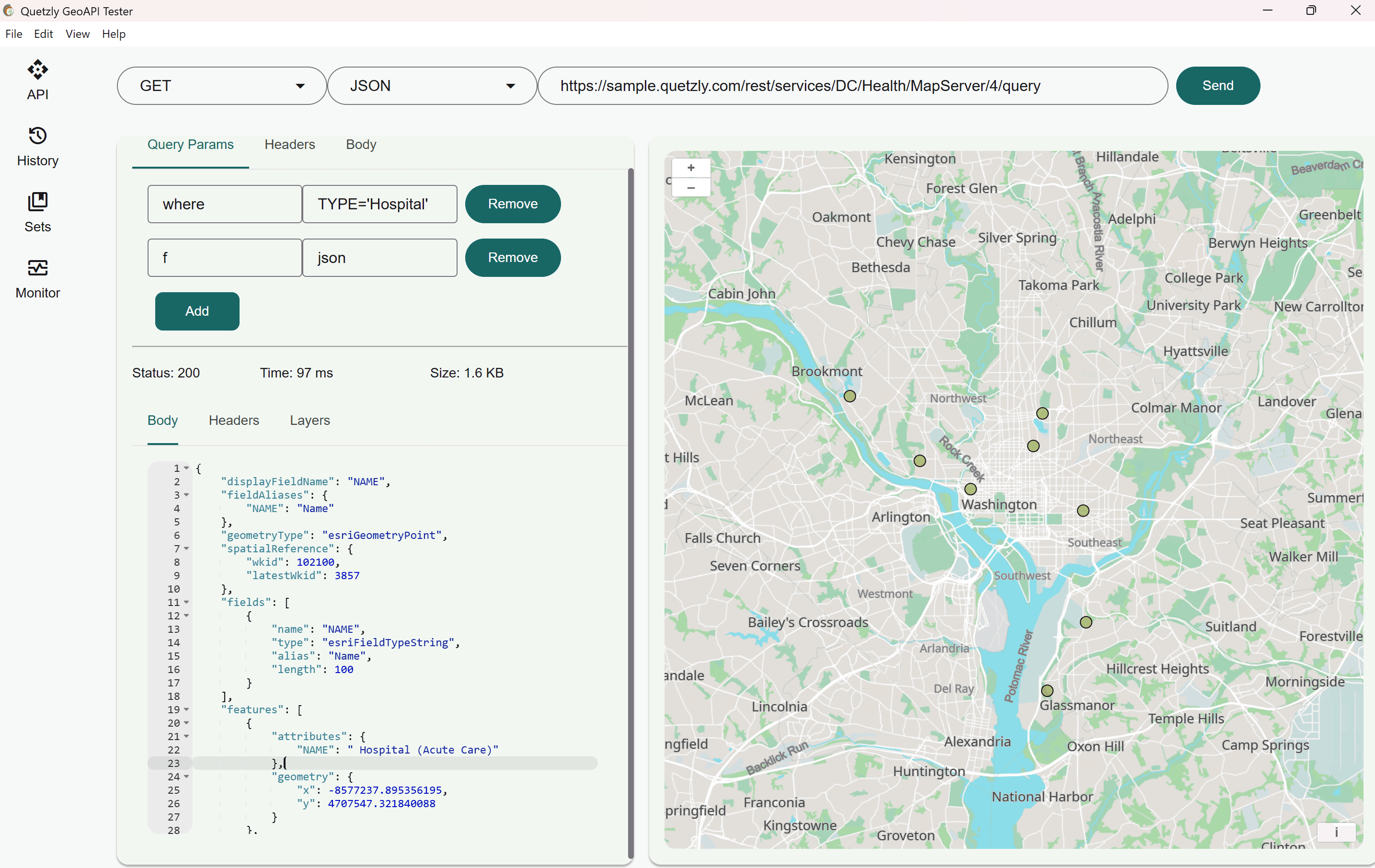
Quetzly
Quetzly is a professional GIS service testing tool designed for developers and IT professionals. It enables users to test, monitor, and visualize various geospatial APIs, including ArcGIS, OGC WMS/WFS, and GeoJSON endpoints. The platform offers a desktop application for deep analysis and a Chrome Extension for quick, browser-based health checks directly from ArcGIS REST Services Directory pages. Users can send requests, inspect JSON responses, and visualize services on interactive maps. Quetzly also monitors service health over time, provides detailed error reports, and generates professional PDF summaries of service uptime and reliability, helping to catch errors before they impact end-users.
Convrse.pro
Convrse.pro is an AI-driven platform designed to optimize 3D meshes, making them suitable for online and real-time 3D environments. It addresses common challenges faced by 3D creators, such as mesh optimization, handling format inconsistencies, and simplifying deployment processes. The tool provides a user-friendly, cloud-based interface that requires no coding, allowing creators to efficiently prepare their 3D assets. By automating complex optimization tasks, Convrse.pro aims to streamline workflows and enable faster integration of 3D content into various digital platforms, enhancing accessibility and performance for interactive experiences.
pixelsplat
pixelSplat provides the code for generating 3D Gaussian splats from image pairs, a method for scalable and generalizable 3D reconstruction. Developed by David Charatan et al. and presented at CVPR 2024, this tool allows users to reconstruct 3D scenes from 2D images. The codebase has been updated to reflect the camera-ready version of the paper, including architectural improvements like per-image self-attention in the epipolar transformer, leading to slightly better results across datasets. It supports running with an arbitrary number of views, though requiring significant GPU memory for more complex setups. The project also offers pre-trained checkpoints and scripts for dataset conversion and evaluation.
Blink Technologies, Inc.
Blink Technologies, Inc. develops advanced AI-based eye tracking software and technology, aiming to create seamless interaction between human eyes and the digital world. Their non-invasive solution is compatible with any camera technology and operating system, including Windows, iOS, macOS, Android, and Linux. It can be deployed locally (edge-based) or remotely (cloud-based), offering flexibility for various applications. Blink's technology is applied across multiple sectors, from redefining online shopping experiences with gaze and fixation data to enhancing automotive safety through driver visual attention monitoring. They also provide solutions for touchless panel operation, 3D display interaction, and advanced eye tracking authentication, moving beyond traditional facial recognition for enhanced privacy and security.
RefineDet
RefineDet is an open-source implementation of a single-shot refinement neural network designed for object detection tasks. Published at CVPR 2018, this method aims to surpass the accuracy of traditional two-stage object detection approaches while preserving the computational efficiency characteristic of one-stage methods. The repository provides comprehensive code for training and evaluating RefineDet models on various datasets, including PASCAL VOC and MS COCO. Users can leverage pre-trained models based on VGG-16 and ResNet-101 architectures, and the system supports both single-scale and multi-scale testing strategies. It includes detailed instructions for installation, data preparation, training, and evaluation, making it a valuable resource for researchers and developers in computer vision.
SNIPER
SNIPER, also known as AutoFocus, is an efficient multi-scale training and inference algorithm designed for instance-level recognition tasks such as object detection and instance-level segmentation. It significantly speeds up multi-scale training by selectively processing context regions around ground-truth objects, called 'chips', operating on low-resolution data. This memory-efficient design allows SNIPER to benefit from Batch Normalization and larger batch-sizes on a single GPU. AutoFocus, the inference component, employs a coarse-to-fine approach, processing only regions likely to contain small objects at finer scales using 'FocusPixels' to generate compact 'FocusChips'. The tool supports half-precision training with no loss in accuracy and offers fast inference speeds, making it suitable for advanced computer vision research and development.
Digital Sierra
Digital Sierra is a comprehensive digital transformation partner specializing in engineering reliable, secure, and scalable IT infrastructure. They offer a range of services including DevOps for accelerated delivery with CI/CD pipelines and Kubernetes, CloudOps for 24/7 infrastructure monitoring, and AIOps for intelligent monitoring and analytics with predictive capabilities. The company also focuses on SecOps for integrating security with zero-trust architecture and GRC for compliance with standards like ISO 27001 and SOC 2. Digital Sierra empowers growth through open-source solutions like Odoo ERP, ERP Next, and WordPress, helping businesses scale efficiently without high licensing costs. They cater to MSMEs, early-stage businesses, and NGOs, providing tailored solutions for various industries.
Chaotix.AI
Chaotix.AI is currently under development, with the goal of becoming a text-to-game AI platform. The platform is designed to allow users to generate games simply by providing text prompts, democratizing game creation. The overarching vision for Chaotix.AI is to empower a broad audience to create and share their own games, fostering a new wave of creative expression within the gaming community. While specific features and capabilities are still emerging, the core promise revolves around simplifying the game development process through intuitive AI-driven tools, making game creation accessible to individuals regardless of their technical expertise.
simpledet
SimpleDet is a versatile, open-source framework designed for object detection and instance recognition tasks. It boasts major features such as FP16 training for significant memory savings and up to 2.5X acceleration, alongside highly scalable distributed training capabilities. The framework provides full coverage of state-of-the-art models, including FasterRCNN, MaskRCNN, CascadeRCNN, RetinaNet, and EfficientNet, among others. It also includes extensive features like large batch BN, loss synchronization, automatic BN fusion, soft NMS, and multi-scale train/test. SimpleDet's modular design allows for coding-free exploration of new experiment settings, making it a powerful tool for researchers and developers in the AI domain.