
Coding & Development
Browsing page 464 of AI tools for Coding & Development. Sorted by confidence score — our independent quality rating.

OCRunner
OCRunner is an open-source tool designed for executing Objective-C code as a script, leveraging an Abstract Syntax Tree (AST) interpreter. It serves as an iOS hotfix SDK, enabling dynamic code patching and execution for applications. Key capabilities include generating binary patch files to increase security, reduce patch size, and optimize startup time. OCRunner supports complete Objective-C syntax, with some limitations regarding pre-compilation and certain C language features. It offers various interaction modes, including interactive, file monitoring, and folder monitoring, allowing real-time code execution and updates on iOS devices. The tool also provides performance testing comparisons against other hotfix libraries like JSPatch and Mango, highlighting its efficiency in patch loading speed.
MultiNet
MultiNet is an open-source AI tool designed for real-time joint semantic reasoning in autonomous driving applications. It excels at simultaneously performing road segmentation, car detection, and street classification, offering state-of-the-art performance in segmentation while maintaining real-time processing speeds. The model is built as an encoder-decoder architecture, utilizing a VGG encoder and independent decoders for each task. This repository combines several TensorFlow models, specifically KittiSeg for road segmentation, KittiBox for car detection, and KittiClass for street classification, which are included as submodules. MultiNet is compatible with the TensorVision backend for organized experiment management and requires Python 2.7 and TensorFlow 1.0.
Godly
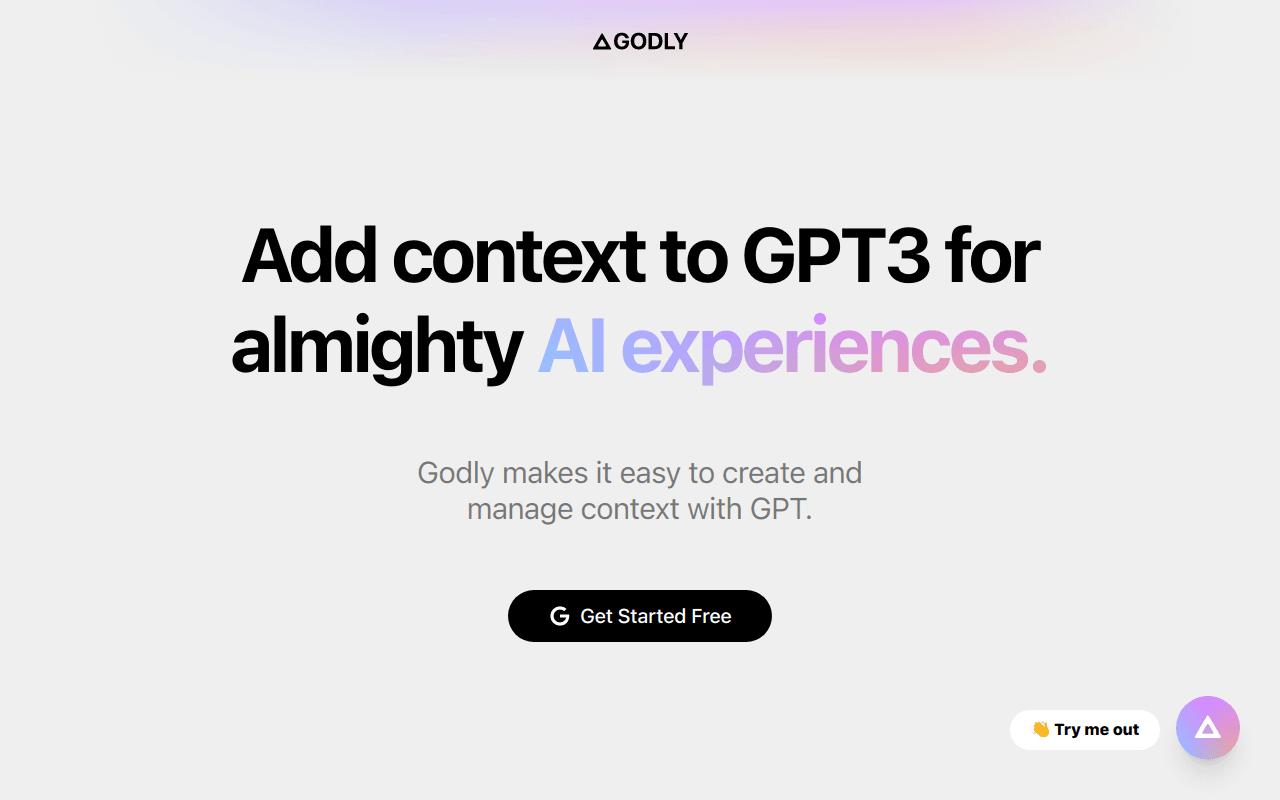
Godly was an AI tool that aimed to enhance the performance of GPT models by providing instant context to user prompts. Its core functionality was to magically append relevant information, thereby moving beyond generic AI responses to more personalized and accurate completions. The tool leveraged OpenAI's embedding model to achieve this contextual integration. However, as of 2023, Godly has been sunset, and its service is no longer operational. All functionality has been discontinued, and the website explicitly states that the service is no longer running.
next-enterprise
next-enterprise is an enterprise-grade Next.js boilerplate designed for building high-performance, maintainable applications. It provides a robust foundation with carefully selected technologies and ready-to-go infrastructure, aiming to maximize developer productivity and accelerate time-to-market for business-critical applications. Key features include Next.js 15 with App Directory, Tailwind CSS v4, strict TypeScript, ESLint 9, Prettier, and Corepack & pnpm as the package manager. It also integrates GitHub Actions for bundle size and performance tracking, a comprehensive testing suite (Vitest, React Testing Library, Playwright), Storybook for component development, and Open Telemetry for observability. The boilerplate supports advanced testing, conventional commits, and automated dependency updates with Renovate BOT, making it ideal for enterprise teams.
Websim
Websim is an interactive platform designed for creating and sharing games and web pages. It enables users to build various simulations and creative projects, ranging from number blocks playgrounds and interactive color mixers to more complex simulations like fractal zoomers and nuclear war simulators. The platform fosters a community where users can share their creations, view popular projects, and explore new content. Websim appears to cater to a broad audience interested in interactive content creation, offering a space for both casual exploration and more involved project development.
tstorage
tstorage is a lightweight, open-source, embedded time-series database designed for efficient handling of large volumes of time-series data. It features a straightforward API with massively optimized ingestion capabilities, ensuring goroutine-safe writes and reads. The database partitions data points by time, using a linear data model structure rather than B-trees or LSM trees, which is ideal for time-series workloads that are mostly append-only. It supports both in-memory and persistent disk storage, allowing users to specify a data path for on-disk persistence. tstorage also handles out-of-order data points by buffering them in memory partitions, making it robust against network latency or clock synchronization issues. This design ensures fast read operations, especially for recent data, and efficient storage by sequentially writing larger files when partitions are full.
YOLOv5-Lite
YOLOv5-Lite is an optimized object detection model evolved from YOLOv5, designed for enhanced lightness, speed, and deployment ease. It significantly reduces model size, with versions as compact as 900kb (int8) and 1.7M (fp16), making it highly efficient for resource-constrained environments. The tool boasts impressive performance, reaching 15 FPS on a Raspberry Pi 4B, making it suitable for edge computing and embedded systems. Key optimizations include the removal of the Focus layer and four slice operations, along with the addition of shuffle channels and a YOLOv5 head for channel reduction. YOLOv5-Lite supports various frameworks and backends like PyTorch, ncnn, mnn, OpenVINO, TensorRT, and TFLite, and provides models tailored for different platforms and precision levels. It includes comprehensive documentation for installation, inference, training, and deployment on diverse hardware.
2d-gaussian-splatting
2d-gaussian-splatting provides an official implementation for creating geometrically accurate radiance fields using 2D Gaussian Splatting. This open-source project represents scenes with 2D oriented disks and utilizes perspective-correct differentiable rasterization. It includes regularizations to enhance reconstruction quality and offers various meshing approaches for Gaussian splatting, including both bounded and unbounded mesh extraction. The tool supports COLMAP and NeRF Synthetic datasets, and provides scripts for training, rendering, and evaluation of novel view synthesis and geometric reconstruction. It also features integrations with community resources like WebGL/Three.js viewers and offers performance improvements through CUDA operator fusing.
advanced_lane_detection
advanced_lane_detection is an open-source project designed for advanced lane detection using computer vision techniques. Developed as part of the Udacity Self-Driving Car Nanodegree, it provides a comprehensive pipeline for identifying lane boundaries in images and video streams. Key steps include camera calibration and distortion correction, creating thresholded binary images using color transforms and gradients, applying perspective transforms for a bird's-eye view, and fitting polynomial curves to detect lane lines. The tool also calculates lane curvature and vehicle position relative to the lane center, and annotates the original image with this information. It's built with Python and relies on libraries like NumPy, OpenCV, Matplotlib, and Pickle.
airframe-react
airframe-react is a free and open-source dashboard template designed for building high-quality admin and analytics interfaces. It leverages Bootstrap 4 and React 16, ensuring responsiveness across smartphones, tablets, and desktops. The template is available under an MIT license, making it highly accessible for developers. It features a minimalist design with an innovative Light UI, perfect for large-scale applications. The project includes React Router and customized reactstrap, with dependencies regularly updated. It offers over 10 layout variations, ready-to-use applications, a large collection of UI components, and more than 120 unique pages, making it ideal for CRMs, CMSs, Admin Panels, and Analytics dashboards.
Awesome-state-space-models
Awesome-state-space-models is a comprehensive collection of research papers and repositories focused on state-space models and hybrid models. This GitHub repository serves as a centralized resource for academics, researchers, and engineers interested in the latest advancements and implementations in this field. It includes a wide array of topics, from foundational theories to specific applications in areas like language models, vision, reinforcement learning, and biomedical imaging. The collection is regularly updated with new arXiv preprints and conference papers, offering insights into various model architectures, optimization techniques, and practical use cases, including Mamba, RWKV, and other hybrid approaches.
Awesome-VLA-Robotics
Awesome-VLA-Robotics is a curated, open-source repository offering an extensive collection of resources focused on Vision-Language-Action (VLA) models in robotics. This includes a detailed list of excellent research papers, various VLA models, relevant datasets, and other valuable materials for researchers and practitioners in the field. The repository defines VLA models, outlines their core concepts, and details key components like Vision Encoders, Language Understanding modules, and Action Decoders. It also explores the relationship between VLAs, VLMs, and Embodied AI, tracing the evolution from VLM adaptation to integrated VLA systems. The resource is structured to provide quick glances at key models and datasets, categorized by application area and technical approach, making it an invaluable reference for understanding and advancing VLA robotics.
Awesome-DLMs
Awesome-DLMs is the official GitHub repository for the survey paper "A Survey on Diffusion Language Models." It serves as a highly-starred, comprehensive, and up-to-date collection of research papers, code, and resources related to Diffusion Language Models. The repository categorizes DLMs into continuous, discrete, and multimodal types, highlighting key milestones in their development. It includes sections for must-read papers, surveys, foundational concepts, training strategies, inference optimization, training frameworks, benchmarks, and applications. This resource is invaluable for researchers, students, and practitioners looking to explore the latest advancements and foundational knowledge in the field of Diffusion Language Models.
awesome-contrastive-self-supervised-learning
awesome-contrastive-self-supervised-learning is an open-source GitHub repository offering a comprehensive and curated list of research papers focused on contrastive self-supervised learning. This resource is invaluable for academics, researchers, and students looking to stay updated with the latest advancements and foundational works in this rapidly evolving AI domain. The repository categorizes papers by year, ranging from 2010 to 2024, and includes surveys, reviews, and specific research contributions, often with links to associated code. It covers diverse applications such as medical image analysis, vision-language representation, graph representations, and natural language understanding, making it a central hub for exploring the theoretical and practical aspects of contrastive learning.
Awesome-Deblurring
Awesome-Deblurring is a comprehensive, curated list of resources dedicated to image and video deblurring. Hosted on GitHub, this open-source repository serves as a central hub for researchers and developers seeking to explore or implement deblurring techniques. It meticulously categorizes resources into various sections, including single-image blind motion deblurring (both non-DL and DL approaches), non-blind deblurring, depth-aware motion deblurring, defocus deblurring, and benchmark datasets. Each entry typically includes the publication year, paper title, and links to associated code or project pages, making it an invaluable tool for navigating the vast landscape of deblurring research and practical applications.
awesome-deep-rl
awesome-deep-rl is a comprehensive, curated list of resources for Deep Reinforcement Learning. This open-source repository serves as a central hub for researchers and practitioners to discover libraries, benchmark results, environments, competitions, and educational materials like books and tutorials. It covers a wide array of topics, from foundational algorithms and historical timelines to advanced frameworks and simulation platforms, making it an invaluable reference for anyone involved in the field of Deep Reinforcement Learning. The resource is continuously updated, reflecting the dynamic nature of AI research.
autoscraper
Autoscraper is a smart, automatic, fast, and lightweight web scraper for Python designed to simplify the process of extracting data from websites. Users provide a URL or HTML content along with a list of sample data they wish to scrape, such as text, URLs, or specific HTML tag values. The tool then intelligently learns the necessary scraping rules to identify and extract similar elements. Once a model is built, it can be saved and reused with new URLs to retrieve similar content or exact elements from different pages. It supports both getting similar results and exact matches, and allows for custom requests parameters like proxies or headers, making it versatile for various scraping needs.
Awesome-BEV-Perception-Multi-Cameras
Awesome-BEV-Perception-Multi-Cameras is a valuable resource for researchers and engineers focused on multi-camera 3D object detection and segmentation within the Bird's-Eye-View (BEV) paradigm. This curated list compiles significant academic papers, including influential works like DETR3D, BEVDet, BEVFormer, BEVDepth, and UniAD. It categorizes papers by key themes such as Longterm BEV, BEV + Stereo, End to End BEV Perception, BEV + Distillation, Robust BEV, Fast BEV, HD Map Construction, Multi-sensor fusion, Survey, Occupancy Network, and Pre-training. Each entry typically includes a link to the paper and its corresponding GitHub repository, making it easy for users to access the research and associated codebases. This tool is essential for staying updated with the latest advancements in vision-centric autonomous driving perception.
balena-engine
balena-engine is a container engine specifically designed for embedded, IoT, and Edge computing environments, while maintaining compatibility with Docker containers. Built upon Docker’s Moby Project, it offers significant optimizations for resource-constrained devices. Key features include a 3.5x smaller footprint than Docker CE, multi-architecture support for a wide range of chipsets, and highly efficient updates through true container deltas, which are 10-70x smaller than traditional layer pulls. The engine also prioritizes minimal wear-and-tear on storage, failure-resistant atomic pulls, and conservative memory use to ensure application stability in low-memory situations. It omits features primarily needed for cloud deployments, such as Docker Swarm and certain logging/networking drivers, making it a lightweight, drop-in replacement for Docker CE in IoT contexts.
canvas-editor
canvas-editor is an open-source rich text editor designed for web applications, leveraging canvas and SVG for rendering. It offers a comprehensive suite of rich text operations, including undo/redo, font styling, alignment, and list management. Developers can easily insert various elements such as tables, images, links, code blocks, page breaks, and mathematical formulas. The editor also supports printing to picture and PDF, controls like select, text, date, radio, and checkbox, and features like context menus, shortcut keys, drag and drop functionality, headers, footers, page numbers, page margins, watermarks, pagination, and comments. It is ideal for creating custom text editing experiences within web applications.
booking-js
booking-js by Timekit is an open-source JavaScript library designed to help developers quickly create and embed beautiful booking widgets. It integrates seamlessly with the Timekit API, enabling robust appointment scheduling functionalities. This tool supports the new projects model and uses an App Widget Key for authentication, ensuring secure and efficient operation. While the repository is primarily for community contributions and customizations, all official documentation, guides, and examples are available on the Timekit developer portal. It's an ideal solution for those looking to implement a customizable booking interface without building from scratch, offering flexibility for developers to tailor the widget to their specific needs.
chronos-forecasting
Chronos-forecasting is an open-source project by Amazon Science that provides a family of pretrained models for time series forecasting. It includes Chronos-2, offering state-of-the-art zero-shot performance for univariate, multivariate, and covariate-informed forecasting, and Chronos-Bolt, a patch-based variant that is significantly faster and more memory-efficient. The original Chronos models are based on language model architectures, transforming time series into tokens for probabilistic forecasting. The package provides an interface for easy inference via pip installation and offers deployment options to AWS with Amazon SageMaker for reliable production use. It also includes tools like fev for benchmarking time series forecasting models.
DarkPose
DarkPose is an open-source project that introduces a novel Distribution-Aware Coordinate Representation of Keypoint (DARK) method for human pose estimation. This method acts as a model-agnostic plug-in, designed to significantly boost the performance of various existing state-of-the-art human pose estimation models. It has demonstrated impressive results, including achieving 76.4 on the COCO test-challenge (2nd place entry of COCO Keypoints Challenge ICCV 2019) and being accepted by CVPR2020. The project provides detailed results on COCO val2017, COCO test-dev2017, and MPII val datasets, showcasing its effectiveness across different benchmarks. DarkPose is particularly valuable for researchers and developers working on computer vision tasks requiring precise human pose analysis.
cvzone
cvzone is a comprehensive computer vision package designed to streamline image processing and AI functionalities. Built upon the robust OpenCV and Mediapipe libraries, it offers an accessible platform for developers and enthusiasts to implement various computer vision tasks. The package includes modules for face detection, hand tracking, pose estimation, selfie segmentation, and color detection. It also provides utilities for image manipulation like rotating, stacking, and overlaying PNGs, along with functions for finding contours and calculating FPS. With straightforward installation via pip and numerous examples, cvzone makes it easy to integrate advanced computer vision capabilities into projects.