
Content & Design
Browsing page 87 of AI tools for Audio & Music in Content & Design. Sorted by confidence score — our independent quality rating.

tacotron
Tacotron is a TensorFlow-based open-source project providing an implementation of the Tacotron text-to-speech synthesis model. It enables developers and researchers to train and experiment with fully end-to-end speech synthesis. The tool supports multiple speech datasets, including the LJ Speech Dataset, Nick Offerman's Audiobooks, and the World English Bible, offering flexibility for different training needs. It provides a well-documented framework, outlining requirements, data preparation steps, training procedures, and sample synthesis. Key features include gradient clipping, Noam style warmup and decay, and bucketed training batches, making it a robust platform for advanced speech synthesis research and development.
Talking-Face-Generation-DAVS
Talking-Face-Generation-DAVS provides the code for generating talking faces using an Adversarially Disentangled Audio-Visual Representation (DAVS) method, as presented in AAAI 2019. This open-source project allows users to synthesize sequences of face images that correspond to given speech semantics, whether from an unconstrained speech audio or video input. The repository includes scripts for testing, training, and preprocessing data, with support for Python 2.7, PyTorch (version 0.2.0), and OpenCV2. While the current version is primarily for research and educational purposes and may not fully reproduce the paper's results without pretraining, it serves as a valuable reference for implementing talking face generation.
ASR w/ pyctcdecode
ASR w/ pyctcdecode is an AI tool hosted on Hugging Face Spaces, designed for automatic speech recognition. It leverages the pyctcdecode library to transcribe audio inputs. While the specific functionalities and user interface details are not explicitly described due to a build error on the live page, the tool's name indicates its core purpose: converting spoken language into text. As a Hugging Face Space, it is typically accessible for free use, making it a potentially valuable resource for developers, researchers, and individuals interested in experimenting with speech-to-text technologies. The tool's current status shows a build error, suggesting it may not be fully operational at this moment.
ESPnet2 TTS
ESPnet2 TTS is an AI-powered text-to-speech tool available as a Hugging Face Space. It is designed to convert written text into spoken audio, leveraging advanced AI models for speech synthesis. The tool is built with Gradio, which suggests an accessible web-based interface for users to interact with the TTS functionality. While the live website currently indicates a runtime error, the underlying technology aims to provide a platform for generating synthetic speech. This tool is particularly relevant for developers, researchers, and individuals interested in experimenting with or implementing text-to-speech capabilities.
TANGO
TANGO is an advanced AI tool designed for co-speech gesture video reenactment, leveraging hierarchical audio-motion embedding and diffusion interpolation. This technology allows users to generate videos where a character's gestures are synchronized with an audio input, creating realistic and expressive motion. The tool is presented as an open-source project, making its codebase available for research and development. It includes features for inference, training joint embedding (CLIP), and creating custom gesture graphs. TANGO is particularly useful for researchers and developers in AI-driven video editing and animation, offering a robust framework for generating dynamic, gesture-rich video content from audio.
voxtral.c
voxtral.c is a pure C implementation of the inference pipeline for the Mistral AI's Voxtral Realtime 4B speech-to-text model, designed for real-time speech recognition. It boasts zero external dependencies beyond the C standard library, making it highly portable and efficient. The tool supports various input methods, including WAV files, live microphone input (macOS), and streaming audio from stdin, allowing for transcription of virtually any audio format via ffmpeg. Key features include Metal GPU acceleration for Apple Silicon, streaming output of tokens as they are generated, a streaming C API for incremental audio processing, and memory-mapped BF16 weights for near-instant loading. It also incorporates a chunked encoder and rolling KV cache to manage memory usage efficiently, enabling unlimited-length audio transcription.
Natural Language Playlist
Natural Language Playlist is an innovative AI-powered platform designed to generate personalized music playlists using natural language descriptions. Users can articulate their desired playlist by focusing on musical and cultural features, lyrical meaning, sonics, and vibes. The tool excels at understanding nuanced descriptions, allowing for highly specific and creative playlist generation. Users can log in with Spotify to generate playlists directly on their accounts, which also helps improve the underlying algorithm. The platform encourages clear, positive language for better results and provides examples for crafting effective playlist descriptions, such as using obscure genres or describing musical features. It's ideal for music lovers who enjoy discovering new music and want a more intuitive way to curate their listening experience.

Yoodli AI
Yoodli AI is an enterprise AI roleplay platform designed to enhance communication skills through interactive simulations. It offers a private, judgment-free environment for users to practice pitches, demos, crucial conversations, and public speaking. The platform provides real-time feedback on content, delivery, and progress over time, utilizing AI-powered follow-up questions. Yoodli AI is trusted by major companies like Google and Sandler for sales enablement, partner training, and learning & development. It supports multi-persona roleplays to simulate group presentations or interview panels, and integrates with existing ecosystems for automatic roleplay assignment, progress tracking, and data synchronization. The tool is SOC 2 Type 2 certified and GDPR compliant, ensuring data security and privacy.
FireRedASR
FireRedASR is a family of open-source, industrial-grade automatic speech recognition (ASR) models developed by FireRedTeam. It provides robust support for Mandarin, various Chinese dialects, and English, setting new state-of-the-art benchmarks for Mandarin ASR. A key differentiator is its outstanding capability in recognizing singing lyrics. The tool offers two main variants: FireRedASR-LLM, designed for SOTA performance and seamless end-to-end speech interaction using an Encoder-Adapter-LLM framework, and FireRedASR-AED, which balances high performance with computational efficiency through an Attention-based Encoder-Decoder architecture. It also includes modules for VAD, LID, and Punc, making it a comprehensive ASR system.
nnsvs
nnsvs is a neural network-based singing voice synthesis library specifically designed for research purposes. It offers a comprehensive set of tools for audio processing and neural network-based synthesis, allowing researchers and developers to build, train, and experiment with advanced singing voice models. The library is open-source, promoting collaboration and further development within the academic community. It includes adaptations from other notable projects like uSFGAN for inference and DiffSinger for diffusion models, showcasing its commitment to leveraging cutting-edge techniques in the field of singing voice synthesis.
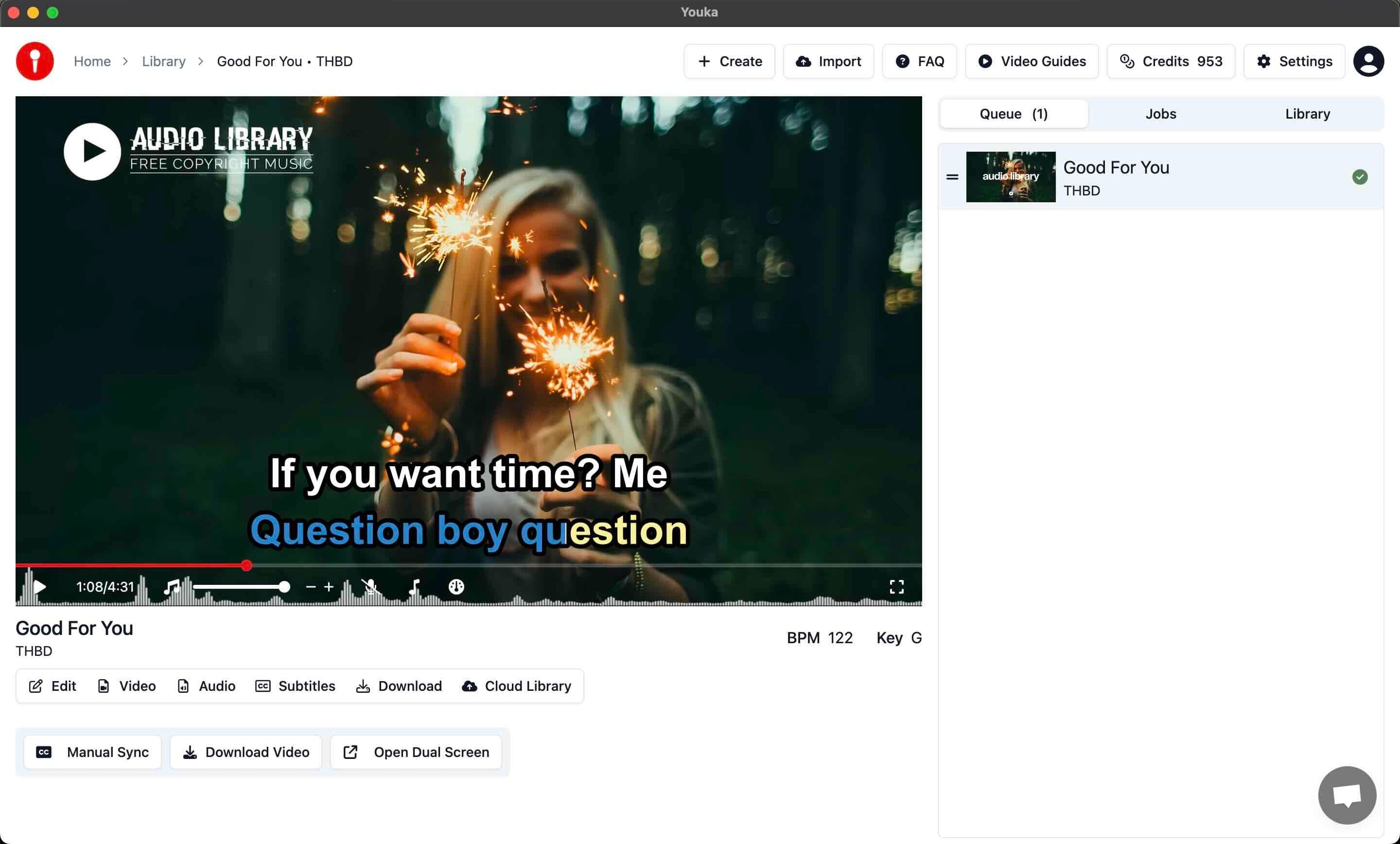
Youka
Youka is an AI-powered karaoke maker that transforms any song into a professional karaoke video in minutes. Users can upload audio or video files, and the AI automatically removes vocals and synchronizes lyrics word-by-word. It offers extensive customization options for backgrounds, fonts, colors, and allows for 1080p MP4 export. Youka supports over 50 languages and provides features like a 1-Click Lyric Video Maker, Duet Mode, and a powerful Sync Editor. Available as an online tool or a desktop application for Windows and Mac, it also offers developer tools for programmatic karaoke creation.

SpeechKit
SpeechKit is an all-in-one AI audio CMS specifically designed for publishers to transform their articles into engaging audio content. The platform offers advanced voice cloning capabilities, allowing users to create lifelike audio using instant or professional cloning, or by selecting from a library of ready-to-use voices. Publishers can deliver captivating audio articles at scale with full control over pronunciations and predictable costs, avoiding runaway regeneration fees. SpeechKit also provides a fully customizable player that aligns with brand aesthetics, meets WCAG 2 accessibility standards, and integrates easily with a few lines of code. Detailed analytics on listen rates, time spent, and completion rates help refine audio strategy and grow audiences, while monetization features allow integration with top ad servers for programmatic audio and video ads.
veles
Veles is a distributed platform designed for rapid deep learning application development, released under the Apache 2.0 license. It comprises several key components, including the core Veles platform, the Znicz Plugin which serves as a neural network engine, and Mastodon, a bridge facilitating integration between Veles and Java-based systems like Hadoop. Additionally, it features a SoundFeatureExtraction library for audio processing. This platform is ideal for developers and researchers looking to build and deploy deep learning applications in a distributed environment, offering tools for both model development and data processing.
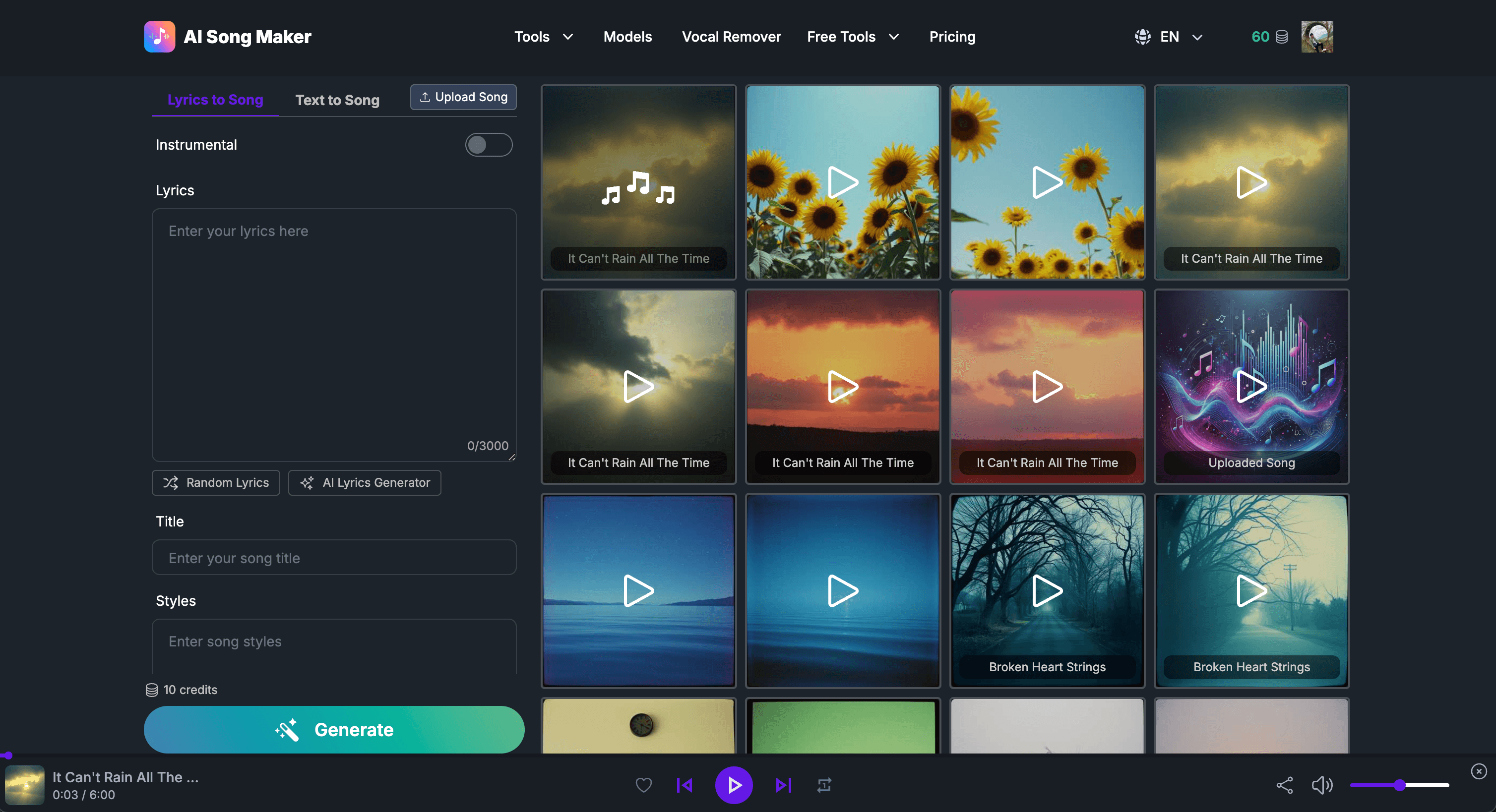
AI Song Maker
AI Song Maker is an intuitive AI music generator designed to help users create royalty-free songs effortlessly. It transforms text and lyrics into music, offering features like text-to-song and lyrics-to-song conversion. Beyond basic generation, the platform includes tools such as an AI Lyrics Generator, AI Song Cover Generator, and AI Singing Photo Generator. Users can also remove vocals from songs, extend music sections, and replace parts of a track. The tool is suitable for social media creators, podcasters, musicians, and marketers looking to generate high-quality music compositions quickly and cost-effectively, streamlining their creative workflow.
VividTalk
VividTalk is an open-source project designed for one-shot audio-driven talking head generation. It leverages a 3D hybrid prior to produce realistic facial animations directly from audio input. This tool is particularly suitable for researchers and developers working in AI-driven video synthesis and deepfake creation, offering a foundation for exploring advanced animation techniques. As a GitHub repository, it provides the code and resources for users to implement and experiment with the technology, making it a valuable asset for those interested in the technical aspects of generating dynamic talking head videos.
voicefilter
VoiceFilter is an unofficial PyTorch implementation of Google AI's VoiceFilter system, designed for targeted voice separation by speaker-conditioned spectrogram masking. This open-source project allows users to filter out specific voices from mixed audio, enhancing speech clarity. While the original author notes some limitations due to its early development, it provides a foundational framework for researchers and developers in audio processing. It includes functionalities for dataset preparation, model training, and inference, utilizing d-vector embeddings for speaker recognition. The project also offers pointers to newer, more reliable VoiceFilter implementations and recommends PyTorch Lightning for deep learning project templates.
aTrain
aTrain is a powerful GUI tool designed for offline transcription of speech recordings, leveraging state-of-the-art machine learning models for high accuracy and speed. Developed by researchers at the University of Graz, it features speaker diarization to identify different speakers in a recording. A key differentiator is its commitment to privacy, processing all data locally on your device without internet uploads, ensuring GDPR compliance. It supports transcription in 99 languages and offers compatibility with popular qualitative analysis tools like MAXQDA, ATLAS.ti, and nVivo. The tool can run on both CPU and NVIDIA GPUs, with GPU support significantly reducing transcription times.
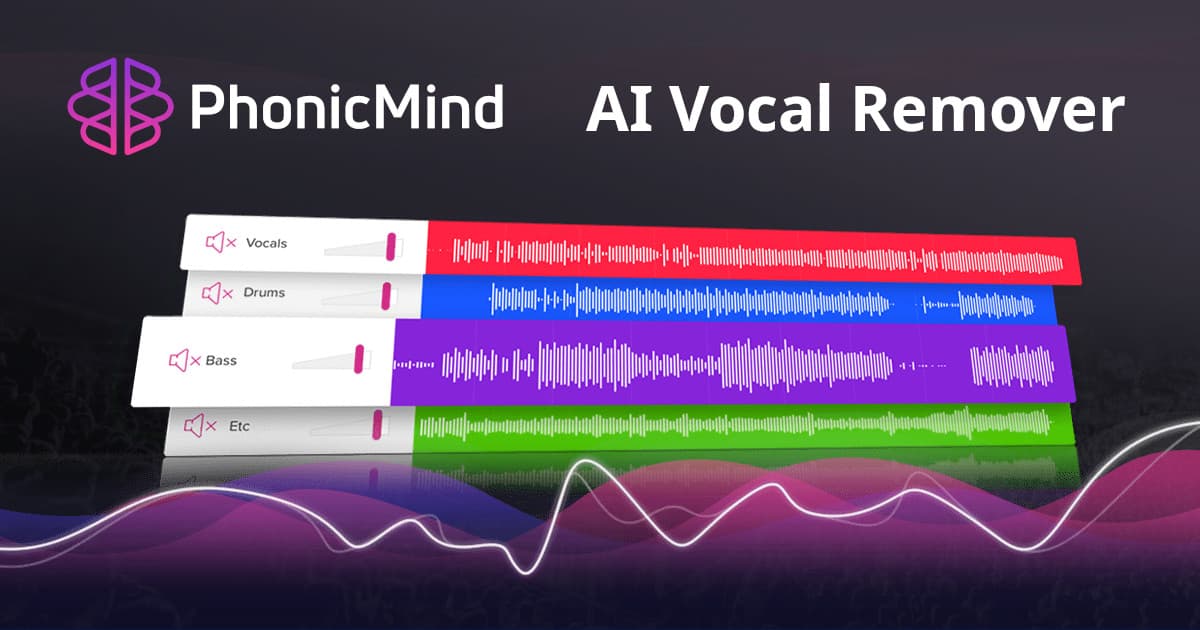
PhonicMind
PhonicMind is an AI-powered online vocal remover and music separator, enabling users to extract vocals, drums, bass, and other instruments from any song. It offers studio-grade separation for creating instrumentals, acapellas, or minus-one tracks. The tool provides an instant preview feature, allowing users to hear the separated stems before exporting. PhonicMind supports various audio formats and processes files up to 100MB. It's designed for musicians, DJs, producers, and teachers who need clean audio stems for remixes, practice, or performance. The platform has been pioneering online AI stem splitting since 2016, continuously training its AI for real-world songs and offering multi-stem accuracy.
Genie-TTS
Genie-TTS is an open-source, lightweight inference engine and model converter specifically designed for GPT-SoVITS ONNX models. It excels in providing near-instantaneous speech synthesis on CPUs, making it highly efficient for various applications. The tool integrates essential functionalities such as TTS inference, ONNX model conversion, and an API server, all aimed at delivering ultimate performance and convenience. It supports GPT-SoVITS V2 and V2ProPlus models, with planned support for V3 and V4, and handles Japanese, English, Chinese, and Korean languages. Genie-TTS also offers significant performance advantages over official PyTorch models, particularly in first inference latency and runtime size, making it an ideal solution for developers and content creators seeking high-performance, CPU-based speech synthesis.
WenetSpeech
WenetSpeech offers a comprehensive 10000+ hour multi-domain Chinese corpus specifically designed for speech recognition tasks. This extensive dataset is compiled from YouTube and Podcast sources, utilizing both Optical Character Recognition (OCR) and Automatic Speech Recognition (ASR) techniques for labeling. To ensure high quality, the corpus undergoes a novel end-to-end label error detection method for validation and filtering. It categorizes data into High Label, Weak Label, and Unlabel sets, suitable for supervised, semi-supervised, or unsupervised training. The dataset also provides various training subsets (S, M, L) and evaluation sets (DEV, TEST_NET, TEST_MEETING) to support diverse ASR system development and benchmarking. Access to the dataset requires visiting the official website, agreeing to the license, and obtaining a password.
Text To Speech SpeechT5 Demo
Text To Speech SpeechT5 Demo is an AI-powered tool available as a Hugging Face Space, designed for converting written text into spoken audio. This demo utilizes the SpeechT5 model, offering users a straightforward and accessible platform for text-to-speech conversion. While the live website indicates a runtime error, the tool's core functionality is to process text input and generate corresponding speech output. It aims to provide a quick and easy way for individuals to experience the capabilities of the SpeechT5 model without complex setup, making it suitable for various applications requiring synthesized voice.
my-neuro
my-neuro is an open-source project designed to help users create their own personalized AI desktop companions. Inspired by Neuro Sama, this tool allows for extensive customization of characters, including voice, personality, and appearance, compatible with various Live2D models. It boasts ultra-low latency responses, with conversations responding in under one second, and supports both local inference with open-source LLMs and integration with closed-source AI models via DMXAPI. Key features include long-term memory, visual recognition, voice cloning, and LLM training, enabling the AI to remember user interactions, understand visual cues, and adapt its responses. The project also plans to integrate advanced human-like interaction designs, such as real-time interruptions, emotional responses, and desktop control capabilities, making it a versatile platform for building deeply personal AI companions.
Clipboard TTS
Clipboard TTS is a next-generation text-to-speech reading aid designed to supercharge your reading experience. It seamlessly scans and reads text from your clipboard, eliminating manual copy-and-paste hassles. The tool boasts high-quality, natural-sounding voices across 49 languages and over 100 voices, making listening an immersive journey. Key features include auto-dictionary for word definitions, image-to-text conversion, and automatic translation before speaking. For users with dyslexia, Clipboard TTS offers customizable highlighting, background overlays, and the OpenDyslexic font to improve readability. An experimental AI Assist feature allows for text mutation and summarization based on custom prompts, providing a versatile tool for various reading and learning needs.
Concert Creator
Concert Creator utilizes cutting-edge AI to analyze audio recordings and convert them into highly realistic video performances and music lessons. The AI is trained on professional musicians, ensuring accurate and human-like results for piano animations. Users can customize various aspects of the generated performances, including camera angles, key colors, and lighting effects. The tool also provides customizable avatars and allows for full control over the AI, enabling users to adjust fingering technique, hand separation, and note force. Concert Creator includes a comprehensive suite of learning features such as sheet music, a built-in song library, playback speed control, section looping, and MIDI in/out capabilities. It is currently available for Mac, PC, and PC VR, with iOS, Android, and Oculus Quest versions planned.