
Research & Education
Browsing page 212 of AI tools for Research & Education. Sorted by confidence score — our independent quality rating.

GAIA Agent - Q&A Chatbot
GAIA Agent - Q&A Chatbot is an AI-powered conversational tool designed to provide detailed answers to user questions. It supports file uploads, enabling the chatbot to process information from various documents in addition to text inputs. This functionality allows for comprehensive responses based on the provided context, making it suitable for information retrieval and insight generation. The tool aims to leverage AI to enhance understanding and interaction by synthesizing data from multiple sources to deliver relevant and informed answers.
HandSpew
HandSpew is an innovative web application that allows users to generate thoughts and text through intuitive hand gestures. Leveraging MediaPipe for precise hand landmark detection, the tool translates your movements into words using the power of Gemini. This unique interaction method offers a fun and engaging way to explore AI-driven text generation. It's a free-to-use platform, making AI interaction accessible and enjoyable for anyone interested in novel human-computer interfaces. HandSpew provides a creative outlet for expressing ideas without typing, simply by moving your hands.
SwiftNotes AI
SwiftNotes AI is an intelligent tool designed to streamline information capture and organization by generating instant AI notes from YouTube videos. It leverages artificial intelligence to help users quickly process and make sense of video content, enhancing overall productivity and knowledge management. The tool aims to be the simplest and fastest AI solution for students and professionals who rely on video content for learning and research, allowing them to study smarter and ensure no important details are overlooked. Users can try it free to experience its benefits.
HKUST(GZ) Information Hub, 港科大(广州)信息枢纽
The HKUST(GZ) Information Hub, part of The Hong Kong University of Science and Technology (Guangzhou), is dedicated to advancing information science and technology through innovative education and research. It emphasizes a cross-disciplinary approach, integrating various fields to address complex challenges. The hub focuses on key areas such as Artificial Intelligence, Data Science, Internet of Things (IoT), and Computational Media, aiming to cultivate forward-looking talents with a global vision. Through its academic structure, which includes various Hubs and Thrust Areas, HKUST(GZ) seeks to promote higher education reform and accelerate collaboration between Hong Kong and Mainland China, contributing significantly to the development of the Greater Bay Area.
Homeworkify.im
Homeworkify.im is an AI-powered platform designed to provide accurate and instant homework assistance across a wide range of subjects. Positioned as an alternative to Homeworkify, it leverages advanced GPT-4o technology to deliver precise answers. Users can input problems via text, images, or files, making it a versatile and user-friendly solution. The platform offers step-by-step solutions, interactive Q&A for follow-up questions, and supports multiple languages. It also includes features like saving and reviewing past problems and multi-platform accessibility, ensuring students can get help anytime, anywhere. This tool is particularly beneficial for STEM learners and students of all levels seeking reliable academic support.
chainer-chemistry
Chainer Chemistry is an open-source deep learning library specifically designed for applications in biology and chemistry. Built upon the Chainer framework, it provides support for a variety of state-of-the-art models, with a particular focus on Graph Convolutional Neural Networks (GCNN) for chemical property prediction. The library enables researchers and developers to train new models on given datasets, perform inference using pre-trained models, and evaluate the performance of different models. It supports numerous GCNN architectures like NFP, GGNN, WeaveNet, SchNet, and MPNN, along with several chemical and network datasets such as QM9, Tox21, MoleculeNet, and ZINC. Chainer Chemistry is a valuable tool for academic research, facilitating advancements in areas like molecular graph generation and the explanation of GCNN predictions.
Groq-LLaMA3/4
Groq-LLaMA3/4 is a chat application built using Streamlit and the Groq API, hosted as a Hugging Face Space. It enables users to engage with various Llama models and other AI models available through a Groq account. The tool supports multimodal interactions, allowing users to upload and reference .txt, .md, or .pdf files within their conversations. Additionally, if the selected model has vision capabilities, users can upload images for analysis. This makes it a versatile platform for exploring and interacting with advanced AI models in a conversational format.
self-correction-llm-papers
This GitHub repository, self-correction-llm-papers, serves as a comprehensive collection of research papers focused on the self-correction mechanisms of Large Language Models (LLMs) using automated feedback. It is an invaluable resource for researchers and practitioners delving into the advancements and methodologies for improving LLM performance and reliability. The collection is meticulously organized into categories such as Training-Time Correction (including RLHF, Fine-tuning, and Self-Training strategies), Generation-Time Correction (covering Re-Ranking and Feedback-guided strategies), and Post-hoc Correction (featuring Self-Refine, External Feedback, and Model-Debate strategies). This structured approach allows users to easily navigate and explore the landscape of diverse self-correction techniques.
ChatTutor
ChatTutor is an innovative open-source AI tutor designed to enhance learning through visual and interactive methods. Unlike traditional text-based chatbots, ChatTutor integrates an electronic whiteboard, allowing AI to utilize teaching tools similar to a real classroom. This capability is particularly beneficial for STEM subjects where visual aids are crucial for understanding complex concepts. Users can set their own API keys and models, providing flexibility and customization. The platform supports features like Math Canvas and Mindmap, making it a versatile tool for personalized tutoring and interactive learning experiences. It aims to bring a more hands-on teaching approach to AI education.
NinjaED
NinjaED is a comprehensive AI-powered educational platform designed to transform how educators plan, teach, and communicate. It offers core features like year-long planning and curriculum management, including instant plan generation, standards alignment, and customizable unit scheduling. Teachers can enhance lessons with AI-powered tools, generate worksheets, and access an extensive resource library. The platform also provides robust classroom management and student tracking capabilities, such as attendance tracking, automated catch-up tasks, and behavior documentation. A smart communication system facilitates professional responses, template-based messaging, and seamless parent-teacher interaction. Additionally, an innovative AI assistant, Sensei Session, offers real-time teaching support and professional development resources, significantly saving time on administrative tasks and enhancing teaching effectiveness.
BuildAspect
BuildAspect is a specialized software solution designed for interior designers and residential design-build teams to streamline product selections, specifications, and installation details. It centralizes product decisions, purchase orders, and installation requirements, moving teams away from disparate spreadsheets, PDFs, and emails. Key features include automated product data capture, an AI-powered Chrome extension for grabbing tear sheets and specs from manufacturer websites, and a client portal for clear decision-making and progress tracking. The platform also offers an audit trail for changes and approvals, simplified purchasing, and mobile-friendly views for jobsite access, ensuring the right information reaches trade partners efficiently.
Saama
Saama provides AI-powered analytics solutions specifically for the life sciences industry, focusing on accelerating clinical development and improving patient outcomes. The platform offers a suite of tools including a Clinical Data Foundation, Data Hub, Smart Data Quality (SDQ), Operational Insights, Patient Insights, and an AI-Powered Document Generator. Saama also specializes in Biometrics Research and Analysis Information Network (BRAIN) solutions. With over a decade of experience in developing and training AI models for life sciences, Saama differentiates itself through its dedicated in-house AI research lab, which has produced numerous publications, citations, and patents. The company offers both SaaS solutions and product-based industry services, aiming to reduce time to data discovery, save manual work hours, and accelerate patient data review and content drafting.
Giant Music Transformer
Giant Music Transformer is a powerful AI tool designed for generating multi-instrumental music. Users can initiate music creation by uploading an existing MIDI file or by starting with a random input, offering flexibility in the creative process. The tool provides various customizable settings, including the number of tokens, temperature, and drum introduction, allowing for fine-tuned control over the generated output. This makes it suitable for musicians, content creators, and anyone looking to experiment with AI-driven music composition. The application is hosted on Hugging Face Spaces and is available under the Apache 2.0 license, promoting open access and collaboration.
Free Youtube URL Video-to-Text Using OpenAI Whisper
Free Youtube URL Video-to-Text Using OpenAI Whisper is an AI tool hosted on Hugging Face Spaces that leverages OpenAI's Whisper model to transcribe audio from YouTube videos into text. This tool allows users to simply input a YouTube video URL, and it processes the audio to generate a text transcription. It is designed for ease of use, providing a straightforward method for converting spoken content from videos into a readable format. While the live website currently shows a runtime error, the tool's core functionality is to provide quick and accessible video-to-text transcription.
Gemma-3-R1984-27B ChatBot
Gemma-3-R1984-27B ChatBot is an AI-powered application designed to provide answers by analyzing various document types, including text, PDF, CSV, and TXT files. Users can upload their documents and then ask questions, receiving detailed responses derived directly from the content. This tool is built for reasoning and deep research, leveraging the Gemma-3 family of models. It is hosted on Hugging Face Spaces and benefits from the processing power of NVIDIA H100 GPUs, indicating a focus on robust performance for complex analytical tasks. The application aims to streamline information extraction and question-answering from diverse data sources.
PDF.ai
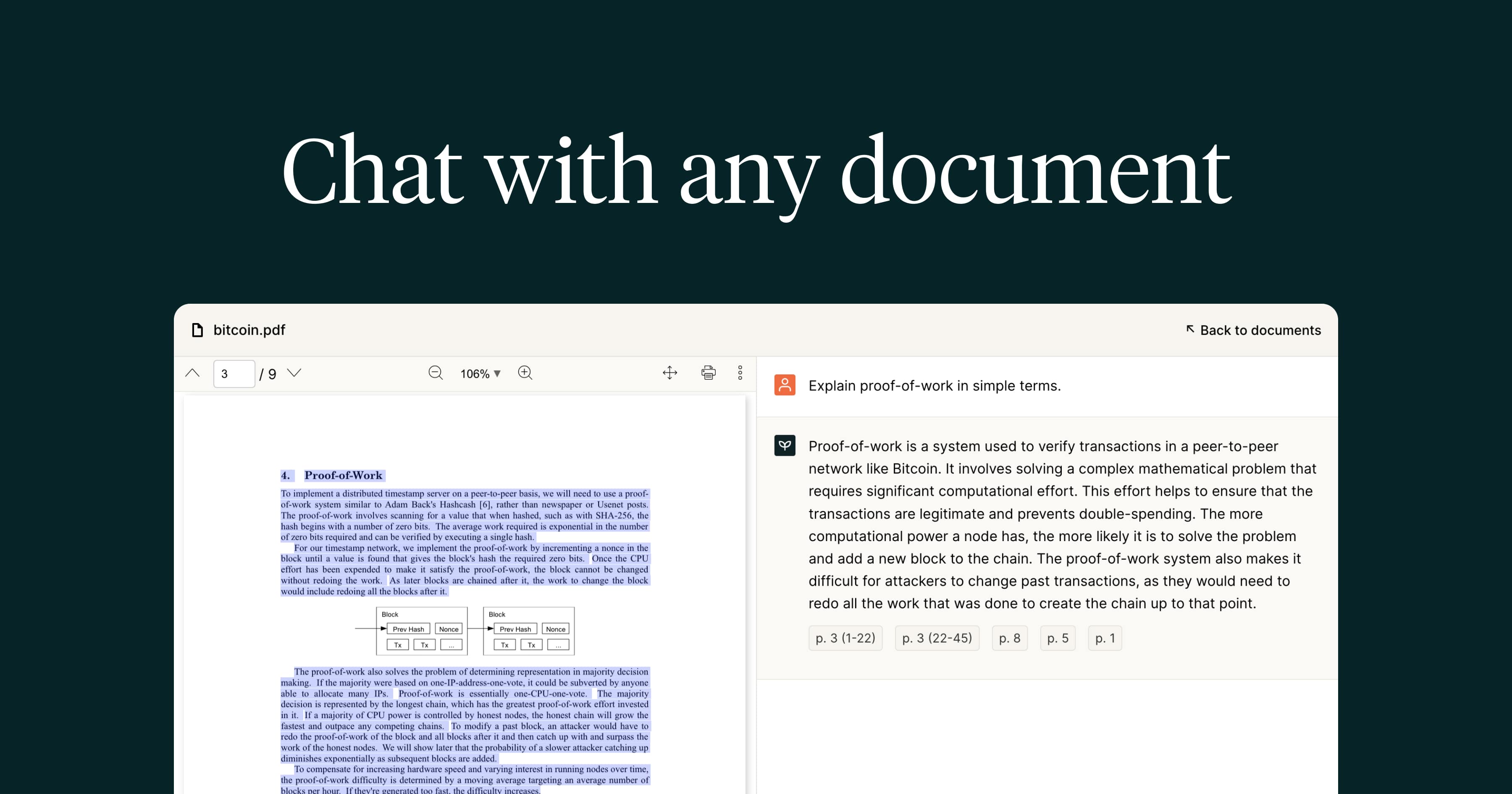
PDF.ai is an AI-powered tool designed to simplify information retrieval and enhance document comprehension by enabling users to interact with their PDFs. It features an AI chat interface where users can ask questions, receive summaries, and find specific answers within their documents. Beyond direct interaction, PDF.ai provides a robust API for developers and businesses to integrate document parsing, data extraction, and PDF splitting capabilities into their own workflows. This makes it a versatile solution for both individual users seeking quick insights and organizations looking to automate document processing tasks.
Software-Engineer-Coding-Interviews
Software-Engineer-Coding-Interviews is a comprehensive GitHub repository designed to help software engineers prepare for technical interviews. It covers essential topics such as Data Structures and Algorithms, System Design (including Generative AI and Machine Learning System Design), Machine Learning, and DevOps. The repository offers a curated collection of interview practices, notes, and resources from various reputable sources like ByteByteGo, Educative, and Princeton University's Algorithm courses. It includes detailed markdown notes, PDF notes, and references to books like "Beyond Cracking the Coding Interview" and "Coding Interview Patterns," making it a valuable self-study guide for aspiring and experienced engineers.
QUT Urban AI Hub
The QUT Urban AI Hub is a dedicated research center within the Queensland University of Technology, focusing on the intersection of artificial intelligence and urban development. Its primary goal is to foster research into smart and sustainable cities and communities. The hub serves as a central point for researchers exploring various topics related to urbanisation and AI, offering a supportive network and resources. It aims to drive innovation and provide solutions for real-world urban challenges by leveraging AI technologies and interdisciplinary collaboration within the academic community.
NonprofitAMA
NonprofitAMA is an AI chatbot designed to be a comprehensive resource for individuals involved in the nonprofit sector. It is built and trained on curated, high-quality resources covering a wide array of topics including leadership, management, governance, fundraising, marketing, incorporation, fiscal sponsorship, organizational design, strategy, advocacy, and DEI. Users can simply type their questions into the form to receive detailed responses. The tool also provides linked sources for further review, ensuring users can verify information and delve deeper into specific subjects. It aims to put a nonprofit expert in your pocket, offering instant insights and support for various operational and strategic challenges.
Mistral Nemo
Mistral Nemo was an AI chatbot available on Hugging Face Spaces, designed to facilitate task automation and content generation. The tool aimed to provide an accessible platform for exploring AI chatbot capabilities, particularly for educational use and interactive experiences. However, the application is currently experiencing a runtime error, indicating that the underlying repository for the model is not found or accessible. This suggests that while the tool was intended to offer free exploration of AI chatbot functionalities, it is presently non-functional due to issues with its model's availability or authentication.
deepLearningBook-Notes
deepLearningBook-Notes offers an in-depth resource for understanding the Deep Learning book by Ian Goodfellow, Yoshua Bengio, and Aaron Courville (2016). This GitHub repository provides detailed notes, intuitive explanations, visual drawings, and practical Python code examples to clarify complex mathematical theories, especially linear algebra concepts crucial for deep learning and machine learning. It's designed to help beginners and advanced beginners grasp the underlying principles, offering a structured syllabus that mirrors the book's chapter on linear algebra. The resource emphasizes hands-on learning through Python notebooks, enabling users to experiment with abstract mathematical notions and visualize linear transformations, making it an invaluable aid for data science skill development.
Daily Reliever
Daily Reliever is an AI-powered communication tool designed to delve into the intricate world of social dynamics. It examines how these dynamics influence both individual actions and collective group behaviors. The tool provides insights into the role of cultural influences and societal norms in shaping interactions. Furthermore, Daily Reliever considers the impact of technological advancements on the evolution of society, offering a comprehensive perspective on modern communication challenges and opportunities. Its core function appears to be analyzing and understanding complex social interactions through an AI lens.
Sentiment-Analysis-Twitter
Sentiment-Analysis-Twitter is an open-source research project focused on determining the best combination of feature sets and machine learning classifiers for sentiment analysis of Twitter data. The project explores various pre-processing steps, including handling punctuations, emoticons, Twitter-specific terms, and stemming. It investigates features such as unigrams, bigrams, trigrams, and negation detection, and trains classifiers using algorithms like Naive Bayes, Decision Trees, and Maximum Entropy. The methodology uses a modularized approach, separating feature extraction and classification, which allows for flexible experimentation. While the original project code remains publicly hosted, the project has been sold and is also available as a commercial API through OnePanel Inc.
sentiment_analysis_fine_grain
sentiment_analysis_fine_grain is an open-source GitHub repository providing resources for multi-label classification with BERT, specifically tailored for fine-grained sentiment analysis. It includes code for training models, deploying BERT for online prediction, and a tutorial for using BERT with Chinese text. The repository offers pre-trained models, data for fine-tuning and pre-training, and scripts for data preprocessing and model evaluation. It supports both BERT and TextCNN architectures, allowing users to experiment with different approaches to sentiment analysis. This tool is ideal for researchers and NLP engineers working on sentiment analysis tasks, particularly those involving Chinese language data.