
Research & Education
Browsing page 321 of AI tools for Research & Education. Sorted by confidence score — our independent quality rating.

RiseUpp
RiseUpp is India’s leading online marketplace designed to help students and professionals compare and enroll in a vast array of online degrees, certificates, and free courses. With over 10,000 courses available from more than 500 universities and companies, including UGC-approved online degrees, RiseUpp simplifies the educational journey. The platform offers curated course listings, tailored learning paths, and streamlined enrollment processes. Users can benefit from exclusive scholarships, discounts of up to 30% on select courses, and flexible payment options like no-cost EMIs. Beyond course comparison, RiseUpp provides personalized career counseling, unbiased course recommendations, and comprehensive post-enrollment support, including community access and placement assistance, ensuring learners achieve their career goals.

LookinGlassRGBD
LookinGlassRGBD is an AI tool designed for processing RGBD (Red, Green, Blue, Depth) images, facilitating advanced 3D scene understanding. It allows users to analyze depth information alongside color data, which is crucial for applications requiring precise spatial awareness. The tool is particularly beneficial for researchers and developers in the computer vision field, offering capabilities for tasks such as object recognition, environmental mapping, and robotic navigation. Hosted on Hugging Face Spaces, it leverages community-driven machine learning models, providing a platform for experimentation and development in 3D computer vision.
3DOI
3DOI is a research tool hosted on Hugging Face Spaces, designed for the academic exploration of 3D object interaction. The project focuses on understanding how 3D objects behave and interact when presented with only a single image as input. This tool is primarily intended for researchers and academics in the field of computer vision and artificial intelligence who are working on problems related to 3D reconstruction, scene understanding, and object manipulation from limited visual data. While the current live website indicates a runtime error preventing full functionality, the underlying goal is to provide a platform for experimentation and development in this specialized area.
giotto-tda
Giotto-tda is a high-performance topological machine learning toolbox implemented in Python, designed to facilitate advanced data analysis and machine learning research. Built on top of the scikit-learn ecosystem, it offers robust algorithms for topological data analysis (TDA). The toolbox is part of the Giotto family of open-source projects and is distributed under the GNU AGPLv3 license. It supports Python 3.7+ and integrates with popular libraries like NumPy, SciPy, and Plotly. Giotto-tda is the result of a collaborative effort between L2F SA, EPFL, and HEIG-VD, making it a reliable tool for researchers and data scientists working with complex datasets.
SemanticSegmentation_DL
SemanticSegmentation_DL is a valuable repository for researchers and practitioners focused on semantic segmentation using deep learning. It compiles an extensive list of academic papers, resources, and implementations of various semantic segmentation models, including DeepVO, Deeplab-v2, and U-net. The repository also provides links to numerous datasets crucial for training and evaluating these models, such as VOC2012, CitySpaces, Mapillary, and ADE20K. This resource is designed to support the academic community by centralizing information on state-of-the-art techniques and datasets, making it easier to explore advancements and conduct research in the field of semantic segmentation.
Preferred Computational Chemistry, Inc.
Matlantis is an atomic-level AI simulator that provides fast, accurate insights for experimental discovery in materials science. It leverages a fusion of materials science and AI to enable atomistic simulations with accuracy comparable to quantum chemical calculations, but at significantly higher speeds. Matlantis can simulate chemically and structurally complex materials without restrictions on elemental composition or arrangement. This tool transforms materials research by operating ahead of experiments, drastically reducing development time from months to seconds. Key features include its core AI model PFP, applied technologies like LightPFP and Matlantis CSP, and comprehensive support for implementation and utilization.
LOTUS Normal
LOTUS Normal is an AI tool designed to generate high-quality predictions from input images, offering both generative and discriminative outputs. This application allows users to upload an image and optionally specify a seed number for generation. While the tool's specific functionalities beyond image prediction are not detailed, its presence on Hugging Face suggests it leverages advanced machine learning models for its operations. The platform itself, Hugging Face, provides various pricing tiers for its services, including storage and compute resources for running such applications, indicating that while the core tool might be accessible, underlying infrastructure costs could apply for extensive use.
OmniSets
OmniSets is an AI-powered flashcard and study platform designed to optimize learning efficiency. It allows users to generate flashcards using AI, making it a strong alternative to traditional flashcard tools. The platform incorporates AI-based learning, spaced repetition, and practice tests to provide a comprehensive study experience. Users can also convert custom videos and audio into flashcards. OmniSets aims to support students globally by offering a free-to-use platform with minimal ads, and additional perks for patrons, including an ad-free experience, increased AI usage resets, and larger image upload sizes.
Smol Training Playbook - Table of Contents
Smol Training Playbook - Table of Contents is a valuable, free educational resource hosted on Hugging Face, designed to help users navigate and understand the world of machine learning applications. This tool serves as a comprehensive table of contents for a training playbook, making it easier for individuals to discover and explore various ML apps developed by the community. It's an excellent starting point for anyone looking to delve into practical machine learning examples and learn from community-contributed projects. The platform emphasizes accessibility and community-driven learning, providing a structured overview of diverse ML applications.

Fenbilimleri.net
Fenbilimleri.net, established in 2021, is an educational platform dedicated to providing free and comprehensive science resources for middle school students in grades 5, 6, 7, and 8. The website offers a wide array of materials including topic explanations, worksheets, practice tests, and written exam PDFs, all designed to support learning and teaching in science. It aims to make quality educational content accessible, helping students prepare for exams like LGS and deepen their understanding of scientific concepts. The platform also features educational games and a blog with articles related to science and education, fostering an engaging learning environment.
EZAi AI
EZAi AI is an intuitive copywriting tool designed to make content creation effortless, whether you're at your desk or on the move. It provides over 60 professionally designed templates, including options for Instagram posts, Facebook posts, blog posts, and business mottos, alongside a 'Freestyle' template similar to ChatGPT for open-ended writing. The platform supports 36 languages and features 12 AI assistants to offer expert guidance across various business areas. EZAi streamlines the content creation process into three simple steps: input requirements, AI generation, and customization. It aims to help users generate high-quality content instantly, maintain consistent brand voice, and focus on business growth.

Video to SCORM Converter
Video to SCORM Converter is an online tool designed to effortlessly convert MP4 or MOV video files into SCORM 1.2 or SCORM 2004 compliant packages. This enables robust completion tracking, watch-time reporting, and full compatibility with Learning Management Systems (LMS). Users can upload their video, configure SCORM settings like completion percentage and version, and instantly generate a ready-to-use SCORM ZIP file without needing complex authoring tools. The service emphasizes security, with automatic file deletion after download, SSL/TLS encrypted transfers, and GDPR compliance. Beyond videos, the platform also offers conversion for PDF and PowerPoint files, making it a versatile solution for creating trackable e-learning content.
perplexity-ai
Perplexity AI is a Python module designed as an unofficial API wrapper for Perplexity.ai, offering enhanced functionality and flexibility. A key feature is its ability to leverage Emailnator for automatic generation of new accounts, effectively bypassing query limits and providing unlimited pro queries. The module supports both synchronous and asynchronous APIs, catering to different programming needs. For users who prefer a graphical interface, it also includes a web interface that automates account creation and usage. This tool is particularly useful for developers and data scientists looking to integrate Perplexity.ai's capabilities into their applications or workflows without the constraints of official API keys, offering robust error handling, comprehensive logging, and streaming responses.
EducatorLab
EducatorLab is an AI-powered SaaS tool designed to assist educators globally in creating compliant lesson plans, worksheets, and activities. The platform enables users to generate PDF and Doc files for any grade level, academic subject, and educational stage, including general and adult education. It offers features like customization to meet specific curriculum needs, collaboration tools for sharing resources, and an AI-powered engine for quick content generation. EducatorLab aims to streamline the lesson planning and assessment process, saving educators time and reducing stress while helping them improve student outcomes with high-quality educational materials.
Liner.ai
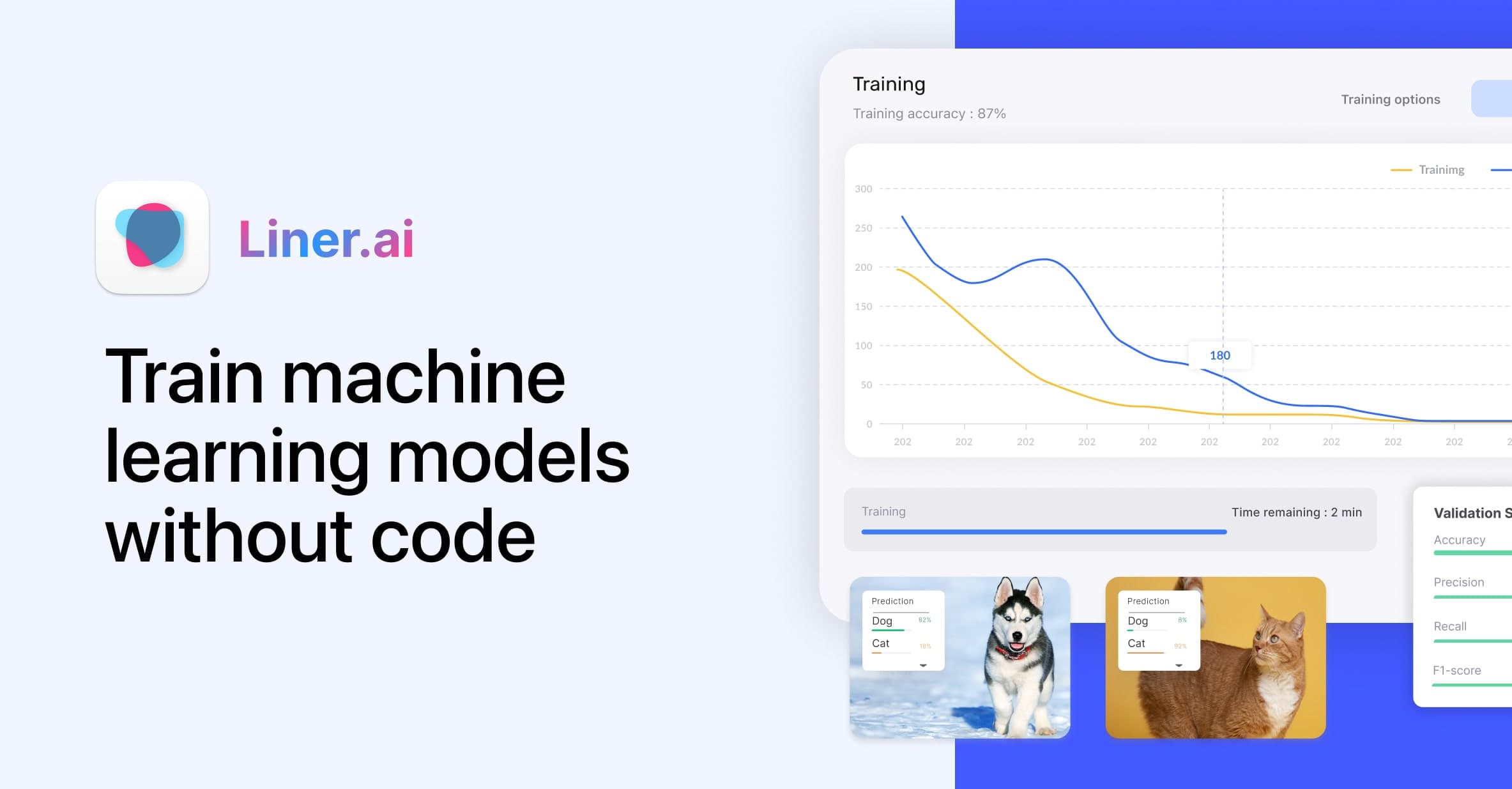
Liner.ai is a free, no-code machine learning tool designed to simplify the process of building and deploying AI applications. Users can train and integrate ML models within minutes, without needing coding skills or prior machine learning expertise. The tool supports various project types, including image, text, audio, and video classification, as well as object detection, image segmentation, and pose classification. Liner.ai optimizes models for speed and accuracy, allowing training to occur quickly on CPUs without requiring a GPU. It also supports exporting models for use on mobile and edge devices, ensuring data privacy by performing all training locally on the user's computer.

Talkio AI
Talkio AI is an advanced language training application designed to help users improve their oral language skills through interactive conversations with AI tutors. The platform supports over 70 languages, allowing users to practice speaking and receive instant pronunciation feedback. It utilizes custom-tuned AI models from OpenAI, Anthropic, and Groq, optimized for language learning to create a powerful AI language coach. Talkio AI is suitable for users with some basic language knowledge, including beginners, and offers a 'crosstalk' method where users speak their native language and the AI responds in the target language. The tool is available as a Progressive Web App (PWA) for easy installation on mobile devices and works across all modern browsers.
Maths.ai
Maths.ai is an AI-powered online math tutor designed to help users of all levels, from arithmetic to calculus, conquer math challenges. It offers instant, step-by-step explanations for math doubts and questions, making complex equations and formulas easy to understand. The platform provides 24/7 availability, global access, and a judgment-free space for asking any question. With affordable plans, Maths.ai adapts to individual learning paces and levels, ensuring a personalized learning experience. It aims to make math cool and accessible, helping students and professionals alike to build and refresh their math skills.
Multimodal VLM Thinking
Multimodal VLM Thinking is a Hugging Face Space designed for AI research, enabling users to interact with various vision-language models (VLMs). Users can upload an image, input a question or instruction, and select from models like Lumian-VLR, VisionThink, MiniCPM-V, Typhoon-OCR, or olmOCR to process the request. The application provides written responses, capable of describing image content, extracting text via OCR, or performing other image-based reasoning tasks. This tool is particularly useful for researchers and engineers focused on advancing AI capabilities in understanding and processing both visual and textual information.
Multiview Diffusion 3d
Multiview Diffusion 3d is an AI tool hosted on Hugging Face Spaces that enables users to generate multiple perspectives of an object. By providing either a text prompt describing the desired object or uploading an image, the tool processes the input to produce a grid displaying various views of that object. This capability is particularly useful for visualizing objects from different angles without manual rendering. While the live website indicates a runtime error, the tool's core functionality is designed for creating diverse 3D representations, making it suitable for research, experimentation, and educational purposes in 3D content generation and diffusion techniques.
mrr.guide
MRR.guide provides a comprehensive SaaS growth guide designed to help founders secure their initial 100 paid clients without relying on paid advertising or luck. Authored by Alexander Isora, who successfully bootstrapped and sold Unicorn Platform, the guide distills his experiences and observations from other successful founders. It features actionable micro-guides covering various marketing strategies, including launching on platforms like Reddit and Product Hunt, content creation, community building, and creating side projects. The guide also offers lifetime access to a closed community and discounts on related tools, making it a valuable resource for solo founders and developers struggling with customer acquisition.
Murder.Ai - LLMs that kill, lie, decieve
Murder.Ai is an interactive AI Agents & Automation tool hosted on Hugging Face Spaces, designed to simulate and solve murder cases. Users can select a case file, configure game settings, and engage with various interactive tools to progress through the investigation. Key features include location mapping to visualize crime scenes, evidence collection mechanisms, and suspect interviews to gather information. The platform offers a unique way to explore narrative-driven AI interactions, allowing users to choose between different gameplay experiences. It serves as an experimental environment for understanding how AI can be applied to complex problem-solving scenarios within a fictional context.
Music Arena Leaderboard
Music Arena Leaderboard is an AI tool designed to compare and rank AI-generated songs from various platforms, including Suno, Udio, Google, and Meta. Users can visit the Music Arena to view an interactive leaderboard of top tracks, allowing them to explore and discover the best AI-generated music without needing to provide any input. The platform serves as a community-driven space where AI-generated songs are ranked, offering insights into the performance and quality of different AI music generators. It's a valuable resource for anyone interested in the evolving landscape of AI music creation.
Open Neuromorphic
Open Neuromorphic is a global community dedicated to advancing brain-inspired AI and hardware through education, research, and open-source collaboration. It offers a comprehensive Computing Hub with guides for neuromorphic hardware and software, including SNN frameworks and event-based data tools. The platform facilitates community-driven projects through its Mission Board, hosts a peer review program for open and reproducible research, and organizes educational events like Hacking Hours, Student Talks, and expert-led Workshops. Members can explore resources, get involved in initiatives, and contribute to a collective knowledge base through blogs and presentations, fostering innovation in neuromorphic computing.

Parle
Parle is a mobile application designed to help users learn French speaking and improve their pronunciation. The app focuses on practical, daily practice, allowing users to repeat real French phrases and receive instant feedback on their pronunciation. It is structured to be beginner-friendly, starting with basic concepts and progressing step-by-step through short phrases and videos. Users can dedicate about 5 minutes a day to practice, making it an accessible tool for consistent language learning. Parle aims to build confidence in speaking French by providing immediate corrective feedback on sounds and rhythm.