
Research & Education
Browsing page 52 of AI tools for Scientific Computing in Research & Education. Sorted by confidence score — our independent quality rating.

Data Co-Lab
Data Co-Lab is a platform dedicated to fostering AI culture, particularly within Tunisia. While the website indicates it is currently under development, its stated mission revolves around learning, engineering, and research in the field of data science. The initiative seeks to boost development through the application and understanding of data science principles. Once launched, it is expected to provide resources and a collaborative environment for students and educators interested in AI and data science.
HMR2.0
HMR2.0 is an AI tool designed for human pose estimation and 3D human reconstruction from images. This tool, available on Hugging Face Spaces, aims to provide capabilities for analyzing and recreating human poses in a three-dimensional space. While the current live website content indicates a runtime error, suggesting the application is not fully functional at the moment, its intended purpose is to process images and derive 3D human models. This technology is typically valuable for researchers, developers, and professionals working in fields such as computer vision, animation, and virtual reality, where accurate human pose data is crucial for various applications.
RNA Digital Solutions
RNA Digital Solutions provides advanced AI and simulation tools specifically designed for the digitalization of mechanical engineering, with a strong focus on feeding technology. Their solutions enable companies to integrate AI and simulation into project planning and CAD engineering, offering a significant competitive advantage. The platform helps accelerate technical sales and construction processes, ensuring faster time-to-market. By digitizing experience-based knowledge, it allows for optimal technical decisions even amidst skilled labor shortages. The tools also aid in early detection of disruptions through simulation, preventing costly rework and improving overall equipment effectiveness (OEE) and performance for end customers.
speechpy
SpeechPy is an open-source Python library designed for various speech processing and recognition tasks. It provides a comprehensive set of tools for extracting features from audio, performing detailed audio analysis, and facilitating the development of speech recognition models. The library is available on GitHub, making it accessible for developers and researchers working on speech-related applications and projects.
LightGlue
LightGlue is an AI-powered tool specifically developed for image matching and feature extraction tasks. It plays a crucial role in various computer vision and robotics applications by accurately identifying and comparing features across different images. The tool is accessible on Hugging Face, making it readily available for researchers and developers. Its core functionality focuses on enhancing the precision and efficiency of visual data processing, which is vital for tasks like object recognition, 3D reconstruction, and autonomous navigation.
flashlight
Flashlight is an open-source C++ library specifically engineered for machine learning research and development. It provides a robust framework for creating and experimenting with machine learning algorithms. The library's design emphasizes both rapid prototyping capabilities, allowing researchers to quickly test new ideas, and the ability to build high-performance applications suitable for demanding computational tasks. Its standalone nature ensures flexibility and ease of integration into various projects.
muzic
muzic is a research project dedicated to the field of AI music, developed by researchers at Microsoft Research Asia and external collaborators. The project's core functionality revolves around leveraging deep learning and artificial intelligence techniques for both understanding existing music and generating new musical compositions. As an open-source initiative, muzic aims to foster collaboration and advancement within the AI music community.
Atinary
Atinary is an AI-powered platform specifically designed to accelerate research and development across a range of industries including pharma, biotech, food, chemicals, energy, and climate tech. The platform focuses on optimizing experimental planning and orchestrating complex workflows. By leveraging advanced machine learning technology, Atinary aims to significantly reduce the time it takes to hit research targets, potentially cutting down development cycles from years to just weeks or months. It is particularly well-suited for applications in formulation, catalysis, and synthesis, providing a robust solution for scientific and industrial innovation.
Intelligent Simulation Ltd
Intelligent Simulation Ltd offers specialized scientific and technical consulting services, leveraging over 20 years of experience. Their expertise spans critical areas such as Computer-Aided Engineering (CAE), Computational Fluid Dynamics (CFD), industrial design, machine learning, and quantum computing. They aim to connect complex scientific and technical concepts for their clients, providing valuable insights and solutions. The company primarily serves engineers, scientists, and researchers who require advanced technical guidance and support.
cifar-10-cnn
cifar-10-cnn is a GitHub repository dedicated to providing implementations of Convolutional Neural Networks (CNNs) specifically designed for the CIFAR-10 dataset. The repository leverages popular deep learning frameworks such as Keras and TensorFlow to construct and train these CNN models. It features various architectures, including the well-known LeNet, offering a practical resource for those working with image classification tasks. Additionally, a PyTorch version of similar implementations is referenced, available at CIFAR-ZOO, indicating broader support for different deep learning ecosystems.
bayesian-neural-network-pytorch
bayesian-neural-network-pytorch is a concise repository that provides a PyTorch implementation of Bayesian neural networks. This tool is designed to help users construct and train two-layer Bayesian neural networks, offering a practical way to explore and apply BNN concepts. It specifically supports experimentation with custom datasets, making it suitable for researchers and developers looking to integrate Bayesian methods into their deep learning projects. The repository requires torch version 1.2.0 and Python 3.6 for operation.
crfasrnn
crfasrnn is a source code repository focused on semantic image segmentation. It leverages Conditional Random Fields (CRFs) integrated as Recurrent Neural Networks (RNNs), a technique first presented at ICCV 2015. The repository provides implementations in popular deep learning frameworks, specifically PyTorch and TensorFlow, making it accessible for researchers and developers working on computer vision tasks. This tool is primarily for those interested in advanced image segmentation methods and deep learning research.
crnn
crnn is an open-source implementation of a Convolutional Recurrent Neural Network (CRNN) designed for image-based sequence recognition. This powerful tool integrates Convolutional Neural Networks (CNNs) for feature extraction, Recurrent Neural Networks (RNNs) for sequence modeling, and Connectionist Temporal Classification (CTC) loss for alignment-free training. It is particularly well-suited for applications such as scene text recognition, where text appears in complex backgrounds, and Optical Character Recognition (OCR) tasks, enabling the conversion of images of text into machine-encoded text. The software is available on GitHub, suggesting a focus on developer and research communities.
SlimLogix
SlimLogix is a comprehensive platform designed for professionals and organizations working with data science, machine learning, deep learning, computer vision, and artificial intelligence. It offers tools and functionalities to facilitate the development and deployment of AI-powered solutions. The platform aims to support a wide array of AI-related tasks and projects, providing a centralized environment for managing the AI lifecycle from conception to deployment.
Brain-Cog
Brain-Cog is an open-source platform designed as a brain-inspired cognitive intelligence engine. It leverages spiking neural networks (SNNs) to develop artificial intelligence systems that mimic biological brains. The platform offers capabilities for brain simulation across various scales, from individual neurons to larger neural networks. Its primary goal is to contribute to decoding the mechanisms of human intelligence and to advance the development of artificial brains.
Hand Tracker V2
Hand Tracker V2 is an AI-powered tool specifically developed to allow the Reachy Mini robot to track and follow human hand movements. This capability is particularly useful for various robotics projects and AI research initiatives where human-robot interaction or gesture control is a focus. The tool is hosted on Hugging Face Spaces, making it accessible to a broad community of developers and researchers. Hand Tracker V2 is provided free of charge, encouraging its adoption and use in academic and experimental settings.
JupyterLab
JupyterLab is an AI-powered tool specifically designed to automate various tasks. Its primary applications lie in content generation, where it can assist in creating diverse forms of content, and in educational settings, where it can support learning and teaching processes. The tool is accessible to users at no cost, making it a free resource for individuals and organizations. JupyterLab is deployed on HuggingFace, indicating its availability and potential integration within that platform's ecosystem.
LL7M JS Tokenizer
LL7M JS Tokenizer is an AI code assistant tool primarily designed for software developers and AI researchers. Its core functionality revolves around facilitating code tokenization in JavaScript. This tool aims to streamline the process of breaking down JavaScript code into individual tokens, which is a fundamental step in many AI and software development tasks, such as code analysis, compilation, and natural language processing of code. It is available for free.
Genie TechBio
Genie TechBio provides a no-code solution for omics data analysis, leveraging large language models (LLMs) to simplify complex biological data interpretation. This software is specifically designed for biologists, enabling them to perform sophisticated analyses and derive insights from omics data without writing any code. It aims to streamline the research process, making advanced data analysis accessible and efficient for biological studies.
TheProphetAI
TheProphetAI is an AI-driven platform specifically tailored for the life science market. It offers services to assist biological reagent suppliers in gaining a deeper understanding of their customer needs. Additionally, the platform provides AI-powered tools and resources for researchers, aiming to enhance their work. The core mission of TheProphetAI is to integrate human expertise with advanced AI capabilities to unlock new opportunities and drive innovation within the life science sector.
Runopt
Runopt is an AI-powered software specifically designed to optimize site plans. It leverages artificial intelligence to enhance the efficiency and feasibility of site development projects. The tool is primarily intended for professionals in the real estate development and civil engineering sectors, helping them streamline their planning processes and make more informed decisions regarding site layouts and project viability.
Medd AI
Medd AI is a tool designed to enhance biomedical research through the application of artificial intelligence. It specializes in providing AI-powered insights to assist researchers in analyzing complex biomedical datasets. The primary goal of Medd AI is to significantly accelerate the research process, thereby facilitating the discovery of new insights and advancements within the biomedical field. It aims to streamline data analysis, allowing researchers to focus more on interpretation and innovation.
Kode Chemoinformatics
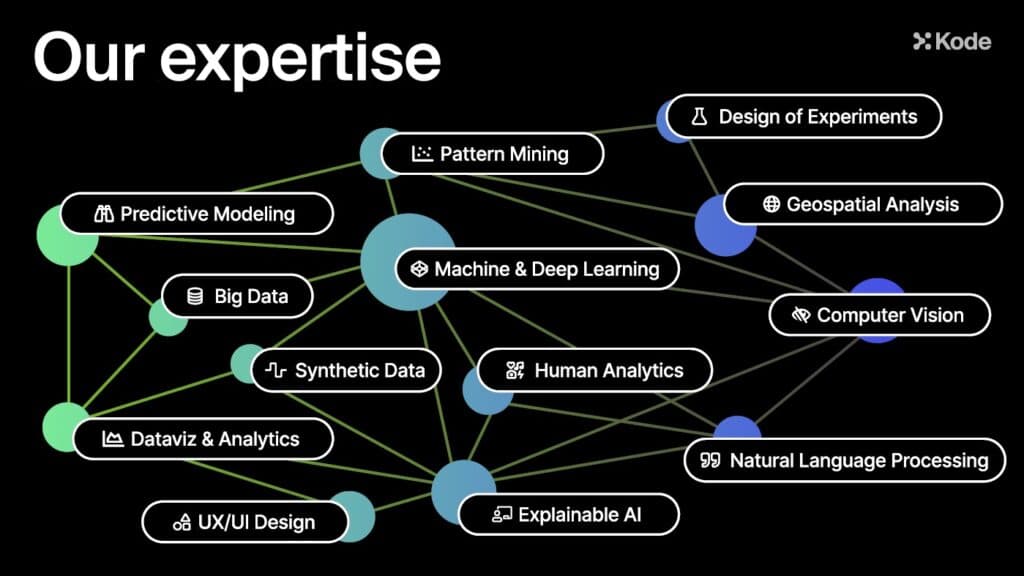
Kode Chemoinformatics offers an AI-powered service specifically designed for the chemical and pharmaceutical sectors. The platform provides comprehensive solutions for managing and analyzing chemical data, utilizing advanced chemometric instruments and machine learning techniques. Key capabilities include Quantitative Structure-Activity Relationship (QSAR) and Quantitative Structure-Property Relationship (QSPR) modeling. This technology supports critical applications such as drug design and ecotoxicological screening, aiming to streamline research and development processes in these industries.
Aiaioo Labs
Aiaioo Labs is a research laboratory dedicated to advancements in machine learning and text processing technologies. Their core activities include the development of sophisticated AI algorithms specifically designed for data extraction tasks. Additionally, they offer intention analysis APIs, enabling businesses to understand user intent from text data. Aiaioo Labs is also a contributor to the Apache OpenNLP project and has been involved in developing versions of the Arduino programming language, showcasing their expertise across various technical domains.