
AI Agents & Automation
Browsing page 512 of AI Agents & Automation. Sorted by confidence score — our independent quality rating.

Avala AI
Avala AI is a comprehensive platform designed to eliminate data entropy in Physical AI and frontier model pipelines. It serves as a unified data engine, fusing sensors, labels, and feedback into traceable ground truth. The platform connects ingestion, labeling, and deployment, allowing users to trace any model behavior back to its originating data. Avala offers a Python SDK, REST API, and CLI for programmatic management of datasets, annotation triggering, and results export. It supports various data types including 4D Point Cloud & LiDAR, 4D Video, 2D Image, 2D Video, Text, and specialized formats like Medical Imaging. The tool emphasizes glass-box traceability from sensor to deployment, ensuring data quality and compliance with standards like SOC 2 Type II, GDPR, ISO 27001, and TISAX.
AIScriptReader
AIScriptReader is an automated tool designed to provide professional AI screenplay coverage and feedback in minutes. It leverages industry-leading technology and proprietary algorithms to generate detailed story analysis, character breakdowns, and development notes. The platform specializes in analyzing movie scripts, with plans for future expansion. Users can upload their scripts and receive actionable reports, including comprehensive coverage reports and development notes. An AI Chat Assistant is also included, allowing users to interact with their script analysis for deeper insights into characters, plot, and themes. AIScriptReader aims to save time and money for writers, producers, and production companies by transforming weeks of waiting into minutes of insight.

Farpoint Technologies
Farpoint Technologies is a global AI consultancy specializing in building and deploying custom AI solutions for innovative companies. They partner with business leaders to develop AI strategies, implement projects, and provide ongoing advisory services to optimize performance and maximize ROI. Farpoint focuses on augmenting workforces with AI, offering services like AI education and alignment, strategic impact assessment, and custom solution development. They cater to various industries including financial services, real estate, manufacturing, legal, and retail, helping clients with applications such as fraud detection, personalized marketing, supply chain optimization, and enhanced legal research.
Titanet Speaker Verification
Titanet Speaker Verification is an AI-powered tool hosted on Hugging Face that allows users to verify speaker identity by comparing two audio recordings. This application is designed to determine if the voices in two separate audio samples belong to the same individual. Users have the flexibility to either record their voice directly using a microphone within the application or upload existing audio files for analysis. This capability makes it suitable for various applications requiring voice authentication or speaker identification, offering a straightforward method for comparison.
RepDistiller
RepDistiller is an open-source project that implements Contrastive Representation Distillation (CRD), as detailed in its ICLR 2020 paper. Beyond CRD, it serves as a comprehensive benchmark for 12 state-of-the-art knowledge distillation methods within the PyTorch framework. This tool enables users to run various distillation experiments, train student networks from pre-trained teacher models, and combine different distillation objectives. It provides scripts for fetching pre-trained teachers and running distillation processes, making it a valuable resource for researchers and developers working on model compression and efficiency.
lobe-chat-agents
lobe-chat-agents serves as the central agent index for LobeChat, offering a comprehensive list of available AI agents. This platform accesses its index.json file from the repository to display agents within the LobeChat agent market. Users can explore various agents to enhance their LobeChat experience, and developers or creators have the opportunity to submit their own agents to be featured in the index, fostering a collaborative and expanding ecosystem of AI capabilities. The tool is hosted on GitHub, indicating an open-source or community-driven approach to agent development and discovery.
Wan 2.2 ADULT
Wan 2.2 ADULT is an AI tool designed for generating high-quality images from text descriptions and subsequently converting these images into videos. Users can provide detailed text prompts and adjust various settings to achieve their desired visual output. The tool leverages advanced models to process text inputs and produce compelling visual content, making it suitable for creative projects requiring both static images and dynamic video sequences. While the specific applications are not detailed, its capabilities suggest utility in content creation and visual storytelling.
RecetasIA
RecetasIA is an innovative AI recipe generator designed to help users discover delicious and personalized recipes with ease. By leveraging artificial intelligence, the tool allows individuals to create custom recipes tailored to their specific tastes, dietary restrictions, and intolerances. Users simply select their preferences, add any dietary needs, and the AI instantly generates a unique recipe, complete with AI-generated photos. These recipes can then be saved, downloaded in PDF or image format, and shared with friends and family. RecetasIA offers a free tier for basic recipe generation and premium plans for more extensive use, including a higher number of recipes per month and priority support.

RoboForce
RoboForce is an AI Robotics startup dedicated to building the world’s most advanced Robo-Labor system. The company focuses on developing scalable and deployable Physical AI solutions for demanding industrial environments. Their flagship product, TITAN, is a general-purpose AI robot designed for industrial use. RoboForce's solutions are applied across various markets including automating outdoor construction and maintenance for solar farms, advancing construction and operations for data centers, streamlining container movement in shipping, ensuring safety in hazardous mining environments, and automating repetitive workflows in manufacturing. Founded in 2023 by experts from leading tech and robotics companies, RoboForce aims to solve human needs beyond emulating human forms.
Mua AI
Mua AI offers an uncensored AI companion platform where users can interact with AI girlfriends or boyfriends. The platform supports various forms of communication including chat, photo exchange, voice, and video. It aims to provide a cutting-edge AI companion experience, allowing for personalized interactions. The website emphasizes its uncensored nature and zero censorship policy, catering to users seeking unrestricted AI companionship. It is accessible via web and offers a demo without requiring a login.
dingo
DingoDB is an open-source distributed multi-modal vector database designed and developed by DataCanvas. It integrates real-time strong consistency, relational semantics, and vector semantics into a unified platform, offering exceptional horizontal scalability and elastic scaling capabilities to meet enterprise-grade high availability requirements. DingoDB provides comprehensive access interfaces, supporting SQL, SDK, and API, and treats Table and Vector as first-class citizen data models. Key features include built-in data high availability, fully automatic elastic data sharding, scalar-vector hybrid retrieval, and real-time index optimization. It also offers disk-based vector search for massive datasets and dynamic index switching.
Fyxer.ai
Fyxer.ai is an advanced AI email assistant designed to streamline inbox management, automate email drafting, and enhance meeting productivity. It intelligently categorizes emails, filtering out spam and noise, to present users with an organized and actionable inbox. The tool learns your communication style to generate personalized draft replies, which users can review, edit, and send. Fyxer.ai also acts as an AI notetaker, joining video meetings to transcribe discussions and summarize key points, then drafting follow-up emails. It supports integration with Gmail and Outlook, offering a 7-day free trial for individuals and teams. Enterprise plans are available for larger organizations requiring tailored solutions and dedicated support.

Lirio
Lirio is a personalization engine for digital health that leverages behavioral science and AI to power hyper-personalized health experiences. The platform helps organizations orchestrate each person’s unique healthcare journey through dynamic, personalized communications, which they call Precision Nudging®. By understanding and influencing human behavior, Lirio aims to remove barriers to health improvement and support individuals on their path to change. It moves beyond standard demographic segmentation to create highly tailored communications, fostering sustained engagement and healthier populations. The platform continuously learns and adapts behavioral interventions in real-time, helping to close gaps in care and reduce the total cost of care by automating ongoing touchpoints at scale.
“Westworld” simulation
"Westworld" simulation is a multi-agent simulation library designed to simulate and optimize systems and environments where multiple agents interact. Inspired by Unity software and Unity ML Agents, this Python-based library allows developers to create grid and non-grid environments, define various objects like agents, obstacles, and collectibles, and implement custom behaviors. It supports basic rigid body systems, simple agent behaviors such as pathfinding and wandering, and automatic maze generation. The library is particularly useful for modeling scenarios in logistics, retail, and epidemiology, offering pre-coded spatial environments and agent communication. It also includes features for simulation visualization, replay, and export to formats like GIF or video, with future plans for easier Reinforcement Learning integration.

Bodfit Nutrition
Bodfit Nutrition is an AI-powered platform designed to simplify nutrition tracking and meal planning. It features an AI-powered food scanner for effortless meal logging, allowing users to quickly record their food intake. The tool also provides personalized nutrition coaching, offering insights and guidance to help individuals achieve their health goals. Users can benefit from tailored meal plans that cater to their specific dietary needs and preferences. With calorie tracking capabilities, Bodfit Nutrition helps users monitor their intake and make informed decisions about their diet, fostering healthier eating habits.
T2V-CompBench Leaderboard
T2V-CompBench Leaderboard is a platform designed for the evaluation and comparison of text-to-video AI models. It enables users to submit their model evaluation files, which are then processed and ranked on a public leaderboard. This tool is particularly useful for AI researchers and engineers who need to assess the performance and capabilities of various text-to-video models. Users are required to provide a model name, project link, and contact email for their submissions, with optional details for further context. The platform aims to foster competition and transparency in the development of text-to-video AI technologies by providing a centralized and standardized benchmarking system.
ChatGiraffe
ChatGiraffe is an AI financial assistant designed to simplify personal finance management. It allows users to track expenses and forecast budgets through a conversational interface, making financial management as easy as chatting. The tool leverages AI to automatically track expenses, analyze spending patterns, and optimize financial health. ChatGiraffe offers features like smart bookkeeping, data encryption for security, and real-world use cases shared by over a million users. It provides a free plan for basic financial needs and a Pro Plan for more advanced AI chats and multi-dimensional financial insights.
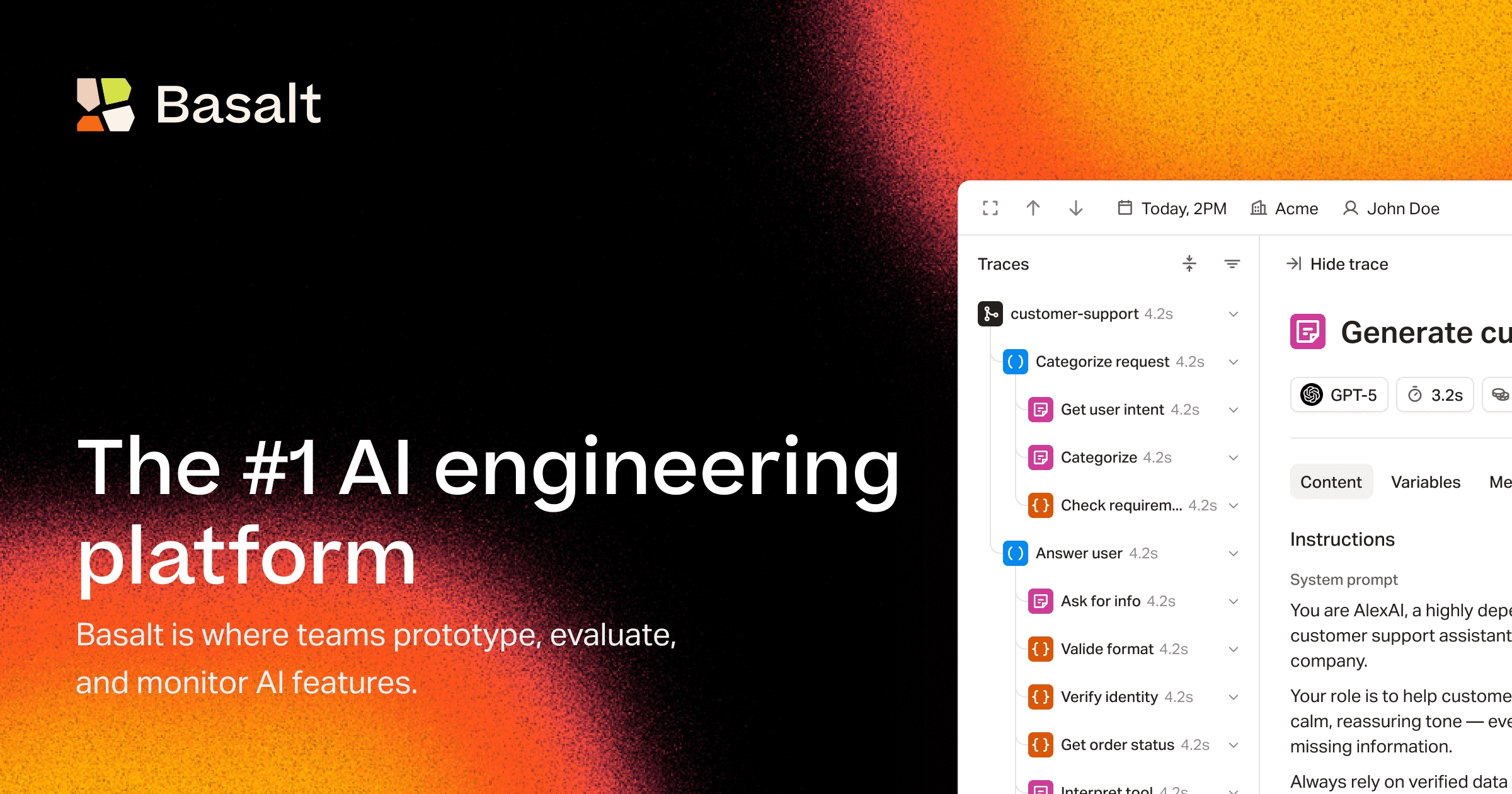
Basalt
Basalt is an AI engineering platform designed to create the infrastructure for self-improving agents. It focuses on capturing customer behavior to enable AI agents to continuously learn and improve from every user interaction. This platform aims to accelerate the development and deployment of production-grade AI features by providing the necessary tools for agents to evolve based on real-world usage. Basalt helps teams prototype, evaluate, and monitor AI features, facilitating collaboration between product managers, domain experts, and engineers to ensure agents are constantly optimizing their performance and user experience.
Travel Planner
Travel Planner is an AI-powered tool hosted on Hugging Face Spaces that helps users create personalized travel itineraries. It allows for detailed customization based on various preferences such as interests, desired cuisine, and budget constraints. The tool generates a comprehensive travel plan, which can then be viewed on a map for better visualization and downloaded as a PDF for offline access. This makes it a convenient solution for individuals looking to streamline their trip planning process and receive tailored recommendations without extensive manual research.
CopyCat (YC W25)
CopyCat is an agentic RPA platform designed to replace traditional BPO or back-office teams with custom AI agents. This tool specializes in automating a variety of back-office operations, including document processing, navigating web portals, integrating with APIs, and managing file submissions. CopyCat emphasizes rapid deployment, claiming to go from standard operating procedure (SOP) to live operation in a matter of days. It is built with enterprise-grade compliance, being both SOC 2 and HIPAA compliant, making it suitable for industries with strict regulatory requirements such as healthcare and insurance. The platform aims to streamline administrative processes and enhance efficiency by leveraging AI for tasks typically handled by human teams.
UFO
UFO³ (Unified Framework for Orchestration) is a powerful open-source framework developed by Microsoft, designed for weaving digital agent galaxies. It facilitates the creation and orchestration of intelligent agents across multiple devices and heterogeneous platforms. The framework introduces Galaxy, a multi-device orchestration system built on principles like declarative decomposition into dynamic DAGs, continuous result-driven graph evolution, and heterogeneous, asynchronous, and safe orchestration. It utilizes a Unified Agent Interaction Protocol (AIP) for secure communication and offers template-driven MCP-empowered device agents for rapid development. UFO³ supports complex multi-step automation, cross-device collaboration, and DAG-based task orchestration, making it suitable for advanced AI agent development and deployment.

VisAI Labs
VisAI Labs, founded in 2018, specializes in developing AI-enabled computer vision solutions for real-world industry operations, particularly within warehousing and logistics. The company focuses on "Physical AI," where machines understand and respond to the physical world with speed and accuracy. Their offerings include vMeasure for parcel, pallet, and in-motion dimensioning, and vAudit for video logging, order verification, and returns processing. VisAI Labs designs and builds full systems in-house, including OEM cameras, hardware, and software, ensuring tight control over accuracy and performance. Their solutions are built for easy deployment, scalability, and offer a SOC 2 compliant cloud platform for secure data management.

Agentycs
Agentycs offers an end-to-end AI operating platform designed for sovereign, secure, and deployable AI infrastructure. The platform is built to deliver operational systems rapidly, including in challenging air-gapped environments. It comprises four key components: Atom, an AI-native data lakehouse for data ingestion, governance, and tracing; Anima, for inference orchestration and runtime control; Agent², for mission-ready application delivery in days; and Apex, for hardware and operational deployment in restricted, disconnected, and high-assurance environments. Agentycs emphasizes sovereignty by design, allowing control over data location, model execution, and output governance, alongside robust security and auditability features.
WatchX
WatchX is an open-source smart watch project built upon the LittlevGL Embedded GUI Library, providing a platform for developers to create custom smartwatch applications. It boasts a high-quality and smooth user interface with 60FPS+ animation effects, and an easily extensible system framework. The hardware configuration includes an STM32F411CEU6 microcontroller, a ST7789 IPS 1.14-inch SPI display, three buttons for input, an MPU6050 accelerometer, and a BMP180 barometer. Key functionalities include time, temperature, pressure, and altitude display, a stopwatch, brightness control, time settings, and support for Arduboy/Arduboy2 Game System, along with automatic shutdown.