
Coding & Development
Browsing page 46 of AI tools for Code Assistants in Coding & Development. Sorted by confidence score — our independent quality rating.

llama.go
llama.go is a pure Golang reimplementation of the popular llama.cpp framework, designed for machine learning enthusiasts and developers. It aims to provide a GGML-compatible environment for debugging and inferring large GPT models directly in Golang, offering an alternative to lower-level languages like C++. The project focuses on performance and elegance, enabling users to work with models like LLaMA-7B, 13B, 30B, and 65B. Key features include multi-threading, cross-platform compatibility (Mac, Linux, Windows), and optimizations for ARM NEON and x64 AVX2. It also supports modern GGUF V3 model format, INT8 quantization, and offers an embedded REST API for production use, allowing parallel inference with configurable pods and threads.
magic-cli
Magic CLI is a command line utility designed to make users more efficient in the terminal by leveraging Large Language Models (LLMs). Inspired by tools like Amazon Q and GitHub Copilot for CLI, it allows users to suggest commands, semantically search their shell history, and generate commands for specific tasks. The tool supports both local LLM providers like Ollama and cloud-based providers like OpenAI, offering flexibility in deployment. It relies on the `orch` library for LLM interactions, including execution and model alignment, and provides configuration options for different LLMs and their settings. While still in early development, it aims to streamline command-line workflows for developers.
DAILA
DAILA, the Decompiler Artificially Intelligent Language Assistant, provides a unified interface for AI systems within decompilers. This decompiler-agnostic plugin supports a wide range of AI models, including remote LLMs like GPT-4, Claude, and Gemini via LiteLLM, as well as local models such as VarBERT for variable renaming. It integrates with popular decompilers like IDA Pro, Ghidra, Binary Ninja, and angr-management, abstracting interactions through the LibBS library. DAILA offers both a GUI for interactive use and a scripting library for programmatic access, enabling tasks like function summarization, variable renaming, vulnerability identification, and free-form prompting. It can be installed via pip or used within a Docker container for offline environments.

Antrika Technologies
Antrika Technologies is an AI-first innovation hub dedicated to fostering the growth of AI-powered enterprises. They operate as a venture studio, offering funding, incubation, and expert growth strategies to AI startups. Antrika assists companies in leveraging AI, data, and automation to develop intelligent solutions, optimize advertising performance, and achieve global growth. Their portfolio includes successful AI products like Flostr (WhatsApp automation), Teptro (AI-powered customer support), and Qrrectly (billing automation). Antrika provides end-to-end support, from concept validation to market expansion, with a focus on performance optimization, targeted efficiency in ad-tech, and empowering workforces through AI solutions.
lux-ui
lux-ui is an open-source admin template designed to create the best Vuetify 3 admin experience. It is built upon Vue3.x, Vite5.x, TypeScript, and Vuetify3.x, incorporating an AI assistant for intelligent features. The project provides a clear and efficient structure, integrating the latest technology frameworks to address a wide range of common technical requirements. It ensures all pages are adaptive across multiple devices, achieving seamless cross-platform compatibility. Key features include component auto-importing, Pinia for state management, Iconify for icons, Firebase authentication, and charting libraries like Echarts and ApexChart. It also supports OpenAI/ChatGPT integration and internationalization with vue-i18n.
Google AI Studio
Google AI Studio is a platform designed to accelerate the development, testing, and deployment of advanced AI models, particularly those powered by Gemini. It offers a streamlined environment for prompt engineering and code generation, enabling developers to quickly prototype and experiment with AI solutions. The platform aims to simplify the journey from initial concept to a production-ready AI application, making it an accessible tool for those looking to integrate sophisticated AI capabilities into their projects. It is offered by Google and is available for free, providing a robust set of features for AI development.
embabel-agent
embabel-agent is an open-source agent framework designed for the JVM, allowing developers to author agentic flows that combine LLM-prompted interactions with custom code and domain models. It features sophisticated planning capabilities, going beyond simple state machines to dynamically formulate and re-plan action sequences to achieve goals. The framework supports strong typing and object-oriented benefits, ensuring clean interaction between prompts and authored code. Key differentiators include superior extensibility, platform abstraction for consistent QoS, and design for effective LLM mixing, enabling the use of various models for different tasks, including local models for cost and privacy. Built on Spring, it integrates easily with existing enterprise functionality and offers robust testing capabilities for both unit and end-to-end agent flows. It supports both annotation-based and Kotlin DSL approaches for flow authoring.
getspecstory
getspecstory is a comprehensive tool designed to transform AI development conversations into a searchable and shareable knowledge base. It captures, indexes, and makes every interaction with AI coding assistants searchable across all projects and tools. The platform offers local-first extensions for popular AI IDEs like Cursor and Copilot, as well as CLI tools such as Claude Code, Cursor CLI, and Codex CLI. All sessions are automatically saved locally to a `.specstory/history/` folder. Users can optionally sync their conversations to the SpecStory Cloud, which provides a centralized knowledge system with full-text search across all projects. This helps solve the problem of lost context, lack of global search, and fragile sharing methods, creating a personal AI coding knowledge base for developers.
gpt-llama.cpp
gpt-llama.cpp acts as an API wrapper around llama.cpp, running a local API server that mimics OpenAI's GPT endpoints. This enables existing GPT-based applications to function with local llama-based models instead of relying on OpenAI's services. The primary goal is to provide a cost-free and private alternative for running AI models, making it a drop-in replacement for GPT-3.5 or GPT-4 applications. It supports interactive mode for speedy responses within chat contexts and is compatible with macOS, Windows, and Linux. Key features include automatic adoption of llama.cpp improvements and support for various GPT-powered applications like chatbot-ui and Langchain.

Delta Bravo AI
Delta Bravo AI specializes in building agentic AI systems tailored for highly regulated industries, including water utilities, wastewater management, and environmental compliance. Their suite of products, Data Mentor, Aquaspec, and PermitPro, are designed to address critical bottlenecks in these sectors. Data Mentor acts as an AI data assistant, Aquaspec focuses on water treatment optimization, and PermitPro streamlines environmental permitting processes. By leveraging agentic AI, Delta Bravo aims to enhance operational efficiency, ensure regulatory adherence, and accelerate America's reindustrialization through intelligent automation of complex, regulated workflows. The company's solutions are trusted by industries requiring robust and auditable AI applications.
qodo-cover
Qodo-Cover is an AI-powered tool designed to automate test generation and enhance code coverage for software projects. It leverages Generative AI models to streamline development workflows by creating unit tests. The tool can be integrated into GitHub CI workflows or run locally as a CLI tool, supporting various programming languages like Python, Go, and Java. Key components include a Test Runner, Coverage Parser, Prompt Builder, and AI Caller, ensuring tests contribute to overall effectiveness and interact with LLMs for generation. It requires an OpenAI API key and a Cobertura XML code coverage report for functionality, with active development for more coverage types.
rag-from-scratch
rag-from-scratch is an open-source project designed to demystify Retrieval-Augmented Generation (RAG) by guiding developers through building it from scratch. It emphasizes local LLMs and avoids black boxes or cloud APIs, fostering a deep understanding of core RAG concepts. The project covers essential components such as embeddings, local vector database construction, retrieval strategies, and context-augmented generation. It offers step-by-step code walkthroughs, explaining every function and concept, making advanced AI approachable. Key learning areas include how embeddings work, building in-memory and LanceDB/Qdrant vector stores, basic and hybrid retrieval, query preprocessing, multi-query retrieval, and query rewriting. The project aims to provide a clear, practical, and comprehensive learning path for developers interested in RAG.
scikit-llm
Scikit-LLM provides a seamless integration of powerful large language models (LLMs) such as ChatGPT into the scikit-learn ecosystem, enabling enhanced text analysis tasks. This tool is designed for data scientists and machine learning engineers who wish to leverage advanced natural language processing capabilities directly within their familiar scikit-learn workflows. It simplifies the process of incorporating LLMs for tasks like zero-shot text classification, as demonstrated by its quick start example. Scikit-LLM is an open-source project available on GitHub, fostering community contributions and support. It aims to bridge the gap between traditional machine learning frameworks and the latest advancements in large language models, making sophisticated NLP more accessible for practical applications.
Eden Tech Labs | Mobile and Web App Development
Ninefold is a human-centric AI studio specializing in mobile and web app development, offering a dedicated product team approach to AI-accelerated execution. They prioritize understanding a client's business to ensure the development of the right solutions, not just fast ones. Their services include consulting to identify realistic AI applications for cost savings or revenue generation, engineering with consistent teams for custom development and MLOps, and automations to connect existing tools and optimize workflows. Ninefold differentiates itself with dedicated teams, AI-enhanced decision-making by experienced humans, and over a decade of delivery across various platforms, acting as product partners rather than mere vendors.

empatyzer
Empatyzer is an AI-powered system designed to enhance leadership and team development within organizations. It focuses on improving communication, fostering better collaboration, and increasing employee retention across the entire company. The platform provides targeted micro-lessons to address specific development areas and offers robust support for one-on-one conversations and feedback sessions. By leveraging AI, Empatyzer helps leaders and teams build self-awareness and develop essential soft skills. It aims to streamline internal communication processes and create a more cohesive and productive work environment, ultimately contributing to a stronger company culture and reduced HR costs.
The Windsurf Editor
The Windsurf Editor is an advanced AI coding assistant designed for developers and enterprises, providing an AI-native Integrated Development Environment (IDE) to enhance productivity and maintain developer flow. It integrates autonomous cloud agents like Devin, which can handle complex tasks on its own machine, allowing developers to focus on core coding. The editor also features local Cascade sessions for real-time code generation and refactoring. Users can manage all agents through a unified Kanban-style dashboard and bundle sessions, PRs, and shared context into 'Spaces' for organized task management. Windsurf supports various model providers and offers first-class integration with JetBrains IDEs via a plugin, making it a versatile solution for individual developers and organizations aiming to multiply their output.
openai-kotlin
openai-kotlin is a robust and unofficial Kotlin client designed for interacting with the OpenAI API. It supports multiplatform development, making it suitable for various Kotlin-based applications, including Android. The client leverages coroutines for asynchronous operations, ensuring efficient and non-blocking API requests. Key features include support for various OpenAI models, chat, image generation, embeddings, file management, fine-tuning, moderations, audio processing, and beta features like Assistants, Threads, Messages, Runs, and Vector Stores. It simplifies the setup process with Gradle and Maven dependencies and offers guides for getting started, chat & tool calls, and file source management. The library is open-sourced under the MIT license, encouraging contributions from the developer community.
OpenAISwift
OpenAISwift is a community-maintained Swift wrapper library designed to simplify interaction with the ChatGPT and OpenAI HTTP API. It enables Swift developers to easily integrate powerful AI capabilities into their applications. The library supports various OpenAI functionalities, including predicting text completions, engaging in chat conversations with models like GPT-3.5 and GPT-4, generating images using DALL·E, performing text edits, classifying text for moderation, and creating vector representations (embeddings). It offers both async/await and completion handler variants for API calls, making it flexible for different Swift concurrency patterns. Installation is straightforward via Swift Package Manager or CocoaPods, providing a convenient way for developers to leverage OpenAI's AI models.
Melio AI
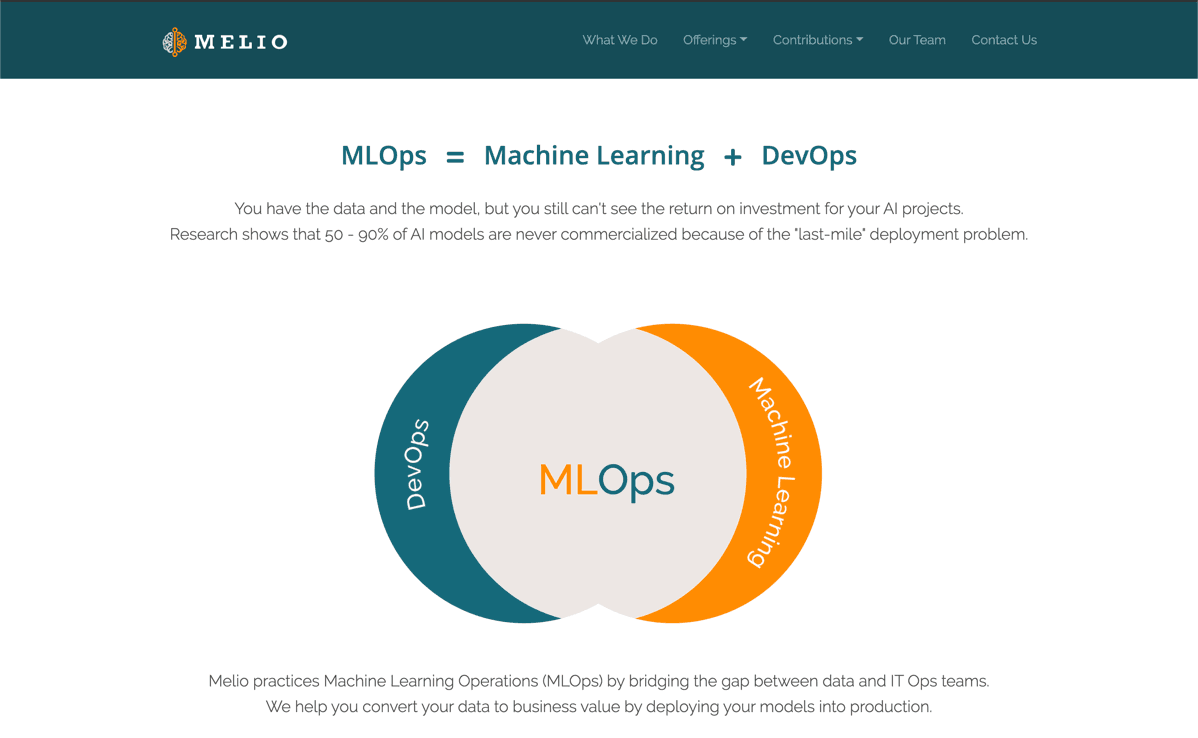
Melio AI specializes in developing and deploying machine learning solutions in the cloud, focusing on commercializing AI models to deliver tangible business value. They address the "last-mile" deployment problem, where many AI models fail to reach production, by practicing Machine Learning Operations (MLOps). This approach bridges the gap between data science and IT operations teams, enabling reproducible machine learning with transparent data and model versioning. Melio AI helps organizations convert data into business value by deploying models into production, ensuring successful and sustained AI implementation, and enforcing governance policies. They offer a phased approach to design, build, and maintain impactful solutions, with a focus on cloud-native technologies and data-driven insights.

Blaze.baby
Blaze.baby is an AI-powered web development tool designed to create stunning websites rapidly. It functions as a modern website builder, allowing users to generate responsive layouts and UI components in seconds. The tool emphasizes ease of use for web development, aiming to simplify the process of creating a web presence. It is suitable for individuals or teams looking for an efficient way to build or prototype websites without extensive manual coding, leveraging AI to accelerate the design and development workflow.
proxypal
ProxyPal is a desktop application designed to bridge the gap between your existing AI subscriptions and your preferred coding environment. It allows users to connect various AI providers such as Claude, ChatGPT, Gemini, Qwen, iFlow, and Vertex AI, as well as custom OpenAI-compatible endpoints, and use them directly within any OpenAI-compatible client like Cursor, Cline, or Continue. The tool wraps CLIProxyAPI, offering a user-friendly interface for managing these connections and monitoring usage analytics, including requests, tokens, success rates, and estimated savings. It also features request monitoring to view API requests with response times and status codes, and auto-configuration for installed CLI agents. ProxyPal supports macOS, Windows, and Linux, making it a versatile solution for developers looking to maximize their AI coding tools.
potpie
Potpie is an open-source platform designed for spec-driven development, transforming entire codebases into a comprehensive knowledge graph. This graph structurally indexes every file, class, and function, capturing their relationships and contextual roles within the codebase. AI agents leverage this graph to reason about code with high precision, assisting in tasks from debugging to feature development. Key features include pre-built agents for debugging, codebase Q&A, code generation, and spec generation, alongside the ability to create custom agents. It supports various GitHub authentication methods and self-hosted Git providers, integrating with VSCode and Slack for enhanced developer workflows. Potpie aims to accelerate developer onboarding, provide precise answers to codebase questions, and automate various development tasks.
chatGPT-shell-cli
chatGPT-shell-cli is a lightweight shell script designed to bring the power of OpenAI's ChatGPT and DALL-E directly to your terminal. It eliminates the need for Python or Node.js installations, making it accessible for developers who prefer command-line interfaces. The script supports various OpenAI models, including gpt-3.5-turbo and gpt-4, for chat completions and image generation. Key features include chat history, chat context for follow-up questions, the ability to generate and execute commands, and customizable initial prompts. It's an efficient way to integrate AI capabilities into your development workflow directly from the command line.
Nimbic AI
Nimbic AI is an AI-powered platform designed to automate the generation and maintenance of internal documentation for modern development teams. It analyzes your codebase to create comprehensive documentation that stays synchronized with your code through continuous updates. The tool offers intelligent code analysis, providing insights into dependencies, patterns, and potential improvements. With features like customizable templates, collaborative editing, and GitHub integration, Nimbic AI streamlines the documentation workflow. It supports multi-language codebases and includes an AI documentation assistant, knowledge graph visualization, and advanced access controls, ensuring documentation remains current, organized, and accessible for teams of all sizes.