
Coding & Development
Browsing page 167 of AI tools for Open Source & Models in Coding & Development. Sorted by confidence score — our independent quality rating.
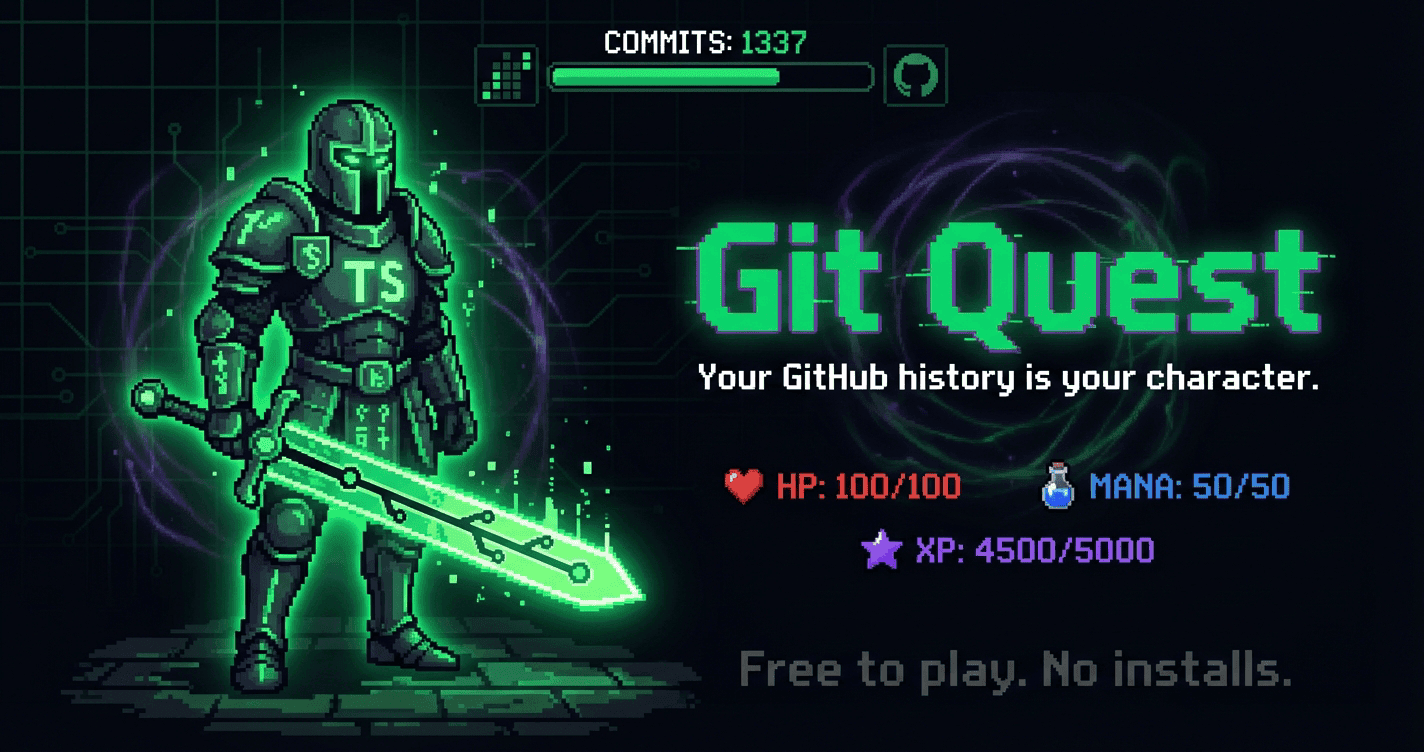
Git Quest
Git Quest is a free developer RPG that gamifies your GitHub commit history, turning your coding efforts into an engaging adventure. By connecting your GitHub account, the platform analyzes your public commit data to create a unique RPG character. Your top programming language determines your character's class, and your commit streaks and overall activity fuel your power and mana. This innovative tool allows your character to automatically battle dungeons while you code, collecting loot and growing stronger. It's designed for developers seeking a fun and motivating way to visualize their productivity and consistency, offering a unique blend of personal analytics and entertainment. Git Quest encourages continuous coding by rewarding every push with in-game progression, fostering a sense of achievement beyond traditional project milestones.

R3PL1C4
R3PL1C4 serves as a dedicated resource hub for professionals and students in the AI and robotics fields. It offers a curated collection of over 190 hand-picked resources, including libraries, models, hardware guides, tutorials, and various tools, all accessible for free. The platform organizes these resources into categories such as Libraries, Models, Robotics, AI Hardware, Serverless AI, Datasets, and Tools, making it easy for users to browse and discover relevant information. Featured resources include Google's Agent Development Kit, Amazon Echo, Amazon SageMaker, and AMD Instinct Accelerators, providing practical examples of the types of content available. R3PL1C4 aims to be a central point for learning and staying updated on advancements in AI and robotics.

Coalition for Secure AI
The Coalition for Secure AI (CoSAI) is a collaborative initiative bringing together AI and security experts from leading organizations. Its primary goal is to establish and share best practices for secure AI deployment and to advance AI security through research and product development. CoSAI actively addresses challenges by fostering a diverse ecosystem of stakeholders, investing in collective AI security research, sharing expertise, and building open-source solutions and methodologies. The coalition focuses on critical workstreams such as software supply chain security for AI systems, preparing defenders for evolving security landscapes, AI security risk governance, and secure design patterns for agentic systems. Operating under OASIS Open, CoSAI aims to make AI systems secure for all by promoting common security standards.
MachineLearningStocks
MachineLearningStocks is an open-source Python project designed to be an intuitive and extensible template for applying machine learning to stock predictions. It guides users through the process of cleaning and preparing historical stock data and fundamentals using pandas, then applying a scikit-learn classifier to predict annual price changes relative to an index. The project includes functionalities for data acquisition, preprocessing, backtesting, and generating predictions on current data. While the project is no longer actively maintained, it serves as a valuable educational resource for understanding the subtleties of ML in finance and as a starting point for developing a profitable trading system.
Hyra Network
Hyra Network is a decentralized AI infrastructure and blockchain platform designed for the sovereign digital era. It provides a 5-layer stack that ensures transparency, sovereignty, and scalability for AI, moving away from centralized control. The platform operates through transparently staked nodes, verified on-chain, with fair reward distribution. It features a community-led DAO for governance, allowing users to influence decisions. Developers can leverage SDKs and Devtools for AI inference and GPU power, along with APIs for staking and voting. Hyra Network also supports digital sovereignty at scale for nations and enterprises, enabling local inference and data processing on domestic nodes, and accelerating public tech projects.
Oxford Dynamics
Oxford Dynamics specializes in developing mission-ready, Sovereign AI Defence Systems designed to enhance intelligence and decision-making in defence operations. Their core technology is AVIS, an AI engine that processes multi-modal data, mirrors operator reasoning, and delivers explainable insights. AVIS is deployed from operations centers to the tactical edge and embedded in their autonomous platforms. These platforms include SR-1, a multi-sensor robot for drone detection and airborne intelligence, and STRIDER, a ground robot built for hazardous environments, integrating advanced sensing and autonomous navigation. Oxford Dynamics aims to provide UK-built AI-enabled systems that offer dominance in the decision space, enabling faster, smarter decisions under pressure while maintaining human control.
WebTotem
WebTotem is a comprehensive website security monitoring tool designed to protect businesses from intrusion and ever-evolving cyber threats. It provides an all-in-one solution that includes an AI-inspired firewall for proactive protection against various attacks like brute force, DoS, SQLi, and XSS. The platform also features a server-side antivirus for malware prevention, file control, and automatic scanning, along with malware removal capabilities. Continuous external monitoring covers downtime, web reputation, SSL expiration, and blacklisting. Additionally, WebTotem offers vulnerability management, including open port scanning and security scoring with recommendations, to help reduce attack risks. It aims to provide peace of mind by saving time and money on security specialists with its fast setup and comprehensive protection.
Sentics
Sentics is a sophisticated AI tool designed for intralogistics, offering a comprehensive solution for managing and optimizing shopfloor operations autonomously. This platform leverages physical operating agents to protect, document, and run industrial environments. By employing computer vision and AI, Sentics can detect and locate people, vehicles, and objects in real-time, significantly enhancing industrial safety through collision prevention. Beyond safety, it provides solutions for infrastructure automation and streamlining processes within industrial settings, aiming for greater efficiency and operational excellence. Sentics is built to provide a single AI solution for complex intralogistics challenges.
CNNMRF
CNNMRF is a Torch-based implementation for image synthesis, leveraging the power of Markov Random Fields and Convolutional Neural Networks. This tool is designed for both unguided image synthesis, such as classical texture generation, and guided image synthesis, which includes transferring styles between different images. Users can transform a photo into a painting using a reference style, or balance content and style in the resulting image. The project provides detailed setup instructions for Ubuntu with CUDA 10 and CUDNN 7.6.2, along with guidance on installing Torch and downloading pre-trained VGG networks. It offers command-line parameters for customizing style, content, and output image sizes, making it a flexible solution for researchers and developers interested in advanced image manipulation.

OpenMeter
OpenMeter is an open-source billing and metering platform designed for AI and DevTool companies, offering flexible solutions for usage-based billing. It allows businesses to turn any events, logs, and metrics into revenue by empowering customers to monitor their usage in real-time and control costs through usage limits, notifications, and quotas. The platform supports rapid pricing iterations with a no-code product catalog and integrates with CRMs, tax, and payment providers. OpenMeter is available as an open-source solution under the Apache 2.0 license and as a managed cloud service, now known as Kong Metering & Billing, providing scalable, real-time metering for AI and API usage.
cvlib
cvlib is a simple, high-level, and easy-to-use open-source Computer Vision library designed for Python developers. It provides straightforward functions for common computer vision tasks, including face detection, gender detection, and object detection using models like YOLOv4. The library is pip installable, with optional GPU support for enhanced performance, requiring pre-installed dependencies such as OpenCV and TensorFlow. cvlib also includes utility functions for video processing, such as extracting frames and creating GIFs. Its focus on ease of use makes complex computer vision tasks accessible with minimal code.
Flojoy
Flojoy is an open-source platform specifically engineered for hardware testing and automation. It provides robust capabilities for engineers and scientists involved in hardware development and testing, enabling them to streamline their workflows. A key feature of Flojoy is its cloud connectivity, which facilitates remote access and control over hardware setups. This allows for flexible operation and monitoring from any location, enhancing collaboration and efficiency in development and testing environments. The platform's open-source nature promotes community contributions and customization, making it a versatile solution for various hardware-related projects.
deep-voice-conversion
Deep-voice-conversion is an open-source project implemented in TensorFlow, designed for voice style transfer using deep neural networks. This tool enables users to convert a source voice to a specific target voice, notably demonstrated with the voice of actress Kate Winslet. A key differentiator is its ability to perform voice conversion without requiring parallel data (like source and target voice recordings of the same utterance), relying instead on a collection of target speaker waveforms and a small set of <wav, phone> pairs from anonymous speakers. The architecture comprises two main modules: Net1 for phoneme classification and Net2 for speech synthesis, utilizing CBHG modules for feature extraction from sequential data. It's ideal for researchers and developers interested in advanced voice manipulation techniques.
motion-diffusion-model
motion-diffusion-model is an open-source PyTorch implementation of the "Human Motion Diffusion Model" paper, designed for generating and editing human motion sequences. The tool boasts significant speed improvements, now running 40X faster with a 50-diffusion-step model and optimized CLIP calling. It supports various tasks including text-to-motion, action-to-motion, and unconstrained motion synthesis. Users can generate motions from text prompts or actions, render SMPL meshes, and perform motion editing such as in-between and upper-body modifications. The project also integrates DiP for ultra-fast text-to-motion and offers features like DistilBERT text encoder support and dataset caching for faster loading.
DeepLabCut
DeepLabCut is an open-source toolbox designed for state-of-the-art markerless pose estimation across various animals and humans. It leverages deep learning to track user-defined features, making it highly versatile and applicable to a wide range of behaviors and species. The tool provides a user-friendly GUI and API, integrating advanced models and frameworks while offering sensible defaults for life scientists. It supports both single and multi-animal pose estimation, identification, and tracking. DeepLabCut is actively maintained, offering continuous improvements, including faster performance variants, real-time capabilities, and a recent backend migration to PyTorch for enhanced flexibility and easier installation. Comprehensive documentation, online courses, and a model zoo are available to assist users.
DiscoFaceGAN
DiscoFaceGAN is a TensorFlow-based implementation for disentangled and controllable face image generation, as presented in a CVPR 2020 Oral paper. This tool allows for the creation of virtual people's faces with precise control over identity, expression, pose, and illumination. It achieves this through 3D imitative-contrastive learning, embedding 3D priors into adversarial learning to imitate the image formation of a 3D face deformation and rendering process. A key feature is its factor disentanglement, ensuring that changing one factor (e.g., expression) does not affect others. The tool also supports reference-based generation, real image pose manipulation, lighting editing, and expression transfer, making it valuable for researchers and developers working with facial image synthesis and manipulation.
erpc
eRPC (Embedded RPC) is an open-source Remote Procedure Call (RPC) system specifically designed for multichip embedded systems and heterogeneous multicore SoCs. Unlike other modern RPC systems, eRPC distinguishes itself by being optimized for tightly coupled systems, utilizing plain C for remote functions, and maintaining a small code footprint (less than 5kB). It is not intended for high-performance distributed systems over a network. eRPC allows developers to export existing C functions without significant prototype changes, and includes a code generator tool, erpcgen, which accepts IDL files to generate shim code for serialization and invocation in C/C++ or Python. It supports various transports like CMSIS UART, NXP Kinetis SPI, TCP/IP, and USB CDC, making it versatile for different embedded environments.
OBBDetection
OBBDetection is an open-source oriented object detection library built upon MMdetection v2.2, designed for researchers and developers working with object detection tasks. It inherits all features from MMdetection, ensuring a robust and familiar environment. The library supports multiple frameworks and implements various oriented object detectors like RoI Transformer and Gliding Vertex. A key feature is its flexible representation of oriented boxes, accommodating Horizontal Bounding Boxes (HBB), Oriented Bounding Boxes (OBB), and 4-point boxes (POLY). It leverages BboxToolkit for oriented bounding box operations and includes a model zoo with benchmarks for supported methods and backbones. The project is released under the Apache 2.0 license.
ESPCN
ESPCN offers a PyTorch implementation of the Efficient Sub-Pixel Convolutional Neural Network, designed for real-time single image and video super-resolution. Based on a CVPR 2016 paper, this tool allows users to upscale images and videos with various factors (2x, 3x, 4x, 8x). It includes scripts for training and testing, with support for datasets like VOC2012 for training and various benchmark datasets for testing. The implementation provides benchmarks for different upscale factors and demonstrates image and video results, making it valuable for researchers and developers in image processing and computer vision.
pet
PET (Pattern-Exploiting Training) is an open-source research tool designed for few-shot text classification and natural language inference. It employs a semi-supervised training procedure that reformulates input examples as cloze-style phrases, allowing language models to better understand tasks. The tool, along with its iterative variant iPET, demonstrates significant performance improvements over traditional supervised training and other semi-supervised baselines, even surpassing GPT-3 in some low-resource scenarios while requiring substantially fewer parameters. It supports various training modes including PET, iPET, and supervised training, and offers evaluation methods like unsupervised and priming. Researchers can use PET for 13 different tasks, including SuperGLUE tasks, and can also customize it for their own specific applications by defining DataProcessors and PVPs (Pattern-Verbalizer Pairs).
Fast-SRGAN
Fast-SRGAN is an open-source deep learning model designed for real-time super-resolution, enabling the upsampling of low-resolution videos to high resolution at 30 frames per second. Built on the SR-GAN architecture and utilizing pixel shuffle for speed, this tool is ideal for enhancing video quality efficiently. It includes a pre-trained generator model on the DIV2k dataset, featuring 8 residual blocks and 64 filters. Users can easily run inference on their own images or train the model with custom settings via a configurable YAML file and command-line parameters. The project provides speed benchmarks, demonstrating its capability to upsample to 720p at around 30fps on an M1 Pro GPU. It also offers clear instructions for installation, usage, and training, making it accessible for developers and researchers.
Facial-Expression-Recognition
Facial-Expression-Recognition is an open-source deep learning project built with TensorFlow, designed for real-time facial detection in video streams and subsequent recognition of emotional expressions. The tool leverages trained models that have achieved 65% accuracy on the fer2013 dataset, making it a valuable resource for researchers and developers in the field of computer vision and emotion AI. It is primarily tested on Ubuntu and macOS Sierra, offering a robust solution for these environments. Users can easily run a demo to capture faces via webcam and recognize expressions, or train their own models from scratch by downloading and integrating the fer2013 dataset. The project is dependent on Python (>= 3.3), TensorFlow (>= 1.1.0), and OpenCV, providing a clear pathway for installation and usage.
Face-Pose-Net
Face-Pose-Net provides a DCNN model and Python code for robustly estimating 6 degrees of freedom (6DoF) 3D face pose or 11 parameters of a 3x4 projection matrix from unconstrained images. A key differentiator is its ability to perform face alignment without relying on fragile landmark detectors, making it highly effective even with low-resolution, occluded, or near-profile views. The tool integrates with a Face Renderer to create an end-to-end pipeline for facial pose estimation and generating multiple rendered views for alignment and data augmentation. It supports both CPU and GPU for extremely fast pose estimation and offers improved face recognition through better face alignment compared to state-of-the-art landmark detectors.
few-shot-object-detection
few-shot-object-detection (FsDet) offers official implementations of few-shot object detection benchmarks, including the ICML 2020 paper "Frustratingly Simple Few-Shot Object Detection." It introduces new benchmarks across PASCAL VOC, COCO, and LVIS datasets, with multiple groups of few-shot training examples and evaluation results for both base and novel classes. The repository provides benchmark results and pre-trained models for a two-stage fine-tuning approach (TFA), where the detector is first trained on abundant base classes and then fine-tuned on a small balanced training set. FsDet is modular, allowing for easy integration of custom datasets and models, serving as a general framework for future research in few-shot object detection.