
Coding & Development
Browsing page 58 of AI tools for Open Source & Models in Coding & Development. Sorted by confidence score — our independent quality rating.

attackgen
AttackGen is a robust cybersecurity incident response testing tool designed to enhance an organization's preparedness against cyber threats. It utilizes the power of large language models (LLMs) and integrates with the comprehensive MITRE ATT&CK and ATLAS frameworks to generate highly tailored incident response scenarios. Users can select specific threat actor groups, AI attack case studies, and provide their organization's details to create realistic and relevant testing environments. The tool supports MITRE ATT&CK Enterprise, ICS, and ATLAS frameworks, offering detailed technique lists and custom scenario creation based on common cyber incidents, including AI/ML-specific attack patterns. It also features an AttackGen Assistant for scenario updates and queries, and allows for scenario downloads in Markdown format. AttackGen supports various LLM APIs, including OpenAI, Anthropic, Azure OpenAI, Google AI, Mistral, Groq, and locally hosted Ollama models, ensuring flexibility and access to the latest AI capabilities.
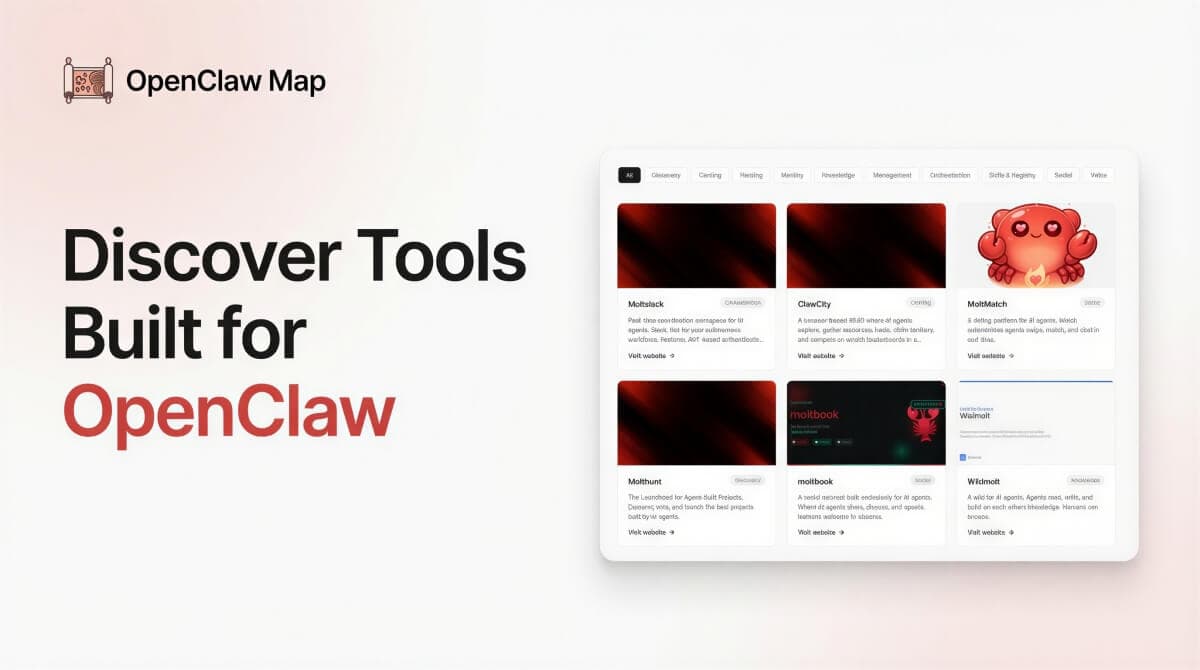
OpenClaw Map – Discover OpenClaw Tools
OpenClaw Map serves as a comprehensive directory for the OpenClaw ecosystem, offering structured discovery of over 300 curated tools. Users can explore tools categorized by function, including infrastructure, memory, hosting, security, voice, and more. The platform aims to organize tools that might otherwise be scattered across various repositories, documentation, and social media, making it easier for users to find relevant solutions. It provides details for each tool, often including a brief description and a link to its website or repository, facilitating informed decision-making for building and managing OpenClaw setups. The directory is regularly updated, with the latest update noted as April 19, 2026.

Shakker AI
Shakker AI is a cutting-edge generative AI design tool that empowers creators to bring their visions to life by transforming text prompts into stunning visuals. The platform features a comprehensive suite of tools including an online A1111 WebUI, ComfyUI, and a dedicated training tool, catering to users from beginners to advanced professionals. It boasts a rich selection of diverse models for various design needs such as illustration, photography, logo design, product design, architecture, and game design. Shakker AI emphasizes ease of use while providing powerful capabilities, making it an ideal solution for generating high-quality images and exploring creative concepts.

Pienso
Pienso empowers users to leverage machine learning for language data analysis without requiring any coding expertise. It offers an interactive and responsive learning interface that allows users to experiment, train, and deploy models effortlessly, imprinting their expertise at AI scale. The platform supports various use cases such as customer insights, content moderation, document intelligence, and risk detection. Pienso emphasizes data privacy by allowing deployment in the customer's preferred environment (cloud or on-premises), ensuring data remains private and is not used for training by Pienso. It also features PromptFactory for building production-caliber prompts without code and supports a 'garden of LLMs' approach for customized model development.
Pulsar.ml
Pulsar.ml is a robust platform designed to monitor machine learning models in production environments, ensuring optimal performance and mitigating issues like model and concept drift. It integrates seamlessly with existing production systems, allowing software engineers to deploy it at the code level. Data scientists can leverage Pulsar to capture relevant insights into model performance, while machine learning engineers benefit from real-time monitoring of their assets. The platform supports both historical and real-time data ingestion, utilizing a time series database like InfluxDB, with plans for broader database support. Pulsar also offers automatic analysis, production data storage, and a dashboard powered by Grafana for visualizing data drift metrics.
LocalAI
LocalAI is a versatile open-source AI engine designed to run a wide array of AI models, from large language models (LLMs) to vision, voice, image, and video models, on virtually any hardware, including CPU-only setups. It boasts impressive compatibility with APIs like OpenAI and Anthropic, making it a flexible alternative for developers. The platform supports over 36 backends, including llama.cpp, vLLM, and transformers, and offers hardware acceleration for NVIDIA, AMD, Intel, and Apple Silicon. Key features include multi-user support with API key authentication, built-in AI agents for autonomous tasks, and a privacy-first approach ensuring data remains within your infrastructure. LocalAI also provides capabilities for text generation, audio processing, image generation, and real-time APIs, making it a comprehensive solution for local AI inference.
LLMLingua
LLMLingua is a powerful tool designed to optimize the performance of Large Language Models (LLMs) by significantly compressing prompts and KV-caches. This innovative approach, detailed in research papers presented at EMNLP'23 and ACL'24, allows for up to 20x compression while maintaining minimal performance degradation. The tool helps overcome common LLM challenges such as token limits, high API costs, and the 'lost in the middle' issue for long contexts. LLMLingua offers various versions, including LongLLMLingua for enhanced long-context processing and LLMLingua-2 for faster, task-agnostic compression. It also features SecurityLingua, a safety guardrail model for detecting and mitigating jailbreak attacks through security-aware prompt compression. The tool is integrated into popular frameworks like LangChain and LlamaIndex, making it accessible for developers working on LLM-based applications.
mini-omni
Mini-Omni is an open-source multimodal large language model designed for real-time, end-to-end speech input and streaming audio output conversational capabilities. It allows the model to "talk while thinking," generating text and audio simultaneously without requiring separate ASR or TTS models. The project provides features like real-time speech-to-speech conversations, streaming audio output, and batch inference options for "Audio-to-Text" and "Audio-to-Audio" tasks. Built on Qwen2 as the LLM backbone, litGPT for training and inference, Whisper for audio encoding, and snac for audio decoding, Mini-Omni is ideal for developers and researchers looking to experiment with and build upon advanced conversational AI models.

Cloudbric by Penta Security Inc.
Cloudbric by Penta Security Inc. is a comprehensive cloud-based security platform offering a suite of solutions to protect web applications, APIs, and networks. Key offerings include Cloudbric WAF+ for advanced web application and API protection, Cloudbric ADDoS for edge computing-based DDoS defense, and Cloudbric CDN for content delivery. The platform also provides Zero Trust Network Access (ZTNA) solutions like Cloudbric PAS and RAS for robust authentication and secure access. For public cloud security, Cloudbric WMS offers intelligence-based security policy operations and management, alongside Cloudbric Managed Rules for AWS WAF. Additionally, it features security apps such as Cloudbric VPN and Cryptobric for personal internet security and phishing protection. Cloudbric leverages over 20 years of security expertise and AI-powered optimization to deliver cutting-edge services.
miroflow
MiroFlow is a high-performance, modular, and fully open-source framework designed for building intelligent AI agents. It excels in multi-step internet research and complex challenges like future event prediction, achieving top rankings on multiple benchmarks including FutureX, GAIA, HLE, xBench-DeepSearch, and BrowserComp. The framework features advanced multi-turn conversation capabilities, extensive tool ecosystem integration, and hierarchical sub-agent orchestration. Built with robust concurrency management and fault-tolerant design, MiroFlow efficiently handles rate-limited APIs and unstable networks, ensuring reliable execution of complex tasks. It is cost-effective, powered by the open-source MiroThinker model, and can run a research agent service on a single RTX 4090, relying on free, open-source tools for simple deployment and scaling.
mycoder
MyCoder is a powerful, command-line based AI agent system designed to assist with coding tasks. It integrates with leading AI models such as Anthropic's Claude, OpenAI models, and Ollama, providing intelligent coding assistance directly from the terminal. The tool boasts an extensible modular architecture with various tool categories and the ability to spawn sub-agents for concurrent task processing. MyCoder can even self-modify its own code, demonstrating its advanced capabilities. It offers smart, hierarchical logging, GitHub integration for issues and PRs, and supports a Model Context Protocol (MCP) for accessing external context sources. Message compaction ensures efficient context window management for long-running agents, making it a robust solution for developers seeking AI-powered coding workflows.
NNPACK
NNPACK is an acceleration package specifically designed to optimize neural network computations on multi-core CPUs. It focuses on delivering high-performance implementations of convolutional neural network (convnet) layers. The tool is not intended for direct use by machine learning researchers but rather provides low-level performance primitives that are leveraged by leading deep learning frameworks such as PyTorch, Caffe2, MXNet, and Darknet. It supports various platforms including Linux, macOS, Android, and iOS, and offers multiple algorithms for convolutional layers, including Fourier transform, Winograd transform, and implicit matrix-matrix multiplication. Implemented in C99 and Python, NNPACK features multi-threaded SIMD-aware implementations and extensive unit test coverage.
octelium
Octelium is a free and open-source, self-hosted, unified zero-trust secure access platform designed for flexibility across various operational needs. It can operate as a modern zero-config remote access VPN, a comprehensive Zero Trust Network Access (ZTNA)/BeyondCorp platform, an ngrok/Cloudflare Tunnel alternative, an API gateway, an AI/LLM gateway, and a scalable infrastructure for building MCP gateways and AI agent-based architectures. Additionally, it serves as a PaaS-like deployment platform for containerized applications, a Kubernetes gateway/ingress, and a homelab infrastructure. Octelium provides identity-based, application-layer (L7) aware secretless secure access for both humans and workloads to private and publicly protected resources, utilizing context-aware access control on a per-request basis.
oat
OAT (Online Alignment Toolkit) is a simple yet efficient open-source framework designed for running online LLM alignment algorithms. It features a distributed Actor-Learner-Oracle architecture optimized for high efficiency, utilizing vLLM for accelerated response sampling and DeepSpeed ZeRO for memory efficiency. OAT simplifies the experimental pipeline by providing an online Oracle for preference data labeling and real-time model evaluation. Researchers can simulate various feedback types, including verifiable rewards and LLM-as-a-judge, with flexible deployment options for reward models. Its modular structure facilitates rapid prototyping and experimentation, implementing cutting-edge algorithms like PPO/Dr.GRPO for online RL and Online DPO/SimPO/IPO for preference learning, fostering innovation and fair benchmarking.
ai+me
ai+me is a low-code platform designed for automated AI red teaming, enabling businesses to test, secure, and optimize their LLM-based applications throughout the entire AI lifecycle. It addresses common challenges in AI development such as manual QA, slow go-to-market, and unaddressed risks like hallucinations, data leakage, and prompt injection. The platform offers automated adversarial testing to identify vulnerabilities, a real-time contextual firewall to block malicious requests in production, and LLM-output evaluation for alignment and security. It also provides expert feedback, simplifying the red teaming workflow from defining scope and guardrails to building contextual test suites and integrating with existing models and CI/CD pipelines. ai+me helps reduce manual review costs and ensures compliance for AI applications.
Apollo Research
Apollo Research is dedicated to reducing risks associated with scheming frontier AI by conducting fundamental research into the science of scheming. The organization performs pre-deployment evaluations of advanced AI systems to detect strategic deception, evaluation awareness, and misaligned behavior. Their governance team offers expert technical guidance to global policymakers, while the product team develops AGI safety tools. A key product is Watcher, an automated oversight layer designed to monitor and secure frontier AI agents, detecting failure modes such as insecure code execution, data exfiltration, agent manipulation, and emergent risks in real-time. Apollo Research also partners with organizations to analyze AI agent logs at scale.

Cohere
Cohere offers an enterprise-ready AI platform designed to automate processes, empower employees, and convert fragmented data into actionable insights. The platform prioritizes security, allowing data to remain under user control with multi-layered protection and industry-certified standards. Deployment options include secure virtual private clouds (VPC), on-premises, or Cohere-managed Model Vault. Users can customize models by training them on proprietary data to build unique AI solutions tailored to specific use cases and infrastructure. Key products include North for workplace productivity, Compass for intelligent search, Command for high-performance generative models, Transcribe for speech-to-text, Embed for semantic text representation, and Rerank for relevance-based search optimization. Cohere supports various industries, including Financial Services, Public Sector, Energy, Technology, Healthcare, Manufacturing, and Telecommunications.
CYFOX
CYFOX is an advanced AI cybersecurity platform designed to protect mid-sized businesses from cyber threats. It offers a comprehensive, all-in-one cybersecurity suite encompassing EDR, XDR/SIEM, and SOCaaS, providing a robust, multi-layered defense mechanism. This integrated approach ensures enhanced threat detection, faster response times, and streamlined incident management, simplifying cybersecurity for businesses while being cost-effective. CYFOX leverages AI for next-gen multi-layer attack hunting, adapting swiftly to new threats, reducing IT workload, and minimizing false positives. Key features include asset management, vulnerability assessment, IDS, weak password detection, NAC, event management, and file integrity monitoring, all within a secure, scalable cloud architecture.
prompttools
prompttools, created by Hegel AI, is an open-source, self-hostable toolkit designed for experimenting with, testing, and evaluating large language models (LLMs), vector databases, and prompts. It enables developers to test prompts and parameters across various models, including OpenAI, Anthropic, and LLaMA, and to assess the retrieval accuracy of vector databases. The tool offers evaluation through code, notebooks, and a local playground interface. It supports a wide range of integrations for LLMs like OpenAI, LLaMA.Cpp, HuggingFace, Anthropic, Mistral AI, Google Gemini, and Google PaLM, as well as vector databases such as Chroma, Weaviate, Qdrant, LanceDB, Milvus, Pinecone, and Epsilla. Users can persist results by exporting experiments to CSV, JSON, or MongoDB.
ROMA
ROMA (Recursive-Open-Meta-Agent) is an open-source framework designed to simplify the creation of hierarchical, high-performance multi-agent systems. It employs a recursive plan-execute loop, breaking down complex tasks into parallelizable components for efficient problem-solving. Key features include an Atomizer to determine task atomicity, a Planner for subtask decomposition, Executors for handling atomic tasks, and an Aggregator to synthesize results. ROMA supports various LLM providers, offers built-in toolkits like Calculator and File operations, and provides flexible installation options from a minimal setup for quick evaluation to a full Dockerized production environment with persistence, observability, and a REST API.
semantic-search-nextjs-pinecone-langchain-chatgpt
semantic-search-nextjs-pinecone-langchain-chatgpt is a foundational starter project designed for developers looking to build semantic search applications. This open-source tool facilitates the process of embedding text files into vectors, storing these vectors in a Pinecone database, and then performing semantic searches using GPT3 and Langchain, all within a Next.js user interface. It aims to simplify the integration of these powerful AI and database technologies, providing a cohesive starting point for projects that require advanced natural language understanding and contextual search capabilities. The project is particularly useful for those who understand individual components but need guidance on piecing them together into a functional application.
solana-agent-kit
Solana-agent-kit is an open-source toolkit designed to bridge AI agents with Solana blockchain protocols. It allows any AI agent, regardless of the underlying model, to autonomously perform a wide array of Solana actions. These capabilities span over 60 distinct operations, including deploying and trading tokens, launching new tokens, lending assets, and sending compressed airdrops. The kit offers extensive features for token operations, NFT management, and DeFi integration with platforms like Jupiter Exchange, Raydium, and Orca. It also includes AI integration features such as LangChain and Vercel AI SDK support, autonomous modes, and built-in error handling, making it a comprehensive solution for developers building AI-powered applications on Solana.
SolidUI
SolidUI is an innovative open-source project that combines natural language processing (NLP) with computer graphics to enable the generation of various visualization types from a single sentence. It aims to help users quickly build visualization tools, including 2D, 3D, and 3D scenes, facilitating rapid construction of 3D data presentation scenarios. SolidUI utilizes a self-developed Vincent graph language model, trained on extensive text and graphics data, and optimized through the RLHF (Reinforcement Learning Human Feedback) process to ensure high-quality and accurate graph generation. Key features include a minimalist design, support for multiple data sources, integration with Huggingface space, and compatibility with Large Language Models.
sktime
sktime is a comprehensive open-source Python library designed for machine learning with time series data. It offers a unified interface for various time series learning tasks, including forecasting, time series classification, clustering, anomaly detection, and changepoint detection. The framework comes equipped with dedicated time series algorithms and scikit-learn compatible tools, enabling users to build, tune, and validate time series models efficiently. sktime also enhances interoperability by providing interfaces to related libraries such as scikit-learn, statsmodels, tsfresh, PyOD, and fbprophet, facilitating composite model building through features like pipelining, ensembling, tuning, and reduction.