
Coding & Development
Browsing page 60 of AI tools for Open Source & Models in Coding & Development. Sorted by confidence score — our independent quality rating.

Open-source security scanner with CI/CD integration, EPSS scoring, and PR comments
Ship Safe is a free and open-source security scanner designed for developers and small teams, offering comprehensive codebase analysis with 23 AI security agents. It detects a wide range of vulnerabilities including LLM vulnerabilities, MCP configuration issues, RAG poisoning, secrets, and dependency CVEs. The tool maps findings to OWASP Agentic AI Top 10 controls and provides live advisory feeds. It integrates seamlessly into CI/CD pipelines, offering features like threshold gating, severity-based failure, and GitHub PR comments. Ship Safe also includes EPSS scoring for dependencies, helping users prioritize real risks, and offers an interactive HTML report for easy remediation tracking.
DINO-X-API
DINO-X-API provides examples for using DINO-X, a unified vision model hosted on DeepDataSpace, designed for open-world object detection and understanding. It offers state-of-the-art performance in open-set detection, including significant improvements in recognizing long-tailed objects. The model accepts text, visual, and customized prompts, generating representations like bounding boxes, segmentation masks, pose keypoints, and object captions. DINO-X supports practical tasks such as Open-Set Object Detection and Segmentation, Phrase Grounding, Visual-Prompt Counting, Pose Estimation, and Region Captioning. It also features a universal object prompt for Prompt-Free Anything Detection and Recognition, and seamless integration with AI tools like Cursor and Claude via DINO-X MCP Server.
Extend App
Extend App is an AI-powered document processing platform designed to transform unstructured documents into high-quality data. It offers robust APIs and tooling for parsing, extraction, classification, splitting, and editing with claimed 99%+ accuracy. The platform features specialized vision models to read any document layout, enabling users to build and deploy reliable data pipelines rapidly. Key capabilities include confidence scoring to flag uncertainties, multiple processing modes for varying latency and accuracy needs, and a Composer Agent that refines schemas and improves accuracy automatically. Extend App also provides end-to-end orchestration for complex document workflows, along with an intuitive Studio and evaluation suite for domain experts to iterate on schemas and catch regressions. It supports enterprise-grade security, including self-hosted deployment options and compliance with SOC 2, HIPAA, and GDPR standards.
TalkCody
TalkCody is a free and open-source AI coding agent designed to accelerate development by generating correct code efficiently. It features a privacy-first design, ensuring 100% local storage so code never leaves the user's machine, and can even work offline with tools like Ollama or LM Studio. The platform boasts multi-model support, allowing developers to use AI models from providers like OpenAI, Anthropic, Google, or local models, ensuring zero vendor lock-in. Its unique four-level parallelism runs projects, tasks, agents, and tools simultaneously, significantly reducing development time. TalkCody also offers professional-grade features including multimodal input (text, voice, images), an Agents & Skills Marketplace, MCP Server support, a built-in terminal, and fully customizable workflows, all within a native application built with Rust and Tauri for lightning-fast performance.
matmulfreellm
MatMul-Free LM (matmulfreellm) is an innovative open-source project that introduces a language model architecture designed to operate without the need for traditional Matrix Multiplication (MatMul) operations. This implementation is fully compatible with the popular Hugging Face Transformers library, allowing developers and researchers to easily integrate and experiment with this novel approach. The project provides pre-trained models of various sizes, including 370M, 1.3B, and 2.7B parameters, along with detailed instructions for installation and usage. It also highlights a steeper scaling law compared to Transformer++, suggesting improved efficiency in leveraging computational resources for performance gains. The repository includes code for model initialization and text generation, making it a valuable resource for those exploring more efficient language model designs.
Searchbase Review
Searchbase is a powerful search solution specifically designed for Firebase applications, enabling developers to implement advanced search capabilities with minimal setup. It seamlessly integrates with Firebase Firestore databases, offering full-text search, real-time updates, and advanced filtering and sorting options. The platform includes a Visual Query Builder to craft complex queries and convert them into instant API calls. Key features like AI-Powered Semantic Clustering and Geo Search enhance user experience, while upcoming capabilities like Image Semantic Search and an Interactive Data Studio promise even deeper data interaction. Searchbase aims to transform Firebase apps into search powerhouses, providing a missing piece for developers seeking to amplify their data discovery.
LucidFlux
LucidFlux is an advanced, caption-free universal image restoration framework designed to produce photo-realistic results. It utilizes a large-scale diffusion transformer, specifically Flux.1, guided by a lightweight dual-branch conditioner and adaptive modulation. This innovative approach allows for robust, high-fidelity restoration without the need for text prompts or MLLM captions, significantly reducing overhead. The tool is capable of 2K image restoration and has been accepted by ICLR'26. It also supports memory-efficient inference, with integrations like ComfyUI_LucidFlux enabling operation with as little as 8 GB–12 GB of memory, and offload/precomputed prompt embeddings reducing VRAM requirements to 28 GB.
wizmap
WizMap is an open-source, scalable interactive visualization tool designed to help users easily explore and interpret large machine learning embeddings directly in their browser. It features a novel multi-resolution embedding summarization method and a familiar map-like interaction design, making it intuitive to navigate complex embedding spaces. WizMap supports millions of embedding points, fast embedding search, and multimodal data including text and images. It also allows for animated embedding evolution, integration with computational notebooks like Jupyter and VS Code, and sharable URLs for collaboration. Users can easily integrate their own embeddings using the provided Python library.
MindPortal
MindPortal is an AI research company pioneering thought-based communication with AI. They have developed three world-first AI models: MindSpeech, which decodes non-invasive free-form thought into text; MindGPT, the world's first thought-based LLM interface for communicating with AI using only thoughts; and MindClick, which allows thought-based selections on graphical user interfaces, including AR/VR hardware. These technologies aim to overcome physical interface bottlenecks, offering silent, seamless interaction with digital worlds and enhancing accessibility for millions. MindPortal's foundation is built on breakthroughs in human-AI communication, with applications ranging from hands-free AI control to silent interfaces.
Webcrumbs Frontend AI
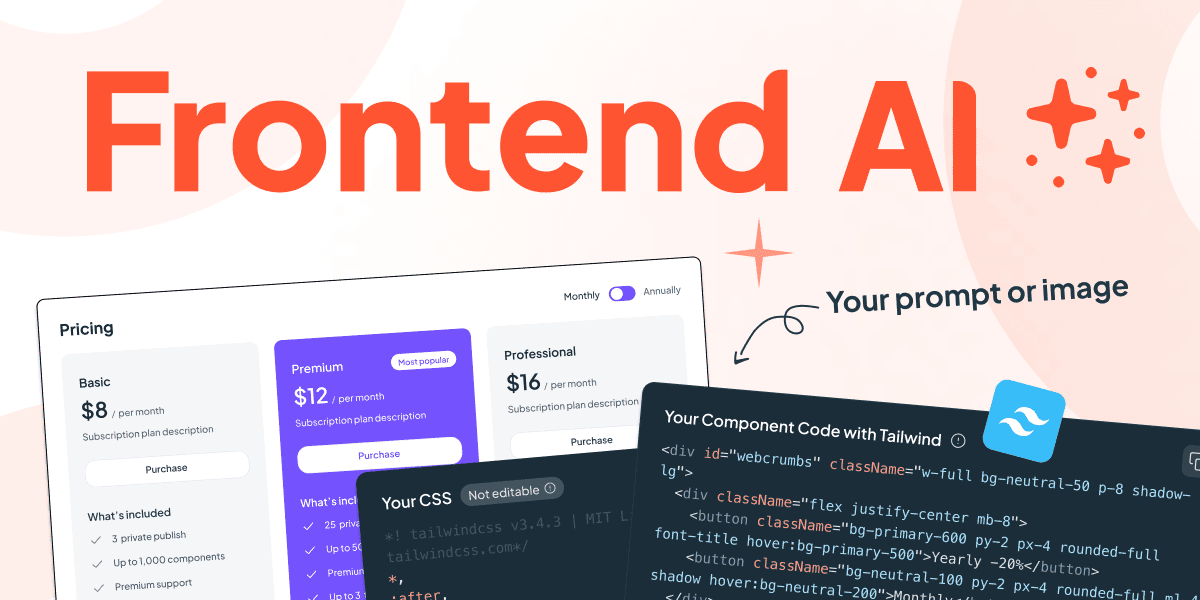
Webcrumbs Frontend AI is an open-source platform designed to elevate frontend development. It provides AI-powered tools and a visual editor, enabling users to create, refine, and perfect components rapidly. The tool focuses on maintaining clean and consistent designs, offering features that streamline the development workflow. It supports the generation of ready-to-use code and allows for customization of design elements such as colors, fonts, and spacing. Webcrumbs Frontend AI is particularly useful for developers looking to accelerate their component building process and ensure design integrity across projects.
Adala
Adala is an autonomous data (labeling) agent framework designed for implementing agents specialized in data processing, with a strong emphasis on diverse data labeling tasks. These agents are autonomous, meaning they can independently acquire one or more skills through iterative learning, influenced by their operating environment, observations, and reflections. Users define the environment by providing a ground truth dataset. Adala offers reliable agents built on ground truth data, controllable output with configurable constraints, and specialized capabilities for various data processing needs. Its flexible and extensible runtime allows a single skill to be deployed across multiple runtimes, supporting dynamic scenarios like the student/teacher architecture. The framework is easily customizable, enabling users to quickly develop agents for specific challenges.
openchatbi
OpenChatBI is an intelligent, chat-based Business Intelligence (BI) tool powered by large language models, designed to enable users to query, analyze, and visualize data using natural language conversations. Built on the LangGraph and LangChain ecosystem, it provides sophisticated chat agents and workflows that facilitate natural language to SQL conversion with schema linking and advanced prompt engineering. Key features include automatic SQL generation, intuitive data visualization via Plotly, and robust data catalog management that automatically discovers and indexes database table structures. It also supports time series forecasting, code execution for data analysis, and interactive problem-solving by proactively asking for more context. With persistent memory and integration capabilities, OpenChatBI offers a comprehensive solution for data interaction.

Frigate NVR
Frigate NVR is an open-source network video recorder designed for real-time AI object detection with IP cameras. It prioritizes privacy by performing all processing locally on your own hardware, ensuring camera feeds never leave your home network. Unlike traditional NVRs that rely on simple motion detection and often produce false positives, Frigate leverages AI accelerators to accurately identify objects like people or cars. This significantly reduces the need for fine-tuning and allows users to review only relevant detections. The system can run over 100 object detections per second, ensuring no frame is missed. It also allows for fine-tuning events and alerts with zones, integrating seamlessly with home automation platforms like Home Assistant via MQTT.
rever
Rever is an AI-powered finance automation platform designed to streamline financial operations for modern CFOs. It addresses common challenges like fragmented systems and overburdened accounting teams by offering an AI-enabled Finance Copilot. Key features include centralized vendor management, easy creation and tracking of purchase orders, and robust bill management with two-way matching against POs. The platform also integrates approval workflows and maintains a detailed audit history for compliance and traceability. Rever aims to transform finance functions from reactive firefighting to intelligent decision-making, offering both a free cloud version and a self-hosted option for full control and compliance.
Unify
Unify AI offers virtual colleagues designed specifically for property operators and real estate professionals. This AI solution automates high-value workflows such as lease abstraction, compliance, deal support, resident operations, and portfolio reporting. Unlike traditional tools, Unify AI colleagues onboard like new hires, integrating seamlessly into existing teams and systems, including custom on-premise software. They learn on the job, adapting to team-specific nuances and becoming experts in weeks. The platform emphasizes security and compliance with SOC 2 Type II, GDPR, and end-to-end encryption. Unify AI is backed by prominent investors like Y Combinator and Microsoft's M12, focusing on delivering productive AI agents from day one.
Neurocle
Neurocle specializes in AI deep learning vision software, addressing industrial challenges with advanced technology. Their product ecosystem includes Neuro-T, a GUI-based no-code software for training high-performance deep learning models, and Neuro-R, a runtime library for real-time inference across various platforms like CPU, GPU, and embedded boards. Neuro-T Engine facilitates MLOps by enabling on-site learning and re-learning, while Neuro-EDU offers an all-in-one educational platform for AI deep learning vision projects. Neurocle's solutions are designed to improve inspection accuracy, reduce resource consumption, and solve data scarcity issues using generative AI, making deep learning vision accessible for manufacturing industries.
ChatGPT_Trading_Bot
ChatGPT_Trading_Bot offers an open-source codebase for building an automated trading bot, as demonstrated in a YouTube video by Siraj Raval. The project is primarily for educational and experimental use, allowing users to understand and implement algorithmic trading strategies. It leverages the FinRL team's iPython notebook, enabling users to pull trading data, simulate environments, train neural networks for stock price prediction using reinforcement learning, and backtest predictions. The bot can then execute buy/sell decisions based on expected returns via the Alpaca API. Users are strongly cautioned about the inherent risks of investing real money in such systems.
cnn-watermark-removal
cnn-watermark-removal is an open-source project providing a fully convolutional deep neural network designed to remove transparent overlays, such as watermarks, from images. The architecture avoids down-sampling to maintain accuracy and utilizes dilated convolutions for a large receptive field without excessive computation. While the current design does not generalize well to vastly different watermark types or non-additive overlays, it offers a solid foundation for image inpainting. Users can train the network with their own datasets or use provided pretrained weights. The project is built with Tensorflow and requires specific libraries and datasets for setup and operation.
Republic Labs AI
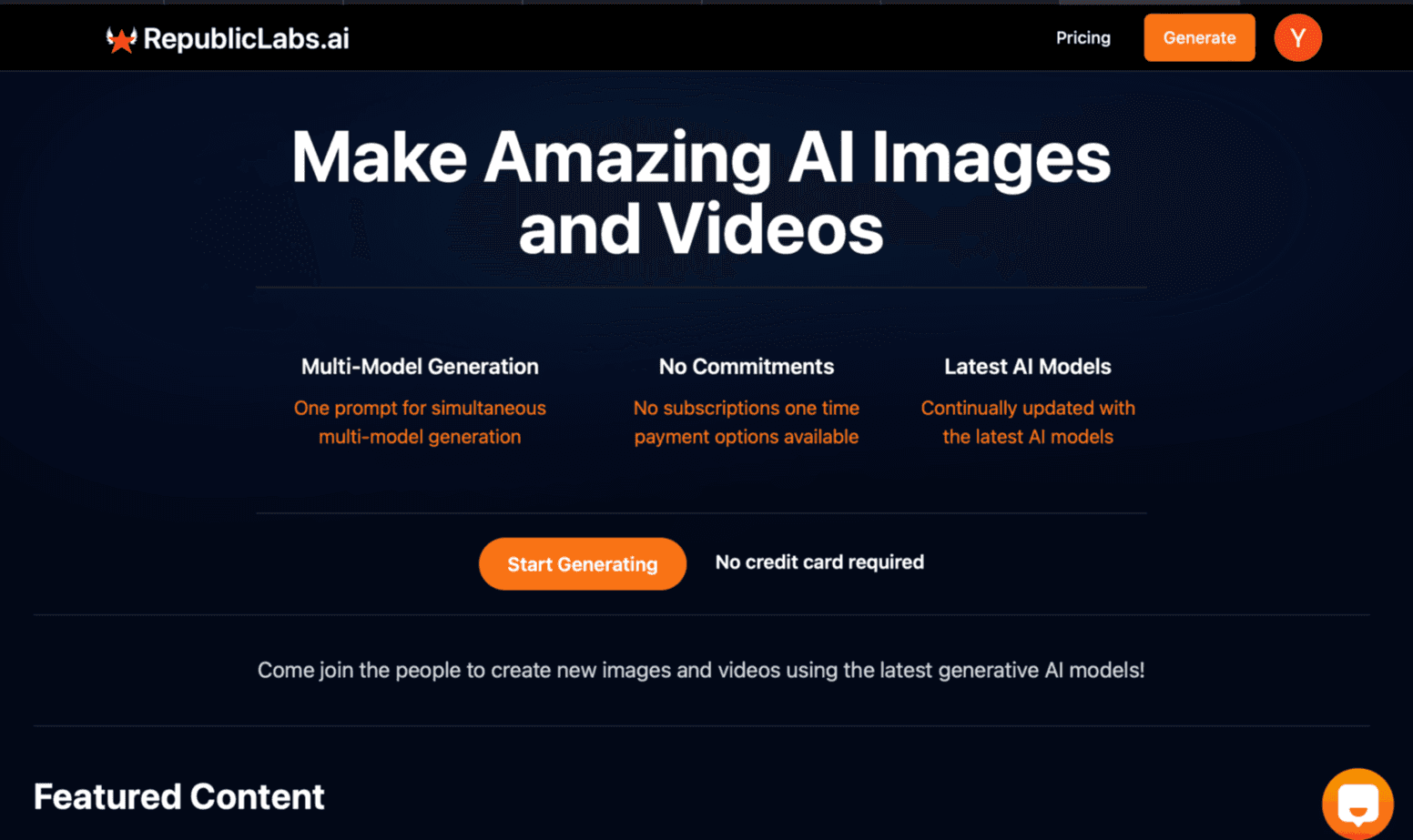
Republic Labs AI is a generative AI platform designed for creating images and videos. It features multi-model generation, allowing users to input a single prompt to generate content across various AI models simultaneously. The platform operates on a one-time payment basis, eliminating the need for subscriptions, and is regularly updated with the newest AI models to ensure access to cutting-edge technology. Users can generate a wide range of visual content, including professional headshots, making it a versatile tool for various creative needs. The platform emphasizes accessibility, requiring no credit card to start generating content.
llama-models
llama-models offers a comprehensive suite of utilities for working with Llama large language models. It provides easy accessibility to cutting-edge LLMs, fostering collaboration and advancements among developers, researchers, and organizations. Users can download model weights and tokenizers, list available models, describe model details, and run inference with various quantization modes like FP8 and Int4 to optimize memory footprint. The platform supports both Meta's direct downloads and Hugging Face access, ensuring broad ecosystem compatibility. It emphasizes responsible use with dedicated guides and reporting mechanisms for issues and risky content, promoting ethical AI development.
llama-stack
OGX, previously known as llama-stack, is an open-source agentic API server designed for building AI applications with maximum flexibility. It serves as a drop-in replacement for the OpenAI API, enabling developers to use any OpenAI-compatible client or agentic framework. OGX supports various models like Llama, GPT, Gemini, and Mistral, and can be deployed on diverse infrastructures, from local development with Ollama to production with vLLM or managed services. Key features include Chat Completions & Embeddings, a Responses API for server-side agentic orchestration with tool calling and file search, and support for Vector Stores & Files. It also offers multi-SDK compatibility, working natively with Anthropic and Google GenAI SDKs alongside OpenAI.
llm-graph-builder
llm-graph-builder is an open-source tool designed to convert various forms of unstructured data, such as PDFs, DOCs, TXTs, YouTube videos, and web pages, into structured knowledge graphs. It utilizes Large Language Models (LLMs) and the LangChain framework to extract nodes, relationships, and properties, storing them in a Neo4j database. Users can upload files from local machines, GCS, S3 buckets, or web sources, select their preferred LLM model, and define custom or existing schemas for graph generation. Key features include graph visualization in Neo4j Bloom, conversational querying of data, and token usage tracking. It supports a wide range of LLMs including OpenAI, Gemini, Anthropic, and Ollama, and offers various embedding models for data vectorization.
llama.go
llama.go is a pure Golang reimplementation of the popular llama.cpp framework, designed for machine learning enthusiasts and developers. It aims to provide a GGML-compatible environment for debugging and inferring large GPT models directly in Golang, offering an alternative to lower-level languages like C++. The project focuses on performance and elegance, enabling users to work with models like LLaMA-7B, 13B, 30B, and 65B. Key features include multi-threading, cross-platform compatibility (Mac, Linux, Windows), and optimizations for ARM NEON and x64 AVX2. It also supports modern GGUF V3 model format, INT8 quantization, and offers an embedded REST API for production use, allowing parallel inference with configurable pods and threads.
Liger-Kernel
Liger-Kernel is an open-source collection of Triton kernels specifically engineered to optimize Large Language Model (LLM) training. Developed by LinkedIn, this tool boasts a 20% increase in multi-GPU training throughput and a 60% reduction in memory usage, enabling longer context lengths, larger batch sizes, and massive vocabularies. It offers optimized Post-Training kernels, including DPO, ORPO, CPO, and SimPO, which can deliver up to 80% memory savings for alignment and distillation tasks. Liger-Kernel is designed for ease of use, allowing users to patch Hugging Face models with a single line of code or compose custom models using its modules. It is compatible with multi-GPU setups like PyTorch FSDP, DeepSpeed, and DDP, and integrates with popular trainer frameworks such as Axolotl and Hugging Face Trainer. The kernels are exact, ensuring computational accuracy with rigorous unit tests and convergence testing.