
Coding & Development
Browsing page 392 of AI tools for Coding & Development. Sorted by confidence score — our independent quality rating.

nexent
Nexent is a zero-code platform designed for auto-generating production-grade AI agents, leveraging Harness Engineering principles. It provides a unified approach to tools, skills, memory, and orchestration, incorporating built-in constraints, feedback loops, and control planes. The platform eliminates the need for complex orchestration or drag-and-drop interfaces, allowing users to develop any agent using pure language. Key features include smart agent prompt generation, scalable data processing for over 20 data formats, personal-grade and internet knowledge search with traceability, and multimodal understanding. It also boasts an MCP tool ecosystem for flexible integration of Python plug-ins, models, and chains without core code modification.
perplexity-ai
Perplexity AI is a Python module designed as an unofficial API wrapper for Perplexity.ai, offering enhanced functionality and flexibility. A key feature is its ability to leverage Emailnator for automatic generation of new accounts, effectively bypassing query limits and providing unlimited pro queries. The module supports both synchronous and asynchronous APIs, catering to different programming needs. For users who prefer a graphical interface, it also includes a web interface that automates account creation and usage. This tool is particularly useful for developers and data scientists looking to integrate Perplexity.ai's capabilities into their applications or workflows without the constraints of official API keys, offering robust error handling, comprehensive logging, and streaming responses.
generative-ai-docs
Generative-ai-docs is a GitHub repository that previously served as the source for guides and tutorials related to Google's Generative AI developer site, specifically for the Gemini API and Gemma. The repository is now deprecated and no longer maintained, but it provides essential links to the active Gemini Documentation, Gemini Cookbook, and Gemma Cookbook. These resources are crucial for developers and data scientists looking to work with Google's generative AI models, offering examples, demos, and documentation to facilitate integration and development. While the repository itself is archived, its historical context and redirection to current resources make it a relevant entry for understanding the evolution of Google's generative AI offerings.
Angular.dev
Angular.dev is the official website for the Angular framework, designed to empower developers in building scalable and modern web applications with confidence. It integrates cutting-edge features such as Signals for reactive state updates, Control Flow for efficient template logic, Deferrable Views for improved performance, and Hydration for faster initial page loads. The platform emphasizes productivity and offers AI-forward resources and integrations to enhance development workflows. Angular.dev is built on opinionated yet versatile principles, leveraging Angular components and dependency injection for modular organization. It provides a fully featured platform with first-party modules for forms, routing, and more, ensuring everything works together seamlessly. Trusted by millions, Angular focuses on performance, enabling the creation of fast, reliable applications that scale with team size.
SmolVLM 256M Instruct WebGPU
SmolVLM 256M Instruct WebGPU is an AI model developed by Hugging Face Smol Models Research, designed to provide instant visual descriptions. Users can upload a photo, and the application will generate a short text caption summarizing the image in clear, natural language. This tool operates entirely within a web browser, eliminating the need for any special setup or installations. It is particularly useful for quickly understanding the content of an image through an AI-generated description, making it accessible for a wide range of users who need immediate visual interpretation without complex configurations. The model is available as a Hugging Face Space, emphasizing its accessibility and ease of use.
Scrapling
Scrapling is a powerful and adaptive web scraping framework designed for both single requests and full-scale, concurrent crawls. It features an intelligent parser that learns from website changes, automatically relocating elements when pages update, ensuring data extraction remains robust. The framework includes advanced fetchers capable of bypassing anti-bot systems like Cloudflare Turnstile and offers full browser automation. Scrapling supports multi-session crawls with pause/resume functionality, automatic proxy rotation, and real-time streaming of scraped items. It also integrates AI capabilities through an MCP server for assisted web scraping, optimizing data extraction and reducing token usage for AI models. Built for performance, it boasts high speed, memory efficiency, and battle-tested architecture with extensive test coverage.
hub
TensorFlow Hub (hub) is a Python library designed to facilitate transfer learning by enabling the reuse of pre-trained TensorFlow models. It allows developers to easily download and integrate SavedModels into their TensorFlow programs with minimal code. While the tfhub.dev platform has transitioned to Kaggle Models, the `tensorflow_hub` library continues to support downloading models that were initially uploaded to tfhub.dev. This tool is particularly useful for accelerating development by leveraging existing, high-quality models for tasks like image classification and text classification, reducing the need to train models from scratch. It includes comprehensive documentation, examples, and guidelines for contributing to the library.
scikit-learn-mooc
scikit-learn-mooc is the official source code repository for the Machine Learning in Python with scikit-learn MOOC. This comprehensive course offers educational material designed to teach machine learning concepts using the popular scikit-learn library in Python. The MOOC provides a rich learning experience with features like quizzes, executable notebooks, and a discussion forum for interactive learning. It is hosted on the FUN-MOOC platform and is completely free, ensuring accessibility for a wide audience interested in data science and machine learning. Users can enroll for the full MOOC experience or browse a static version of the course online, with options to launch online notebook environments or run notebooks locally.

Prompt.Cafe
Prompt.Cafe is a prompt generator designed to help users rapidly create app ideas. By allowing users to mix various 'ingredients' into prompts, the tool streamlines the ideation process for application development. It aims to eliminate the initial blank-cursor problem, enabling faster iteration and exploration of app concepts. The platform focuses on providing a quick and efficient way to generate prompts, making it easier for developers and creators to kickstart their projects without getting stuck on the initial brainstorming phase. The intuitive interface encourages experimentation with different combinations to discover unique app ideas.
GradAI
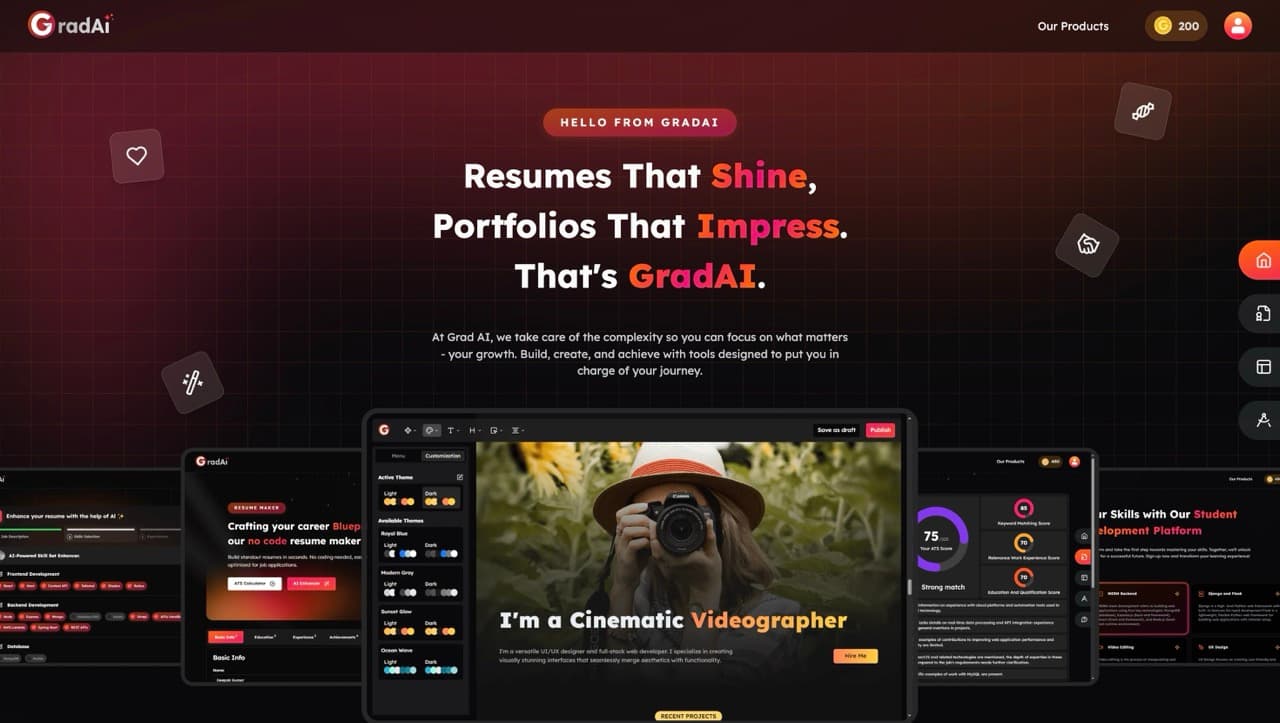
GradAI is a powerful AI-driven platform designed to enhance job seekers' resumes and portfolios, helping them land their dream jobs. It offers an intuitive drag-and-drop no-code portfolio creator, allowing users to showcase projects, skills, and testimonials effectively. The platform also includes an AI Resume Enhancer to optimize resumes with relevant keywords, ensuring they pass Applicant Tracking System (ATS) screenings. Users can analyze their resume's ATS compatibility with the ATS Calculator and receive personalized improvement tips. GradAI provides new resume templates and allows for seamless export and sharing across platforms like LinkedIn. It aims to simplify the job search process by providing tools to build, create, and achieve career goals.
seq2seq-signal-prediction
seq2seq-signal-prediction is an open-source project designed to teach users how to implement Sequence-to-Sequence (seq2seq) Recurrent Neural Networks (RNNs) for time series forecasting using TensorFlow. The project includes a series of four exercises of increasing difficulty, starting with deterministic signal prediction and progressing to more complex tasks like denoising and Bitcoin price forecasting. It provides a Jupyter notebook and a Python script version, with instructions for running the code locally or on Google Colab with GPU support. The exercises guide users through adjusting hyperparameters and modifying network architectures to achieve accurate predictions, making it a practical learning resource for those with some prior knowledge of RNNs.
feature-engineering-book
feature-engineering-book is the official GitHub code repository accompanying the book "Feature Engineering for Machine Learning" by Alice Zheng and Amanda Casari, published by O'Reilly in 2018. This resource is invaluable for students, researchers, and practitioners looking to implement the feature engineering techniques discussed in the book. The repository contains various Jupyter Notebooks covering topics such as binning, count features, log and Box-Cox transformations, interaction features, text processing (TF-IDF, chunking), regression on categorical variables, feature hashing, PCA, K-means clustering for featurization, and HOG image features. It also includes end-to-end recommender system examples, providing practical code for a deeper understanding of machine learning concepts.
VVTerm
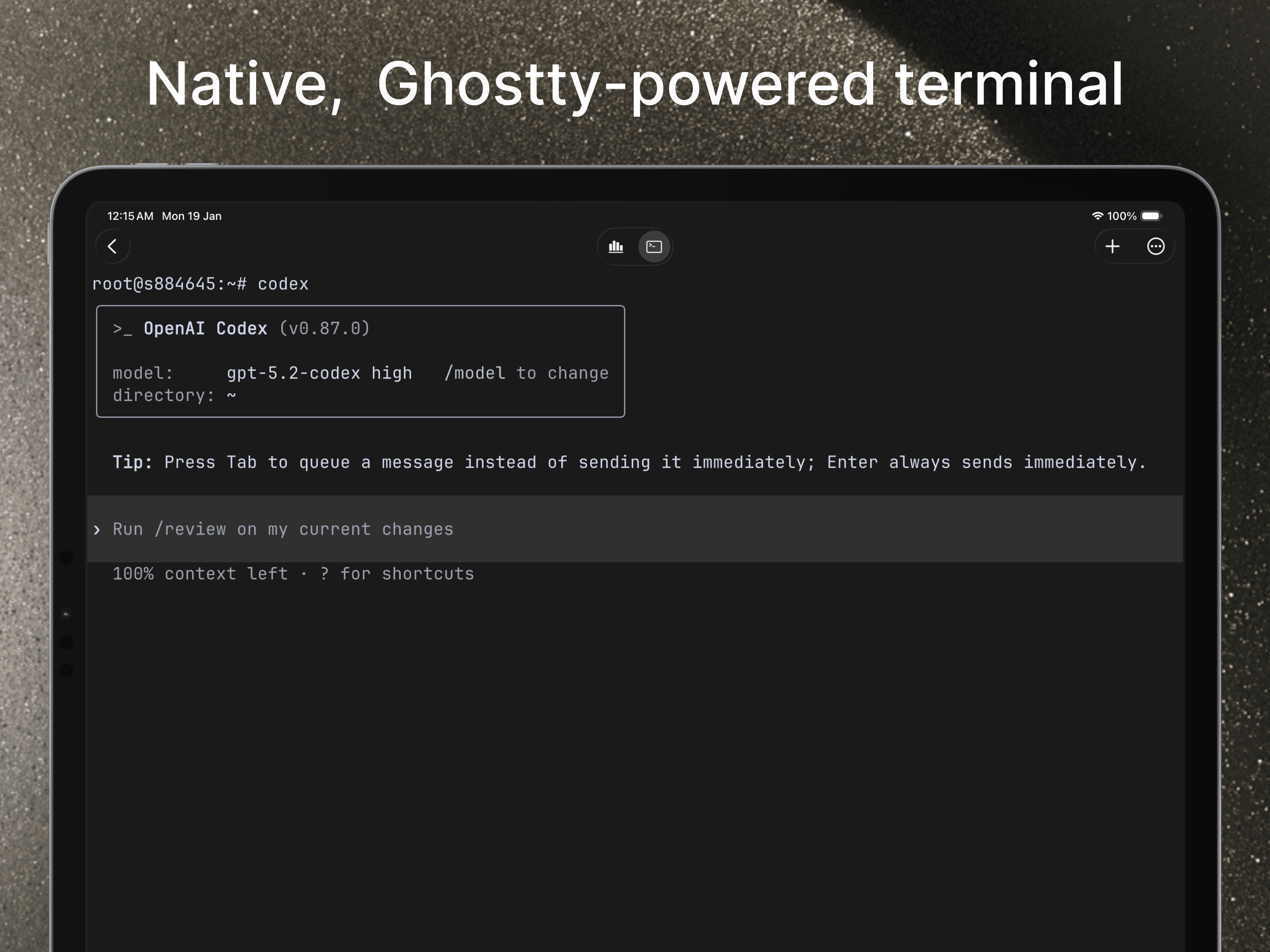
VVTerm is a native SSH terminal and SFTP client designed for iPhone, iPad, and Mac users, enabling seamless server management across Apple devices. It supports various connection methods including standard SSH, Mosh, Tailscale SSH, and Cloudflare Tunnel SSH. The tool integrates iCloud sync for server configurations and leverages Apple Keychain for secure password and SSH key management. Beyond terminal access, VVTerm includes a built-in SFTP remote file browser, allowing users to preview text, image, and video files, perform uploads and downloads, rename, move, delete items, create folders, and edit POSIX permissions on supported servers. It also features a GPU terminal (libghostty), multiple workspaces, environment filters, voice-to-command functionality, and multiple connection tabs, making it a comprehensive solution for developers and system administrators on the go.
TensorFlow-Lite-Object-Detection-on-Android-and-Raspberry-Pi
This GitHub repository offers a comprehensive tutorial for training, converting, and running TensorFlow Lite object detection models on various edge devices, including Android phones and the Raspberry Pi. It guides users through the process of creating custom TensorFlow Object Detection models, optimizing them for TensorFlow Lite, and deploying them for real-time applications. The tutorial provides Python code for performing object detection on images, videos, web streams, or webcam feeds. It also highlights the benefits of using Google Colab for training, offering a free GPU-enabled virtual machine, and includes step-by-step setup guides for different devices. The resource emphasizes faster inference times and reduced processing power requirements compared to standard TensorFlow models.

Arondite
Arondite is a British defense technology company specializing in software platforms for accelerated decision-making in autonomous systems. The company brings together a unique blend of operational and technical expertise to build technology with immediate, real-world impact on a global scale. Their flagship product, Cobalt, is described as a defense software platform. Arondite's team comprises individuals with backgrounds in the British Army, Ministry of Defence, and leading tech companies like Palantir, Helsing, and Betfair, indicating a strong foundation in both defense and advanced software engineering. They aim to address evolving global threats by developing innovative solutions.
TextGAN-PyTorch
TextGAN-PyTorch is a comprehensive PyTorch framework designed for Generative Adversarial Networks (GANs) based text generation models. It supports both general and category-specific text generation, making it a versatile tool for researchers and developers. The framework serves as a benchmarking platform, facilitating the evaluation and comparison of various GAN-based text generation models. It is particularly beneficial for those familiar with PyTorch, enabling them to quickly engage with the text generation field. The repository includes implementations of several prominent models like SeqGAN, LeakGAN, and RelGAN, along with detailed instructions for setup and usage, including real data experiments and visualization tools.
VectorHub
VectorHub is a free and open-source learning platform designed for individuals ranging from software developers to senior ML architects who are keen on integrating vector retrieval into their machine learning stack. The platform offers practical resources to help users create Minimum Viable Products (MVPs) with easy-to-follow learning materials. It also assists in solving use case-specific challenges related to vector retrieval, enabling users to confidently take their MVPs to production. Additionally, VectorHub provides insights into various vendors in the space, helping users select the solutions that best fit their needs. A notable tool offered by VectorHub is the Vector DB Comparison, which outlines and verifies the feature sets of different Vector Database solutions.
ViT-pytorch
ViT-pytorch offers a PyTorch reimplementation of the Vision Transformer (ViT) model, based on the paper 'An Image is Worth 16x16 Words: Transformers for Image Recognition at Scale'. This tool allows users to leverage the power of Transformers for image recognition, demonstrating that applying them directly to image patches and pre-training on large datasets yields state-of-the-art results. It includes various pre-trained models like ViT-B_16, R50+ViT-B_16, and ViT-L_32, which can be downloaded and used for training. The repository provides scripts for training models on datasets like CIFAR-10 and CIFAR-100, with options for mixed precision training and gradient accumulation. Additionally, it supports visualization of attention maps, offering insights into how the model processes images.
ViTPose
ViTPose is an official PyTorch implementation for human pose estimation, based on the NeurIPS'22 paper "ViTPose: Simple Vision Transformer Baselines for Human Pose Estimation" and the TPAMI'23 paper "ViTPose++: Vision Transformer for Generic Body Pose Estimation." This tool achieves impressive accuracy, including 81.1 AP on the MS COCO Keypoint test-dev set. It supports both single-task and multi-task training, covering human, animal, and whole-body pose estimation. ViTPose provides pre-trained models, detailed configurations, and a web demo integrated into Huggingface Spaces for easy experimentation with videos and images. It's built on PyTorch and utilizes mmcv, making it a robust solution for researchers and developers in computer vision.

Lucid AI
Lucid AI, based in San Francisco, positions itself as a simulation company. Its core focus appears to be on the creation of "World Models" and "Generative Video," suggesting an emphasis on advanced AI for creating simulated environments or visual content. The company's messaging, including phrases like "Memory Made Manifest" and "Dreamer of Dreams," indicates an exploration of consciousness, memory, and the unfolding of infinite worlds within the mind. It invites users to consider if they are "lucid," implying a connection to dream states and the potential for AI to bring these concepts to life.
Machine-Learning-for-Cyber-Security
Machine-Learning-for-Cyber-Security is a comprehensive, curated list of tools and resources dedicated to the application of machine learning in the cyber security domain. This GitHub repository serves as a central hub for anyone looking to explore or implement ML techniques for threat detection, prevention, and analysis. It categorizes resources into essential sections such as Datasets, Papers, Books, Talks, Tutorials, and Courses, making it easy for users to find relevant information. From foundational research papers on network intrusion detection to practical tutorials on building an antivirus with machine learning, this resource aims to equip security professionals, researchers, and students with the knowledge and tools needed to leverage AI in combating cyber threats.
FastAPI + React Template
FastAPI + React Template offers a robust foundation for developing web applications, leveraging the power of FastAPI for efficient backend operations and React for dynamic, interactive frontend experiences. This template is designed to accelerate the creation of web demos and full-stack applications, particularly within the Hugging Face Spaces environment. It allows users to quickly set up a web interface where they can interact with various features, making it ideal for rapid prototyping and deployment of AI-powered or data-driven applications. The combination of these popular frameworks ensures a scalable and maintainable codebase for developers.
VLM2Vec
VLM2Vec is an open-source project from TIGER-AI-Lab, providing a unified framework for training and evaluating powerful multimodal embeddings across diverse visual formats, including images, videos, and visual documents. It introduces MMEB-V2, a comprehensive benchmark with 78 tasks designed to systematically evaluate embedding models across these modalities. VLM2Vec-V2 sets a new state-of-the-art, outperforming strong baselines. The tool supports easy configuration of training and evaluation using YAML files and allows for easy extension with new datasets. It is built on state-of-the-art Vision-Language Models like Qwen2-VL, using instruction-guided contrastive training to produce fixed-dimensional embeddings for various inputs.
m1-machine-learning-test
m1-machine-learning-test is a GitHub repository offering code and detailed instructions for benchmarking the performance of Apple's M1, M1 Pro, M1 Max, M1 Ultra, and M2 chips when running machine learning tasks with TensorFlow. The repository includes sample code for various experiments, such as training a TinyVGG model on CIFAR10, an EfficientNetB0 feature extractor on Food101, and a RandomForestClassifier on the California Housing dataset. It provides comprehensive guides for setting up a TensorFlow environment on Apple Silicon using Miniforge, installing necessary dependencies like tensorflow-macos and tensorflow-metal for GPU acceleration, and common data science packages like Jupyter, pandas, numpy, matplotlib, and scikit-learn. This resource is ideal for developers and data scientists looking to optimize and test machine learning workflows on Apple's hardware.