
Coding & Development
Browsing page 395 of AI tools for Coding & Development. Sorted by confidence score — our independent quality rating.

mlhelper
mlhelper is an open-source JavaScript library designed for machine learning tasks, built upon Node.js. It offers a comprehensive suite of algorithms and utilities, including core functionalities like matrix and vector operations essential for numerical computations in ML. Beyond basic math, mlhelper supports practical aspects such as file parsing, enabling easy data ingestion, and feature engineering for preparing data for models. It also incorporates data visualization tools, particularly for graphs like Decision Trees and logistic regression, aiding in understanding model behavior. The project aims to foster a richer ecosystem for machine learning development within the JavaScript environment.
use-stick-to-bottom
use-stick-to-bottom is a lightweight, zero-dependency React Hook and Component specifically designed for AI chat applications. It automatically sticks to the bottom of a container and smoothly animates content to maintain its visual position as new messages are added. This tool does not rely on `overflow-anchor` CSS support, making it compatible with browsers like Safari. It uses the `ResizeObserver` API to detect content resizing, supporting both content growth and shrinking without losing stickiness. The hook also correctly handles scroll anchoring, preventing content jumps when elements above the viewport resize. Users can cancel stickiness by scrolling up, with clever logic distinguishing user scrolls from animation events. It features a custom smooth scrolling algorithm with velocity-based spring animations, ideal for streaming content with variable sizing common in AI chatbots.
Gradio_opencv
Gradio_opencv is a specialized tool designed to bridge the gap between OpenCV's powerful computer vision capabilities and Gradio's user-friendly interface for machine learning applications. It enables developers and researchers to easily create interactive web demos for image processing and computer vision tasks. The tool facilitates the integration of complex OpenCV functions into Gradio applications, making it simpler to showcase and test computer vision models. This is particularly useful for those working on real-time video analysis or developing prototypes that require visual interaction. While the current live website indicates a runtime error, the core purpose of Gradio_opencv is to streamline the development and deployment of computer vision applications within the Gradio ecosystem.
gradio_huggingfacehub_search V0.0.7
gradio_huggingfacehub_search V0.0.7 is a specialized AI search engine designed to navigate the vast resources available on the Hugging Face Hub. This tool enables users to efficiently search for models, datasets, and various AI spaces by simply entering their query. It streamlines the discovery process for AI components, providing a list of relevant results that can be explored further. Ideal for developers and researchers, it simplifies the task of finding specific AI tools and resources, making it easier to integrate them into projects or studies. The tool is hosted as a Hugging Face Space, indicating its accessibility and potential for community-driven development.
AViD
AViD is a streamlined toolkit designed for fine-tuning state-of-the-art vision-language detection models with parameter-efficient adaptation. Built upon the powerful Grounding DINO framework, AViD introduces capabilities for fine-tuning image-to-text grounding on custom datasets, which is crucial for applications requiring precise alignment between textual descriptions and image regions. Key features include a complete fine-tuning pipeline, parameter-efficient training with LoRA (allowing training of only ~2% of parameters), and EMA stabilization to retain pre-trained knowledge. It also offers optional phrase-based NMS for removing redundant boxes and includes a sample fashion dataset for immediate experimentation. The framework provides a comprehensive evaluation suite with metrics like mAP, Precision, Recall, and F1 Score, along with visualizations and detailed reporting.
Gpt-4o-mini Battles
Gpt-4o-mini Battles is an AI tool hosted on Hugging Face Spaces, designed for comparing the performance of various AI models, specifically focusing on GPT-4o-mini. Users can explore and filter chat conversations between different models, making it a valuable resource for evaluating language model responses. The application provides options to select the language of the conversation, the opponent model involved, the outcome of the battle, and even specific questions asked. This detailed filtering capability allows researchers, developers, and AI enthusiasts to gain insights into model behavior and performance under different conditions. It serves as a practical platform for understanding the nuances of AI model interactions and identifying strengths and weaknesses.
Voqal
Voqal offers a native voice control SDK designed for mobile developers to integrate Arabic and English voice commands into their iOS and Android applications. The SDK supports over 10 Arabic dialects, including Egyptian, Gulf, Levantine, Maghrebi, and Iraqi, ensuring broad user understanding. It boasts a response time of less than 5 seconds and an accuracy rate exceeding 95%. Voqal handles voice recognition, intent parsing, and response handling, allowing developers to add voice control without modifying their backend. The integration process is streamlined, taking minutes rather than days, and supports popular frameworks like React Native and Flutter. Built-in analytics provide insights into usage patterns and recognition accuracy, making it a comprehensive solution for voice-enabling mobile apps in the MENA region.
granite-docling-258M demo
The granite-docling-258M demo is a Hugging Face Space by ibm-granite, showcasing the capabilities of the granite-docling-258M language model. This application enables users to upload images of documents, including pages, tables, charts, formulas, or code snippets. Once uploaded, users can interact with the document by asking questions or requesting specific conversions. The tool is designed to return clear text answers and extract structured information, making it useful for various data extraction and document understanding tasks. Built with Gradio and licensed under Apache-2.0, it provides a practical demonstration of advanced document AI.
brian2
Brian2 is a free, open-source simulator for spiking neural networks, primarily written in Python. It provides a user-friendly and efficient platform for researchers to model and simulate complex neural circuits. The simulator is designed with ease of learning and use in mind, aiming to save scientists' time in addition to processing power. Brian2 is highly flexible and easily extensible, making it suitable for a wide range of neuroscience research applications. It is available on almost all platforms and offers comprehensive documentation. Users are encouraged to report issues via GitHub or the Brian forum and to cite the provided article if used for published research.
iconkit.dev
iconkit.dev is an AI-powered platform designed to instantly generate professional icon libraries and design assets from simple prompts. It caters to developers, designers, entrepreneurs, and marketers by streamlining the creation of visual elements for apps, design systems, and brand identities. Users can generate logos, icons compatible with Next.js, v0, React, and Vue, as well as brand materials and design systems. The tool offers features like project-scoped library management, version control, and export in multiple formats, including SVG. It aims to accelerate workflows for individuals and teams, providing ready-to-use assets without requiring extensive technical or design expertise.
OpenCoder 8B Instruct
OpenCoder 8B Instruct is an 8B parameter instruct model from the OpenCoder family, designed to assist developers with code-related tasks. Users can enter a description of what they want a program to do, and the application will write the corresponding source code. This tool is versatile, capable of handling a wide range of programming tasks, from generating simple functions to creating small games. It is hosted on Hugging Face Spaces, making it easily accessible for anyone looking to quickly generate code based on their specifications. The model aims to streamline the coding process by translating natural language into functional source code.
Grok API Service
Grok API Service is a tool designed to verify the operational status of an API. It checks the functionality of an API to ensure it is running correctly and provides feedback on its performance. The service does not require specific input, as it automatically assesses the API's status and reports any issues or confirms normal operation. This tool is hosted on Hugging Face Spaces, indicating its potential use for developers and AI enthusiasts who need to monitor the health of their integrated AI services or other APIs. Currently, the Space is paused, and users are directed to the community tab to request its restart from the author.
rep
REP, or Reproducible Experiment Platform, is an ipython-based environment designed for conducting data-driven research with an emphasis on consistency and reproducibility. It provides a unified Python wrapper for several machine learning libraries, including Sklearn, XGBoost, and Theanets, allowing users to work with a consistent interface. Key features include parallel training of classifiers on clusters, classification/regression reports with interactive plots, and smart grid-search algorithms with parallel execution. REP also supports research versioning using Git and offers pluggable quality metrics for classification. It aims to extend scikit-learn by providing a better user experience and tools for meta-algorithm design, making it a valuable resource for data scientists and researchers.

Relic
Relic is an award-winning spatial entertainment platform designed for creating and deploying interactive spatial experiences. It simplifies the content creation process by allowing users to generate 3D assets from 2D images/videos, animate, and rig them using simple prompts, eliminating the need for coding or complex game engines like Unity or Unreal Engine. The platform integrates various 3D AI tools into an agentic interface, making it accessible for creators of all skill levels. Content can be easily deployed on the Relic App, embedded via an SDK, or shared as a WebXR Link. Relic also enables users to watch 4D AR, 6DoF, and fully Spatial Movies, bringing characters to life and transforming viewing experiences into immersive worlds.
Cased
Cased provides AI-native agents and workflows designed for infrastructure and platform teams, aiming to accelerate code deployment to production while enhancing safety and intelligence. The platform offers deep infrastructure understanding, enabling faster problem identification and resolution, thereby improving MTTR and reducing downtime. It connects to various data sources for real-time insights and visualizations. Cased agents leverage memory, history, and context from past incidents and conversations to continuously improve accuracy. Key features include deploy monitoring for anomalies and performance issues, custom infrastructure agents for automating routine tasks, and natural language capabilities for DevOps tasks like setting up CloudWatch alarms. It also offers drift detection with automated fixes and integrates with numerous familiar tools, providing them with "superpowers."
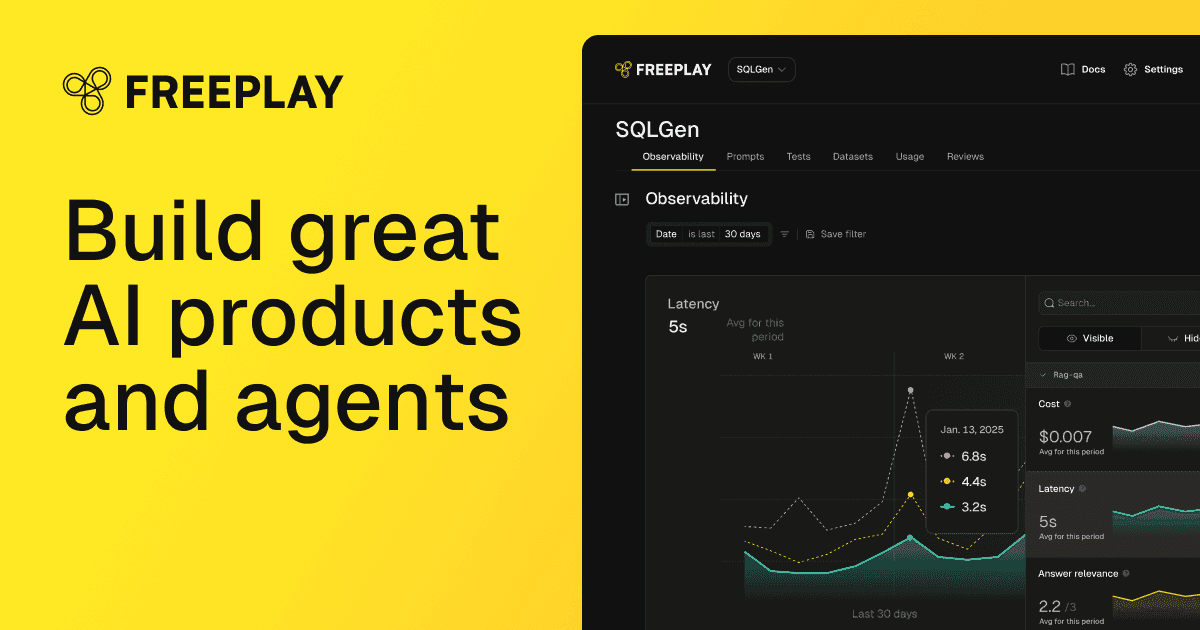
Freeplay
Freeplay is an ops platform designed for AI engineering teams, offering a comprehensive workflow to build, test, observe, and iterate on AI products. It integrates observability, evaluations, and testing into a continuous improvement loop, allowing teams to understand agent performance and quickly iterate. Key features include tracing completions, tool calls, and agent steps, instant log search, automatic traffic categorization, and turning production logs into test cases. The platform supports custom evaluations, prompt management, and AI feature reviews, ensuring confidence in shipping AI products. Freeplay is trusted by leading AI teams and offers enterprise-grade security, flexible deployment options, and expert support from AI engineers.

LoreKeeper
LoreKeeper is a comprehensive TTRPG game prep toolkit designed for Game Masters. It allows users to upload existing lore, notes, voice memos, and videos, which the AI then learns to power various generation features. Key capabilities include generating NPCs, monsters, maps, and names, as well as creating character portraits, location maps, and scene art from your lore. The tool also offers cinematic video scene generation and the ability to produce full campaign sourcebooks in PDF format. LoreKeeper aims to transform hours of game preparation into minutes of work, supporting D&D, Pathfinder, and any other tabletop RPG system.
Gpu Tflop Finder
Gpu Tflop Finder is a specialized tool hosted on Hugging Face Spaces, designed to provide quick access to GPU TFLOPS data. Users can easily view and filter this information by categories such as consumer, workstation, or datacenter GPUs. The interface includes toggle checkboxes, enabling users to hide or show specific GPU types, streamlining the search for relevant performance metrics. This tool is particularly useful for AI developers and researchers who need to evaluate GPU performance for hardware selection and optimizing AI models, offering a straightforward way to compare different GPUs based on their TFLOPS.
Built a mobile app to create and play AI visual stories
Davia is a mobile application designed for creating and playing immersive AI visual stories. It provides an interactive experience where user choices directly influence the narrative progression and outcomes, offering a dynamic and replayable storytelling platform. Users can play interactive stories, create their own worlds, and share them with others on both iOS and Android devices. The tool aims to offer a more engaging alternative to traditional text-only AI roleplay, focusing on meaningful choices and creator-made content.
wenet
wenet is an open-source, production-first, end-to-end speech recognition toolkit designed to offer comprehensive solutions for automatic speech recognition (ASR). The project emphasizes production readiness and ease of use, making it suitable for developers and organizations looking to integrate robust speech recognition capabilities into their applications. It provides the foundational components necessary for building and deploying ASR systems, focusing on practical implementation rather than just research. The toolkit is hosted on GitHub, indicating a collaborative development model and accessibility for the developer community.
weight-loss
weight-loss is an open-source GitHub repository that leverages machine learning to analyze personal weight and lifestyle data, helping users understand the factors contributing to weight changes. It provides scripts for data collection, conversion to a machine learning-friendly format (Vowpal Wabbit), and analysis to identify correlations between lifestyle choices (diet, sleep, exercise) and weight fluctuations. The project emphasizes a personal journey of experimentation and discovery, offering insights into effective weight loss strategies, particularly those related to ketosis and fasting. Users can apply the provided code to their own data to gain personalized insights, with a focus on identifying significant factors like sleep and carbohydrate intake.
.png&w=3840&q=75)
Niyoto Technologies
Niyoto Technologies Pvt. Ltd. is a deep tech startup specializing in hardware and software solutions for the defense sector. They leverage a proprietary, state-of-the-art AI platform and custom-built hardware to address diverse problems. A winner of the iDEX Defence India Startup Challenge, Niyoto supports the “Make in India” initiative. Their key products include AI software for tunnel detection, landmine and IED detection with pinpoint accuracy, and buried object/crevasse detection in challenging environments like Himalayan glaciers. The platform features powerful AI, remote operation for operator safety, rapid data acquisition, intuitive UI, autonomous flying capabilities, non-destructive data acquisition, end-to-end encryption, and near real-time analytics. Niyoto also aims to develop dual-use technologies for applications beyond defense, such as utility mapping, underground pipe leakage detection, archaeological site mapping, and disaster relief operations.
My Zodiac AI Relationship App
My Zodiac AI Relationship App is a mobile application designed to provide personalized astrological insights using artificial intelligence. It assists users in understanding their personality through detailed natal charts and offers daily horoscopes. The app also aims to guide users in navigating their personal growth and connections by providing deep relationship compatibility analysis based on cosmic wisdom. This tool is intended to help individuals gain a better understanding of themselves and their relationships through the lens of astrology and AI.
deepframeworks
deepframeworks offers a comprehensive evaluation of popular deep learning toolkits, including Caffe, CNTK, TensorFlow, Theano, and Torch. This resource, though last updated in early 2016, provides detailed insights into each framework's modeling capability, interfaces, model deployment, performance, architecture, and ecosystem. It highlights strengths and weaknesses, such as Caffe's strong computer vision support versus poor recurrent network capabilities, or TensorFlow's clean architecture but lack of Windows support at the time. The evaluation also covers cross-platform compatibility and performance benchmarks, making it a valuable historical reference for understanding the evolution of deep learning frameworks.