
Coding & Development
Browsing page 413 of AI tools for Coding & Development. Sorted by confidence score — our independent quality rating.

fastformers
FastFormers is an open-source project from Microsoft that provides a collection of methods and recipes for achieving highly efficient inference with Transformer models, specifically for Natural Language Understanding (NLU) tasks. The tool demonstrates impressive speed-ups, including a 233x acceleration on CPU with multi-head self-attentive Transformer architecture. It allows users to replicate results presented in the FastFormers paper and supports various optimization techniques such as model training, distillation, pruning, 8-bit integer quantization for CPU with ONNX Runtime, and 16-bit floating point conversion for GPU. The repository is built on top of several open-source projects including Hugging Face's transformers and ONNX Runtime.

Ramen VR
Ramen VR is a game development studio focused on creating meaningful virtual reality games and advanced tools for game development. The team, composed of experienced developers, previously launched Zenith: The Last City, which became the #1 VR game on Steam and Oculus Quest. Having raised over $40 million in funding, Ramen VR is currently working in stealth mode on their next game, alongside developing cutting-edge tools designed to shape the future of game development. Their mission is to empower game developers and believe that meaningful games can change lives, starting with the developers themselves. They are actively solving complex problems in game creation.
TestPilotAI
TestPilotAI offers automated Shopify checkout testing, running a full homepage to checkout flow after every release to prevent regressions. It provides a live health score for each managed store, indicating what's working, degraded, or failing. The tool requires no coding or scripts, with a 60-second setup by simply pasting a URL. It performs real browser-based testing, monitoring product discovery, variant selection, add to cart, checkout reachability, and payment form integrity. Unlike basic uptime monitoring, TestPilotAI ensures customers can actually complete orders, catching silent failures that traditional checks miss. It alerts users instantly with screenshots and HTML snapshots when issues are detected, allowing for quick debugging before clients or customers notice.
catboost
CatBoost is a high-performance, open-source Gradient Boosting on Decision Trees library designed for a variety of machine learning tasks, including ranking, classification, and regression. It offers superior quality compared to other GBDT libraries on many datasets and boasts best-in-class prediction speed. CatBoost supports both numerical and categorical features, and provides fast GPU and multi-GPU support for out-of-the-box training. It also includes built-in visualization tools and enables fast, reproducible distributed training with Apache Spark and CLI. The library is compatible with Python, R, Java, and C++, making it a versatile tool for developers and data scientists.
WriteMage
WriteMage is an AI application designed to seamlessly integrate ChatGPT capabilities into macOS and iOS devices. It allows users to interact with AI directly within any macOS app, functioning like Apple Spotlight with context-awareness, eliminating the need for copy-pasting. The tool features memory, enabling it to remember conversation context within a session, and saves all chat history locally with labels for easy retrieval. WriteMage also includes a Prompt Editor GUI, empowering users to customize and create their own prompts. For iOS, it integrates natively with the keyboard, working across various apps. The app offers both subscription and lifetime deal options, with a beta period that includes free usage and discounts.
reward-bench
RewardBench is an open-source benchmark and evaluation tool specifically designed for assessing the capabilities and safety of reward models, including those utilizing Direct Preference Optimization (DPO). The repository offers common inference code compatible with various reward models such as Starling, PairRM, OpenAssistant, and DPO. It ensures fair evaluation through standardized dataset formatting and testing procedures. Additionally, RewardBench includes robust analysis and visualization tools to help researchers and developers interpret results effectively. It supports quick evaluation of any reward model on any preference set, with features for logging model outputs and accuracy scores, and options for generative models (LLM-as-judge) and DPO models. The platform also facilitates contributing models to a public leaderboard and offers offline ensemble testing.
MLIP Playground
MLIP Playground is a Hugging Face Space designed for running, testing, and comparing over 17 state-of-the-art universal MLIPs (Machine Learning Interatomic Potentials). This web interface hosts Streamlit applications, enabling users to interact with them through a simple browser UI. Users can provide required inputs, such as text, numbers, or files, via the app’s widgets to evaluate and compare different models. The platform is ideal for developers and researchers who need to quickly assess the performance and characteristics of various MLIPs without complex setup, offering a streamlined environment for model experimentation and validation.
Chub
Chub is a dynamic platform designed for discovering, sharing, and interacting with a vast array of AI characters and models. It fosters a community where users can explore diverse AI personalities and engage in unique conversational experiences. This tool helps users connect with AI creations from various developers and enthusiasts, providing a central hub for AI model exploration and interaction. The platform aims to democratize access to AI models and characters, allowing for a broad range of applications from casual conversation to more specialized interactions. It serves as a bridge between AI developers and end-users, promoting innovation and accessibility within the AI ecosystem.

Codejet
Codejet is a no-code platform designed to empower users to build websites, applications, and backends without writing a single line of code. It utilizes a proprietary puzzle block logic, simplifying the development process and making it accessible to a wider audience. The platform aims to accelerate the design-to-code transformation, allowing users to create functional and responsive digital products efficiently. Codejet focuses on providing a streamlined experience for building and deploying web solutions.

Lync
Lync is a free, open-source VS Code extension designed for developers to automatically track their coding time. It provides real-time analytics, productivity insights, and seamless cloud synchronization without requiring manual timers. The tool focuses on privacy, tracking only metadata like coding time, languages, and project names, ensuring source code remains on the user's machine. Lync offers deterministic tracking with explicit states, human-friendly defaults to reduce overcount, and an explainable audit timeline for transparency. It supports features like language and project breakdowns, team collaboration tracking, and robust data recovery. Setup is quick, taking under two minutes, and it's free forever with no credit card required.
pwa-asset-generator
pwa-asset-generator automates the creation and declaration of assets for Progressive Web Apps (PWAs). It generates various image types including icons, splash screens, favicons, and mstile images, ensuring they comply with Web App Manifest specifications and Apple Human Interface guidelines. The tool automatically updates `manifest.json` and `index.html` files with the generated assets. A key feature is its ability to scrape the latest Apple Human Interface guidelines via Puppeteer to ensure compatibility with current iOS devices. It supports multiple source formats like local images, HTML files, or remote assets, and offers extensive customization options for output, including dark mode splash screens and maskable icons. The tool can be used via its command-line interface or as a JavaScript module.
Series Entertainment
Series Entertainment pioneers game development by leveraging generative AI to convert imaginative concepts into captivating gaming experiences. Their core mission is to empower human creativity, integrating it with advanced AI technologies to develop immersive franchise games that engage and inspire players globally. The company aims to build worlds where players can become the heroes of their own epic adventures. They are actively seeking talent with a vision for pushing the boundaries of game development, emphasizing cutting-edge technology and AI development tools.
MavTools
MavTools serves as a comprehensive discovery platform for content creators, solopreneurs, and new founders seeking to launch and scale their businesses. The platform curates a wide array of battle-tested SaaS, apps, and AI tools, making it easier for users to find solutions for their specific needs. Users can browse tools by category, pricing type (including free, freemium, and free trial options), and platform compatibility (web, mobile, desktop). The site highlights newly listed tools and allows users to save their favorites. With a focus on practical applications, MavTools aims to simplify the process of finding effective business tools without requiring extensive research.
yolov3-channel-and-layer-pruning
yolov3-channel-and-layer-pruning is an open-source project built upon ultralytics/yolov3, designed to optimize YOLOv3 and YOLOv4 object detection models. It leverages the principles of Network Slimming (ICCV 2017) by pruning channels based on BN layer Gamma coefficients, and also incorporates layer pruning. This approach significantly reduces model parameters and computational load, leading to faster inference times. The project offers various channel pruning strategies, including those that handle shortcut connections, and introduces layer pruning to compress model depth. Additionally, it integrates knowledge distillation strategies to help recover or even improve model accuracy after aggressive pruning. The tool supports sparse training, fine-tuning, and offers different sparsity strategies to balance compression and accuracy.
PoseEstimation-CoreML
PoseEstimation-CoreML is an open-source project designed for inferencing pose estimation on iOS devices utilizing Apple's Core ML framework. This tool allows developers to estimate body poses from still images and real-time video feeds captured by the device's camera. Key features include visualizing poses as heatmaps or lines and points, and the ability to capture and match poses. It supports various models like cpm and hourglass, providing performance metrics across different iPhone models. The project offers clear instructions for integrating models, handling camera permissions, and performing inferences using the Vision framework, making it a valuable resource for iOS machine learning development.
PyRCA
PyRCA is a Python machine learning library designed to facilitate root cause analysis (RCA) in complex IT environments, particularly those utilizing microservices architectures. It offers a comprehensive suite of state-of-the-art RCA algorithms, primarily focusing on metric-based analysis. Users can identify anomalous metrics using methods like ε-diagnosis or pinpoint root causes based on topology/causal graphs through techniques such as Bayesian inference and Random Walk. The library also provides a convenient tool for building and refining causal graphs from time series data and domain knowledge, simplifying the development of graph-based RCA solutions. PyRCA supports various methods including ε-Diagnosis, Bayesian Inference-based RCA, Random Walk-based RCA, Root Cause Discovery, and Hypothesis Testing-based RCA, with plans to expand to trace and log-based RCA in the future. It also includes a benchmark for evaluating different RCA methods.

Bridging Technologies
Bridging Technologies is an American multinational technology company with headquarters in California and offices in Mohali, India. They develop, customize, support, and sell software and services, focusing on global enterprise software solutions across various industries. The company builds its legacy through knowledge in areas such as CRM, PRMS, answering services, and social media marketing. Bridging Technologies emphasizes innovation, utilizing AI to help businesses stay competitive, and focuses on the growth of both businesses and their employees. They provide optimal infrastructure with high-performance storage and low-latency networks. Their product offerings include solutions for obtainable financing, online marketing tools, microloans, credit score boosting, tailored payment plans, and AI-driven debt collection.
pytorch-template
The pytorch-template project offers a streamlined foundation for building PyTorch deep learning applications. It establishes a clear, organized folder structure and includes pre-configured settings, allowing developers to quickly set up new projects without starting from scratch. This template facilitates easy configuration management, robust checkpointing for model training, and flexible customization of training loops. By providing a ready-to-use framework, pytorch-template aims to significantly accelerate the development process for PyTorch users, enabling them to focus more on model experimentation and less on boilerplate setup.
gore
gore is an open-source Go REPL (Read-Eval-Print Loop) designed to enhance interactive Go development. It offers essential features such as line editing with history, multi-line input, and robust code completion, which requires `gopls` for optimal functionality. Developers can evaluate Go expressions, statements, and function declarations directly within the REPL environment. The tool also supports package importing with completion, showing documents, and auto-importing. While gore provides significant value for Go users, it's noted that its implementation, which runs code using `go run` for each input, can lead to slower execution compared to more actively maintained REPLs like `gomacro` or `yaegi`. It supports Go modules, allowing users to load local modules and automatically download remote ones without manual `go get` commands.
Python-Machine-Learning-Second-Edition
Python-Machine-Learning-Second-Edition is a comprehensive code repository accompanying the second edition of the book published by Packt. This resource is designed to support readers in their journey to learn and implement machine learning models. It includes all the necessary project files, allowing users to follow along with the book's examples and exercises. The content specifically focuses on practical applications of machine learning using popular libraries such as TensorFlow and scikit-learn, making it an invaluable asset for those looking to gain hands-on experience in the field. It serves as a practical companion for understanding and applying machine learning concepts.
PaddleSlim
PaddleSlim is an open-source library designed for deep model compression and architecture search, offering a comprehensive suite of strategies to optimize machine learning models. It supports techniques such as low-bit quantization, knowledge distillation, and various sparsity methods, enabling developers to significantly reduce the size and improve the efficiency of their models. Key features include automated compression, which allows direct loading of ONNX and Paddle models for tasks like offline quantization (PTQ), quantization-aware training (QAT), and sparse training. The library also provides tools for performance estimation on various ARM CPU devices and supports deployment with Paddle Inference and Paddle Lite. PaddleSlim is particularly useful for optimizing models for deployment on resource-constrained environments like mobile devices.
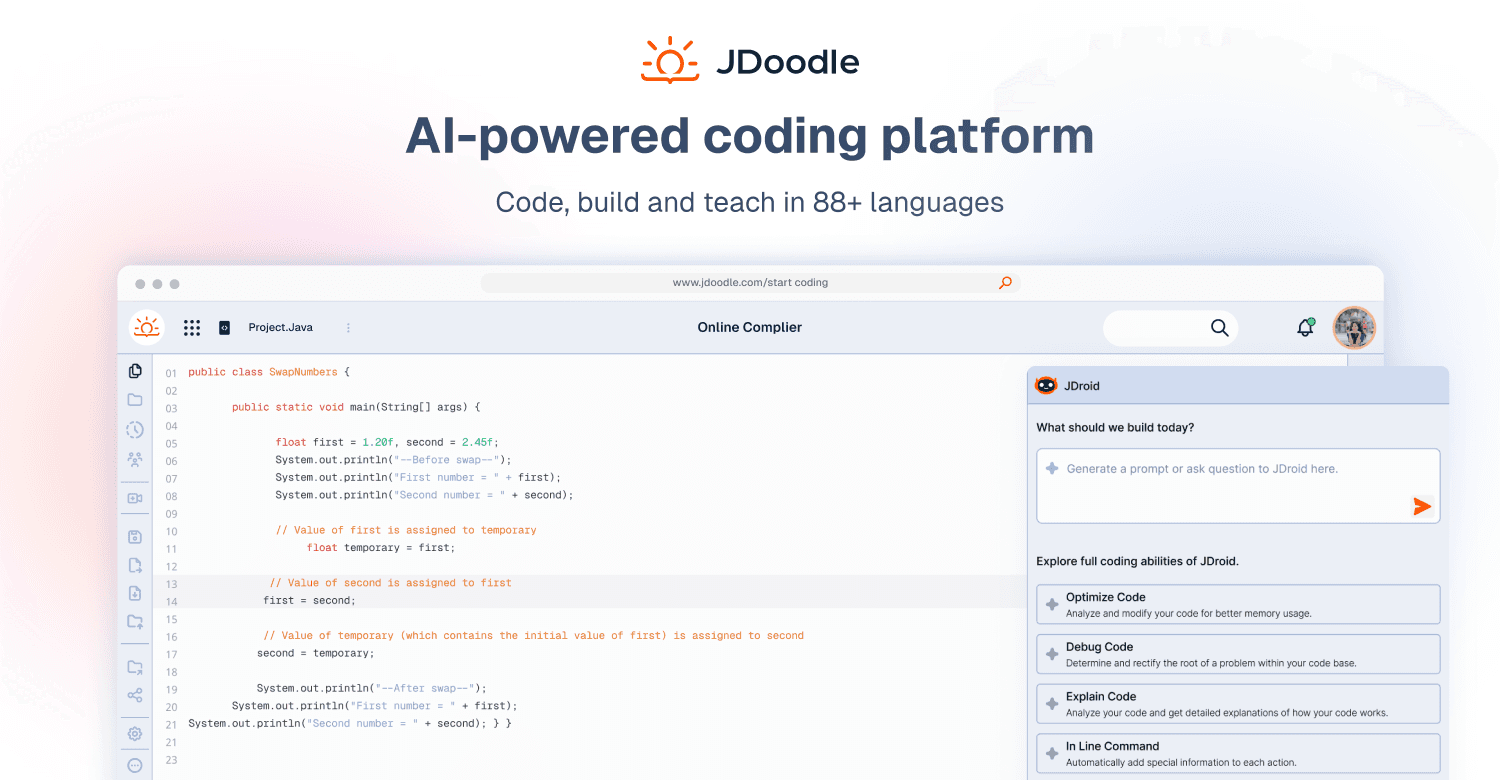
JDoodle
JDoodle is a comprehensive online compiler, editor, and Integrated Development Environment (IDE) designed to support over 110 programming languages. It offers a convenient platform for developers and students to write, compile, and execute code directly in their web browser without needing local installations. Users can run programs on the fly, save their code for future reference, and easily share their projects with others. The platform aims to provide a quick and easy way to compile and run programs online, making it an accessible tool for learning, testing, and collaborating on various coding tasks. It supports popular languages like Java, C, C++, PHP, Perl, Python, and Ruby, among many others.
ddpm-segmentation
ddpm-segmentation is an official implementation of the paper "Label-Efficient Semantic Segmentation with Diffusion Models" (ICLR'2022). This open-source project investigates representations learned by state-of-the-art Denoising Diffusion Probabilistic Models (DDPMs) and demonstrates their value for downstream vision tasks. The tool offers a simple semantic segmentation approach that leverages these representations, showing superior performance in few-shot operating points compared to other methods. It includes implementations for DDPM, DatasetDDPM, MAE, SwAV, and DatasetGAN, along with pretrained models and scripts for training interpreters and generating synthetic datasets. The project is built upon datasetGAN and guided-diffusion techniques, providing a robust framework for research and application in semantic segmentation.

TestFlight
TestFlight is Apple's official platform for distributing and testing beta versions of iOS, iPadOS, macOS, tvOS, visionOS, and watchOS apps, as well as App Clips and iMessage apps. Developers can invite testers via email or public links, allowing them to install and test pre-release builds for up to 90 days. Testers can provide valuable feedback directly through the TestFlight app, including screenshots and crash reports, helping developers refine their applications. The platform supports automatic updates for beta builds and allows testers to access previous versions. TestFlight is crucial for ensuring app quality and user experience across various Apple devices before an app is launched on the App Store.