
Coding & Development
Browsing page 403 of AI tools for Coding & Development. Sorted by confidence score — our independent quality rating.

awesome-automl-papers
awesome-automl-papers is a comprehensive, curated list of resources dedicated to Automated Machine Learning (AutoML). This open-source project compiles a wide array of materials including academic papers, insightful articles, practical tutorials, informative slides, and relevant projects. It serves as an invaluable resource for anyone looking to understand or stay abreast of the rapidly evolving AutoML landscape. The repository covers key areas such as Automated Data Clean, Automated Feature Engineering, Hyperparameter Optimization, Meta-Learning, and Neural Architecture Search. It also provides an overview of various AutoML approaches and their applications, making it a central hub for both newcomers and experienced professionals in the field.
Allyzio Copilot
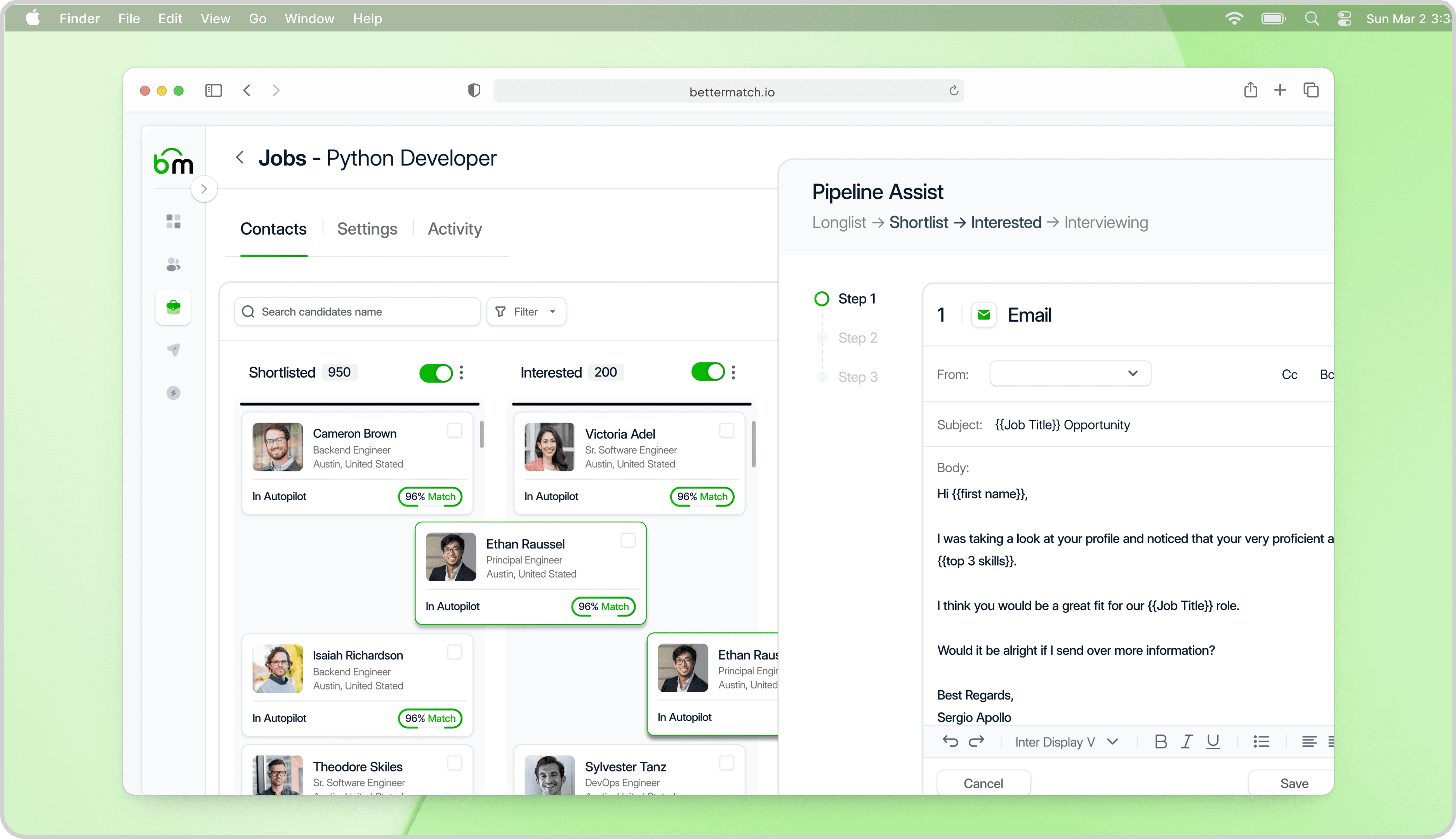
Better Match is an intelligent AI recruiting platform designed to revolutionize the hiring process for businesses of all sizes. It leverages AI to find, research, and match with candidates from a global talent pool of over 800 million people. Users can describe their ideal candidate in plain English, and the system will analyze and rank the best matches. The platform includes a Research Assistant for automated candidate research, inferring experiences, skills, and company fit, and an Outreach Engine to create intelligent engagement workflows, automated sequences, and meeting coordination. Better Match aims to cut costs and improve results by replacing traditional hiring stacks, making it ideal for recruiters, agencies, and startups looking to scale their hiring efforts.
awesome-attention-mechanism-in-cv
awesome-attention-mechanism-in-cv is an open-source GitHub repository providing a curated list of attention mechanisms and plug-and-play modules specifically for computer vision applications. This resource is designed to assist researchers and developers by offering a comprehensive collection of relevant papers, their publication links, and associated GitHub repositories. The list covers various categories including Attention Mechanisms, Dynamic Networks, Plug and Play Modules, and Vision Transformers. It aims to provide a quick reference for understanding and implementing different attention-based techniques, although it acknowledges that not all modules may be included due to the vastness of the field. Users are encouraged to contribute suggestions and improvements to enhance the list's completeness.
nn_robust_attacks
nn_robust_attacks is an open-source tool designed to evaluate the robustness of neural networks against adversarial attacks. It provides implementations of three attack algorithms in TensorFlow, enabling researchers and developers to find adversarial examples. The tool supports Python 3 and requires setting up models for MNIST, CIFAR, or Inception. It allows users to create a model class with a predict method to run predictions without softmax, defining image size, number of channels, and labels. The CarliniL2 attack, for instance, can be run with tunable hyperparameters to assess model vulnerabilities. This code is based on the paper "Towards Evaluating the Robustness of Neural Networks" by Nicholas Carlini and David Wagner.
InvoGames
InvoGames is a leading game development studio based in the USA, offering expert services in creating high-quality games across various platforms. Their expertise spans AI-driven games, immersive 3D experiences, augmented reality (AR), and virtual reality (VR) applications. They also develop mobile, PC, and simulation games, providing end-to-end solutions for studios, startups, and larger enterprises. With a focus on cutting-edge technology, InvoGames helps clients bring their game concepts to life, from initial design to final deployment, ensuring engaging and innovative digital experiences for players worldwide.
DDT
DDT, developed by Raghav Dhaka, is a platform designed to facilitate the sharing of honest opinions. The tool's primary function appears to be enabling users to express their views and receive feedback from others. The homepage prominently features the phrase "Honest opinions. Share Ah, you again. What is it? Clear Try for Free." This suggests a focus on open communication and potentially a question-and-answer or feedback-sharing mechanism. While specific features beyond opinion sharing are not detailed, the emphasis on "honest opinions" indicates a community-driven or feedback-oriented service. The platform is built with Brancher.ai, suggesting a no-code or low-code development approach.
Personal_AI_Infrastructure
Personal_AI_Infrastructure (PAI) is an open-source agentic AI platform designed to amplify human potential by providing personalized AI assistance. Unlike traditional chatbots, PAI learns from every interaction, capturing signals, analyzing mistakes, and reinforcing successful patterns to continuously improve. It understands user goals, preferences, and history, evolving its skills and workflows over time. PAI emphasizes user-centricity, optimal output, and continuous learning, making it suitable for individuals, teams, and companies. It features a robust architecture with primitives like deep goal understanding (TELOS), user/system separation for safe upgrades, granular customization, a structured skill system, and a three-tier memory system. The platform also includes an AI-based installer, security policies, notification system, and a voice system for enhanced interaction.
mnist_challenge
The MNIST Adversarial Examples Challenge is a platform designed to explore the adversarial robustness of neural networks using the MNIST dataset. It builds upon recent advancements in adversarial attacks by providing a structured challenge. Researchers are invited to submit attacks against a pre-trained, robust neural network, with the objective of finding adversarial examples that significantly reduce the network's accuracy. The platform provides both the training code and the network architecture, while initially keeping the network weights secret to encourage black-box attack development. A leaderboard tracks the most successful attacks, fostering reproducibility and empirical comparisons in the field of defense mechanisms against adversarial attacks. The challenge has evolved to include white-box attacks after the release of the secret model weights.
multimodal-agents-course
multimodal-agents-course is a free, open-source educational program designed to teach developers how to build advanced AI agents. The course focuses on creating agents that can process and understand multimodal data, including images, text, audio, and videos. Participants will learn to build an MCP (Model Context Protocol) server for video processing using Pixeltable and FastMCP, design Groq-powered agents, and integrate systems with Opik for observability and prompt versioning. The curriculum emphasizes practical, hands-on implementation, covering topics like complex multimodal processing pipelines, video search engines, and LLMOps principles, making it suitable for ML/AI engineers, software engineers, and data engineers/scientists.
awesome-open-data-annotation
awesome-open-data-annotation is a comprehensive, curated list of open-source tools designed for data annotation and labeling, crucial for machine learning workflows. The repository categorizes tools by data type, including multi-modal, text, images, audio, and video, making it easy to find specific solutions. Each entry provides a brief description and license information. The list is actively maintained and welcomes contributions, ensuring its relevance and utility for developers and data scientists looking to implement data-centric MLOps practices. It serves as a valuable resource for identifying functional and well-supported open-source options.
dr-tulu
DR Tulu is an open-source Deep Research (DR) model designed for tackling long-form research tasks. The DR Tulu-8B model has demonstrated performance comparable to OpenAI DR on long-form DR benchmarks. This repository provides the official code for DR Tulu, including an agent library with a MCP-based tool backend, high-concurrency async request management, and a flexible prompting interface for developing and training deep research agents. It also includes RL training code based on Open-Instruct and SFT training code based on LLaMA-Factory, allowing for supervised fine-tuning and reinforcement learning with GRPO and evolving rubrics. An interactive CLI demo is available for users to experiment with DR Tulu-8B.

T-ROBOTICS
Trener Robotics develops Acteris, an AI software platform designed to transform standard industrial robots into intelligent, self-learning operators. Powered by Physical AI, Acteris enables robots to see, learn, and adapt to complex, high-mix, low-volume production scenarios where traditional automation often fails. The platform reduces deployment times, simplifies changeovers without reprogramming, and enhances robot autonomy with built-in recovery flows. It offers operational visibility through real-time production monitoring and is compatible with leading robot brands like ABB, Universal Robots, and FANUC, with plans for further expansion. Acteris addresses the challenges of rigid programming and high changeover costs in modern manufacturing.
mlops-on-gcp
mlops-on-gcp is a GitHub repository by Google Cloud Platform dedicated to MLOps. It offers a comprehensive collection of hands-on labs and code samples, showcasing best practices and effective patterns for implementing and operationalizing production-grade machine learning workflows on Google Cloud Platform. The repository is structured into two main sections: mini-workshops for instructor-led learning and code samples that illustrate various ML Engineering topics. This resource is ideal for developers and data scientists looking to deploy and manage machine learning models efficiently within the Google Cloud ecosystem, providing practical guidance and examples for continuous training, model serving, and more.
maro
Maro is an open-source Multi-Agent Resource Optimization (MARO) platform developed by Microsoft, offering Reinforcement Learning as a Service (RaaS) for solving complex, real-world resource optimization challenges. It is applicable across various industrial domains, including container inventory management in logistics, bike repositioning in transportation, virtual machine provisioning in data centers, and asset management in finance. Beyond Reinforcement Learning (RL), Maro also supports other planning and decision mechanisms like Operations Research. The platform is structured around key components: a simulation toolkit for building and running scenarios, an RL toolkit providing a full-stack abstraction for agents, algorithms, and learners, and a distributed toolkit for communication, user-defined functions, and job orchestration.
Float16
Float16 is a comprehensive GPU management platform designed for deploying, managing, and scaling AI models. It offers a full spectrum of services including AI-as-a-Service (AaaS) for instant access to ready-to-use AI models without coding, Platform-as-a-Service (PaaS) for flexible resource allocation, and Infrastructure-as-a-Service (IaaS) for bare-metal GPU instances. The platform emphasizes ease of use with one-click deployment, significantly reducing setup time from weeks to minutes. Float16 provides dedicated and isolated GPU resources, ensuring zero interference and optimal performance for workloads. It features a credit-based quota system for flexible GPU utilization, eliminating waste from fixed time slots. Supported by NVIDIA Inception Program, Float16 is ideal for ML engineers, data scientists, software developers, and researchers seeking efficient and scalable GPU solutions.
Gologin Cloud Browser
Gologin Cloud Browser offers a robust cloud browser infrastructure designed for AI teams and automation. It enables users to launch secure, isolated browser instances either through its application or via API. Each browser profile comes with a unique digital fingerprint, cookies, browsing history, and settings, making it appear as a distinct user to websites. This functionality is crucial for tasks requiring multiple online identities, such as affiliate marketing, social media management, and web scraping, while maintaining privacy and avoiding detection. The tool supports automation with Selenium and Puppeteer, and offers features like headless or headful modes, proxy attachment, and cloud server launching. It also includes team management capabilities for account sharing and collaboration.
MAIro AI Slop in Games
MAIro AI Slop in Games presents an interactive demonstration of game levels generated in real-time by Cloudflare Workers AI. This tool allows users to experience a game environment where every level is dynamically built, showcasing the capabilities of AI in procedural content generation. Players can control a character to move, jump, and run through the levels. The game also includes interactive elements such as muting sound, firing fireballs (as Fire Mario), and squishing enemies for points, with combos leading to higher scores. It serves as a practical example of how AI can be integrated into game development for live content creation.
MobiLlama
MobiLlama is an open-source small language model (SLM) specifically designed for efficient deployment on edge devices. It addresses the limitations of larger LLMs by focusing on reduced memory footprint, energy efficiency, and faster response times, making it ideal for privacy-sensitive and resource-constrained environments. MobiLlama offers models ranging from 0.5 billion to 1.2 billion parameters, demonstrating superior performance compared to other SLMs in its class. The project provides fully transparent training and evaluation scripts, pre-trained models, and even an Android APK for mobile integration, making it accessible for developers and researchers working on on-device AI applications.
Jules.Google
Jules is an autonomous coding agent designed to streamline development workflows by taking on tasks developers often don't want to do. It integrates directly with GitHub, allowing users to select repositories and branches, then provide detailed prompts for tasks such as bug fixing, version bumping, or feature building. Jules utilizes the latest Gemini 3 Pro model to develop plans, fetches repositories to a Cloud VM, and provides a diff of proposed changes for quick review and approval. Once approved, Jules creates a pull request, enabling developers to easily merge changes. This allows developers to focus on more complex or preferred coding tasks while Jules handles the routine or less desirable work.
UnSQL AI
UnSQL AI simplifies data analysis for traditional and legacy enterprises by allowing users to ask questions in plain English, eliminating the need for data engineering skills. It features a text-to-SQL model that supports 24 different SQL databases and facilitates seamless syntax conversion, simplifying analysis and migration. The tool offers a personal data concierge, allowing users to engage with their data via phone calls, removing the need for internet connectivity or extended screen time. UnSQL AI also provides automated insights, identifying key metrics like customer churn and upsell opportunities, and supports legacy databases. It emphasizes data security with on-premise analysis options, audit logs, role-based access control, and is on track for SOC 2 Type II compliance.

Raydian
Raydian is an AI-first full-stack platform designed for the reliable building, shipping, and scaling of web applications. It provides a platform optimized for leveraging AI in the development process, complemented by options for manual refinement. The tool aims to accelerate product development through visual design capabilities, database management, and authentication features. It supports both no-code and low-code approaches, making it versatile for various development needs. Raydian helps users design, engineer, and ship their projects faster by integrating AI assistance throughout the development lifecycle.
recurrentjs
recurrentjs is a Javascript library designed for implementing Deep Recurrent Neural Networks (RNN) and Long Short-Term Memory (LSTM) networks. Beyond these specific neural network types, the library offers general functionality to construct arbitrary expression graphs, over which it can perform automatic differentiation, similar to capabilities found in Python's Theano or Torch. This allows developers to build various neural networks and execute automatic backpropagation. The library provides core components like a Graph structure for managing matrix connections and a Mat class for 2-dimensional matrices, including their values and derivatives. It's an open-source tool, making it accessible for those looking to explore or implement neural networks in Javascript.
kaolin
Kaolin is a PyTorch library developed by NVIDIA GameWorks, designed to accelerate 3D deep learning research. It offers a comprehensive PyTorch API for handling diverse 3D representations, including meshes, point clouds, and voxel grids. The library features a growing collection of GPU-optimized operations such as modular differentiable rendering, efficient conversions between 3D formats, and advanced data loading capabilities. Key functionalities also include a differentiable camera API, lighting with spherical harmonics and Gaussians, and a powerful quadtree acceleration structure called Structured Point Clouds. Kaolin provides an interactive 3D visualizer for Jupyter notebooks and a convenient batched mesh container, making it a versatile tool for researchers and developers in 3D AI.
nn-from-scratch
nn-from-scratch is an open-source project available on GitHub that provides a practical implementation of a neural network from scratch. This resource is designed for individuals looking to deepen their understanding of how neural networks function at a foundational level. The project includes Python code, an iPython notebook for interactive learning, and a related blog post that explains the concepts in detail. It covers the setup of a virtual environment and installation of necessary requirements, making it accessible for hands-on learning and experimentation with neural network architectures.