
Research & Education
Browsing page 293 of AI tools for Research & Education. Sorted by confidence score — our independent quality rating.

Pose-Transfer
Pose-Transfer is an open-source project providing the code for person image generation, implementing the Progressive Pose Attention method detailed in a CVPR19 paper. This tool allows users to transfer poses from one image to another, and also supports generating videos from a single input image. It offers functionalities for data preparation, including dataset splitting and keypoint annotation for datasets like Market1501 and DeepFashion. Users can train and test models, and evaluate performance using metrics such as SSIM, IS, DS, and PCKh. The project is built on PyTorch and provides pre-trained models for convenience.
GraphGPT
GraphGPT is a research framework presented in a SIGIR'24 full paper, focusing on Graph Instruction Tuning for Large Language Models. It enhances LLMs' understanding of graph structural information by aligning graph encoding with natural language space through a text-graph grounding paradigm. The framework employs a dual-stage graph instruction tuning process to adapt language models for graph learning tasks and incorporates Chain-of-Thought (CoT) Distillation to improve reasoning and accuracy, especially with diverse graph data. The repository offers code, data, and model weights, including efficient training scripts for two Nvidia 3090 GPUs, making it a valuable resource for researchers in the field.
rq-vae-transformer
rq-vae-transformer is the official open-source implementation of "Autoregressive Image Generation using Residual Quantization" (CVPR 2022). This framework, consisting of RQ-VAE and RQ-Transformer, is designed for autoregressive modeling of high-resolution images. It precisely approximates feature maps and represents images as stacks of discrete codes, facilitating the generation of high-quality images. The tool supports image generation using both class and text conditions, with pretrained checkpoints available for various datasets including FFHQ, LSUN, ImageNet, and CC-3M. It also includes a large-scale RQ-Transformer for text-to-image generation, trained on millions of text-image pairs. The repository provides code for training and evaluation pipelines, as well as Jupyter notebooks for easy text-to-image generation.

Fingerprint for Success
Marlee, previously known as Fingerprint for Success, offers AI-powered coaching designed to help individuals and teams unlock their full potential. The platform utilizes cutting-edge AI and evidence-based coaching methods to deliver personalized guidance across various goals, including work, career, leadership, financial, well-being, and relationships. Users can discover their unique motivations, strengths, and blind spots through a revolutionary analysis based on 20+ years of research. Coach Marlee curates personalized online coaching programs for over 1,000 different goals, with bite-sized 15-minute sessions for flexibility. It also provides tools for people analytics, culture mapping, and benchmarking, making it suitable for both individual growth and organizational development.
Explaintxt
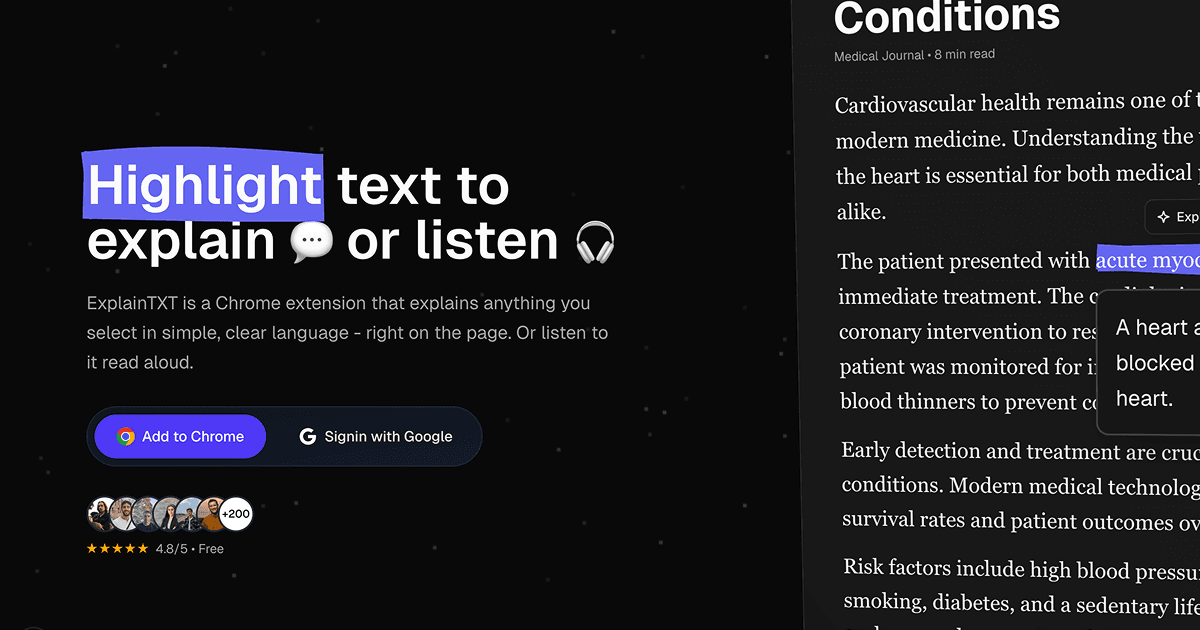
Explaintxt is an AI-powered Chrome extension designed to enhance reading comprehension by providing instant, clear explanations for any highlighted text on the web. It simplifies complex language found in various documents such as legal contracts, medical results, technical papers, and academic research. Users can simply highlight confusing text on any website and receive an immediate, easy-to-understand explanation. The tool aims to make the web more accessible by breaking down jargon, making it ideal for anyone who frequently encounters specialized terminology. It works without requiring an account and is compatible with any website, offering a seamless experience for clarifying information on the fly.
self-attention-cv
Self-attention-cv is an open-source repository offering implementations of diverse self-attention mechanisms specifically tailored for computer vision applications. Built in PyTorch, it leverages `einsum` and `einops` for efficient and flexible module creation. The repository serves as an ongoing collection of building blocks, enabling developers to integrate advanced attention models into their projects. It supports a range of computer vision tasks, including image recognition and segmentation, with examples for Multi-head attention, Axial attention, Vision Transformers (ViT), and TransUnet. It also includes various positional embedding implementations.
StyleSwin
StyleSwin is an official implementation of a transformer-based Generative Adversarial Network (GAN) designed for high-resolution image generation, as presented at CVPR 2022. It leverages a Swin transformer within a style-based architecture, incorporating local and shifted window attention for computational efficiency and modeling capacity. A key innovation is the double attention mechanism, which combines local and shifted window contexts to enhance generation quality. StyleSwin also addresses the challenge of spatial coherency in high-resolution synthesis by employing a wavelet discriminator to suppress blocking artifacts. The tool demonstrates superior performance over prior transformer-based GANs, particularly at resolutions like 1024x1024, achieving competitive results with StyleGAN on datasets such as CelebA-HQ and FFHQ.
SEOmatic AI
SEOmatic AI is a content infrastructure platform designed for agencies, SaaS companies, and e-commerce brands to scale their SEO efforts programmatically. It enables users to transform recurring page types, such as service + location, category, and comparison pages, into scalable templates. By integrating data and AI-assisted content generation, SEOmatic AI allows for the instant production of hundreds of high-quality, unique SEO pages. The platform supports bulk generation and publishing directly to various CMS platforms like WordPress, Webflow, and Shopify, ensuring consistent SEO quality across all pages. Key features include AI content generation, dynamic variables, spin syntax, dataset import (CSV, API), drip publishing, internal linking, and page indexing, making it an efficient solution for automating content at scale without requiring developers.
tennis_analysis
Tennis_analysis is an open-source project designed to analyze tennis players and ball movements within video footage. It leverages advanced computer vision techniques, including YOLO v8 for player detection and a fine-tuned YOLO model for tennis ball detection. Additionally, the tool utilizes Convolutional Neural Networks (CNNs) to accurately extract court keypoints, providing a comprehensive understanding of on-court activity. This project is ideal for individuals looking to enhance their machine learning and computer vision skills through a practical, hands-on application. It measures player speed, ball shot speed, and the total number of shots, offering valuable insights for performance analysis.
Made-With-ML
Made-With-ML is a comprehensive open-source resource designed to teach developers how to build, deploy, and iterate on production-grade machine learning applications. It emphasizes combining machine learning concepts with robust software engineering practices, covering everything from experimentation to deployment and iteration. The platform offers lessons and code examples, guiding users through MLOps components like tracking, testing, serving, and orchestration. It supports scaling ML workloads in Python and demonstrates how to achieve continuous integration/continuous deployment (CI/CD) for models. Made-With-ML is suitable for all developers, college graduates seeking practical industry skills, and product/leadership roles looking to build a technical foundation in ML.
whisper-timestamped
whisper-timestamped is an open-source extension of OpenAI's Whisper model, offering multilingual automatic speech recognition with enhanced word-level timestamps and confidence scores. Unlike the original Whisper, it provides more accurate start/end estimations for words and assigns confidence scores to each word and segment. The tool utilizes Dynamic Time Warping (DTW) applied to cross-attention weights for precise alignment, and it's designed to be memory-efficient, capable of processing long audio files. It also integrates Voice Activity Detection (VAD) to prevent hallucinations from silent audio and supports fine-tuned Whisper models from Hugging Face. This makes it ideal for developers and researchers requiring highly accurate and detailed audio transcription.
Archive Intel
Archive Intel is an AI-powered platform designed for financial firms to ensure compliance with SEC and FINRA regulations. It offers two core solutions: AI Communications Archiving and AI Marketing Review. The communications archiving solution automatically captures and archives all digital client communications, including text (iMessage, Android SMS, WhatsApp), email, chat (Slack, Teams, Zoom, Bloomberg), social media (LinkedIn, YouTube, X/Twitter, Meta), and web content. This system reduces manual compliance workload by up to 95% and cuts false positives by 99%. A key differentiator is its ability to archive text messages from personal phones without requiring additional apps or devices, supporting BYOD policies. The AI Marketing Review solution simplifies content compliance by scanning documents for high-risk terms and providing compliant suggestions, streamlining approval workflows and ensuring audit readiness. Archive Intel offers instant reporting, full audit trails, and customizable pricing based on users and connectors, with no hidden export fees.
ZeroCostDL4Mic
ZeroCostDL4Mic is a free and open-source toolbox designed to democratize deep learning in microscopy. It consists of a collection of self-explanatory Jupyter Notebooks, hosted on Google Colab, which provides the necessary computational resources at no cost. The tool features an easy-to-use graphical user interface, making it accessible for researchers with little or no coding expertise. Its primary goal is to allow users to quickly test, train, and utilize popular Deep-Learning networks for processing microscopy data. This project originated from a collaboration between the Jacquemet and Henriques laboratories and has expanded with global contributions, as acknowledged in their Nature Communications paper.
multiagent-competition
multiagent-competition offers the foundational code for environments detailed in the paper "Emergent Complexity via Multi-agent Competition." This tool is designed for researchers and academics focusing on multi-agent reinforcement learning, providing a platform to simulate and study emergent behaviors in competitive scenarios. It includes agent policies for various environments such as run-to-goal, you-shall-not-pass, sumo, and kick-and-defend tasks. The repository, though archived and read-only, serves as a valuable resource for understanding and replicating the experiments described in the associated paper, allowing for in-depth analysis of complex interactions between AI agents.

Caktus AI
Caktus AI is an all-in-one AI-powered academic platform specifically designed for students, offering a comprehensive suite of over 25 specialized tools. It enables users to generate high-quality essays with real, verifiable academic citations in various styles like APA, MLA, Chicago, and Harvard. The platform also features a step-by-step math solver for algebra, calculus, and statistics, ensuring students understand the process. A key differentiator is its AI Text Humanizer, which transforms AI-generated content into natural, human-sounding prose with multiple style presets. Additionally, Caktus AI includes tools for research, flashcard creation from notes, and specialized assistance for science and STEM subjects, making it a versatile academic assistant.

Minduck
Minduck is a web-based AIGC platform that uniquely combines human logic and ideas with the generative power of AI models through visual mind maps. Unlike chat-based AI, Minduck allows users to influence AI's outputs by structuring their thoughts visually, enabling the AI to understand and build upon their unique logic and thought process. This approach simplifies the AI generation process, making it accessible for anyone to turn ideas into reality with clear, organized steps. It's ideal for creating, exploring, and structuring ideas naturally, streamlining writing and drawing, and transforming search results into organized knowledge maps. Minduck aims to align AI with how users think, fostering next-generation creativity.

Lexroom
Lexroom is an advanced AI platform specifically designed for legal professionals, including lawyers, law firms, and in-house legal teams. It transforms legal research, analysis, and document drafting into efficient processes by leveraging AI to provide verified, citable, and transparent answers. Key features include natural language search, specialized modules for various legal areas (e.g., Banking, Labor, Civil), and a private library for secure document management. Lexroom also offers custom clause drafting and immediate access to original source documents. The platform is built to eliminate AI hallucinations by working exclusively with verified and updated legal sources, ensuring accuracy and reliability for critical legal tasks.

Legora
Legora is a collaborative AI platform designed to empower lawyers by streamlining routine tasks and enhancing legal work. It enables faster review of vast amounts of material, analyzing tens of thousands of documents simultaneously and suggesting well-crafted markup based on user preferences. The tool also facilitates smarter drafting by drawing on precedent to rewrite and refine content in Word, identifying substance and suggesting ready-to-use language. Furthermore, Legora deepens research capabilities by providing access to up-to-date information, legal databases, and DMS content through integrations with iManage and SharePoint. This allows lawyers to focus on strategic advising and complex problem-solving rather than administrative burdens.
Ordered-Neurons
Ordered-Neurons is an open-source project offering the code used for word-level language model and unsupervised parsing experiments, as detailed in the paper "Ordered Neurons: Integrating Tree Structures into Recurrent Neural Networks." This repository, originally forked from the LSTM and QRNN Language Model Toolkit for PyTorch, requires Python 3.6, NLTK, and PyTorch 0.4. It enables researchers to train language models and perform unsupervised parsing using the Penn Treebank data, with specific scripts provided for each task. The default settings achieve competitive perplexity on the PTB test set and unlabeled F1 on the WSJ test set, making it a valuable resource for academic research in natural language processing.
PreSumm
PreSumm is an open-source project providing code for text summarization with pretrained encoders, based on an EMNLP 2019 paper. It offers capabilities for both abstractive and extractive summarization, allowing users to condense text into shorter versions. The tool supports summarizing raw text input, with specific formatting requirements for sentence boundaries in extractive summarization. It includes pre-trained models for datasets like CNN/DailyMail and XSum, and provides detailed instructions for data preparation, model training, and evaluation. PreSumm is primarily designed for researchers and developers working in natural language processing and text summarization.
WASPGPT
WASPGPT is an AI tool designed to simplify blockchain exploration through conversational AI. It enables users to interact with complex blockchain data in a more intuitive and user-friendly manner, making the technology accessible to a wider audience. The tool aims to bridge the gap between intricate blockchain mechanics and everyday users by providing an AI-powered interface for queries and data analysis. While the provided content is from GitHub's pricing page, suggesting a development-focused platform, the original description indicates WASPGPT's core functionality revolves around making blockchain data understandable through AI conversations.
rl4co
rl4co is a comprehensive PyTorch library dedicated to Reinforcement Learning (RL) for Combinatorial Optimization (CO). It offers a unified and flexible framework for developing and benchmarking RL-based CO algorithms, aiming to decouple scientific research from engineering complexities. Built upon TorchRL, TensorDict, PyTorch Lightning, and Hydra, rl4co provides efficient implementations of various policies including constructive (autoregressive and non-autoregressive) and improvement methods. The library also features modular components like environment embeddings, allowing for easy adaptation to new problems. It supports installation via pip and offers clear examples for training models with default or custom configurations, making it accessible for researchers and developers in the field.
Translation-Agent-WebUI
Translation-Agent-WebUI is an AI-powered translation tool accessible via a web user interface. It is designed to facilitate text translation between various languages, making it a convenient option for users needing quick and accessible translation services. The tool is available for free on Hugging Face, indicating its open-source or community-driven nature. While the specific features beyond basic text translation are not detailed, its web-based interface suggests ease of access without requiring complex installations. The project is hosted on Hugging Face Spaces, which often provides a platform for experimental or community-developed AI applications.
Sentiment-Analysis-in-Event-Driven-Stock-Price-Movement-Prediction
Sentiment-Analysis-in-Event-Driven-Stock-Price-Movement-Prediction is an open-source project designed to predict stock price movements using natural language processing (NLP) on news headlines. Specifically, it leverages Reuters news data to build a connection between Bayesian Deep Neural Networks (DNN) and stock price prediction. The methodology involves collecting and preprocessing data, including crawling ticker lists, news from Reuters, and stock prices. It then performs feature engineering through tokenization, unifying word formats, and implementing one-hot encoding. The tool trains Bayesian Convolutional Neural Networks using Stochastic Gradient Langevin Dynamics for robust predictions, which can then be used to forecast stock reactions to news events. It provides scripts for data collection, tokenization, model training, and prediction, making it a comprehensive solution for event-driven stock analysis.