
Research & Education
Browsing page 294 of AI tools for Research & Education. Sorted by confidence score — our independent quality rating.

sequence_tagging
sequence_tagging is an open-source project hosted on GitHub, providing a robust implementation of Named Entity Recognition (NER) using Tensorflow. This tool utilizes a combination of Long Short-Term Memory (LSTM) networks, Conditional Random Fields (CRF), and character embeddings to achieve state-of-the-art performance in sequence tagging tasks. It is particularly well-suited for researchers and NLP engineers focused on information extraction. The repository includes detailed instructions for setting up the environment, building training data, and evaluating the model, making it accessible for those looking to implement or experiment with advanced NER models. The project also provides guidance on data formatting, aligning with the CoNLL2003 dataset structure, and offers configuration options for integrating pre-trained word vectors like GloVe.
SRCNN-pytorch
SRCNN-pytorch offers a PyTorch implementation of the 'Image Super-Resolution Using Deep Convolutional Networks' model (ECCV 2014). This tool is designed to enhance the resolution of images, providing a practical solution for super-resolution tasks. Key differences from the original implementation include the addition of zero-padding, the use of the Adam optimizer instead of SGD, and the removal of specific weight initialization. Users can train the model with custom datasets or utilize provided pre-trained weights for various scales. It supports datasets like 91-image and Set5, allowing for training and evaluation of image upscaling capabilities.
SRCNN-Tensorflow
SRCNN-Tensorflow is an open-source implementation of Super-Resolution Convolutional Neural Networks (SRCNN) using TensorFlow. This tool is designed to enhance the resolution of images by applying deep learning techniques, specifically convolutional neural networks. It provides a practical way to reproduce the results described in the original research paper, offering a robust solution for image upscaling. The implementation requires TensorFlow, Scipy (version > 0.18), h5py, and matplotlib. Users can train the model with their own datasets or use the provided pre-trained model for testing. The project details the training process and provides example results, demonstrating its capability to produce super-resolved images comparable to reference papers.
.webp&w=3840&q=75)
Quench AI
Ollo, formerly known as Quench AI, functions as an AI operating system designed for mid-market companies. It integrates with existing company tools like Slack, Notion, and Google Drive to deliver accurate, context-aware responses and automate workflows. The platform addresses common AI challenges by providing solutions that understand unique company data, policies, and processes, moving beyond generic internet responses. Key features include deep secure search with organizational context, agentic workflow orchestration, and robust security measures like SOC II and ISO27001 certifications. Ollo aims to reduce the time spent searching for information and streamline operations without requiring massive IT overhead.
ExpiredAI
ExpiredAI is a specialized search engine designed to assist users in discovering expired .ai domains. This tool is particularly useful for individuals and businesses looking to acquire specific .ai domain names that have become available after their previous registration lapsed. By focusing exclusively on the .ai top-level domain, ExpiredAI streamlines the process of identifying valuable domain assets for various purposes, including investment, branding, or establishing an online presence related to artificial intelligence. The platform aims to simplify the often complex and time-consuming task of monitoring and acquiring expired domains, offering a targeted solution for a niche market.
suiron
Suiron is an open-source project dedicated to applying machine learning principles to RC cars, offering a platform for developing and testing autonomous navigation and control systems. The project provides a comprehensive set of tools and scripts for collecting data, training neural networks, and visualizing predictions. It supports Python 2.7 and integrates with libraries like TensorFlow for model training. Users can collect data from their RC cars, train models based on this data, and then visualize how the trained models predict car behavior. This makes Suiron an excellent resource for robotics enthusiasts, machine learning students, and researchers interested in practical applications of AI in autonomous systems.
Elia
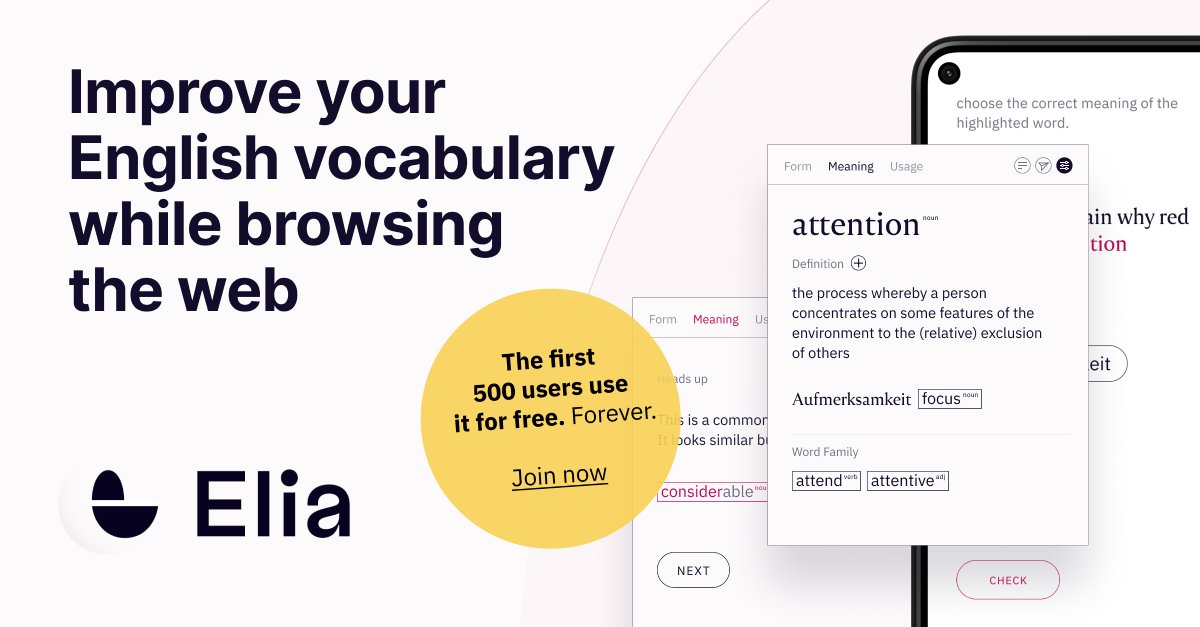
Elia is an AI-powered tool designed to significantly enhance English vocabulary and language skills directly within the user's browsing experience. It enables users to translate English words on any webpage with a single click and save them to a personalized wordlist for future practice. A key feature is Elia's ability to highlight saved words on other websites, reinforcing learning through repeated exposure. Furthermore, it identifies and highlights new words tailored to the user's proficiency level, facilitating the acquisition of up to 300 new words monthly from their favorite online content. Elia aims to boost productivity and job performance by making language learning an integrated and effortless part of daily web browsing.
Stock-Price-Prediction-LSTM
Stock-Price-Prediction-LSTM is an open-source project designed for predicting the OHLC average stock price of Apple Inc. utilizing a Long Short-Term Memory (LSTM) recurrent neural network. The tool processes historical stock data, specifically Open, High, Low, and Closing Prices from Yahoo Finance, dating from January 2011 to August 2017. It employs data pre-processing to convert the OHLC average into two-column time series data, with all values normalized between 0 and 1. The model, built using Keras, consists of two sequential LSTM layers and one dense layer, trained with 75% of the data using the Adagrad optimizer. It provides predictions for future stock values with a focus on quantitative trading decisions.
summarize.site
summarize.site is a browser extension designed to efficiently summarize web page content using OpenAI ChatGPT. Available for Chrome and Edge, this tool helps users quickly grasp the main points of articles and web content, making reading and research more efficient. It allows for local installation or building from source, offering flexibility for users. The extension also provides options to customize the summary prompt, including configurations for different languages like Chinese, enabling users to tailor the output to their specific needs, such as brevity, outline form, or translation. This makes it a versatile tool for anyone looking to condense information quickly.
text-summarization-tensorflow
text-summarization-tensorflow is an open-source project providing a TensorFlow implementation of text summarization. It utilizes a seq2seq library with an encoder-decoder model, incorporating an attention mechanism for improved performance. The tool initializes word embeddings using Glove pre-trained vectors and employs LSTM cells for both encoding and decoding processes. It supports training with custom datasets and offers options for configuring hyperparameters such as network size, depth, beam width, and learning rate. Users can also test the model with pre-trained weights and evaluate performance using ROUGE metrics. This tool is ideal for researchers and students looking to understand and experiment with text summarization techniques.
Law School AI
Law School AI is a technology company dedicated to empowering law students with advanced AI-driven solutions. The platform is designed to optimize the learning process and enhance the overall academic experience for those pursuing legal studies. By leveraging artificial intelligence, Law School AI aims to provide comprehensive support, offering smart tools and resources tailored to the unique challenges faced by law students. This includes features that can assist with research, study, and understanding complex legal concepts, ultimately contributing to improved academic performance and efficiency in their studies.
Clore AI
Clore AI offers a decentralized GPU cloud marketplace, enabling users to rent powerful GPUs for various high-performance computing tasks such, as AI training, inference, and 3D rendering. The platform supports flexible payment options, including Bitcoin and CLORE tokens, with per-minute billing. It features a robust API for seamless integration, extensive developer documentation, and secure data storage solutions. Clore AI is optimized for AI, rendering, and scientific simulations, providing unmatched scalability and speed. Users can choose from a wide variety of CPUs, GPUs, and memory configurations, with over 20,000 GPUs available. The platform also includes a Proof of Holding (POH) system, rewarding users for holding CLORE tokens with increased rewards and service discounts.
Whimsy
Whimsy Audio offers a unique AI-powered service that generates personalized audio stories for children aged 4-12. Users can input a child's name, age, and interests, and Whimsy crafts a one-of-a-kind adventure where the child is the hero. These stories are brought to life with multiple character voices, background music, and engaging sound effects, creating an immersive listening experience. Unlike traditional personalized books, Whimsy delivers stories instantly via email as high-quality MP3 files, making it a convenient option for last-minute gifts. Each full story is approximately 5 minutes long, with free 30-second previews available. The platform emphasizes age-appropriateness and offers a 100% money-back guarantee.
Link Whisper
Link Whisper is an AI-powered WordPress plugin designed to streamline internal linking for SEO. It intelligently analyzes website content to identify optimal opportunities for internal links, allowing users to build thousands of links quickly. Key features include AI-powered suggestions for relevant links, an orphan page finder to identify content without internal links, and broken link detection. The tool also offers auto-linking, Google Console integration, dynamic visual sitemaps, and monthly link maintenance. It's trusted by over 50,000 WordPress publishers and aims to save significant time by automating the internal linking process, ultimately helping improve search engine rankings.
tensorforce
Tensorforce is an open-source deep reinforcement learning framework built on TensorFlow, designed for both research and practical applications. It stands out for its modular, component-based design, allowing for highly configurable feature implementations. A key differentiator is the separation of the RL algorithm from the application, making algorithms agnostic to input and output structures. The entire reinforcement learning logic, including control flow, is implemented in TensorFlow, enabling portable computation graphs. It supports a wide range of features including various network layers, memory types, policy distributions, reward estimation, training objectives, and optimization algorithms. Tensorforce also offers extensive exploration techniques, preprocessing options, and regularization methods, making it a versatile tool for developing and training reinforcement learning agents.
trfl
TRFL (pronounced "truffle") is an open-source library developed by Google DeepMind, designed to simplify the implementation of Reinforcement Learning (RL) agents using TensorFlow. It offers a collection of essential building blocks and loss functions, such as Q-learning, that are crucial for developing and experimenting with various RL algorithms. The library integrates seamlessly with existing TensorFlow environments, allowing developers to leverage its powerful computational graph capabilities. TRFL does not list TensorFlow as a direct requirement, giving users flexibility to install specific CPU or GPU versions, along with TensorFlow Probability, separately. This modular approach makes it a valuable resource for researchers and practitioners in the field of AI and machine learning.
CoGrader
CoGrader is an AI-powered, rubric-based essay grading and feedback platform designed for K-12 educators. It significantly reduces grading time by up to 80% while providing individualized, actionable feedback to students. The platform supports custom rubric uploads, integrates seamlessly with Google Classroom, Canvas, and Schoology, and offers detailed per-student feedback reports. CoGrader ensures consistent, bias-minimized grading, supports multi-language assignments, and includes AI plagiarism detection. It is compliant with major privacy standards like FERPA, COPPA, and SOC 2, and student data is never used for AI model training. Teachers maintain full control, reviewing and adjusting grades before publishing.
UniAnimate
UniAnimate is an open-source framework designed to enable efficient and long-term human video generation using unified video diffusion models. It addresses limitations in existing techniques by mapping reference images, posture guidance, and noise video into a common feature space, reducing optimization burden and ensuring temporal coherence. The tool supports a unified noise input for random or first-frame conditioned input, enhancing long-term video generation capabilities. UniAnimate also explores an alternative temporal modeling architecture based on state-space models to replace computation-consuming temporal Transformers, allowing for the generation of highly consistent videos up to one minute in length by iteratively employing a first-frame conditioning strategy. It provides code and models for human image animation, including features for pose alignment and generating video clips at various resolutions.
vjepa2
vjepa2 is an open-source project from Facebook AI Research (FAIR) providing PyTorch code and models for V-JEPA 2 and V-JEPA 2.1, self-supervised learning approaches for video. These models are pre-trained on internet-scale video data to achieve state-of-the-art performance in motion understanding and human action anticipation tasks. V-JEPA 2.1 further refines the training recipe to learn high-quality and temporally consistent dense features, leveraging dense predictive loss, deep self-supervision, and multi-modal tokenizers. The project also includes V-JEPA 2-AC, a latent action-conditioned world model for robot manipulation tasks, demonstrating capabilities like reaching, grasping, and pick-and-place without extensive environment-specific data. It offers pretrained checkpoints and easy integration via PyTorch Hub and HuggingFace.
WritingTools
WritingTools is an Apple Intelligence-inspired application designed to supercharge writing across Windows, Linux, and macOS. It functions as a system-wide grammar assistant, allowing users to proofread, rewrite, and optimize text with AI using a single hotkey. Beyond basic grammar, it can summarize webpages, YouTube videos, and documents, and even chat with the summaries. The tool supports various LLMs, including the free Gemini API and a wide range of local LLMs via Ollama, offering greater intelligence than Apple's Writing Tools or Grammarly Premium. It is completely free, open-source, privacy-focused, and supports multiple languages and custom commands, making it a versatile and powerful writing companion.
Windrecorder
Windrecorder is an open-source personal memory search engine designed for Windows, offering an alternative to tools like Microsoft's Windows Recall or Rewind. It records screen activity in a small size, enabling users to rewind past sessions and query content using OCR text or image descriptions. All functionalities run locally, ensuring data privacy and no internet connection is required. Key features include recording multiple screens or active windows with low resource consumption, indexing only changed scenes, custom skip conditions, and automatic database maintenance. It provides a complete web UI for reviewing screens, conducting queries, and generating activity statistics like word clouds and timelines. The tool supports multiple OCR engines and AI-based tag summarization.

Snipo
Snipo is a comprehensive note-taking tool designed to enhance video-based learning by integrating seamlessly with Notion. It allows users to capture timestamped notes directly from videos, take screenshots of important content like charts or slides, and access video transcripts for easy reference. A standout feature is its AI Flashcards maker, which automatically generates flashcards from learning videos or any webpage, with the option to export them to Anki. Snipo supports popular learning platforms such as YouTube, Udemy, Coursera, Skillshare, and LinkedIn Learning, making it an invaluable asset for students and lifelong learners looking to streamline their study process and organize their notes efficiently.
Flexi
Flexi is an AI-powered vocabulary builder designed to enhance language learning through intelligent flashcards and an advanced spaced repetition system. Users can effortlessly create flashcards with AI-generated translations, examples, and definitions, with image generation planned for Premium subscribers. The app promotes long-term retention by scheduling reviews at optimal intervals. Flexi also allows users to jot down quick notes that can later be converted into flashcards, track daily study streaks for motivation, and utilize free text-to-speech for audio pronunciations. Premium features include AI-generated word suggestions and the ability to import flashcards from Anki and Quizlet, making it a comprehensive tool for students and language enthusiasts alike.
BiRefNet
BiRefNet is an open-source project offering a powerful solution for high-resolution dichotomous image segmentation, as detailed in the CAAI AIR 2024 paper. It provides official implementations and well-trained weights for various tasks, including general image segmentation, matting, Dichotomous Image Segmentation (DIS), High-Resolution Salient Object Detection (HRSOD), and Co-Salient Object Detection (COD). The tool supports dynamic resolution ranges, from 256x256 up to 2304x2304, and demonstrates robust performance across different image sizes. Users can leverage its capabilities through Hugging Face Models for easy integration or explore online demos for inference and evaluation. BiRefNet also supports ONNX conversion for efficient deployment and has been integrated into several third-party applications and frameworks, making it accessible for both researchers and developers.