
Research & Education
Browsing page 77 of AI tools for Research & Education. Sorted by confidence score — our independent quality rating.

jupyter-ai
Jupyter AI is an open-source extension designed to integrate AI agents directly into JupyterLab computational notebooks. It offers a native chat user interface, allowing users to collaborate with various frontier AI agents such as Claude, Codex, GitHub Copilot, Gemini, and Mistral Vibe, all connected via the Agent Client Protocol (ACP). Agents are automatically detected upon installation of their dependencies, simplifying the setup process. This tool enables agents to perform actions like reading and writing files, executing terminal commands, and interacting with notebooks through a built-in Jupyter MCP server. A robust permission system ensures user control over agent actions, requiring approval for file writes or command executions. Jupyter AI supports multiple concurrent chats, drag-and-drop context from files or notebook cells, and real-time collaboration. Its flexible and extensible architecture allows for custom MCP servers and AI personas, avoiding vendor lock-in and promoting an open ecosystem.
Shortcast.AI
Shortcast.AI is an AI-powered platform designed to efficiently summarize YouTube videos and podcasts. It transforms long-form audio and video content into brief, easy-to-read text summaries, enabling users to quickly extract key information without consuming the entire original material. This tool is ideal for individuals who need to process a large volume of content, such as researchers, students, or content creators, allowing them to save time and enhance their understanding of various topics. By providing concise overviews, Shortcast.AI helps users stay informed and productive.
recaply.ai
Recaply.ai is an AI-powered platform designed to streamline information consumption by automatically summarizing various forms of media. It specializes in generating concise summaries of videos, podcasts, and meetings, allowing users to quickly extract the most important information without needing to review the entire content. This tool is particularly useful for professionals and students who need to process large volumes of audio and video content efficiently. By focusing on key points, Recaply.ai aims to enhance productivity and improve information retention, making it easier to stay informed and make decisions based on summarized data.
Taped.ai
Taped.ai is an AI-powered tool that excels at transforming diverse media into concise, actionable insights. It can transcribe audio, extract information from images, and summarize text-based content, making it highly versatile for different use cases. The platform focuses on converting raw data into organized notes and structured summaries, helping users quickly grasp key information without sifting through extensive content. This capability is particularly useful for professionals and students who need to process large volumes of information efficiently, enabling them to extract core concepts and create structured overviews from various sources.

Teachally
Teachally is an AI-powered platform designed to empower educators by streamlining lesson planning and content creation. It generates HQIM compliant lesson plans, teaching guides, assessments, and enrichments without the need for complex prompting. The tool effortlessly aligns educational content to over a million national, state, AP, and specialized standards, ensuring accuracy and consistency. Teachally also offers extensive differentiation tools, allowing teachers to tailor lessons for individual student needs and translate resources into over 100 languages. It supports various lesson models like 5E, UDL, and Montessori, and provides classroom-ready presentations, activities, and printable worksheets. The platform emphasizes privacy, stripping out PII before LLM use and complying with FERPA, GDPR, and COPPA.
LLaDA
LLaDA (Large Language Diffusion with Masking) offers the official PyTorch implementation for Large Language Diffusion Models, providing a robust framework for developing and training diffusion models for natural language processing tasks. This open-source tool introduces an unprecedented 8B scale diffusion model, trained from scratch, demonstrating performance comparable to LLaMA3 8B. Key features include support for conditional likelihood evaluation and conditional generation, with pre-trained models available on Huggingface. LLaDA also offers guidelines for pre-training and Supervised Fine-Tuning, making it adaptable for researchers and developers. It explores a theoretically complete language modeling approach, distinguishing itself from BERT by using a varying masking ratio and serving as a generative model capable of in-context learning and instruction-following.
Skilledge Global LLC.
Skilledge Global LLC. specializes in providing enterprise training programs for AI, Cloud, Data, and Leadership. They design custom learning journeys tailored to specific business outcomes, aiming to deliver measurable capability uplift rather than just completion metrics. Their offerings include comprehensive development across technology and leadership domains, with programs in Generative AI & LLMs, Cloud & DevOps, Data Engineering, Strategic Thinking, and Leading in the AI Age. Skilledge Global emphasizes measurable ROI, customized curricula, and expert facilitators to help organizations build enterprise capability that drives impact and addresses strategic goals.
OfferGenie
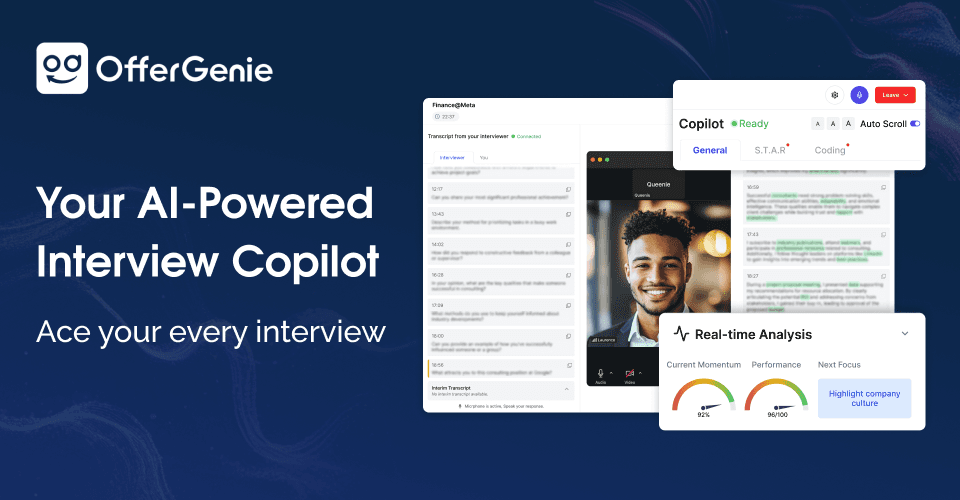
OfferGenie is a comprehensive AI-powered career advancement platform designed to help job seekers ace interviews, build resumes, and secure their dream jobs. It offers a real-time AI Interview Copilot that provides instant suggestions and answer guidance during live interviews, compatible with platforms like Zoom, Teams, and Meet. Beyond interview assistance, OfferGenie includes AI mock interviews with personalized feedback, an ATS-optimized resume builder, LinkedIn profile generator, and cover letter generator. The platform also features Job Match AI, an Interview Question Predictor, and Career Path Recommendations, making it an all-in-one solution for job search preparation and success.
mamba-chat
Mamba-Chat is a groundbreaking chat language model that leverages a state-space model architecture, distinguishing it from traditional transformer-based LLMs. Developed by redotvideo, it is based on Albert Gu's and Tri Dao's Mamba work and offers training and fine-tuning capabilities. The model, specifically Mamba-2.8B, has been fine-tuned on 16,000 samples from the HuggingFaceH4/ultrachat_200k dataset. This open-source project provides developers with the necessary code to run a CLI chatbot, a Gradio app, and fine-tune the base Mamba model, making it an excellent resource for experimenting with novel LLM architectures.
Math-To-Manim
Math-To-Manim is an open-source AI tool designed to generate epic math and physics animations and study notes from text and images. It utilizes advanced AI pipelines, including Google Gemini 3, Claude Sonnet 4.5, and Kimi K2.5 Swarm, to analyze concepts, discover prerequisites, enrich content with LaTeX equations, and design visual specifications. The tool then composes verbose prompts to generate working Manim Python code, enabling the creation of complex animations without manual coding. It focuses on building pedagogically sound animations that flow from foundational to advanced topics, making it ideal for educational content creation.
CerePlay Text-to-Speech
Capacity Text-to-Speech (TTS) is an advanced conversational AI solution designed to enhance customer engagement through natural-sounding speech. Leveraging neural TTS technology, it generates lifelike voices with precise tone and clarity, supporting over twenty-four languages and dialects. The tool offers flexible deployment options, including on-premise, cloud, hybrid, or SaaS, and integrates seamlessly with leading contact center platforms via gRPC and MRCP APIs. It's optimized for native compatibility with Capacity's Automatic Speech Recognition (ASR) for real-time, bidirectional conversations, making it ideal for automating customer support, outbound communications, and IVR self-service.
makefilm.jp
makefilm.jp is an AI-powered platform focused on video analysis and tagging. It provides users with a dashboard to gain insights from their video content. While the current description mentions video creation, editing, and summarization, the live website content primarily highlights its video analysis and tagging features, suggesting a focus on understanding and organizing existing video assets rather than generating new ones. The tool aims to streamline the process of extracting valuable data from videos.
MATLAB-Deep-Learning-Model-Hub
The MATLAB-Deep-Learning-Model-Hub is an open-source repository on GitHub offering a comprehensive collection of pretrained deep learning models specifically designed for use within the MATLAB environment. It covers a wide array of applications including computer vision tasks such as image classification, object detection, semantic segmentation, instance segmentation, image translation, pose estimation, 3D reconstruction, and video classification. Beyond vision, it also includes models for natural language processing (Transformers), audio analysis (embeddings, sound classification, pitch estimation, speech-to-text), and Lidar point cloud processing. This hub is ideal for researchers and developers looking to accelerate their deep learning projects by utilizing pre-trained models and applying transfer learning techniques.
KnowHow
KnowHow is an AI-powered tool designed to enhance knowledge management within organizations. It offers AI-driven access to company information, making it easier for users to find the data they need quickly and efficiently. A key feature of KnowHow is its ability to simplify the creation of Standard Operating Procedures (SOPs), helping businesses to standardize and streamline their internal documentation. The platform aims to improve overall knowledge sharing and operational consistency by leveraging artificial intelligence to manage and disseminate critical company knowledge.
Quark Smart Assistant
Quark Smart Assistant is a powerful AI Chrome extension designed to be your digital companion for navigating the online world. It offers rapid answers to your questions and delivers information by leveraging real-time network connections. Key functionalities include word translation, intelligent search capabilities, writing assistance, and even PPT generation. This tool aims to streamline your online experience, making information retrieval and content creation more efficient. It's easily activated via a keyboard shortcut, providing a convenient and intelligent digital assistant experience directly within your browser.
machine-learning-list
The machine-learning-list is a curated curriculum hosted on GitHub, designed to educate individuals on foundation models, with a particular emphasis on language models. It offers a balanced approach, covering both techniques relevant for deploying machine learning in production and strategies for long-term scalability. The curriculum is structured into tiers, allowing users to progress from fundamental concepts like neural networks and gradient descent to advanced topics such as world models, causality, and AI safety. Key areas include Transformers, various foundation model architectures (GPT-2, GPT-3, LLaMA), training and finetuning methods, reasoning and runtime strategies (Chain of Thought, Tree of Thoughts), and applications in science, forecasting, and search. It also delves into practical aspects like production deployment, benchmarks, and datasets, making it a valuable resource for anyone looking to deepen their understanding of modern AI.
Policy Pro
Policy Pro is an AI chatbot designed to streamline access to crucial information within organizations by extracting policy details from Standard Operating Procedures (SOPs). This tool aims to provide real-time answers to policy-related questions, enhancing efficiency and ensuring quick access to vital organizational guidelines. By leveraging AI, Policy Pro can quickly process and interpret complex documents, making it easier for users to find the specific information they need without manually sifting through extensive policy manuals. This capability is particularly beneficial for organizations looking to improve information dissemination and reduce the time spent on policy lookups.
ProfBot
ProfBot is a revolutionary AI-powered chatbot designed to enhance the learning experience for university students. It offers personalized feedback in real-time, allowing students to engage more deeply with their education and significantly improve academic performance. Available 24/7 on any device, ProfBot provides flexible access to learning support. The tool integrates with OpenAI to create powerful learning tools, ensuring a user-friendly interface and tailored learning experiences. Dr. Sean Wise, Professor of Entrepreneurship and Co-Founder of ProfBot.ai, highlights its capabilities in providing personalized learning experiences and feedback.

UneeQ
UneeQ is a cutting-edge digital human technology platform that provides immersive learning experiences and AI brand ambassadors. Built on 10 years of R&D, its Digital Human OS creates lifelike, emotionally intelligent interactions that feel genuinely human, not robotic. The platform features Synanim™, an AI animation engine for realistic behaviors, and robust LLM orchestration that integrates with OpenAI, Anthropic, or custom AI. UneeQ offers an Immersive Training Platform for psychologically safe practice of high-stakes conversations, and a Digital Human Creative Brand Agency for custom AI brand ambassadors. It supports multi-platform deployment, 4K Ultra HD resolution, 100+ languages, and is SOC 2 and GDPR compliant, making it ideal for enterprise solutions.
deep_learning_cookbook
Deep_learning_cookbook is an open-source repository featuring 35 Python notebooks that illustrate fundamental machine learning techniques using the Keras framework. These notebooks are designed to accompany the book "Deep Learning Cookbook" but are fully functional as standalone educational resources. The collection covers a wide range of topics, from using pre-trained word embeddings and building recommender systems to generating text, classifying sentiments, and working with image recognition networks. It also includes examples for productionizing embeddings and preparing Keras models for deployment on platforms like TensorFlow Serving and iOS. While a GPU is not strictly required, its use is recommended for faster processing.
deeplearning-notes
deeplearning-notes offers a detailed collection of study materials for the Deep Learning Specialization courses by deeplearning.ai on Coursera, led by Andrew Ng. This resource is designed to help students and professionals understand the core principles of deep learning, including neural networks, convolutional networks (CNNs), recurrent neural networks (RNNs), and sequence models. It covers practical aspects like hyperparameter tuning, optimization algorithms, and structuring machine learning projects. The notes delve into various topics such as Adam, Dropout, BatchNorm, Xavier/He initialization, and provide insights into real-world applications in healthcare, autonomous driving, and natural language processing. The content is structured to support learning in Python and TensorFlow, making it a valuable companion for those mastering deep learning theory and its industrial application.
deeplearning4nlp-tutorial
deeplearning4nlp-tutorial offers a hands-on tutorial for deep learning, specifically tailored for Natural Language Processing (NLP). This GitHub repository provides comprehensive resources, including slides and source code, from various lectures and seminars. Users can explore different deep learning models such as Feed Forward Architectures for sequence classification, Convolutional Neural Networks for sentence/text classification and relation extraction, and Long-Short-Term-Memory (LSTM) Networks for sequence classification. The tutorial supports Python 2.7 or 3.6, Keras, and either Theano or TensorFlow as backend, making it a valuable resource for students and practitioners looking to implement deep learning methods in NLP.
MMaDA
MMaDA is an open-sourced family of multimodal diffusion foundation models designed for superior performance across diverse domains including textual reasoning, multimodal understanding, and text-to-image generation. It introduces a unified diffusion architecture with a shared probabilistic formulation and modality-agnostic design, eliminating the need for modality-specific components. MMaDA also features a mixed long chain-of-thought (CoT) fine-tuning strategy for a unified CoT format across modalities, and a unified policy-gradient-based RL algorithm called UniGRPO for consistent performance improvements in both reasoning and generation tasks. The project provides various checkpoints like MMaDA-8B-Base and MMaDA-8B-MixCoT, supporting capabilities from basic text and image generation to complex textual and multimodal reasoning.
ml-diffucoder
ml-diffucoder is an open-source research project accompanying the paper "DiffuCoder: Understanding and Improving Masked Diffusion Models for Code Generation." It explores how diffusion LLMs (dLLMs) differ from autoregressive models in code generation, investigates data modality differences (code vs. math), and examines diversity and post-training strategies for dLLMs. The project introduces Coupled-GRPO, a novel post-training method designed to enhance DiffuCoder's performance by improving the efficiency and accuracy of log-probability computations during training. The repository provides the implementation of Coupled-GRPO, built upon open-r1, along with scripts for training, data preparation, and inference. It also offers pre-trained DiffuCoder models (Base, Instruct, and cpGRPO) on HuggingFace, complete with usage examples for both base code completion and chat-based instruction following.