
AI Agents & Automation
Browsing page 74 of AI Frameworks & Infra in AI Agents & Automation. Sorted by confidence score — our independent quality rating.

Q.ANT
Q.ANT is at the forefront of photonic computing, offering solutions for more energy-efficient AI and High-Performance Computing (HPC). Their flagship product, the Native Processing Server (NPS), is the first commercial photonic processor designed to integrate seamlessly into existing computing ecosystems. This technology promises up to 30 times higher energy efficiency compared to conventional CMOS technologies, significantly reducing operational costs and environmental impact for data centers. Q.ANT's approach addresses the limitations of traditional computing by providing a scalable and sustainable alternative for complex AI training, inference, machine learning, physics simulations, and time-series analysis.
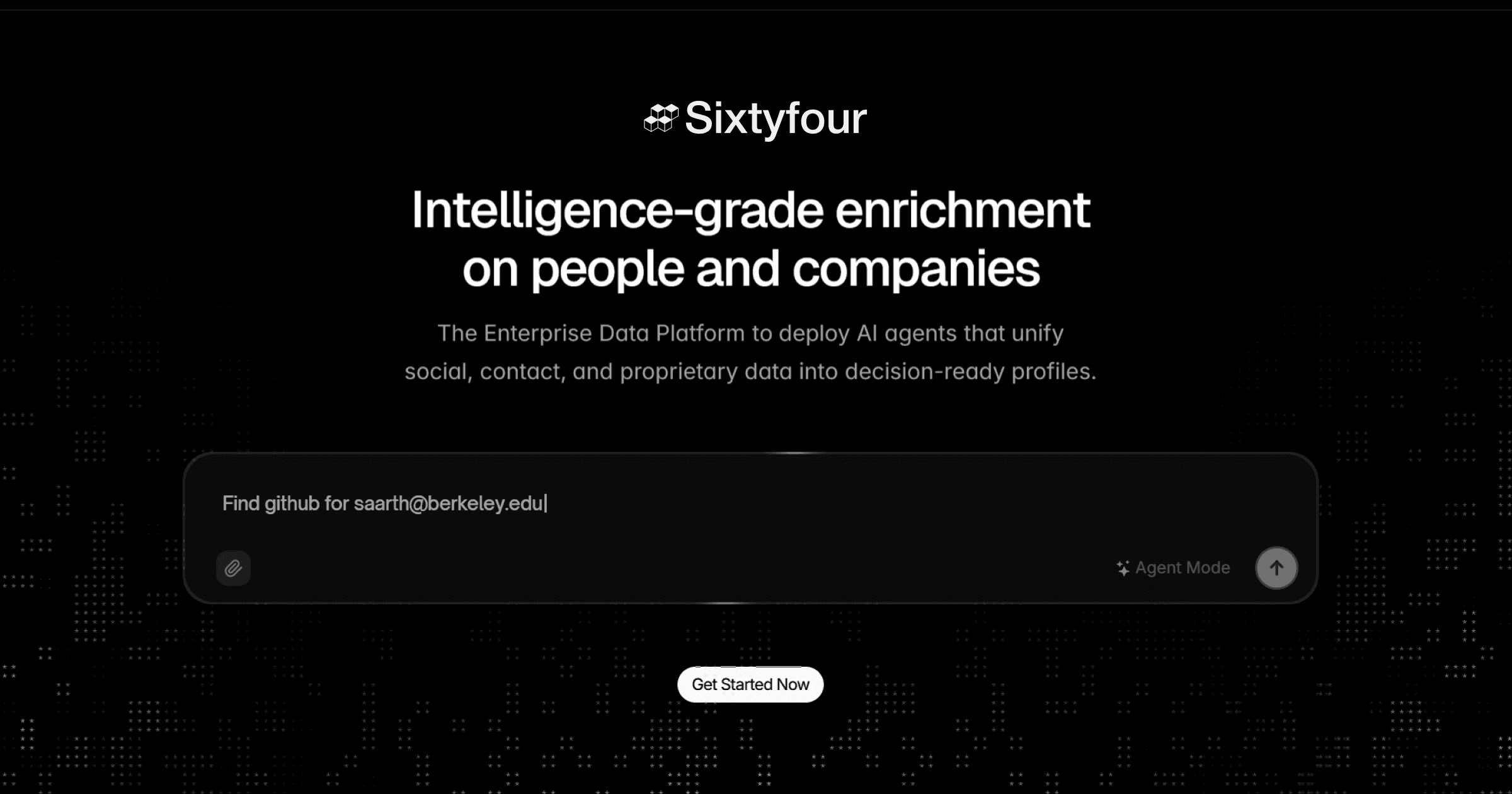
Sixtyfour
Sixtyfour is an enterprise data platform designed to deploy AI agents for comprehensive intelligence gathering on people and entities. It unifies social, contact, and proprietary data to create decision-ready profiles. The platform enables AI agents to investigate, resolve identities, map relationships, and surface risk signals across various sources, including the open and dark web, official records, and unstructured documents. Sixtyfour is ideal for teams needing to embed research agents into their products, workflows, or data pipelines for identity resolution, background screening, threat actor intelligence, and entity intelligence. It delivers exhaustive, structured profiles with every data point sourced and cited, supporting investigations, compliance, and decision-making.

context-space
Context Space offers a comprehensive context engineering infrastructure designed to enhance the productivity of AI agents, automation workflows, and developer tools. It provides unified MCP (Model Context Protocol) tools and secure, verified integrations, allowing AI agents to access real-world data and services effectively. The platform addresses challenges like manual credential handling with one-click OAuth and vault security, inconsistent APIs with a single RESTful API, and complex deployments through a unified context plane. Context Space is evolving into a complete context engineering platform, supporting advanced AI capabilities like semantic retrieval, context optimization, and real-time updates, making AI agents truly usable and secure.
ChatMLX
ChatMLX is a modern, open-source, and high-performance chat application specifically designed for MacOS. It utilizes large language models (LLMs) and is built upon the powerful MLX framework, optimized for Apple silicon. The application supports multiple models, including Llama, OpenELM, Phi, Qwen, Starcoder, Cohere, and Gemma, offering users a diverse range of conversational options. A key differentiator is its ability to run LLMs locally, which significantly enhances user privacy and security. ChatMLX is multilingual, supporting 39 major App Store languages, making it accessible to a global audience. It's compatible with macOS 14.0 and later.
CogDL
CogDL is a comprehensive, open-source library designed for graph deep learning, enabling researchers and developers to efficiently train and compare models. It supports key tasks such as node classification, graph classification, and other important graph domain applications. The library emphasizes efficiency through optimized operators for faster training and reduced GPU memory usage, ease of use with intuitive APIs for hyper-parameter search, and extensibility for applying GNN models to new scenarios. CogDL also incorporates features like fast sparse matrix-matrix multiplication (SpMM) for accelerated GNN training and supports mixed-precision training. It has been accepted by WWW 2023 and offers resources like a free GNN course and a discussion forum.
cnn-text-classification-tf
cnn-text-classification-tf is an open-source project offering a simplified implementation of a Convolutional Neural Network (CNN) for text classification using TensorFlow. This tool is based on the principles outlined in Kim's "Convolutional Neural Networks for Sentence Classification" paper. It provides the necessary code and scripts for users to train and evaluate their own text classification models, making it accessible for those looking to implement CNNs in their natural language processing tasks. The repository includes Python scripts for data helpers, model evaluation, the CNN architecture itself, and training, along with configurable parameters for embedding dimensions, filter sizes, dropout, and more.
ZenoX AI
ZenoX AI offers the Vydar Threat Intelligence platform, an AI-powered solution designed to help organizations proactively identify, prioritize, and prevent cyberattacks. It specializes in real-time monitoring and analysis of vast amounts of threat data from sources like the dark web, Telegram channels, and specialized forums. The platform utilizes the Tellyu AI engine for advanced pattern recognition, natural language understanding of fraudster terminology, and interactive data search. Key features include cyber threat intelligence, dark web monitoring, brand protection, supply chain intelligence, phishing detection, and fraud mitigation. ZenoX AI helps companies protect against leaked credentials, stolen cards, and fraudulent domains, ensuring a strong security posture.
data-juicer
Data-Juicer is an open-source, cloud-native, and AI-ready data processing system designed for the foundation model era. It offers a modular and extensible architecture with over 200 operators for text, image, audio, video, and multimodal data. Users can create reproducible YAML pipelines, chain complex workflows, and orchestrate full pipelines with ease. Data-Juicer supports various applications including pre-training, fine-tuning, RL, agent systems, RAG, and analytics. It boasts production-ready performance, scaling seamlessly from laptops to large clusters, with features like automatic OP fusion, adaptive parallelism, and CUDA acceleration. The system also includes built-in tracing for debugging and iterative improvement, making it a comprehensive solution for large-scale data preparation.

Wedge
Wedge serves as an operating system for healthcare AI agents, specifically designed to automate the entire back office for large health systems. It offers tailored AI solutions, handling development, integration, and maintenance. The process begins with a comprehensive audit to identify automation opportunities, followed by defining clear ROI for each AI agent. Onsite engineers then customize and develop these agents, moving department by department to automate tasks. Key offerings include AI Payment Reconciler, AI Records Retrieval, AI Governance, AI Receptionist, AI Claims Manager, and AI Medical Coder, all aimed at improving efficiency, reducing costs, and maximizing revenue recovery for healthcare organizations.
determined
Determined is an open-source machine learning platform designed to streamline the entire machine learning lifecycle. It simplifies complex tasks such as distributed training, allowing for faster model development and iteration. The platform also provides robust hyperparameter tuning capabilities to help users achieve optimal model performance. Beyond training, Determined offers comprehensive experiment tracking for analysis and reproducibility, alongside efficient resource management to help reduce cloud GPU costs. It is fully compatible with popular deep learning frameworks like PyTorch and TensorFlow, making it a versatile solution for developers and researchers.

Vaital
Vaital is an AI consulting service designed to guide businesses through their AI journey, from strategy development to execution. It addresses the common challenge of organizations lacking the capacity to implement effective AI strategies, aiming to help them disrupt their markets rather than be disrupted. Vaital offers an "AI Battle Plan" workshop to provide insights for transforming data into competitive advantage, focusing on achieving human-led, agent-accelerated ROI. The service emphasizes solving complex business problems using data and artificial intelligence, helping clients build disruptive intellectual property and accelerate growth.

The LLM Data Company
The LLM Data Company specializes in training frontier models for critical domains, with a current emphasis on medical applications. Their approach addresses the limitations of generalist models by developing specific intelligence for areas where ambiguity, resistance to sycophancy, and robust verification are paramount. They are currently developing the Kos series of medical models, with Kos-1 Lite achieving SOTA (State-Of-The-Art) performance on HealthBench Hard. The company focuses on post-training curricula to ensure models handle complex, sensitive data effectively, distinguishing itself from models optimized for coding or general tool-use.

The Strong AI
The Strong AI specializes in bridging the gap between AI experiments and production-ready systems for enterprises. They design and implement enterprise-grade AI systems that deliver measurable business outcomes, focusing on the challenges organizations face in scaling AI initiatives. Their approach involves incremental "Value Slices" to deliver early business value and build AI infrastructure organically. Key capabilities include developing reliable data pipelines, scalable infrastructure, deployment frameworks, monitoring systems, and integration with operational workflows. The Strong AI offers services in Data Platforms & Foundations, Decision & Intelligence Systems, AI Infrastructure & MLOps, and Agentic AI Systems, helping companies transform AI from isolated experiments into reliable, impactful systems.
fastagency
FastAgency is an open-source framework designed to bridge the gap between rapid prototyping and production-ready deployment for multi-agent AI workflows. It offers a unified programming interface, allowing developers to write core workflows once and reuse them across various user interfaces like console-based applications via ConsoleUI and web-based applications via MesopUI. A key differentiator is its seamless external API integration, enabling the connection of OpenAPI specifications to agents with minimal code. FastAgency also includes a Tester Class for continuous integration, ensuring reliability and robustness, and a powerful command-line interface (CLI) for orchestrating and managing multi-agent applications. It supports scalable, production-ready architectures through network adapters like REST API via FastAPI and NATS.io via FastStream.

Augen Pro
Augen Pro is at the forefront of engineering AI-driven, general-purpose computing designed to enhance everyday life. The company focuses on "Pro-Human" invisible computing, aiming to make technology work effortlessly for users and unlock limitless potential. Their research and development is currently centered on two innovative devices: A¹ Sense and B¹ Eye, which are part of their wearable and neural technology initiatives. Augen Pro's mission is to create smarter, smaller AI health tools and lead the future of Invisible Computing, simplifying Heads-Up Computing industries. They prioritize safety, accessibility, and reliability, ensuring their advanced technological devices are seamlessly integrated with the human body.
Alteia
Alteia is a visual intelligence platform designed to accelerate AI development by transforming visual data into actionable insights. It utilizes computer vision, machine learning, and artificial intelligence to analyze, filter, display, and distribute visual data at scale. The platform offers pre-built ML models and an intuitive interface for creating custom models. Alteia operates across industries such as energy, grid infrastructure, and environment, providing solutions for optimizing operations, managing assets, and ensuring compliance. It enables rapid deployment of visual intelligence projects, moving from briefing to production within months, and is used by public, private, and non-profit sectors to address complex challenges.
FireRedTTS
FireRedTTS is an open-sourced, LLM-empowered foundation Text-to-Speech (TTS) system designed for generative speech applications. It provides tools for developing and researching advanced TTS technologies, including an upgraded streamable foundation TTS system (FireRedTTS-1S). Key features include acoustic LLM and flow-matching decoders, enabling high-quality speech synthesis. The system also incorporates zero-shot voice cloning functionality, intended strictly for academic research purposes. Developers can clone the repository, set up a Conda environment, and install necessary dependencies to utilize the system. Pre-trained checkpoints and inference code are available, making it a robust platform for speech technology innovation.
gateway
Gateway is an open-source AI Gateway designed for fast, reliable, and secure routing to over 1600 language, vision, audio, and image models. It offers a lightweight, enterprise-ready solution that integrates with any language model in under 2 minutes, boasting blazing fast latency (<1ms) and a tiny footprint (122kb). The tool is battle-tested, having processed over 10 billion tokens daily, and provides enterprise-grade security, scalability, and custom deployments. Key functionalities include automatic retries and fallbacks to prevent downtimes, load balancing for high availability, and conditional routing for scaling AI applications. It also features robust guardrails to protect AI deployments, multi-modal capabilities, and integrations for agentic workflows. The enterprise version offers advanced capabilities like org management, governance, and enhanced security.
genkit
Genkit is an open-source framework designed for building full-stack AI-powered applications, actively used in production by Google's Firebase. It offers SDKs for JavaScript/TypeScript, Go, and Python, providing a consistent API across these languages. The framework simplifies AI development by offering a unified interface for integrating models from providers like Google, OpenAI, Anthropic, and Ollama. Developers can rapidly build and deploy chatbots, automations, and recommendation systems using streamlined APIs for multimodal content, structured outputs, tool calling, and agentic workflows. Genkit also includes a local CLI and Developer UI to accelerate development, allowing for prompt testing, debugging with execution traces, and production monitoring.
graphbit
GraphBit is the world’s first enterprise-grade Agentic AI framework, built on a Rust core with a Python wrapper for unmatched speed, security, and scalability. It enables reliable multi-agent workflows with minimal CPU and memory usage, making it production-ready for real-world enterprise environments. GraphBit is designed for developers who need deterministic, concurrent, and ultra-efficient AI execution without the overhead. It powers multi-agent workflows that run in parallel, persist memory across steps, self-recover from failures, and ensure 100% task reliability. Key features include tool selection, type safety, multi-LLM support, resource management, and observability.
gpt-oss
gpt-oss is a series of open-weight language models developed by OpenAI, designed for advanced reasoning, agentic tasks, and diverse developer use cases. It includes two primary models: gpt-oss-120b, suitable for production and general-purpose high-reasoning tasks on a single 80GB GPU, and gpt-oss-20b, optimized for lower latency and specialized local applications within 16GB of memory. Both models are trained with a harmony response format, which is crucial for their correct operation. Key features include a permissive Apache 2.0 license, configurable reasoning effort, full chain-of-thought access for debugging, fine-tunability, and agentic capabilities like function calling and web browsing. The models also utilize MXFP4 quantization for efficient memory usage.

LaunchLemonade
LaunchLemonade offers AI agents designed to automate back-office operations for regulated professional services firms, including accountants, financial advisors, consultants, and fractional CFOs. The platform provides pre-built agents and workflows for tasks like meeting intelligence (notes, action items, follow-ups), email management (triaging, scheduling), and searchable knowledge bases from firm-wide data. It emphasizes compliance and governance, with features like audit logs, role-based access, and data retention controls built-in. LaunchLemonade also offers services for custom agent development, AI consulting, team training, and white-labeling the platform, enabling firms to integrate AI safely and efficiently without needing an in-house engineering team.
kan-gpt
kan-gpt is an open-source project offering a PyTorch implementation of Generative Pre-trained Transformers (GPTs) integrated with Kolmogorov-Arnold Networks (KANs) for language modeling. This tool provides a flexible framework for researchers and developers to explore and experiment with novel neural network architectures in the context of large language models. Key features include the ability to train and prompt models, with usage examples provided for easy adoption. It supports various datasets like Tiny Shakespeare, MNIST, and WebText, and allows for comparison between KAN-GPT and traditional MLP-GPT models. The project is actively developed with a clear roadmap for future enhancements, including integration with minGPT and pykan, improved dataset parsing, and comprehensive testing.
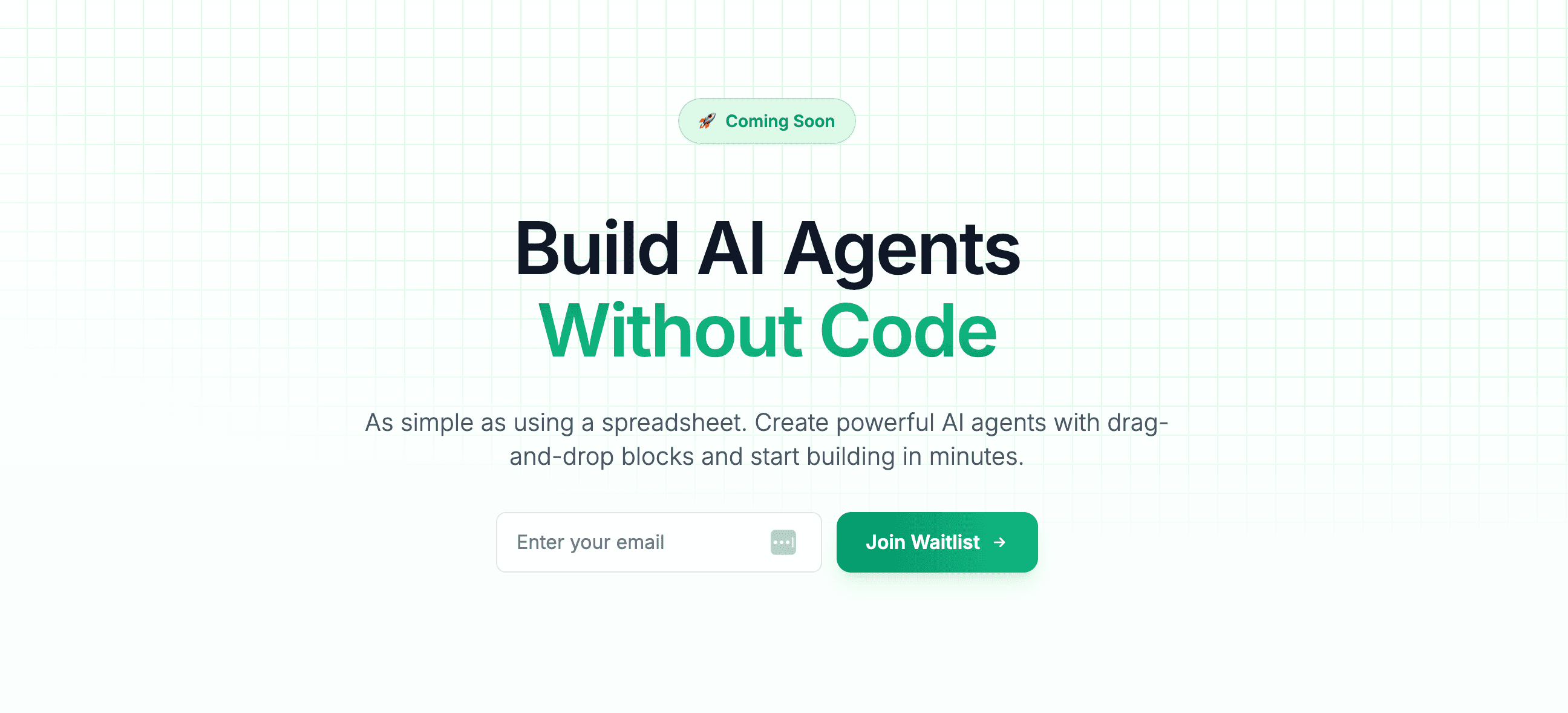
SageFlow
SageFlow is a no-code platform designed for building and deploying powerful AI agents using a drag-and-drop interface. Users can create custom agents with pre-built blocks, enabling rapid development and deployment. The platform also features an AI Marketplace where users can discover and rent expert-crafted AI agents for various tasks, or monetize their own creations. Key benefits include predictable income for creators, effortless scaling of agents, and flexible payout options. SageFlow aims to simplify agentic AI for everyone, offering solutions for tasks like SEO optimization and social media strategy, with future integrations planned for voice assistants, mobile devices, and a community platform.