
AI Agents & Automation
Browsing page 403 of AI Agents & Automation. Sorted by confidence score — our independent quality rating.

AltaML
AltaML specializes in building vertical AI solutions with an agentic-first approach, aiming to provide organizations with a competitive advantage and a faster return on investment. The company offers services like AI Navigator for strategic AI pathing, AI Foundations for establishing essential skills and systems, and the Agentic AI Lab for prototyping agent-driven solutions. They also have GovLab, tailored for public sector AI needs. AltaML supports industries such as Energy and Industrial Operations, Public Sector, and Health, focusing on mission-critical AI, trusted public services, and compliant healthcare solutions. Their AltaForge platform streamlines the AI development journey from concept to implementation, ensuring smoother deployments and higher success rates.
Wolfe By Slideworks
Wolfe by Slideworks is an AI-powered management consultant designed to assist with a wide range of business questions and challenges. It leverages advanced generative language models and the expertise of top-tier management consultants to provide strategic guidance. Wolfe can act as a co-pilot for tasks such as research, drafting, analysis, and communication, making these processes more efficient. It helps users create presentation storylines, develop frameworks for projects like digital transformation, solve business problems, optimize pricing, and analyze data for insights. Founded by ex-consultants and developers in partnership with Slideworks, Wolfe aims to augment corporate teams and consultants with cutting-edge AI capabilities.
AteneAI
AteneAI is an AI Visibility tool designed to help modern brands optimize their presence and be recommended in AI chatbots such as Gemini. It provides comprehensive features for tracking brand mentions, analyzing sentiment, and understanding competitive share of voice across AI platforms. The platform offers real-time insights into query patterns and opportunities, enabling brands to strategically control their narrative and position themselves effectively in AI-generated responses. AteneAI aims to transform AI search into a growth channel, leveraging higher conversion values and surging AI traffic. It also provides competitive intelligence to identify gaps and outperform competitors, with lightning-fast tracking and secure, private data handling.
Beam AI
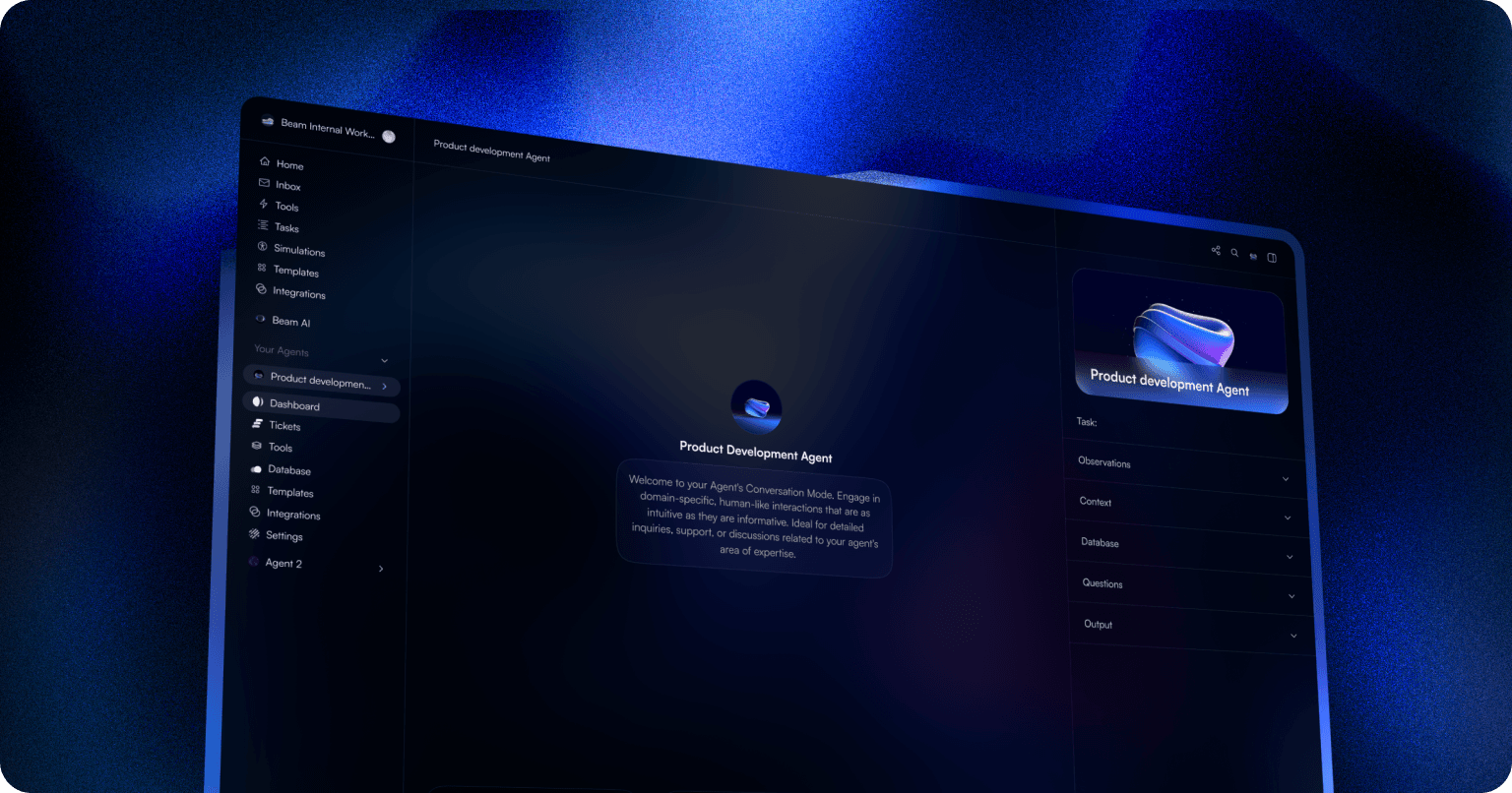
Beam AI provides a leading platform for agentic automation, enabling enterprises to deploy self-learning AI agents for various operations. It helps reduce operational costs, increase efficiency, and transition organizations into AI-native market leaders. The platform supports building and deploying agents quickly, integrating with over 1000 systems including SAP and Salesforce. Beam AI agents are designed for enterprise scale and security, offering continuous learning, human-in-the-loop capabilities, and no-code development. It ensures secure, compliant, and auditable operations, meeting GDPR, ISO 27001, and SOC 2 Type II standards, with flexible deployment options including cloud and on-premise.
open-trading-api
The open-trading-api GitHub repository offers comprehensive sample code for integrating with the Korea Investment & Securities (KIS) Open API. Designed for both Python developers and LLM-based automated trading environments, it simplifies the process of understanding and utilizing the KIS API. The repository includes functional unit samples for LLMs, practical API call examples for users, a strategy builder with visual UI, and a backtesting engine. It supports various API categories including domestic and overseas stocks, bonds, futures, options, ELW, and ETF/ETN. The tool aims to reduce development burden and facilitate the creation of AI-driven trading strategies and automated systems.
Assessgru
Assessgru is an online assessment platform designed to streamline hiring and talent evaluation processes. It enables employers to conduct structured skill tests, psychometric evaluations, and secure proctored assessments, ensuring accurate, fair, and data-backed hiring decisions. The platform features AI-based proctoring for real-time monitoring and integrity maintenance, instant evaluation with automated scoring, and flexible question formats for customized assessments. Assessgru supports end-to-end talent assessments, pre-employment testing, and skill-based evaluations, helping identify skill gaps and support workforce growth. It also offers AI-powered evaluation for insightful analysis and secure data storage with enterprise-grade protection.
Breakup Buddy
Breakup Buddy is an AI-powered companion designed to help individuals navigate the emotional challenges of a breakup. It provides a safe and private space for users to discuss their feelings, vent, and engage in interactive healing exercises. The tool leverages a powerful LLM to personalize responses and offer contextually relevant guidance. Key features include 24/7 AI chat support, a variety of helpful exercises to question underlying beliefs and foster self-discovery, and a smart journal for tracking progress. Messages are stored only on the user's device, ensuring privacy. Breakup Buddy aims to offer a comprehensive toolkit for healing and personal growth after heartbreak.
Netwrck
Passisto is an AI-powered enterprise platform designed to revolutionize recruitment and knowledge management. It automates the entire hiring pipeline, from defining job offers and screening candidates at scale to conducting intelligent AI interviews and making data-driven decisions. The platform features automated CV screening, flexible phase management, AI interview templates, and automated communications to streamline the hiring process. Beyond recruitment, Passisto Enterprise includes a full suite of AI tools such as an AI Knowledge Base for unifying company documents, an AI Email Builder for generating context-aware emails, and an AI Form Builder for instant form creation. It aims to accelerate time-to-hire, enhance candidate quality, reduce recruitment overhead, and increase diversity and fairness in hiring.
NATSpeech
NATSpeech is a comprehensive open-source framework for Non-Autoregressive Text-to-Speech (NAR-TTS) research and development. It offers official PyTorch implementations of advanced models like PortaSpeech (NeurIPS 2021) and DiffSpeech (AAAI 2022), facilitating high-quality and portable speech generation. The framework includes robust features such as data processing for NAR-TTS using Montreal Forced Aligner, a scalable training and inference system, and an efficient random-access dataset implementation. It's designed for technical users who want to explore and build upon state-of-the-art speech synthesis technologies, providing the necessary tools and code for experimentation and deployment.
Log10
Log10's Everest platform is an agentic AI solution specifically designed for life sciences services, including Pharma/Biotech, MedTech, CROs, and consultancies. It enables teams to transform their expertise into scalable, compliant workflows for document generation. Everest can produce a wide range of documents, from regulatory submissions like 510(k)s and IND/CTA Briefing Packages to clinical reports such as Clinical Trial Protocols and Investigator Brochures, and strategic documents like Market Landscape Summaries. The platform emphasizes speed, accuracy, and compliance, aiming to accelerate documentation processes without increasing team size. It also offers white-labeling solutions for CROs and consultancies to deliver AI-powered documents under their own brand.
gpt-3-experiments
gpt-3-experiments is a GitHub repository offering a collection of test prompts for OpenAI's GPT-3 API, alongside the resulting AI-generated texts. This resource is designed to showcase the robustness and capabilities of the GPT-3 model. The repository also features a Python script, `openai_api.py`, which enables users with OpenAI API access to efficiently query texts from the API, bypassing the web interface. All generated texts within the repository are presented in their original, unedited, and uncurated form, unless explicitly noted. The script allows for generating texts at various temperatures (0.0, 0.7, 1.0, 1.2) to explore different levels of 'creativity' in the AI's output. Users can configure their OpenAI API secret key and run the script from the command line to generate texts based on custom prompts or text files.
gpt4v-browsing
gpt4v-browsing is an open-source tool designed for web scraping and information extraction using the GPT-4 Vision API and Puppeteer. Users can ask questions, and the tool will browse to a specified website, take a screenshot, and then leverage the GPT-4 Vision API to analyze the image and provide answers. The JavaScript version offers enhanced functionality, allowing it to not only open URLs directly but also interact with web pages by clicking on links. This makes it a versatile solution for automating tasks that require visual understanding and interaction with web content, providing a powerful way to gather insights from dynamic web pages.
Recepto.ai
Recepto.ai is an AI-powered lead generation platform designed to help B2B revenue teams identify and engage with high-intent prospects. The tool captures real-time intent signals from potential customers, indicating their current market interest in specific offerings. Users can define Ideal Customer Profiles (ICPs) and Watchlists to automatically discover prospects who are actively looking for solutions. Recepto.ai offers various 'Plays' to target different types of signals, from custom and social triggers to deep intent signals. It provides bundled personalized reach-outs via email, LinkedIn, and WhatsApp, aiming to generate qualified sales opportunities. The platform is built to help companies systematically capture intent signals and convert them into sales-qualified leads, significantly widening their sales funnel.
ithaca
Ithaca is a pioneering deep neural network developed by Google DeepMind for the restoration, geographical, and chronological attribution of ancient Greek inscriptions. This open-source tool significantly enhances the historian's workflow by providing a collaborative, decision-support, and interpretable architecture. It achieves 62% accuracy in restoring damaged texts, and when used by historians, their performance leaps from 25% to 72%. Ithaca can also attribute inscriptions to their original location with 71% accuracy and date them with a distance of less than 30 years from ground-truth ranges, contributing to critical debates in Ancient History. The project includes an interactive online notebook and an offline library for advanced users.
ai-agents-from-scratch
ai-agents-from-scratch is a comprehensive educational resource designed to demystify AI agents by guiding users through building them from scratch. This repository emphasizes a hands-on approach, utilizing local LLMs and node-llama-cpp to provide a deep understanding of how agents function without relying on black-box frameworks. It covers fundamental concepts such as basic LLM interaction, system prompts, reasoning, parallel processing, streaming, function calling (tools), persistent memory, and advanced patterns like ReAct and Atom of Thought (AoT) planning. The resource includes detailed code examples, step-by-step explanations, and conceptual deep dives, making it ideal for developers who want to grasp the underlying mechanisms before engaging with production frameworks.
natbot
natbot is an open-source project designed to automate browser interactions using GPT-3. It allows users to control a web browser through AI commands, effectively turning natural language instructions into browser actions. The tool is hosted on GitHub, indicating a developer-centric approach and encouraging community contributions for its enhancement. While currently a foundational tool, the project roadmap includes improvements such as better prompt engineering, prompt chaining, enhanced DOM serialization, and the ability for the agent to manage multiple tabs. This makes natbot a valuable resource for developers looking to experiment with AI-driven browser automation and contribute to its evolution.

qomplement
qomplement is an AI agent designed to automate desktop tasks across various software applications, significantly streamlining workflows by automating repetitive processes. This tool is particularly useful for tasks such as document filling and data entry, enhancing overall productivity for individuals and businesses. By leveraging AI, qomplement aims to reduce manual effort and potential errors associated with routine administrative work. Its focus on automating desktop interactions makes it a valuable asset for improving efficiency in daily operations.
neuronika
Neuronika is a machine learning framework built entirely in Rust, emphasizing ease of use, rapid prototyping, and performance. At its core, Neuronika utilizes reverse-mode automatic differentiation, enabling the creation of dynamically changing neural networks with minimal effort and overhead through a lean, imperative, and define-by-run API. The framework leverages the power of the Rust language to offer an intuitive and efficient interface without the need for Foreign Function Interfaces (FFI). It supports GPU-accelerated primitives via CUDA, serialization with Serde, and transparent BLAS support for optimized matrix multiplication. Neuronika is currently in active development, with breaking changes expected as it evolves.
hamiltonian-nn
Hamiltonian-nn offers the code for the paper "Hamiltonian Neural Networks," which introduces a novel approach to modeling physical systems using neural networks. Unlike traditional neural networks, Hamiltonian Neural Networks (HNNs) are designed to learn and adhere to exact conservation laws, such as energy conservation, in an unsupervised fashion. The tool provides practical examples for various tasks, including modeling ideal mass-spring systems, pendulums (both ideal and real), two-body and three-body problems, and pixel observations of a pendulum. HNNs demonstrate faster training and better generalization compared to regular neural networks, with the added benefit of being perfectly reversible in time. This makes it particularly useful for researchers and developers working on physics-informed machine learning.
HALOs
HALOs (Human-Centered Loss Functions) is a Python library designed to facilitate the alignment of Large Language Models (LLMs) with human preferences. It provides extensible implementations of popular alignment methods such as DPO, KTO, PPO, and ORPO. The library emphasizes modularity, separating dataloading, training, and sampling, and extensibility, allowing users to quickly implement custom dataloaders or new alignment losses. HALOs is built for simplicity, making it easy to hack on, and has been tested with LLMs ranging from 1B to 30B parameters. It supports LoRA training, reference logit caching to reduce memory, and integrates with tools like Hydra for configuration and Accelerate for job launching with FSDP. The repository also includes scripts for evaluation with AlpacaEval and LMEval.
GPTFuzz
GPTFuzz is an open-source tool designed for red teaming large language models (LLMs) by automatically generating jailbreak prompts. This process helps identify vulnerabilities and weaknesses in AI models, ultimately enhancing their robustness and security. The repository provides the official codebase for "GPTFUZZER: Red Teaming Large Language Models with Auto-Generated Jailbreak Prompts." It includes datasets for harmful questions and human-written templates, along with a finetuned RoBERTa-large model for judgment. Researchers can use GPTFuzz to generate their own adversarial templates and contribute to building a general black-box fuzzing framework for LLMs.
Intrusion-Detection-System-Using-Machine-Learning
This repository offers open-source code for developing Intrusion Detection Systems (IDS) using a range of machine learning algorithms. It's designed for general IDS and anomaly detection applications, particularly in the context of the Internet of Vehicles (IoV). The project includes implementations of tree-based algorithms like Decision Tree, Random Forest, XGBoost, LightGBM, and CatBoost, as well as unsupervised learning with k-means, and ensemble methods such as stacking and the proposed LCCDE. It also incorporates hyperparameter optimization techniques like Bayesian optimization. The code is accompanied by published research papers detailing three specific IDS models: a tree-based IDS, MTH-IDS (a multi-tiered hybrid IDS), and LCCDE (a decision-based ensemble framework). Datasets like CICIDS2017 and CAN-intrusion are used for experimentation, making it a valuable resource for cybersecurity researchers and developers.
InternNav
InternNav is an all-in-one open-source toolbox built on PyTorch, Habitat, and Isaac Sim, designed for embodied navigation. It provides modular support for the entire navigation system, including vision-language navigation with discrete action space (VLN-CE), visual navigation (VN) with various goal types, and full VLN systems with continuous trajectory outputs. The platform is compatible with mainstream simulation platforms, catering to diverse training and evaluation needs. It offers comprehensive datasets, models, and benchmarks, including the advanced InternData-N1 dataset and the dual-system navigation foundation model, InternVLA-N1, which demonstrates leading performance and zero-shot generalization capabilities in real-world scenarios. InternNav also supports distributed evaluation and provides resources for real-world deployment.
self-llm
self-llm is an open-source project by Datawhale China, offering a comprehensive guide for deploying and fine-tuning large language models (LLMs) and multimodal large language models (MLLMs) on Linux environments. Specifically tailored for Chinese users and beginners, it simplifies the process of working with open-source models like LLaMA, ChatGLM, and InternLM. The guide covers essential steps including detailed environment configuration, local deployment, and various fine-tuning methods such as full parameter fine-tuning, LoRA, and ptuning. It also provides instructions for application deployment, including command-line invocation, online demo deployment, and integration with frameworks like LangChain. The project aims to make advanced LLM technology accessible to a broader audience of students and researchers.