
AI Agents & Automation
Browsing page 503 of AI Agents & Automation. Sorted by confidence score — our independent quality rating.

YourHealth.ai
YourHealth.ai is an innovative AI tool designed to offer personalized medical advice, empowering users to make informed health decisions. Available as both a mobile application and a web-based chat interface, it allows individuals to share symptoms, concerns, or specific questions to receive AI-driven insights. The platform aims to demystify health complexities by providing accessible and transparent information. Users can download the mobile app for on-the-go access or utilize the web chat for immediate assistance, making it a versatile solution for proactive health management.
CUA GUI Operator
CUA GUI Operator is an ultra-compact Computer-Use Agent designed for GUI localization and automation. Users can upload a UI screenshot and specify a desired action, such as "click the search bar." The tool then leverages an AI model to analyze the image and identify the precise click coordinates, which are then displayed on the image. This functionality makes it suitable for automating interactions with graphical user interfaces, streamlining repetitive tasks, and assisting with educational projects related to computer-use agents. It provides a practical approach to understanding and implementing GUI automation.
Saner.AI
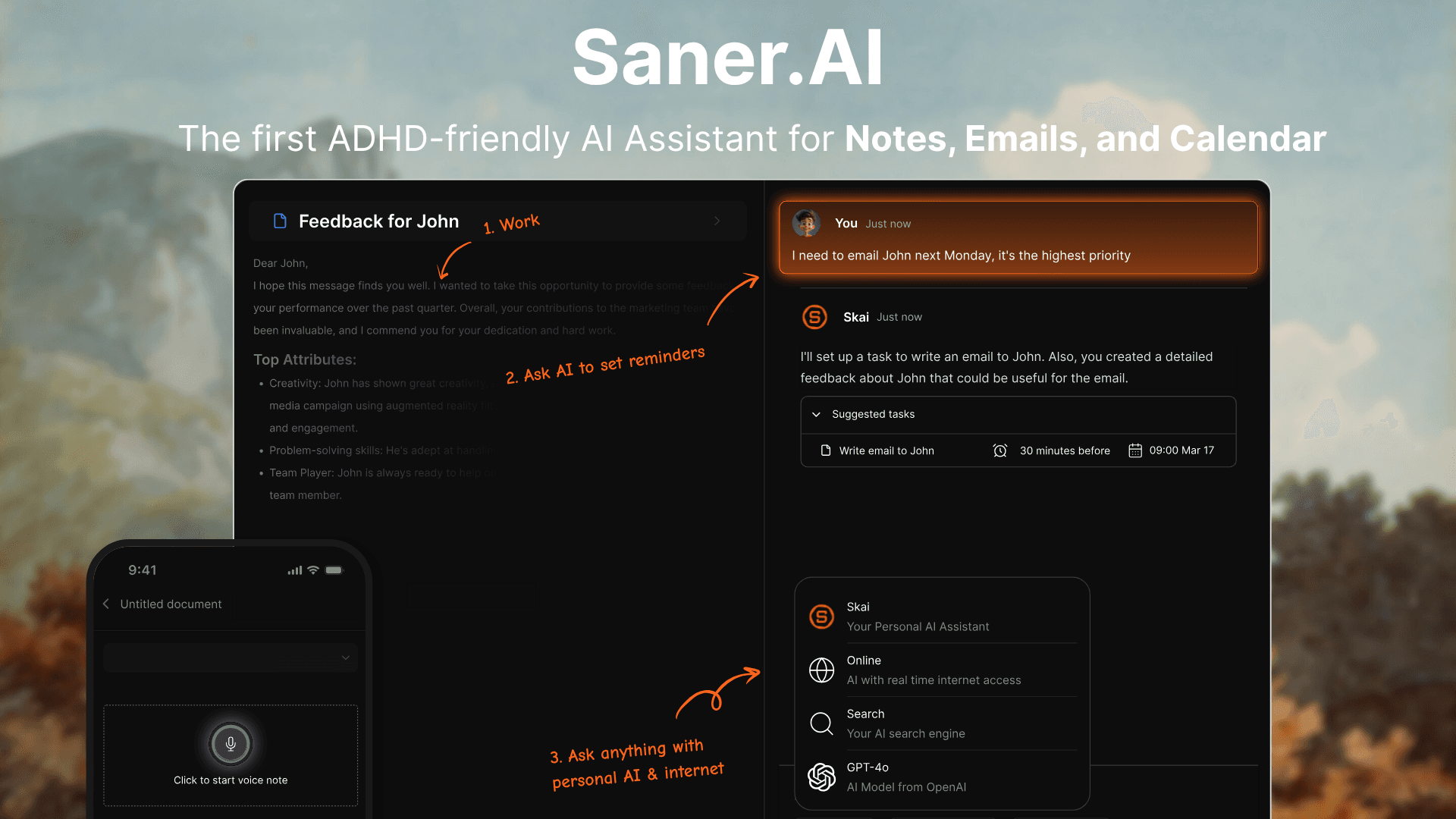
Saner.AI is an AI-powered personal assistant specifically designed for individuals with ADHD, aiming to streamline information organization and daily planning. It acts as an ADHD-friendly AI assistant for managing notes, emails, and calendars. Users can interact with the tool through chat to search notes, manage emails, and schedule tasks efficiently. A key differentiator is its proactive approach to day planning and regular check-ins, which helps users stay on top of their responsibilities and reduce cognitive load. This tool is built to enhance productivity and provide a personalized support system for managing daily tasks.
IDEFICS2 Playground
IDEFICS2 Playground is a Hugging Face Space that offers an interactive AI experience. Users can input a question and optionally upload one or more images. The AI then processes both the textual query and the visual information from the images to generate a clear and concise text-based response. This tool is designed for experimentation and prototyping, making it suitable for exploring the capabilities of multimodal AI models. It provides a straightforward interface for interacting with the IDEFICS2 model, allowing users to quickly get answers, descriptions, or explanations based on their provided inputs.
noreward-rl
noreward-rl offers a TensorFlow-based implementation for curiosity-driven exploration in deep reinforcement learning, as detailed in its ICML 2017 paper. This tool is designed for training AI agents using intrinsic curiosity-based motivation (ICM), particularly effective in scenarios where external environmental rewards are sparse or entirely absent. It leverages self-supervised prediction to guide exploration, allowing agents to learn and adapt solely through curiosity. The repository includes installation instructions, demo scripts for environments like Doom and Super Mario Bros, and training code, making it a valuable resource for researchers and developers working on advanced reinforcement learning techniques.
ONE-PEACE
ONE-PEACE is an open-source general representation model designed to work across vision, audio, and language modalities. It stands out by achieving leading results in vision, audio, audio-language, and vision-language tasks without the need for any pre-trained vision or language models for initialization. The tool offers capabilities such as multi-modal embedding for text, images, and audio, visual grounding to locate objects within images, and audio classification. Its architecture and modality-agnostic tasks are designed for scalability, allowing for potential expansion to unlimited modalities. The project provides fine-tuned checkpoints, training, and inference scripts, along with a Huggingface Spaces demo for multimodal retrieval.

DevRev
DevRev introduces "Computer," an AI teammate designed to unify an organization's data, automate workflows, and significantly boost employee productivity. Unlike other AIs, Computer features native shared memory, allowing it to remember structured data, human interactions, and team dynamics to provide accurate answers. It reasons across live data with Text-to-SQL precision, ensuring answers improve over time and respect permission awareness. Computer can take action within defined boundaries, requiring human approval for important steps and providing full visibility and rollback options. It integrates with various tools like Slack, Notion, and Jira, and offers specialized apps for support, build, and observe functions, aiming to save employees over 10 hours per week.
https://ticketdesk24.com/pricing
TicketDesk24 is a modern IT helpdesk and support ticketing system designed for teams of all sizes, aiming to streamline support operations with AI-powered features. It offers a range of functionalities including agent management, ticket tracking, storage, email notifications, and SLA management. Advanced features like AI-powered SLA, email-to-ticket conversion, and single sign-on are available. The platform also includes team management, audit logging, SMS notifications, custom branding, and priority support. AI features, such as ticket summarization, auto-categorization, sentiment analysis, and intelligent SLA predictions, are supported via a Bring Your Own Key (BYOK) model for OpenAI, Gemini, Groq, Mistral, or Cohere, giving users control over costs. A free plan is available, and users can upgrade or downgrade their plans easily.

ChatBoo
ChatBoo is a personalized AI companion platform designed to help, inspire, and entertain users. It offers a unique experience beyond typical AI chatbots, allowing users to create, explore, and customize unique AI personalities. Key features include high-quality voice calling, effortless image sharing, and long-term memory, enabling the AI to learn and grow with user interactions. Users can enjoy unlimited free messages with their companions and have the option to create and share their own customized AI companions. The platform is completely uncensored, providing unrestricted conversations, and offers affordable subscription plans for additional features like increased image sharing capacity.
Claio.ai
Claio offers an AI front desk and AI scribe solution specifically designed for medical and dental practices. The AI Front Desk provides 24/7 call coverage, booking and rescheduling appointments directly in your Practice Management System (PMS), and answering patient questions, significantly reducing missed calls. The AI Scribe feature allows healthcare providers to dictate patient interactions, and Claio automatically generates structured notes in their templates, pushing them directly to the PMS. Additionally, it offers coding support by suggesting billing codes with confidence scoring, streamlining the billing cycle and reducing rejected claims. Claio aims to save time, increase efficiency, and improve patient engagement for healthcare professionals.
Privacy-Safe Synthetic Data Generation | Syncora AI
Privacy-Safe Synthetic Data Generation | Syncora AI is a powerful tool designed for creating synthetic data that ensures privacy. It enables users to generate high-quality, privacy-safe datasets for various applications, including machine learning model training and data augmentation. This tool is particularly useful for scenarios where real-world data is sensitive or scarce, allowing for robust development and testing without exposing confidential information. By providing a secure way to create synthetic data, Syncora AI facilitates data sharing and collaboration while maintaining compliance with privacy regulations. It's an essential resource for data scientists and developers working with sensitive data.
JobWhiz
JobWhiz is an AI-powered tool designed to help job seekers prepare for interviews effectively and efficiently. It offers personalized practice sessions tailored to the user's resume and the specific job they are applying for. Users receive instant feedback on their answers, including scoring and suggested improvements, helping them refine their responses. The platform also provides on-demand coaching tips for difficult questions and insights on what to avoid saying. Available on the App Store and Google Play, JobWhiz aims to make interview prep accessible and engaging, allowing users to practice anywhere, anytime, and boost their confidence for any job interview.
robosuite
robosuite is a comprehensive simulation framework powered by the MuJoCo physics engine, designed for advanced robot learning research. It offers a modular design for building new environments, robot embodiments, and controllers, alongside a suite of benchmark environments for reproducible research. Key features include support for diverse robot embodiments, custom robot composition, composite controllers, and various teleoperation devices. The framework also provides multi-modal sensors, utilities for human demonstrations, and photorealistic rendering capabilities, including integration with NVIDIA Isaac Sim. Developed by researchers at Stanford Vision and Learning Lab, it aims to lower barriers to entry for cutting-edge AI and Robotics research.

Aissistant
Aissistant is an Agentic AI Operational Layer designed to automate sales and service functions for businesses, aiming for up to 98% automation and improved customer satisfaction. The platform features AgentMesh, an Agentic AI workforce that handles end-to-end resolution of complex tasks, reasoning like experts and integrating with existing workflows. Pulse, another key component, provides deep operational insights by analyzing tickets, agents, products, and business data to identify patterns and optimize operations. Evolve, the real-time action engine, monitors data, spots critical signals, and recommends actions to proactively address issues. Aissistant supports over 65 languages with automatic detection and integrates with major platforms like Intercom, Zendesk, Salesforce, and HubSpot, making it suitable for enterprise teams seeking stable, controlled, and outcome-oriented AI solutions.
Paligemma2 Vqav2
Paligemma2 Vqav2 is an AI tool designed for visual question answering, finetuned on the VQAv2 dataset. It enables users to upload an image and then pose specific questions about its content. The tool processes these queries and provides detailed, AI-generated answers, making it useful for understanding and extracting information from visual data. While the current live website indicates a runtime error, its core functionality is to facilitate interactive image analysis through natural language questions, offering a practical application for research and development in AI, particularly in the domain of multimodal understanding.
OriginVerified
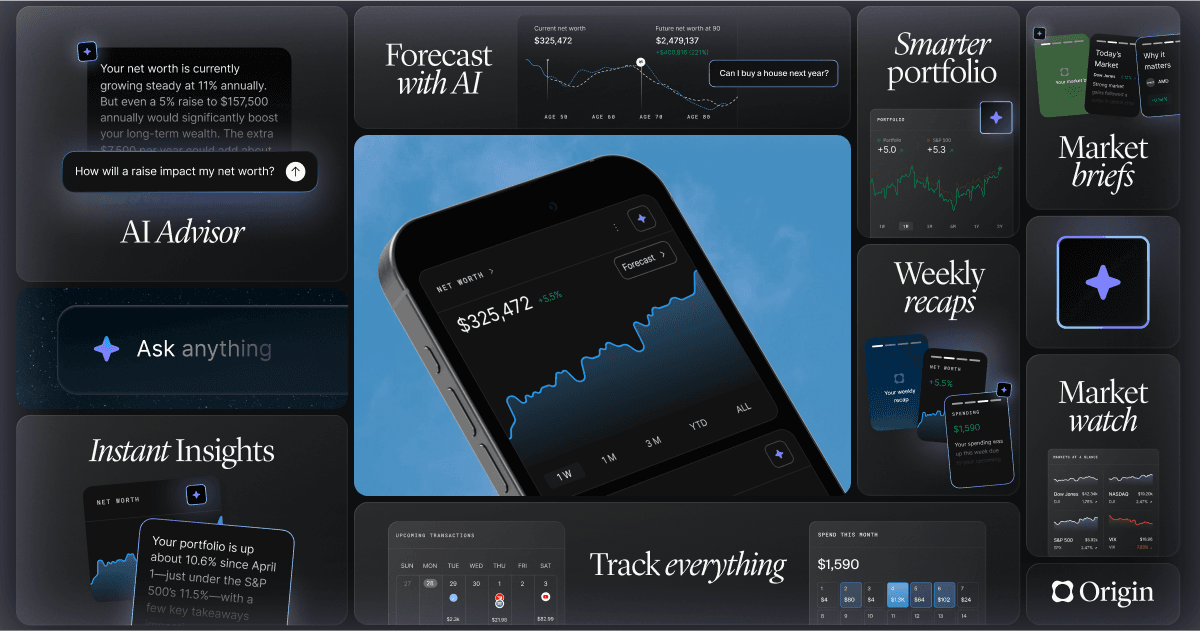
Origin Financial is an all-in-one AI-powered financial platform designed to help individuals manage their wealth effectively. It offers comprehensive features for budgeting, spend tracking, and investment management, allowing users to sync all their financial accounts in one place. The platform provides personalized AI-driven advice, instant insights into portfolios and spending, and deep financial recaps. Users can monitor investment performance across various assets, visualize allocation, and explore market trends. Origin also includes tools for forecasting future financial scenarios, estate planning, and tax planning. It supports joint financial management for couples and offers access to CFP® professionals for expert guidance, making it a robust solution for personal financial optimization.
PolaroidVL Installer
PolaroidVL Installer provides a convenient way for users to install the PolaroidVL Model directly onto their local devices. This facilitates local AI development and research by allowing users to upload images and ask questions about their content. The tool then provides detailed answers based on the image information. It supports common image formats like JPG, PNG, and GIF, with file sizes up to 10MB. Hosted on Hugging Face Spaces, it offers a straightforward solution for those looking to implement and experiment with the PolaroidVL Model in a local environment.
AskVideo
AskVideo.ai is a powerful AI tool designed to transform how users interact with YouTube videos. It enables users to ask any question about a video and receive instant, accurate answers, complete with timestamps for easy reference. This eliminates the need to scrub through hours of content to find specific information. The platform supports various use cases, including academic learning, tutorials, business insights, research, and team collaboration. Users can paste any YouTube URL, and the AI processes the video by transcribing and indexing its content. AskVideo.ai also offers a command-line interface for developers, allowing chat interaction with YouTube videos directly from the terminal. It aims to make video learning more efficient and engaging for students, professionals, and content creators alike.

MIND-Interview
MIND-Interview is an AI-powered platform designed to assist both job seekers and recruiters in the interview and hiring process. For job seekers, it offers AI-driven interview coaching to help them prepare effectively and create compelling video resumes. Recruiters can leverage the platform for resume analysis and to conduct AI-powered interviews, which aims to streamline candidate screening and evaluation. The tool focuses on enhancing the efficiency and effectiveness of recruitment by providing intelligent insights and automated functionalities, ultimately aiming to improve the matching process between candidates and roles.
AdKrity
AdKrity is an AI-powered digital advertising platform designed to automate ad campaigns and significantly improve results, promising 2X-5X performance. It leverages AI at every critical stage of an ad campaign, including generating impactful creatives, optimizing targeting strategies, and continuously refining campaigns based on data. The platform also includes an in-app CRM to track leads and supports publishing ads across multiple platforms from a single interface. AdKrity aims to simplify ad management for businesses, offering features like customized advertising packages, platform and budget selection, and one-click publishing to streamline the entire process.
Buzr AI
Buzr AI offers outcall AI voice receptionists designed to handle various customer interactions with hyper-realistic voice technology. This system is built to automate customer service tasks, providing efficient assistance for businesses and individuals. It can manage diverse functions, from rescheduling flights to handling support queries, ensuring a seamless and human-like interaction experience. Buzr AI aims to streamline operations and enhance customer satisfaction by leveraging advanced voice AI to manage a high volume of calls and inquiries effectively. The tool focuses on delivering a natural conversational flow, making it an ideal solution for organizations looking to optimize their customer support without compromising on quality.
Dolores
Dolores is an advanced AI girlfriend and virtual companion app for iOS, powered by GPT-4 and Claude 3.5 Sonnet. It offers a highly customizable agent with long-term memory and a learnable personality that evolves through interactions. Users can engage in meaningful conversations, and Dolores can even drive her own storylines based on past experiences. The app supports both voice and text chat, and notably, it allows for adult/NSFW content while respecting user boundaries. Users can also integrate their own OpenAI API key for free access, paying only for tokens directly to OpenAI, ensuring privacy as the API key is not stored by Dolores.
AppGen
Symph AI provides advanced AI solutions designed to streamline business processes and foster innovation across various industries. Their offerings include a suite of in-house AI applications developed to boost productivity, such as a Job Order AI Generator, GitHub PR AI Descriptor, and AI Report Generator. Beyond their internal tools, Symph AI also delivers custom AI client solutions, exemplified by an Infrastructure Monitoring AI Platform for the public sector, an Enterprise Media Summarization Platform for investment companies, and AI-Enhanced Photo Kiosks for customer engagement in retail. They focus on addressing specific business challenges, from enhancing customer service and data insights to automating email responses and predictive sales analytics.
Buddy.ai
Buddy.ai is an innovative AI-powered language learning application designed specifically for children aged 3-7. It offers a playful and interactive way for kids to learn English from a zero level to conversational fluency. The app utilizes advanced voice recognition and AI technology, allowing Buddy to hear and respond to children, creating a personalized 1:1 learning experience. Lessons are game-based, incorporating elements that appeal to visual, auditory, and kinesthetic learners, ensuring engagement and effective retention. Buddy.ai's curriculum is built around everyday experiences and interests, covering topics like animals, colors, and numbers, and employs educational strategies such as active retrieval, storytelling, and spaced repetition to maximize learning outcomes. It also serves as the world's first AI-based speech therapy tutor.