
AI Agents & Automation
Browsing page 603 of AI Agents & Automation. Sorted by confidence score — our independent quality rating.

Gradio_YOLOv5_Det
Gradio_YOLOv5_Det is an AI tool designed for object detection, leveraging the powerful YOLOv5 model. It provides a user-friendly interface built with Gradio, enabling individuals to easily upload images and perform object detection tasks. This tool is particularly useful for automating image analysis and various computer vision applications. While the live website currently shows a runtime error, the underlying purpose is to offer a straightforward way to apply advanced object detection capabilities. It is licensed under GPL-3.0, indicating its open-source nature and potential for community contributions and modifications.
Gemma 2 llama.cpp 2B/9B/27B
Gemma 2 llama.cpp 2B/9B/27B is a Hugging Face Space that provides an interactive interface to the Gemma-2 language model. Users can input questions or prompts into a chat box and receive replies generated by the AI. A key feature is the flexibility to select different model sizes, specifically 2B, 9B, or 27B, catering to varying computational needs and desired output complexity. Additionally, users have control over settings such as the response length, allowing for tailored interactions. This tool is licensed under Apache-2.0, making it an open-source option for those interested in experimenting with or integrating the Gemma-2 model.
TimeScope
TimeScope is a Hugging Face Space application designed for visualizing the accuracy curves of various video models. Users can upload CSV files containing accuracy data for different models and context lengths, enabling a clear comparison of their performance over time. This tool is particularly useful for researchers and developers working with video models, offering a straightforward way to analyze and understand how model accuracy evolves. It provides a visual interface to interpret complex data, making it easier to identify trends and evaluate the effectiveness of different AI models in video analysis tasks.
TDAgentTools
TDAgentTools is a cybersecurity platform designed to assist professionals in gathering critical threat intelligence. The tool provides functionalities for DNS enumeration, IP location tracking, and abuse data analysis. Users can input URLs, IP addresses, or domain names to receive detailed analyses, enhancing their understanding of potential threats. This platform aims to streamline the process of collecting cybersecurity information, making it easier for users to gain insights into various digital assets and their associated risks. It is presented as a set of tools to enhance threat insights within the cybersecurity domain.
mosaico
Mosaico is a blazing-fast open-source data platform specifically engineered for Robotics and Physical AI, aiming to bridge the gap between physical world data and scalable production systems. It excels at transforming traditional monolithic sensor logs into a structured, queryable archive optimized for multi-modal data. The platform utilizes a modern data lake approach with a zero-copy architecture, enabling direct and random access to specific signals without parsing entire files, which significantly surpasses the limitations of older storage formats like .bag or .mcap. Mosaico enforces a strictly-typed data ontology, ensuring data validity, optimized transport, and deep queryability by physical values. It supports durable long-term storage and strict data lineage through immutable data layers, ensuring deterministic query history. The platform includes a Python SDK and a Rust backend, operating on a client-server model to manage data conversion, compression, and organized storage.
Godly
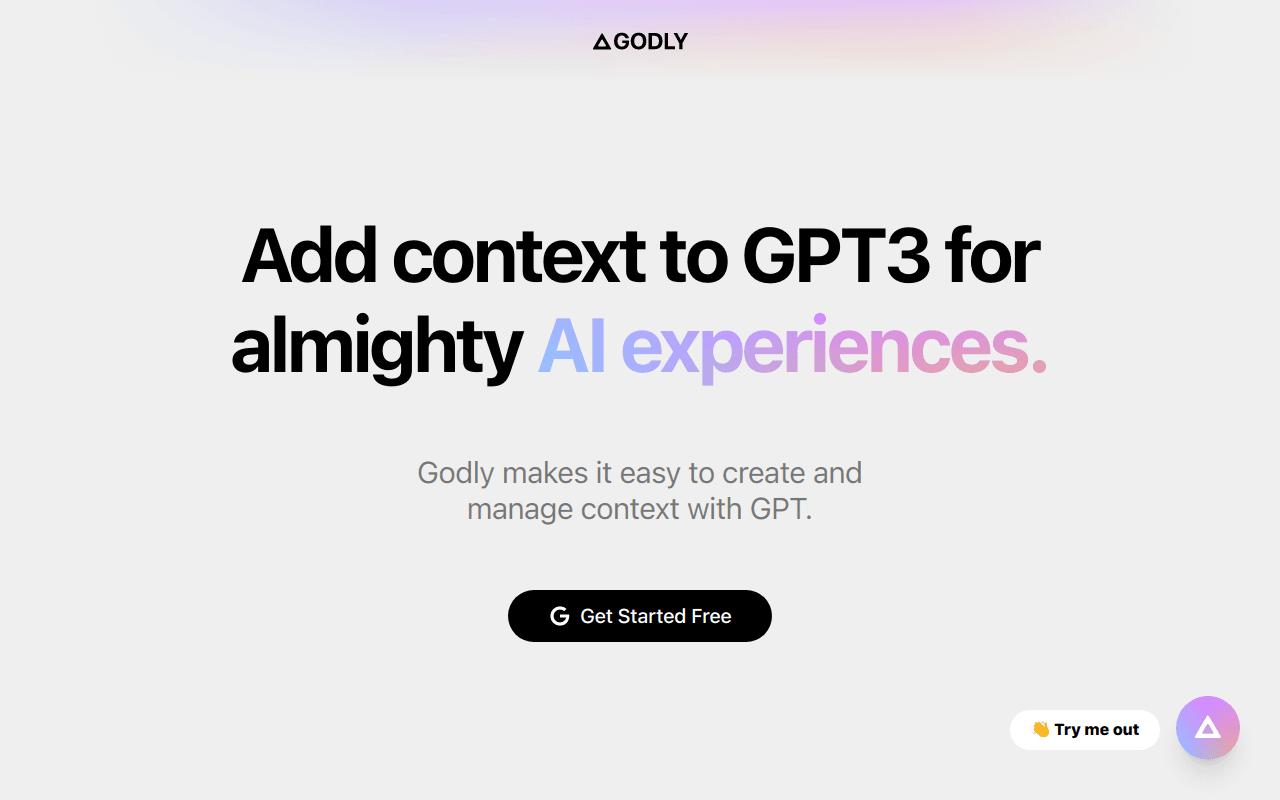
Godly was an AI tool that aimed to enhance the performance of GPT models by providing instant context to user prompts. Its core functionality was to magically append relevant information, thereby moving beyond generic AI responses to more personalized and accurate completions. The tool leveraged OpenAI's embedding model to achieve this contextual integration. However, as of 2023, Godly has been sunset, and its service is no longer operational. All functionality has been discontinued, and the website explicitly states that the service is no longer running.
FocusOnDepth
FocusOnDepth is an AI tool designed for depth estimation in images, hosted as a Hugging Face Space. While the tool aims to provide capabilities for analyzing and processing images to determine depth, it is currently experiencing runtime errors due to insufficient hardware capacity. This makes it unavailable for immediate use. When operational, it would be suitable for researchers and developers interested in image processing and AI model testing, particularly those working with depth perception in computer vision applications. The tool is free to use, making it accessible for experimentation and academic purposes.
llm-twin-course
llm-twin-course is a free educational resource designed to guide users through the process of building a production-ready Large Language Model (LLM) and Retrieval Augmented Generation (RAG) system. The course emphasizes LLMOps best practices, offering practical, hands-on lessons and accompanying source code. It covers the entire development lifecycle, from initial data gathering to the final stages of productionizing LLMs, with a specific focus on creating an AI replica.
FaceMyAI
FaceMyAI is an AI tool dedicated to generating highly realistic digital humans. These digital humans are equipped with advanced natural language processing capabilities and emotional intelligence, allowing for more natural and engaging interactions. The platform provides customizable digital assistants that can be tailored to specific needs. FaceMyAI operates on a subscription model and also offers licensing options for seamless enterprise integration. Its applications span across diverse sectors including customer service, education, healthcare, and entertainment, providing versatile solutions for businesses looking to leverage AI-powered digital human technology.
SquadGPT
SquadGPT is an AI-powered platform specifically designed to enhance and streamline the hiring process for businesses. It leverages artificial intelligence to automate key recruitment tasks, including the creation of job descriptions and the initial screening of candidates. The primary goal of SquadGPT is to improve the efficiency and reduce the costs associated with recruitment, making it a valuable tool for startups and established businesses alike. The platform operates on a token-based pricing model.
posenet-python
posenet-python is an open-source project offering a pure Python implementation of Google's TensorFlow.js PoseNet model, designed for real-time human pose estimation. This port focuses on multi-pose detection and includes significant performance optimizations over a literal translation of the original JavaScript code, achieving throughputs of 90-110fps on a GTX 1080+ with its 'fast' post-processing. It supports various MobileNet models and provides demo applications for image processing, performance benchmarking, and webcam integration. Developers can easily install it within a Python 3.x environment with TensorFlow, making it accessible for integrating real-time pose estimation into their projects.
Llama 3.1 70b Demo
Llama 3.1 70b Demo is an AI chatbot specifically designed for engaging in conversational tasks. Its core capabilities include advanced language understanding and efficient text generation. This tool can serve as a valuable educational resource, providing a platform for users to interact with and learn from an AI. It is offered to users at no cost.
wechat-bot
wechat-bot is an open-source WeChat robot designed to automate interactions and management within the WeChat platform. Built on the WeChaty framework, it integrates with multiple AI services including ChatGPT, Claude, Kimi, DeepSeek, and Ollama to provide intelligent and automated responses to messages. Beyond basic messaging, the bot assists with community analysis, helping users understand and manage their WeChat groups. It also includes features for friend management, such as detecting and identifying 'zombie fans' to help maintain a clean contact list.
Llama 2 7B Chat
Llama 2 7B Chat is an AI chatbot specifically developed for engaging in conversational tasks. Its core functionalities revolve around advanced language understanding and efficient text generation, making it suitable for various interactive applications. The tool is also positioned as a valuable educational resource, offering capabilities that can aid learning and exploration in AI and language processing. It is noted for being available at no cost.
AiDA Technologies Pte Ltd
AiDA Technologies Pte Ltd specializes in providing artificial intelligence and machine learning solutions tailored for the banking and insurance industries. Their technology is designed to ingest and process both structured and unstructured data, enabling financial institutions to leverage AI for improved operations and decision-making. AiDA's solutions are flexible, capable of deployment in either on-premise or cloud environments, catering to the specific infrastructure needs of their clients. They primarily serve tier-one customers in Asia, offering a pay-per-transaction pricing model.
Lama
Lama is an AI-powered tool available on Hugging Face that focuses on task automation. It enables users to streamline and automate a variety of tasks through artificial intelligence. The tool is provided as a free resource, making it accessible for a broad range of users. Its capabilities extend to areas such as content generation, where it can assist in creating various forms of content, and educational purposes, suggesting its utility in learning and teaching environments.
Vintern-1B-v2-Demo
Vintern-1B-v2-Demo is an accessible AI chatbot offered free of charge, primarily hosted on the Hugging Face platform. This tool serves as an excellent resource for educational exploration, enabling users to understand and interact with artificial intelligence. Beyond its educational utility, it also provides an entertaining experience for individuals curious about AI's capabilities and applications. It is particularly well-suited for users who are keen to delve into the world of AI and discover its various facets.
nerves
Nerves offers a comprehensive set of tools and libraries for developing and deploying embedded software using Elixir. It leverages the robust Erlang virtual machine and the Linux kernel to create small, self-contained software images for microprocessor-based systems. While not a full Linux distribution, Nerves integrates the Erlang runtime early in the boot process, allowing Elixir to manage the system. It supports a wide range of hardware, including various Raspberry Pi models and BeagleBone boards, and provides access to the Elixir ecosystem, including Phoenix, LiveView, Elixir Nx, and Livebook. Nerves also includes a C/C++ cross-toolchain for consistent builds across host platforms and offers modules for hardware access, networking, and SSH capabilities.
Rofunc
Rofunc is an open-source Python package designed for robot learning from demonstration and robot manipulation. It provides a comprehensive framework for developing and deploying advanced robot learning algorithms. The tool is hosted on GitHub, making it accessible for researchers and developers in the robotics field. Rofunc facilitates the entire workflow, from initial algorithm development to practical deployment, supporting various aspects of robot control and interaction. Its open-source nature encourages community contributions and collaborative development, making it a valuable resource for advancing robotics research and applications.
ML-GCN
ML-GCN is a PyTorch implementation of Multi-Label Image Recognition with Graph Convolutional Networks, as presented in a CVPR 2019 paper. This open-source project provides researchers and developers with the code and pre-trained models necessary to apply GCNs to multi-label image recognition tasks. The implementation highlights improvements achieved by replacing Global Average Pooling (GAP) with Global Max Pooling (GMP) for feature aggregation, demonstrating enhanced performance on datasets like COCO, NUS-WIDE, and VOC2007. It includes detailed instructions for setting up requirements, downloading models, and running demos for VOC 2007 and COCO 2014 datasets, making it a valuable resource for academic research and practical application in computer vision.
Llama TutorVerified
Llama Tutor is an AI-powered personal tutoring tool designed to provide customized learning experiences. Users can specify the subject matter they wish to learn and select their educational level, ranging from elementary to graduate studies. The tool then generates tailored lessons that adapt to the individual learner's pace and existing knowledge. Llama Tutor aims to make personalized education accessible and is fully open-source, allowing for community contributions and transparency.
Template Free Reconstruction of Human-object Interaction with Procedural Interaction Generation
HDM is an AI tool hosted on Hugging Face that specializes in the template-free reconstruction of human-object interaction. It leverages procedural interaction generation to achieve its results, making it a valuable resource for researchers and developers in the field of computer vision and human-computer interaction. The tool is designed to facilitate advanced studies and applications related to how humans interact with objects, offering a flexible and accessible platform for experimentation and development. Its availability as a free template on Hugging Face further enhances its utility for academic and research purposes.
ObjectDetection-OneStageDet
ObjectDetection-OneStageDet is an open-source object detection framework developed by Tencent, designed to provide a unified platform for single-stage generic object detectors. Currently, it supports YOLOv2 and YOLOv3 implementations, with future plans to integrate YOLO and SSD into a single framework. The tool emphasizes performance and speed, offering good mAP scores and fast inference times, especially with various efficient backbones like TinyYOLO, MobileNet, and ShuffleNet. It provides comprehensive instructions for installation, data preparation, training, evaluation, and benchmarking, making it suitable for developers and researchers working on object detection tasks.
cuvs
cuVS is an open-source library specifically designed to perform vector search and clustering operations directly on the GPU. This capability allows for significantly faster data analysis and accelerates various machine learning workflows. It provides a high-performance solution for tasks requiring efficient similarity search and data grouping, making it a valuable tool for professionals working with large datasets and complex models.