
AI Agents & Automation
Browsing page 602 of AI Agents & Automation. Sorted by confidence score — our independent quality rating.

GPT4oMini.app
GPT4oMini.app, operating under the name "Data Science in Libraries," is a project focused on equipping librarians and library administrators with the necessary skills and frameworks to leverage data science. The initiative highlights two primary challenges: a skills gap among mid-career librarians who lack coordinated data science education, and a management gap where administrators need strategic toolkits for data-driven decision-making. The platform aims to foster a community that contributes to developing and sustaining the National Digital Platform by thoughtfully applying data science in libraries. This project is supported by the Institute of Museum and Library Services grant number RE-43-16-0149-16.
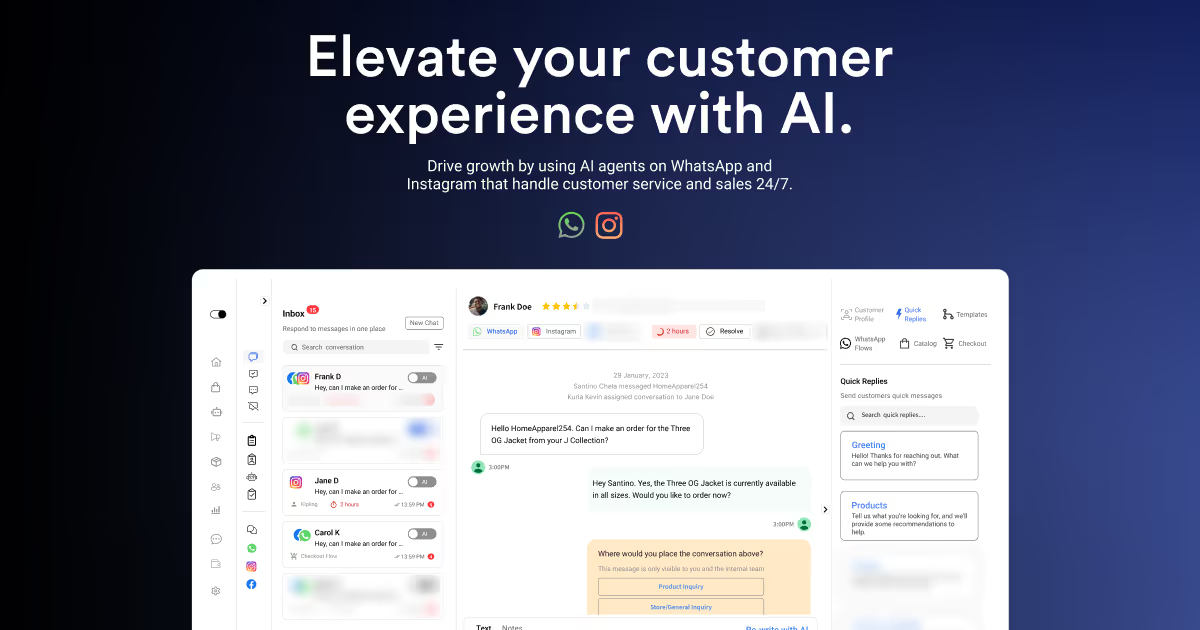
chpter.
chpter. is an AI-powered conversational commerce platform specifically designed to help businesses enhance their sales efforts on popular social media platforms. The tool automates key aspects of customer interaction, including conversations, marketing campaigns, and payment processing, directly within messaging apps like WhatsApp and Instagram. By leveraging AI agents, chpter. aims to significantly improve customer service efficiency and drive increased sales for businesses operating in the social commerce space.
deep-trading-agent
Deep-trading-agent is an open-source project that provides a Deep Reinforcement Learning based Trading Agent for Bitcoin. It leverages a DeepSense Network for Q function approximation, offering a robust framework for developing and testing algorithmic trading strategies. The tool is designed to maximize total accumulated rewards by allowing the agent to choose between neutral, long, and short positions for each trading unit. It includes functionalities for data preprocessing of Bitcoin price series, Docker support for easy setup and deployment, and integration with Tensorboard for logging and monitoring training progress. The project is suitable for researchers and developers interested in applying advanced AI techniques to financial markets.
Blue
Blue is a native macOS application that brings the power of ChatGPT directly to your desktop, allowing you to interact with AI models like GPT-4o and GPT-3.5 Turbo within any application. It features AppVision, which enables the AI to understand the context of what's on your screen, providing more relevant assistance without requiring you to copy and paste. Blue prioritizes user privacy, storing all data on-device, encrypting it with your Apple ID, and ensuring no data is used for model training. It is GDPR-compliant and designed for professional use, offering a secure and efficient way to leverage AI for tasks like coding, brainstorming, and report polishing.
Cross Image Attention
Cross Image Attention is an AI tool designed for analyzing and visualizing attention mechanisms between two images. It provides a platform for users to explore how different regions or features in one image relate to those in another. Built with Gradio, this tool is freely available on Hugging Face Spaces under the MIT license, making it accessible for a wide range of users. It is particularly useful for AI research and educational purposes, offering insights into complex AI models and their interpretability. The tool aims to facilitate a deeper understanding of how AI systems process and connect visual information across different inputs.
Florence 2
Florence 2 is an AI tool developed by HuggingFaceM4 that enables users to interact with images by asking questions. Users can upload an image and provide a text prompt to query the image, and the application will generate an answer based on the visual content and the contextual information given. This tool is designed for image-based question answering, allowing for a deeper understanding and extraction of information from visual data. It is offered as a free-to-use application, licensed under Apache-2.0, making it accessible for various applications including research and educational purposes.
robohive
RoboHive is a comprehensive, open-source framework designed to facilitate robot learning through a collection of simulated environments and tasks. Utilizing the MuJoCo physics engine, it offers a robust platform for developing and testing robot learning algorithms. The framework is exposed via the OpenAI-Gym API, ensuring compatibility with popular agent training frameworks such as Stable Baselines, RLlib, TorchRL, and AgentHive. RoboHive includes diverse suites like Hand-Manipulation, Arm-Manipulation, Myo-Suite for musculoskeletal control, and MultiTask Suite, covering a wide range of robotic challenges. It's an essential tool for researchers and developers in robotics and AI, providing standardized benchmarks and environments for advanced manipulation and control tasks.
Candle BERT Semantic Similarity Wasm
Candle BERT Semantic Similarity Wasm is an AI tool designed to identify semantic similarity within text using a BERT model. Users can input their own text or load existing content into the application. Once the text is provided, the tool allows for searching similar sentences, and it highlights the most semantically related sentences, making it easy to pinpoint relevant information. Built with Candle and Wasm technologies, this tool offers a straightforward way to analyze textual data for semantic relationships. It is hosted on Hugging Face Spaces and is available for free use, providing a practical solution for tasks requiring text comparison and understanding.
solon
Solon is an open-source Java enterprise application development framework designed for full-scenario development, emphasizing efficiency and openness. It boasts significant performance improvements, including 700% higher concurrency and 50% memory savings, with startup times 10 times faster than alternatives. The framework also achieves 90% smaller packaging sizes, making deployments more efficient. Solon is compatible with Java versions 8 through 25, supports LTS, and is presented as a replaceable alternative to Spring. Built from scratch, it offers flexible interface specifications and an open ecosystem, catering to developers looking for a high-performance, resource-efficient, and modern Java development solution.
friso
Friso is an open-source, high-performance Chinese tokenizer developed in ANSI C, utilizing the popular MMSEG algorithm. It offers robust support for both GBK and UTF-8 character sets, ensuring broad compatibility. Designed with modularity in mind, Friso can be seamlessly integrated into various applications, including MySQL, PostgreSQL, and PHP. The tool provides four distinct segmentation modes: simple, complex, detect, and maximum, catering to different performance and accuracy requirements. Additionally, Friso includes advanced features such as keyword, key phrase, and key sentence extraction based on the TextRank algorithm, along with support for custom dictionaries, simplified/traditional Chinese conversion, and mixed English/Chinese word recognition. It also offers plugins for PHP5, PHP7, OCaml, and Lua, making it a versatile solution for Chinese text processing.
Dumbbell AI
Dumbbell AI is an innovative AI tool designed to personalize fitness routines and help users achieve their health and fitness goals more effectively. By analyzing individual performance data, the platform provides intelligent recommendations to optimize workouts. It focuses on data-driven guidance, ensuring continuous improvement and tailored exercise plans. This approach helps individuals maximize their training efficiency and progress, making fitness more accessible and effective for a wide range of users. The tool aims to simplify the process of creating and adjusting workout regimens, leveraging AI to adapt to user needs and performance.
BuzzWork
BuzzWork.ai is presented as a premium domain for sale through Atom, a marketplace specializing in expert-curated, brandable domains. The platform emphasizes secure transactions, guaranteeing transfers and holding payments until delivery is confirmed. It offers fast domain transfers, often within hours, and flexible payment options including full payment via credit card, crypto, or wire transfer, or installment plans with an immediate start to using the domain. Atom also provides various domain services, including AI naming contests, domain appraisal, and a domain name generator, alongside trademark and logo design services.
BLUE FROG ROBOTICS
BLUE FROG ROBOTICS specializes in social robotics, developing human-centered solutions like Buddy, an emotional companion robot. Buddy is designed to foster connection, promote inclusion, and support educational, medical, and professional applications. It serves various sectors, including assisting hospitalized students, supporting seniors in nursing homes, enhancing business reception, and promoting social inclusion. The robot features an open and scalable platform with an Android SDK, allowing developers to create custom applications, integrate third-party services, and design interactive experiences tailored to specific needs. This adaptability makes Buddy a versatile tool for schools, retirement homes, and businesses seeking innovative robotic solutions.
EasyNMT
EasyNMT is a powerful and user-friendly open-source package designed for state-of-the-art neural machine translation across more than 100 languages. It simplifies the process of machine translation with its easy installation and usage, requiring only a few lines of code to get started. Key features include automatic download of pre-trained models, translation between over 150 languages, automatic language detection for 170+ languages, and support for both sentence and document translation. The tool also offers multi-GPU and multi-process translation capabilities, making it efficient for various workloads. EasyNMT integrates models like Opus-MT, mBART50_m2m, and M2M_100 from Facebook Research, providing a wide range of translation directions and model sizes to suit different needs.
Mozilla Firefox is getting a free built-in VPN, with a catch
Mozilla Firefox is enhancing its browser with a free, built-in VPN service, set to roll out with version 149. This feature allows users to route their browser traffic through a Mozilla proxy, effectively hiding their IP address and location for stronger privacy and protection online. The service is designed to be straightforward, requiring no extra downloads, and will initially be available in the US, France, Germany, and the UK. While it offers a respectable 50GB of data per month, ideal for casual browsing and accessing geo-blocked content, Mozilla has not specified the exact consequences of exceeding this limit. This initiative aims to provide a trustworthy VPN solution from a reputable company, addressing common privacy concerns associated with many free VPN offerings.
openai-cookbook
OpenAI-cookbook is an open-source repository offering a collection of examples and guides designed to help developers effectively use the OpenAI API. It provides practical code samples, primarily in Python, along with clear instructions for accomplishing common tasks and integrating OpenAI's powerful AI models into various applications. The cookbook serves as a valuable resource for understanding API functionalities, exploring different use cases, and accelerating development with OpenAI's technologies. Users need an OpenAI account and API key to run the examples, which can be set via an environment variable or an .env file.
Trading-Gym
Trading-Gym is an open-source project designed for the development and testing of reinforcement learning algorithms within the context of financial trading. It offers a flexible environment, currently featuring a SpreadTrading environment, which allows users to trade spreads based on bid and ask price time series for multiple products. A key feature is its generic data feeding mechanism, enabling users to create custom DataGenerators to input diverse price data. The environment's state includes prices, entry price, and position (long, short, or flat). Trading-Gym's API is inspired by OpenAI Gym, aiming for full compatibility to integrate as an additional OpenAI environment, making it accessible for researchers and developers familiar with the OpenAI Gym framework.
YOLOv6
YOLOv6 is a robust, single-stage object detection framework specifically designed for industrial applications. It offers a comprehensive suite of models, including YOLOv6-N, YOLOv6-S, YOLOv6-M, and YOLOv6-L, with varying performance and computational requirements. The framework supports object detection, segmentation, and face detection, with specialized models like YOLOv6-Segmentation and YOLOv6-Face. It also provides optimized models for mobile and CPU deployment, such as the YOLOv6Lite series, making it versatile for different hardware environments. YOLOv6 emphasizes ease of use with quick start guides for installation, training on custom datasets, evaluation, and inference. It also supports various deployment options including ONNX, OpenVINO, TensorRT, and NCNN, catering to diverse industrial needs.
SFA3D
SFA3D is an open-source PyTorch implementation designed for super fast and accurate 3D object detection using LiDAR point clouds. It features an anchor-free approach, eliminating the need for Non-Max-Suppression, which contributes to its speed. The tool supports distributed data parallel training, making it suitable for large-scale applications, and includes pre-trained models for immediate use. SFA3D is particularly relevant for autonomous driving and robotics, as highlighted by its use in the Udacity Self-Driving Car Engineer Nanodegree Program. It also offers ROS source code integration for robotics applications and provides detailed technical documentation and demonstration capabilities.
CharacterFactory
CharacterFactory is an innovative AI tool hosted on Hugging Face Spaces, designed to generate consistent character images across various scenes and ages. Users can input multiple short prompts, one per line, to guide the AI in creating a series of unique pictures featuring the same individual. This allows for the development of a character's visual narrative, from different environments to various life stages. The tool offers the flexibility to either initiate a completely new character concept or build upon an existing one, making it versatile for creative projects, storytelling, or visual development. It's an accessible platform for anyone looking to visualize characters with consistency and ease.
Lomdi
Lomdi, established in 1999 and listed in Shanghai in 2020, is a prominent manufacturer in the industrial electrical field. The company focuses on a comprehensive range of products including low-voltage power distribution equipment, industrial control appliances, and intelligent meters. Lomdi's solutions cater to diverse industries such as power generation, new energy, and manufacturing, providing essential components for various electrical systems. Their product catalog spans from circuit breakers and relays to transformers and complete high/low voltage switchgear assemblies, ensuring robust and reliable electrical infrastructure for their clients.
Clinity - AI Health Companion
Hello Health Group is building Emerging Asia’s leading Digital Health Ecosystem, empowering millions of people to live healthier and happier lives. With over 25 million unique monthly users and 50 million monthly page views, the platform offers over 100,000 pieces of medically reviewed, relevant, and engaging content. Operating 9 platforms across 8 markets in local languages, Hello Health Group is a leader in health and wellness content development to drive consumer patient engagement. They partner with clients to provide innovative solutions for business and digital marketing challenges, connecting them with highly engaged audiences at meaningful points in their health and wellness journey to drive engagement, participation, and conversion.

DatologyAI
DatologyAI is an advanced Data & Analytics platform designed to automatically curate and optimize training data for AI models. Leveraging cutting-edge research, it helps organizations train high-performing models more efficiently, reducing both time and computational costs. The platform addresses common issues like low-quality training data and the impossibility of manual data review at petabyte scale by automatically identifying and prioritizing the most valuable data points. This leads to faster model training, improved performance, and the ability to deploy smaller, more cost-effective models in production. DatologyAI offers data curation as a service, aiming to improve model performance, reduce deployment costs, and increase overall speed.
DiMeR Demo
DiMeR Demo is an AI tool hosted on Hugging Face that specializes in generating 3D models and meshes from either text descriptions or uploaded images. Users can input a text prompt or provide an image, and the application will process it to create a detailed 3D asset. This generated model can then be viewed directly within the application and downloaded for further use. The tool is presented as a demonstration, indicating its purpose is to showcase and allow interaction with its AI capabilities in 3D content creation.