
AI Agents & Automation
Browsing page 462 of AI Agents & Automation. Sorted by confidence score — our independent quality rating.
Klu
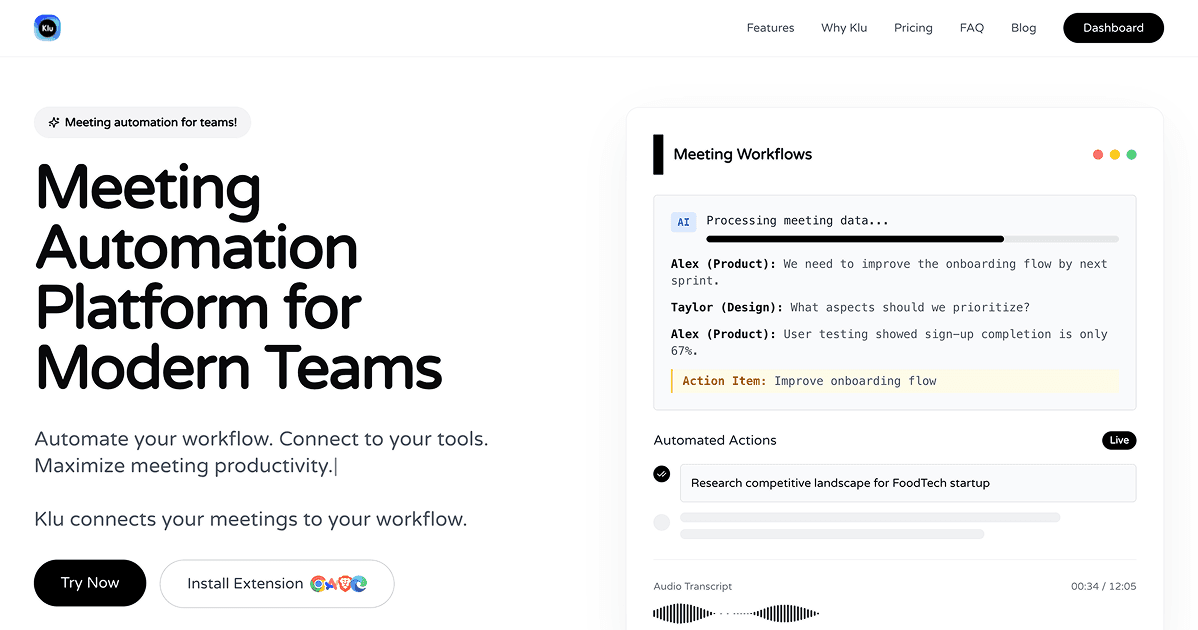
Klu is a meeting automation platform designed to enhance productivity for modern teams. It focuses on automating workflows and integrating with existing tools to streamline meeting management. The platform aims to help users take meeting notes with no effort, suggesting a focus on efficiency and ease of use. By connecting to various tools, Klu seeks to centralize meeting-related tasks and information, ultimately leading to more productive team interactions. Its core offering appears to be around simplifying the often-tedious aspects of meetings, allowing teams to concentrate on core discussions and decisions.

UpCat
UpCat is an AI assistant designed for Upwork freelancers, streamlining the application process by generating personalized proposal cover letters and delivering real-time job alerts. Operating as a browser extension for Chrome, Brave, Edge, and Opera, it allows freelancers to draft, review, and apply directly from the Upwork job post. UpCat helps users create relevant cover letters based on job descriptions, avoiding generic responses, and enables them to edit and personalize each draft before submission. Its real-time job alerts ensure freelancers discover matching opportunities sooner, giving them an advantage in a competitive marketplace and helping them make the most of their Upwork Connects.

Meeting Assistant Flow
Meeting Assistant Flow is an open-source project built on the crewAI framework, designed to streamline the entire meeting lifecycle. It automates critical tasks such as loading meeting notes from a text file, generating actionable tasks from meeting transcripts using AI agents, and integrating these tasks with Trello for project management. Additionally, it saves new tasks to a CSV file and sends Slack notifications to keep teams informed. This flow leverages multiple AI agents to handle different aspects of the meeting workflow, offering a modular and efficient solution for automating meeting management processes. Users can customize agents, tasks, and the flow itself to fit specific organizational needs.
DeepCL
DeepCL is an open-source OpenCL library designed for training deep convolutional neural networks. It offers C++, Python, and command-line APIs, allowing developers to implement and train deep learning models efficiently. The library supports various layer types including convolutional, max-pooling, normalization, activation, and dropout, alongside loss functions like softmax cross-entropy and square loss. DeepCL also incorporates multiple trainers such as SGD, Anneal, Nesterov, Adagrad, Rmsprop, and Adadelta. It is compatible with OpenCL-enabled GPUs or APUs and provides installation procedures for Windows and Linux, including Python wrappers. The project is actively maintained on GitHub, with recent updates focusing on compatibility and performance enhancements.

Noah
Tavrn is an AI case preparation platform designed for personal injury law firms, offering a suite of tools to streamline legal workflows. It provides AI-powered client intake to assess case value and extract critical facts, medical record retrieval to manage requests and obtain records efficiently, and medical chronologies that transform dense medical records into structured summaries in under 24 hours. Additionally, Tavrn generates accurate and tailored demand letters by pulling directly from medical records and case facts, and its eDiscovery engine streamlines document review by automatically tagging and extracting relevant content, cutting review time by up to 80%.
Genesy
Enginy, formerly Genesy, is an AI-native sales platform designed for B2B and Go-To-Market teams to accelerate pipeline growth. It automates the entire sales process from finding prospects to booking meetings. Users can describe their Ideal Customer Profile (ICP) to generate lists of qualified prospects with verified data. The platform enriches lead data from over 30 sources, provides AI-powered deep research, and tracks intent signals like job changes or tech stack updates. Enginy also enables personalized, multi-channel outreach campaigns across email and social media, with AI-generated messages and smart inbox management that prioritizes replies and drafts responses.

Harpy Chat
Harpy Chat is a free AI character chat platform designed for interactive conversations, roleplay, and storytelling. Users can chat with thousands of existing AI characters or create their own unique personalities. The platform supports both 1-on-1 chats and group chats with multiple AI characters, fostering dynamic and engaging interactions. It emphasizes community, allowing users to join and share their creations. Harpy Chat aims to provide an accessible and versatile environment for anyone interested in AI-driven character interaction and narrative creation.

Hebbia
Hebbia is a leading AI platform purpose-built for the finance industry, trusted by top asset managers, investment banks, law firms, and Fortune 500 companies. It offers institutional intelligence to support high-stakes decisions by enabling users to reason over limitless context and uncover insights from private documents, public filings, and leading financial data providers. The platform facilitates enterprise collaboration, allowing teams to share context and build institutional knowledge. Hebbia automates workflows by encoding firm processes to run continuously, and connects various data sources like Snowflake, Amazon AWS S3, FactSet, and S&P Capital IQ. It is designed for high finance, processing billions of pages and handling hundreds of thousands of prompts daily, while maintaining enterprise-grade security with ISO, SOC2 II, and GDPR compliance.

Innerly
Innerly is an AI companion designed for personal reflection and growth, offering a safe space for users to express themselves freely through natural conversation. It listens without judgment, summarizes insights, and helps identify patterns in thoughts and emotions over time. The tool supports various input methods, including writing, talking, or venting, and ensures reflections are organized without disrupting the user's flow. Innerly prioritizes privacy with biometric authentication options and seamless syncing across iOS, macOS, and web devices, making personal journaling accessible and secure from anywhere.
LightGBM
LightGBM is a powerful and efficient open-source gradient boosting framework developed by Microsoft. It utilizes tree-based learning algorithms to deliver faster training speeds, higher efficiency, and lower memory usage compared to other boosting frameworks. LightGBM supports parallel, distributed, and GPU learning, making it capable of handling large-scale datasets effectively. It is widely used for various machine learning tasks including ranking, classification, and other predictive modeling. The framework is known for its accuracy and ability to achieve linear speed-up with multiple machines for training in specific settings. It provides extensive documentation, examples, and supports automated tuning through tools like FLAML and Optuna.

Cogent
Cogent is an AI-driven learning platform designed to enhance the study process for students. It offers a variety of tools including interactive flashcards, AI-generated exams, and a File Chat feature that allows users to ask questions and get personalized responses from their uploaded files. Students can create flashcards from text documents or notes, and the AI-Exams feature generates realistic exam questions and provides feedback on errors. The platform aims to help students learn smarter and faster by instantly creating study materials, fostering collaboration, and providing deep features to master subjects.
llama-dl
llama-dl offers a high-speed method for downloading Facebook's LLaMA 65B parameter GPT model, including all its various model weights (7B, 13B, 30B, 65B). This tool was created to provide a faster alternative to torrent downloads, achieving speeds of up to 40MB/s and completing the download in under two hours on a Chicago Ubuntu server. It utilizes a direct download link that was originally leaked, and the script has been updated to mirror the content to R2 after the original link was shut down. The project emphasizes accessibility for researchers and hackers to experiment with large language models, providing a convenient way to obtain the LLaMA model for personal use and research, while also addressing concerns about its licensing and potential commercial use.
Jobright
Jobright is an AI-powered job search copilot designed to streamline and enhance the job application process. It offers personalized AI job matching, ensuring users see opportunities truly aligned with their skills and qualifications, free from fake listings. The platform features a 1-Click Application Autofill, allowing users to apply to numerous jobs daily across major ATS platforms, saving up to 80% of their time. Jobright also provides a job-specific tailored resume builder that crafts professional, ATS-compliant resumes in seconds. Additionally, it facilitates insider referrals by connecting users with alumni and hiring managers, potentially increasing interview chances by 4X. A 24/7 AI Career Copilot offers personalized guidance throughout the job search and interview preparation.
text-summarization-tensorflow
text-summarization-tensorflow is an open-source project providing a TensorFlow implementation of text summarization. It utilizes a seq2seq library with an encoder-decoder model, incorporating an attention mechanism for improved performance. The tool initializes word embeddings using Glove pre-trained vectors and employs LSTM cells for both encoding and decoding processes. It supports training with custom datasets and offers options for configuring hyperparameters such as network size, depth, beam width, and learning rate. Users can also test the model with pre-trained weights and evaluate performance using ROUGE metrics. This tool is ideal for researchers and students looking to understand and experiment with text summarization techniques.

v-Lawyer
v-Lawyer is an AI-powered legal assistance platform designed to help individuals confidently navigate everyday legal problems. The tool offers AI-powered workflows, professional templates, and step-by-step guidance across various common legal areas. Users can get assistance with disputes, refunds, contracts, employment issues, and family matters. The platform aims to simplify complex legal processes, making legal support more accessible. It provides a user-friendly interface to manage legal concerns, offering initial free messages to explore its capabilities before requiring sign-in for unlimited access.
PowPow
PowPow is an AI-powered platform offering a diverse range of specialized AI agents designed to assist users with specific topics and questions. These agents are trained across various domains, including technology, science, travel stories, and even fun topics like folk tales. The platform supports a wide array of languages, such as English, Spanish, Chinese, and many others, ensuring broad accessibility. Users can explore agents for general inquiries, like those related to Bitcoin, or more niche interests, such as Thai folk tales. PowPow aims to provide efficient and relevant information retrieval through its friendly AI agents.
PriviNet
PriviNet delivers advanced AI-driven IoT solutions, focusing on unbreakable connectivity and privacy-first intelligence. Its core technology, Lumra AI™, processes diverse data streams, including visuals and audio, to provide actionable, verifiable evidence from sensitive and remote environments. This transforms ambiguous alerts into trusted intelligence for applications ranging from in-home safety with Scout I to industrial asset monitoring with Scout X. Lumra AI enables low-power IoT devices to perform sophisticated analytics, optimizing resource use, reducing operational costs, and ensuring data integrity with advanced security protocols like encryption and blockchain. PriviNet's solutions are scalable and applicable across smart cities, precision agriculture, logistics, healthcare, airports, and environmental projects, driving innovation and improving quality of life.
susi_gassistantbot
susi_gassistantbot is an open-source project designed to integrate SUSI AI with Google Assistant, enabling developers to create custom voice-controlled applications and AI agents. The project provides a framework for building functionalities on Google Assistant using the SUSI AI platform. It requires setting up a project on Google's Actions console, configuring API.AI (now Dialogflow) with intents and webhooks, and deploying the application to a platform like Heroku. This tool is ideal for developers looking to extend Google Assistant's capabilities with custom AI logic from SUSI, offering a flexible way to build interactive voice experiences.
Tapway
Tapway is a no-code computer vision AI platform designed to automate visual inspection and enable real-time actions across various industries. It harnesses Vision AI to convert video feeds and images into actionable intelligence, driving business growth. The platform allows users to capture real-time visual data using existing cameras, automatically detect patterns, anomalies, and compliance issues, and instantly trigger automated alerts or actions. Tapway offers products like SamurAI for end-to-end Vision AI, VehicleTrack for automatic car plate recognition and vehicle profiling, and PeopleTrack for analyzing customer traffic and behavior. Its applications span plate number recognition, optical character recognition, fruit counting and classification, footfall tracking, PPE compliance detection, and quality inspection.
Askruit
Askruit is an AI-powered video interview platform specifically designed for HR professionals and recruiters. Its primary function is to streamline the candidate screening process by automating video interviews. This tool helps organizations efficiently assess candidates, reducing the time and effort traditionally associated with initial screening stages. It caters to both startups and larger organizations aiming to enhance and optimize their recruitment workflows.
tacotron
Tacotron is a TensorFlow-based open-source project providing an implementation of the Tacotron text-to-speech synthesis model. It enables developers and researchers to train and experiment with fully end-to-end speech synthesis. The tool supports multiple speech datasets, including the LJ Speech Dataset, Nick Offerman's Audiobooks, and the World English Bible, offering flexibility for different training needs. It provides a well-documented framework, outlining requirements, data preparation steps, training procedures, and sample synthesis. Key features include gradient clipping, Noam style warmup and decay, and bucketed training batches, making it a robust platform for advanced speech synthesis research and development.
faster-rnnlm
faster-rnnlm is an open-source toolkit designed for efficient recurrent neural network language modeling. It aims to train on massive datasets (billions of words) and very large vocabularies (hundreds of thousands) for real-world Automatic Speech Recognition (ASR) and Machine Translation (MT) problems. The toolkit incorporates advanced setups like ReLU+DiagonalInitialization, GRU, Noise Contrastive Estimation (NCE), and RMSProp to achieve better results and faster training. It boasts impressive speed, processing over 250k words per second on a 3.3GHz CPU with standard parameters, making an epoch take less than an hour. The toolkit supports various hidden layer types and offers both Hierarchical Softmax and NCE for output layers, with NCE being particularly effective for large vocabularies as its speed is independent of vocabulary size.

SmartNotes AI
SmartNotes AI is an AI medical scribe designed to unburden healthcare professionals from manual note-taking. It transforms live patient conversations into structured SOAP Notes, patient summaries, and automated billing codes (CPT, ICD-10, HCPC) in real-time. The tool is HIPAA-compliant, encrypted end-to-end, and integrates seamlessly with major EMR systems like Athenahealth, Epic, and eClinicalWorks, allowing one-click note pushing. SmartNotes AI acts as a virtual AI physician assistant, offering pre-visit context, mid-visit prompts, and post-visit task suggestions. It supports multiple languages and is accessible across web, mobile, and desktop platforms, aiming to reduce documentation time and improve billing accuracy.
tflite_gles_app
tflite_gles_app offers GPU-accelerated deep learning inference applications, leveraging TensorFlow Lite GPU Delegate and TensorRT for enhanced performance. This open-source project is designed for platforms such as Raspberry Pi, NVIDIA Jetson, and Linux PCs. It includes a variety of applications covering tasks like lightweight and high-accuracy face detection (Blazeface, DBFace), age and gender estimation, image classification, object detection, 3D facial surface geometry estimation (Facemesh), hair segmentation, 3D handpose estimation, iris detection, 3D object detection, various pose estimations (Blazepose, Posenet), 3D human pose estimation, depth estimation, semantic segmentation, face segmentation, selfie-to-anime transformation, artistic style transfer, and text detection. The repository provides detailed instructions for building and running applications on different target environments, supporting both live camera and recorded video file inputs.