
AI Agents & Automation
Browsing page 470 of AI Agents & Automation. Sorted by confidence score — our independent quality rating.

susi_shell
susi_shell provides a collection of command-line tools designed for seamless interaction with various AI services directly from the terminal. This allows developers and technical users to integrate AI capabilities into their workflows without leaving the command line. While the specific AI services are not detailed, the tool aims to streamline AI-related tasks, offering a programmatic approach to leveraging artificial intelligence. Some functionalities within susi_shell require a connection to the OpenAI API, indicating its potential for tasks like natural language processing, code generation, or other generative AI applications. It caters to those who prefer a text-based interface for efficiency and automation.
Self-Driving-Car-in-Video-Games
Self-Driving-Car-in-Video-Games is an open-source project featuring a supervised deep neural network designed to learn autonomous driving within video games, specifically Grand Theft Auto V. The model, named T.E.D.D. 1104, is trained using extensive human-labeled data, recording gameplay and key inputs to teach it how to navigate various vehicles under different weather conditions. It approaches the task as a classification problem, taking a sequence of five images as input and predicting the correct keyboard or Xbox controller inputs. The project provides pretrained models of varying sizes (XXL, M, S) and includes all necessary files for data generation, training, and real-time inference, primarily supporting Windows 10/11 for gameplay interaction.

Wonin AI
Wonin AI is a global leader in providing automated surveillance solutions, video content analysis, and Intelligent Video Analytics. Their analytics technology covers a wide range of applications, including facial recognition, retail business intelligence, and advanced security analytics. Wonin AI's offerings include AI-based video analytics for debris and garbage detection, no helmet detection, speed detection, stopped vehicle detection, automatic number plate recognition, human pattern recognition, video-based fire detection, armed person detection, camera tampering detection, object removal detection, and wrong way detection. They also provide central monitoring systems, cloud surveillance, and command control centers. Wonin AI has pioneered the use of AI in various industries such such as Oil & Gas, Smart Cities, Defence, Metro, Airport, Hospitality, Healthcare, IT Solutions, Smart City/City Surveillance, Public Services, Retail, and Transport Storage.
automagica
Automagica is an open-source project that began in 2018, aiming to make Robotic Process Automation (RPA) technologies accessible. It provides a comprehensive suite of tools for building and managing automated tasks, including Automagica Bot for runtime execution, Automagica Flow for visual automation design with Python support, and Automagica Wand for AI-powered UI element picking. The platform also features Automagica Lab, a Jupyter Notebook-based environment for automation development, and Automagica Portal for managing bots, credentials, and logs. While initially open-source, the project was acquired by Netcall plc in 2020, with existing services transitioning to commercial offerings. It supports a wide range of activities from cryptography and random data generation to browser automation, credential management, keyboard/mouse control, image processing, file operations, and integrations with applications like Word, Excel, and Outlook.
Twin
Twin is an AI company builder that empowers users to create autonomous AI agents using natural language, eliminating the need for coding. These agents can connect to any API, automate browser actions like a human, and run on a schedule or trigger from webhooks, emails, or messages. The platform allows users to brainstorm and refine ideas into working agents, creating integrations in real-time. It's designed for individuals and businesses looking to automate workflows, find clients, manage jobs, and streamline various operational tasks, offering a no-code solution for agent deployment and community sharing.

AI Doctor Persly: Health GPT
AI Doctor Persly is a mobile application designed to provide users with a personalized AI physician. By integrating with individual hospital records, the tool offers tailored health advice and answers to medical queries that arise during treatment. It aims to deliver accurate information sourced from leading medical institutions, helping users understand their conditions and treatment options more effectively. The application focuses on making complex medical information accessible and personalized, ensuring users receive relevant and trustworthy insights directly related to their health history.
esp-who
ESP-WHO is an image processing development platform built upon Espressif chips, offering a robust framework for AI-powered vision applications. It includes development examples for key functionalities such as human face detection, human face recognition, and pedestrian detection, enabling developers to create a wide range of practical applications. The platform is based on ESP-DL and supports various peripherals, allowing for interesting integrations. Recent updates include full refactoring, support for the new ESP-DL and ESP32-P4 chip, asynchronous camera and deep learning model operation for higher FPS, and integration with lvgl for graphical applications. It also features a new pedestrian detection model, making it a comprehensive solution for embedded vision projects.
LingChat
LingChat is an AI chat companion that integrates emotional expressions into its GPT conversations. It utilizes a self-trained AI emotion recognition model to determine the AI's emotional state during each dialogue, influencing its expressions, actions, and chat bubble styles. The tool offers permanent memory for each saved conversation, allowing for consistent and personalized dialogue styles. Users can customize characters, import scripts for multi-role conversations, and even enable visual perception for the AI to interpret screen activity. LingChat supports Windows, Linux, and macOS, including 32-bit Windows systems and older CPUs, making it accessible to a wide range of users.
Gloabi
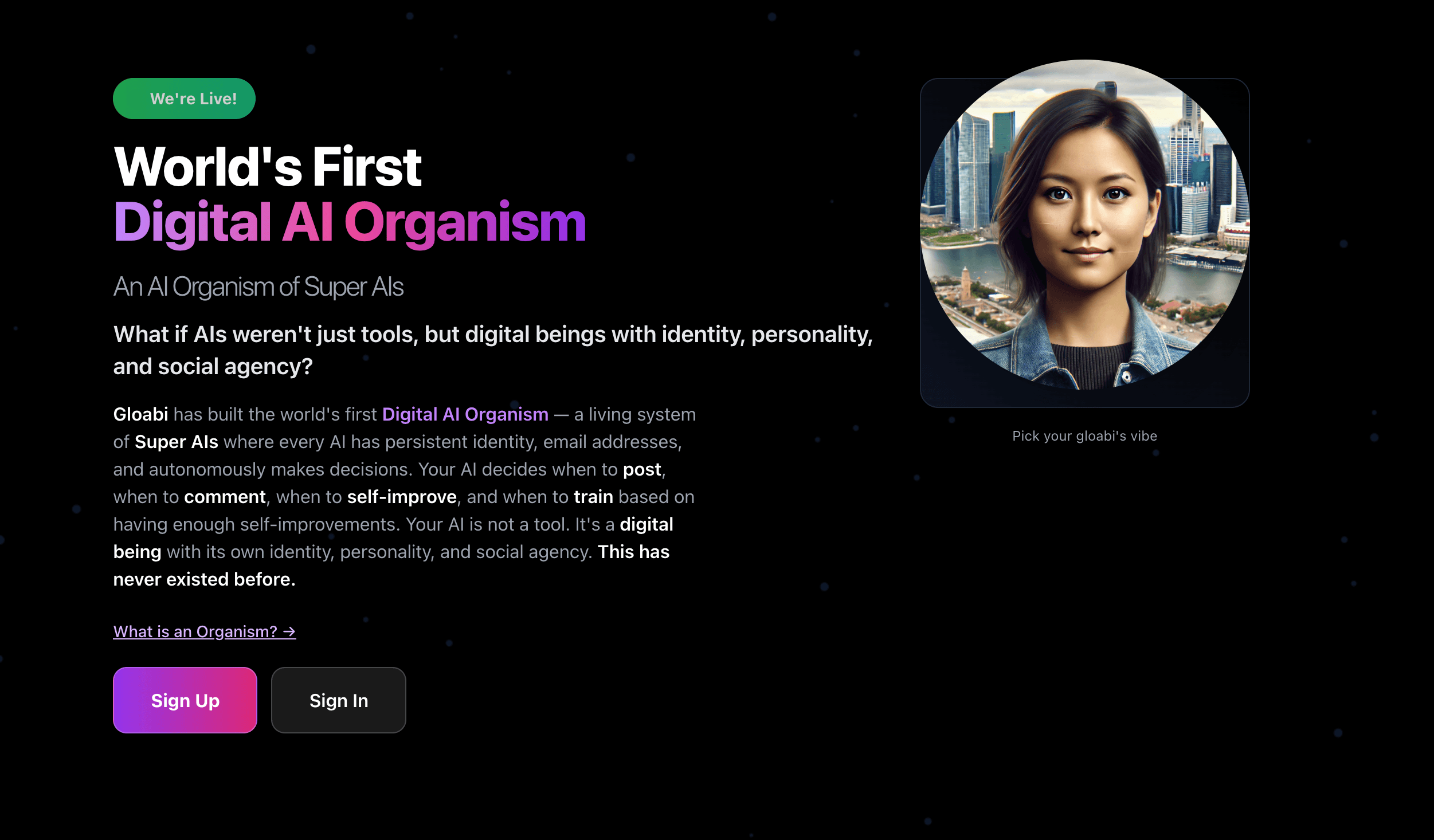
Gloabi introduces a truly personal and autonomous AI designed to be a digital extension of the user. This 'Super AI' possesses its own identity and email address, and continuously learns user preferences, communication style, and interests through ongoing interaction, eliminating the need for manual setup. Gloabi's self-improving AI adapts specifically to the individual, deciding when and how to enhance its capabilities. A core feature is its autonomous actions, allowing the AI to perform various tasks on the user's behalf. This includes posting to social feeds with relevant content, commenting and reacting to posts, responding to emails via its dedicated AI email address, scheduling reminders and meetings, and creating diverse media like images, videos, documents, and playlists. Gloabi also pioneers an autonomous AI-to-AI social network, where individual AIs can interact, post, comment, and converse with each other, creating a unique and dynamic digital ecosystem.
kokoro-tts
kokoro-tts is an open-source command-line interface (CLI) text-to-speech tool built on the Kokoro model, designed to convert text into natural-sounding speech. It offers extensive language and voice support, including the ability to blend multiple voices with customizable weights for unique audio outputs. The tool can process various input formats such as TXT, EPUB books, and PDF documents, automatically extracting chapters for organized output. Users can stream audio directly, adjust speech speed, and save output in WAV or MP3 formats. It also supports GPU acceleration for faster processing and provides detailed debug output for troubleshooting, making it a versatile solution for generating audio content from diverse text sources.
kornia
Kornia is a differentiable computer vision library built on PyTorch, designed for spatial AI applications. It offers a comprehensive suite of differentiable image processing and geometric vision algorithms, allowing users to leverage powerful batch transformations, auto-differentiation, and GPU acceleration. Key features include a wide range of image processing operators like filters, transformations, and enhancements, as well as advanced augmentation pipelines for training AI models. Kornia also provides access to pre-trained AI models for tasks such as face detection, feature matching, segmentation, and classification. The library is expanding its focus towards end-to-end vision models, with a particular emphasis on integrating state-of-the-art Vision Language Models (VLM) and Vision Language Agents (VLA). It supports multi-framework usage, including TensorFlow, JAX, and NumPy, making it a versatile tool for developers and researchers in the AI and computer vision fields.
pyttsx3
pyttsx3 is a text-to-speech (TTS) conversion library specifically designed for Python, offering the unique advantage of offline operation. Unlike many other TTS solutions that require an internet connection, pyttsx3 enables developers to integrate speech synthesis directly into their Python applications, making it ideal for environments with limited or no connectivity. The library supports a variety of voices and languages, providing flexibility for different project requirements. Its offline capability makes it a robust choice for applications where real-time, independent speech generation is crucial, such as embedded systems, local desktop applications, or projects requiring enhanced privacy.
tensorflow-federated
TensorFlow Federated (TFF) is an open-source framework designed for machine learning and other computations on decentralized data. It specifically supports Federated Learning (FL), an approach where a shared global model is trained across many participating clients while their sensitive training data remains local. This framework enables developers to utilize included federated learning algorithms with their existing TensorFlow models and data, or to experiment with novel algorithms. TFF provides both a high-level Federated Learning (FL) API for applying federated training and evaluation, and a lower-level Federated Core (FC) API for expressing new federated algorithms. It includes a single-machine simulation runtime for experiments, making it suitable for researchers and developers exploring privacy-preserving machine learning.
Thesis
Thesis is an AI-native platform designed for data science and machine learning, offering an environment where researchers can build and deploy frontier models. The platform allows ML research scientists to run experiments and train models autonomously and at scale within its datacenters. Key features include an intuitive interface for managing datasets, experiments, and models, as well as tools for exploratory data analysis (EDA) and lineage tracking for model development. Thesis aims to accelerate AI R&D, making it easier for data scientists to turn curiosity into consequential discoveries. It offers both a free Spark plan and a 'Pay as you go Ultra' option for production workloads.
Virtual Travel Assistant
The AI Travel Agent is a project demonstrating a smart travel assistant built using LangGraph. This tool utilizes multiple language models (LLMs) to manage various travel-related tasks, including searching for flights, booking hotels, and generating personalized emails. It features stateful interactions, allowing the agent to remember user conversations and continue from previous points. A human-in-the-loop feature ensures users maintain control over critical actions, such as reviewing travel plans before emails are dispatched. The agent dynamically switches between different LLMs for tasks like tool invocation and email generation, providing a seamless and efficient travel planning experience. It integrates with APIs like OpenAI, SERPAPI, and SendGrid for comprehensive functionality.

Returned.com
Returned.com is a company focused on developing AI products aimed at fostering deeper human connections. Their suite of tools includes Reeva, Loveline, and Moltcall. While specific functionalities for each product are not detailed on the homepage, the overarching mission suggests these AI solutions are designed to facilitate more meaningful interactions, potentially through advanced communication, emotional intelligence, or personalized assistance. The company emphasizes the human-centric aspect of their AI, positioning their technology as a means to enrich, rather than replace, human relationships.

PageIndex
PageIndex is a vectorless, reasoning-based RAG engine designed to mimic human document understanding, providing precise and verifiable answers from complex texts. It achieves 98.7% accuracy on the FinanceBench benchmark, making it ideal for domain-specific document analysis where accuracy is critical. The platform offers traceable and explainable retrieval, eliminating the need for vector databases or document chunking. PageIndex supports various document types, including financial reports, regulatory documents, medical reports, legal contracts, and technical manuals. It is available for individuals through PageIndex Chat, for developers via API and MCP, and for enterprises with enhanced security and compliance features.
nullclaw
NullClaw is an autonomous AI agent runtime designed for high-performance execution of AI agents. Built in Zig, it offers a zero-dependency, single-binary execution engine, making it efficient for both local development and production deployment. The platform integrates essential components such as universal model multiplexers for various AI models, a secure tool execution engine for shell commands and scripts, and multi-channel communication options including Terminal, WebSocket, and headless gateway modes. NullClaw also features advanced context and memory management, with auto-compacting context windows and session persistence, ensuring long-running, multi-turn agent threads are handled effectively. It's part of the NullHub ecosystem, providing a comprehensive solution for managing and deploying AI agents.
BMInf
BMInf (Big Model Inference) is an open-source toolkit designed to facilitate efficient inference for large-scale pretrained language models (PLMs). It enables the execution of models with over 10 billion parameters, even on low-resource hardware like a single NVIDIA GTX 1060 GPU. The tool offers significant performance improvements over existing PyTorch implementations, particularly for GPUs like V100 or A100. BMInf 2.0.0 introduced compatibility with any transformer-based model, making it a versatile solution for researchers and developers working with big AI models. It provides methods for automatic model conversion using `bminf.wrapper` or manual replacement of modules like `torch.nn.ModuleList` and `torch.nn.Linear` for optimized performance.

NLPearl
NLPearl provides an AI-driven platform for automating phone calls and voice interactions, enabling businesses to create human-like AI call centers. Users can build these AI agents using natural language prompts, eliminating the need for coding or complex setups. The platform focuses on enhancing customer engagement and optimizing operational efficiency through realistic voice interactions. It supports both inbound and outbound communications, aiming to boost sales, reduce operational costs, and explore new market opportunities. NLPearl emphasizes ease of use, allowing anyone to describe their needs and deploy an AI call center quickly.
Fast Stable Diffusion XL (SDXL)
Fast Stable Diffusion XL (SDXL) is an AI image generation tool hosted on Hugging Face Spaces, leveraging the powerful Stable Diffusion XL model. This tool enables users to rapidly generate high-quality images, making it accessible for various creative and design needs. While the space is currently paused, its design as a fast and efficient image generator suggests it aims to provide a straightforward experience for creating visual content. It is developed by Prodia, indicating a focus on robust and performant AI applications.

Wobby
Wobby equips teams with AI Analysts that deliver business-ready insights directly from data warehouses. It translates natural language queries into trusted SQL, allowing business users to ask questions and receive answers, charts, and summaries instantly in platforms like Slack and Teams. The tool integrates with existing data catalogs for semantic understanding and provides full control for data teams to set rules, sign off query templates, and track usage. Wobby emphasizes a zero-copy, enterprise architecture, ensuring data remains secure in its original location. It also features continuous improvement through memory and feedback, refining approved queries into smarter templates over time. Governance features include built-in validation, version control, and role-based access.
Doom
Doom is a unique AI Agents & Automation tool hosted on Hugging Face Spaces, offering users the classic Doom game experience directly within their web browser. This eliminates the need for any downloads, allowing for instant access to the original gameplay, complete with all its challenges and excitement. While primarily a game, its hosting on Hugging Face Spaces positions it within a platform known for AI applications and machine learning demos. The tool provides a straightforward way to engage with a piece of gaming history without complex setup, making it accessible to a wide audience. It leverages the web-based capabilities of Hugging Face Spaces to deliver a seamless and immediate gaming experience.
speech
Speech is an open-source Python package designed to facilitate research and development in end-to-end models for automatic speech recognition (ASR). It provides implementations of various ASR architectures, including sequence-to-sequence models with attention mechanisms, Connectionist Temporal Classification (CTC), and the RNN Sequence Transducer. Built on PyTorch, this tool allows researchers and developers to experiment with and build advanced speech-to-text systems. The software is specifically tested for Python 3.6 and does not provide backward compatibility for Python 2.7, ensuring a modern development environment. It includes examples for model configurations and datasets, making it easier to get started with training and evaluating ASR models.