
AI Agents & Automation
Browsing page 471 of AI Agents & Automation. Sorted by confidence score — our independent quality rating.

Book Bot
Book Bot is an innovative AI tool that converts books into interactive learning experiences. Users can upload various file types, including EPUB, PDF, DOC, DOCX, and TXT, to create a "BookBot." This AI-powered bot then allows readers to ask questions and receive customized responses, fostering a dynamic and adaptive learning environment. Authors and educators can utilize Book Bot to publish their works in an interactive format, with the option to embed these BookBots directly into their own websites. The platform emphasizes data privacy, ensuring that uploaded book source material is never exposed or used to train AI models, offering a secure way to engage with content.

FormWise
FormWise provides the infrastructure for agencies and experts to transform their specialized knowledge and methodologies into branded AI products. Users can create custom SmartForms, CoPilots, and Toolsets that clients can pay to use, effectively productizing their expertise. This platform is designed to empower professionals to scale their services by offering AI-powered solutions tailored to specific client needs. It enables the development of unique AI tools without extensive coding, making advanced AI capabilities accessible for various business applications and client engagements.

InstantAPI Ai
InstantAPI Ai revolutionizes web scraping by leveraging AI to transform any webpage into a customizable API. This powerful tool automates complex tasks such as JavaScript rendering, CAPTCHA solving, and handling dynamic content updates, making data extraction seamless and efficient. Users can obtain structured data in various formats including JSON, HTML, or Markdown, enabling real-time data integration with existing systems. InstantAPI Ai is designed to simplify the process of gathering information from the web, providing a robust solution for developers and businesses needing reliable and automated data feeds without extensive coding.
SmallCapDemo
SmallCapDemo is an AI application hosted on Hugging Face Spaces by RitaParadaRamos. The tool is currently experiencing a runtime error, making its specific functionalities inaccessible. Based on its hosting platform, it is likely intended as a demonstration or experimental AI agent. While the exact capabilities are not visible due to the error, such spaces typically showcase machine learning models or AI-driven tasks. Users interested in exploring AI capabilities or specific agent functionalities might find this space relevant once the technical issues are resolved.

Complexio
Complexio offers an intelligence layer designed for enterprise AI, connecting an organization's data, people, and systems into a unified operational view. It builds a live map of how work happens, called the Event Knowledge Graph (EKG), providing real-time insights. The Context Broker links this EKG to existing systems and teams, ensuring all insights and actions are grounded in a shared understanding of operational reality. Users can ask questions in natural language through Stevie and receive answers based on their real operations. Additionally, the Automated Automations Engine (AAE) identifies patterns and orchestrates executable workflows, turning observations into automated actions with traceability and control.

BondAI
BondAI is an open-source Python framework specifically designed for the development of AI agents. It empowers users to construct, evaluate, and deploy intelligent agents that can effectively interact with their surroundings. The framework emphasizes extensibility, allowing for seamless integration with existing tools and workflows. Developers can leverage BondAI to create agents that observe their environment, perform actions, and learn from experiences, fostering a robust platform for advanced AI applications. Its open-source nature promotes community contributions and flexible customization for various use cases.
SparkNLP_NER
SparkNLP_NER is presented as a Hugging Face Space, suggesting it is an AI application focused on Named Entity Recognition (NER) using the Spark NLP library. However, the live website indicates a persistent 'Build error' with an exit code of 1, making the application currently non-functional. The platform is hosted on Hugging Face, a common environment for sharing and deploying machine learning models and applications. Despite the current technical issue, the tool's name implies its intended purpose is to identify and classify named entities in text, a core task in natural language processing.
Solda.AI
Solda.AI offers fully automated sales departments designed for B2C businesses, handling the entire sales cycle through both voice and text communication. The platform scales instantly, allowing businesses to expand their sales operations with a click of a button. It optimizes conversion rates through A/B testing and manages all aspects of communication, including follow-ups, callbacks, and incoming calls. Solda.AI aims to provide a top-performing salesperson capable of speaking any language, as demonstrated by its case studies in credit card sales, SMB outreach, debt collection, and card activation. It can even qualify needs and introduce AI agents.
TransmogrifAI
TransmogrifAI (pronounced trăns-mŏgˈrə-fī) is an open-source AutoML library written in Scala, designed to run on Apache Spark. Developed by Salesforce, it focuses on enhancing machine learning developer productivity by automating various stages of the ML workflow, from feature engineering and validation to model selection. The library enforces compile-time type-safety, modularity, and reusability, enabling the creation of robust machine learning applications in a fraction of the time compared to traditional hand-tuned methods. It supports building models with minimal machine learning expertise, making advanced ML accessible to a broader range of developers. TransmogrifAI is particularly useful for structured data and offers flexibility for users who require more control over their ML pipelines.
veles
Veles is a distributed platform designed for rapid deep learning application development, released under the Apache 2.0 license. It comprises several key components, including the core Veles platform, the Znicz Plugin which serves as a neural network engine, and Mastodon, a bridge facilitating integration between Veles and Java-based systems like Hadoop. Additionally, it features a SoundFeatureExtraction library for audio processing. This platform is ideal for developers and researchers looking to build and deploy deep learning applications in a distributed environment, offering tools for both model development and data processing.
Thesis
Thesis is an AI-native platform designed for data science and machine learning, offering an environment where researchers can build and deploy frontier models. The platform allows ML research scientists to run experiments and train models autonomously and at scale within its datacenters. Key features include an intuitive interface for managing datasets, experiments, and models, as well as tools for exploratory data analysis (EDA) and lineage tracking for model development. Thesis aims to accelerate AI R&D, making it easier for data scientists to turn curiosity into consequential discoveries. It offers both a free Spark plan and a 'Pay as you go Ultra' option for production workloads.
tensorflow-federated
TensorFlow Federated (TFF) is an open-source framework designed for machine learning and other computations on decentralized data. It specifically supports Federated Learning (FL), an approach where a shared global model is trained across many participating clients while their sensitive training data remains local. This framework enables developers to utilize included federated learning algorithms with their existing TensorFlow models and data, or to experiment with novel algorithms. TFF provides both a high-level Federated Learning (FL) API for applying federated training and evaluation, and a lower-level Federated Core (FC) API for expressing new federated algorithms. It includes a single-machine simulation runtime for experiments, making it suitable for researchers and developers exploring privacy-preserving machine learning.
minotauris agentic editor for writers
Minotauris provides an autonomous AI workforce designed to operate securely on your local machine, enabling users to manage complex workflows and significantly boost productivity. It offers a desktop team canvas for orchestrating AI agents, ensuring data privacy by keeping files local. The tool supports various AI models and allows users to bring their own API keys (BYOK) for direct provider payments. With features like remote worker handoff, tasks can continue even when your computer sleeps, making it a robust solution for continuous automation and scaling productivity across different operations.
Starter Pack Generator
The Starter Pack Generator is an AI chatbot hosted on Hugging Face Spaces by the user 'merve'. Unfortunately, the tool is currently encountering a runtime error, preventing it from functioning as intended. The error message indicates an issue with fetching a Stable Diffusion model from another Hugging Face Space, suggesting the tool's core functionality relies on external AI models. While the original intent was likely to generate content, its current state makes it unusable. The project is open source, licensed under Apache-2.0, and is part of the Hugging Face community's collection of ML applications.

FocusFr
FocusFr is a free AI-powered cover letter generator specifically designed for freshers, students, and job seekers. It enables users to create high-impact, personalized cover letters in minutes, significantly increasing their chances of landing interviews. The platform focuses on helping individuals at the early stages of their careers, including those applying for internships. By leveraging AI, FocusFr streamlines the application process, allowing users to quickly generate professional pitches tailored to specific job opportunities. It's an ideal tool for anyone looking to enhance their job application materials efficiently and effectively.
Self-Driving-Car-in-Video-Games
Self-Driving-Car-in-Video-Games is an open-source project featuring a supervised deep neural network designed to learn autonomous driving within video games, specifically Grand Theft Auto V. The model, named T.E.D.D. 1104, is trained using extensive human-labeled data, recording gameplay and key inputs to teach it how to navigate various vehicles under different weather conditions. It approaches the task as a classification problem, taking a sequence of five images as input and predicting the correct keyboard or Xbox controller inputs. The project provides pretrained models of varying sizes (XXL, M, S) and includes all necessary files for data generation, training, and real-time inference, primarily supporting Windows 10/11 for gameplay interaction.
Rabot
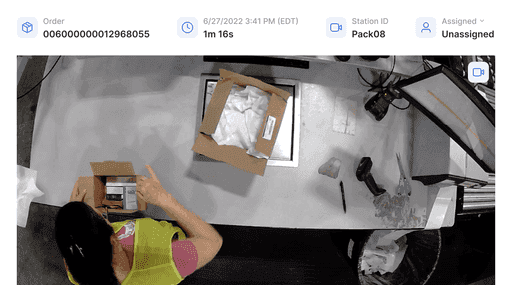
Rabot is a Vision AI platform designed for warehouse pack stations, offering comprehensive quality control and operational insights. It records and AI-analyzes every order packed, providing verifiable proof, preventing errors, and improving overall performance. The platform has processed over 113 million items and integrates with more than 62 Warehouse Management Systems (WMS) without requiring WMS changes or API modifications. Rabot helps businesses cut costs by optimizing shipping, guides teams to reduce ramp-up time, resolves disputes with video evidence, and ensures operations compliance. It offers products like Pack, Scan, and Ship Right, with capabilities such as Pulse for single-screen operation and Workflows for enforcing rules.
pytorch_active_learning
pytorch_active_learning is an open-source PyTorch library designed for active learning, accompanying the "Human-in-the-Loop Machine Learning" book. It offers a range of active learning methods, including Least Confidence, Margin of Confidence, Ratio of Confidence, and Entropy sampling. The library also supports more advanced techniques like Model-based Outlier sampling, Cluster-based sampling, and various forms of Active Transfer Learning. It is suitable for researchers and practitioners looking to experiment with and apply active learning strategies in computer vision and natural language processing, with a focus on real-world diversity to avoid bias. The code is stand-alone and can be easily integrated with existing PyTorch installations.
PyTorch-BayesianCNN
PyTorch-BayesianCNN provides an implementation of Bayesian Convolutional Neural Networks (CNNs) with variational inference, specifically utilizing Bayes by Backprop, within the PyTorch framework. This tool allows researchers and developers to build CNNs that can infer intractable posterior probability distributions over weights, offering a significant advantage over traditional frequentist approaches by providing uncertainty estimations. It includes two types of Bayesian layer implementations: BBB (Bayes by Backprop) and BBB_LRT (Bayes by Backprop with Local Reparametrization Trick), which enhances sampling efficiency. The repository supports standard datasets like MNIST, CIFAR10, and CIFAR100, and includes implementations of common models such as AlexNet and LeNet, making it a valuable resource for experimenting with Bayesian deep learning and understanding model uncertainty.
Osprey
Osprey is a cutting-edge computer vision tool that enhances multimodal large language models (MLLMs) by incorporating pixel-wise mask regions into language instructions. This innovative approach enables fine-grained visual understanding, allowing Osprey to generate detailed semantic descriptions, including both short and elaborate explanations, based on specific input mask regions. It seamlessly integrates with Segment Anything Model (SAM) in various modes like point-prompt, box-prompt, and segmentation everything, to extract and describe semantics associated with particular parts or objects within an image. Osprey is built upon the LLaVA-v1.5 codebase and is designed for researchers and developers working on advanced visual instruction tuning and pixel-level image analysis.
OpenML
OpenML is a collaborative online machine learning platform designed to facilitate the sharing and organization of data, machine learning algorithms, and experimental results. It aims to create a frictionless, networked ecosystem where scientists and practitioners can easily integrate their existing processes and tools to collaborate globally. The platform provides significant benefits for science by enabling rapid building upon others' results, answering complex questions quickly through prior experiments, and making larger studies feasible. For scientists, it saves time on routine duties, compares new experiments to the state of the art, and offers potential for new discoveries and publications. OpenML also serves as a valuable learning environment for students and citizen scientists, allowing them to explore state-of-the-art methods and contribute their own work.

Elevatus.io
Elevatus is an AI hiring operating system designed for enterprise-scale recruitment, offering autonomous recruiting from requisition to onboarding without requiring any coding. The platform provides solutions like EVA-REC for streamlining recruitment, EVA-SSESS for pinpointing top performers through assessments, and EVA-BOARD for initiating onboarding before day one. It caters to various industries including education, financial services, and government, and is built for speed, scale, and complexity. Elevatus ensures full compliance, offers deployment in under one week, and integrates seamlessly with over 2000 tools like LinkedIn, Zoom, Slack, and SAP. It also features built-in intelligence for every stage of recruitment, supporting diverse hiring, first-class candidate experiences, dynamic analytical reports, and multilingual support.
LMDrive
LMDrive is an open-source, closed-loop, end-to-end autonomous driving framework that leverages large language models (LLMs). It is designed to interact with dynamic environments by processing multi-modal and multi-view sensor data, alongside natural language instructions. This framework facilitates the development and research of advanced autonomous driving systems. Key features include vision encoder pre-training to generate visual tokens from sensor inputs and an instruction finetuning stage to align language instructions with control signals. The project provides a comprehensive dataset collected in the CARLA simulator, including sensor data, navigation instructions, and human notice instructions, making it a robust platform for researchers and developers in the autonomous driving domain.
Warp
Warp is an agentic development environment designed to modernize the terminal experience for developers. It addresses the limitations of traditional terminals and the scalability challenges of agentic development tools. Warp integrates modern UI and code editing features, allowing users to leverage its built-in agent, Oz, or run other CLI coding agents like Claude Code, Codex, or Gemini CLI. Oz functions as an orchestration platform for cloud agents, enabling the spin-up of unlimited parallel coding agents that are programmable, auditable, and fully steerable. This facilitates the automation of repetitive tasks and the parallel execution of agents in the cloud. The project is actively developed, with weekly updates and plans to open-source its Rust UI framework and parts of its client codebase.