
Coding & Development
Browsing page 44 of AI tools for DevOps & Infrastructure in Coding & Development. Sorted by confidence score — our independent quality rating.

Clibrain AI
Clibrain AI offers an advanced AI infrastructure platform specifically designed to cater to the needs of Spanish-speaking organizations. Its core offering is LINCE, a large language model (LLM) that demonstrates superior performance in Spanish compared to models primarily trained in English. The platform provides robust APIs and SDKs, enabling seamless integration and development for a diverse range of customers. Clibrain AI focuses on delivering efficient and reliable AI capabilities, making it a valuable asset for businesses and developers looking to leverage cutting-edge AI technology within a Spanish linguistic context. This specialization ensures higher accuracy and relevance for Spanish language processing tasks.
Clibrain AI
Clibrain AI is an AI infrastructure platform specifically designed to cater to Spanish-speaking organizations, offering a suite of efficient and reliable AI solutions. A core offering is the LINCE LLM, a large language model optimized for high performance in Spanish. The platform provides robust APIs and SDKs, enabling various customers to integrate and leverage its AI capabilities seamlessly into their existing systems and applications. This focus on the Spanish language and comprehensive developer tools positions Clibrain AI as a key player for businesses looking to implement advanced AI within a Spanish-speaking context.
CloudKitect Inc
CloudKitect offers a platform for enterprises to launch secure, agentic AI solutions on AWS within 24 hours. It provides an AI Command Center for comprehensive governance, guiding, and managing AI agents, ensuring enterprise compliance and full data control. The platform allows users to build and deploy AI agents and workflows using an intuitive drag-and-drop canvas, integrating seamlessly with existing systems like email and databases. CloudKitect emphasizes NIST 800-53 alignment and SOC 2 Type II compliance, ensuring data remains within the user's AWS account. It supports various use cases across finance, HR, compliance, legal, IT, and operations, offering pre-built modules and real-time dashboards for ROI tracking.
Brainboard
Brainboard is an AI-driven platform designed to simplify cloud infrastructure management. It allows users to visually design cloud architectures and automatically generates production-ready Terraform code, supporting multi-cloud environments like AWS, Azure, GCP, OCI, and Scaleway. The platform facilitates collaborative work, integrates with GitOps workflows, and offers features like drift detection and remediation to maintain consistency between designed and deployed infrastructure. Brainboard also includes a visual CI/CD engine, AI-powered infrastructure generation, and robust security features like RBAC and policy enforcement tools (Checkov, Tfsec, Terrascan, OPA). It aims to reduce the learning curve for IaC, standardize infrastructure, and enable self-service provisioning.

DoubleCloud
DoubleCloud offers a comprehensive platform for building data analytics infrastructure, leveraging fully managed open-source solutions like ClickHouse, Apache Kafka, and Apache Airflow. The platform streamlines data pipelines from ingestion to visualization, providing integrated, reliable, and zero-maintenance services. Key offerings include a no-code ELT tool for real-time data syncing, and a managed open-source Data Visualization tool for creating dashboards and charts. Designed for engineers, DoubleCloud focuses on exceptional performance, security with ISO 27001, SOC 2, GDPR compliance, and cost-effectiveness through a pay-as-you-go model and hybrid storage options. It aims to simplify day-to-day operations by handling routine maintenance, allowing engineers to focus on product development.

BentoML
BentoML offers a comprehensive inference platform designed for speed and control, enabling users to deploy any AI model anywhere. It provides tailored inference optimization, efficient scaling, and streamlined operations for various models, including LLMs and custom architectures. The platform simplifies inference infrastructure while offering full control over deployment, supporting open-source models and custom models alike. Key features include deployment automation, CI/CD, comprehensive observability, and fine-grained access control. BentoML also offers intelligent resource management with cross-region scaling, elastic auto-scaling, and cold-start acceleration, ensuring optimal compute utilization across various cloud environments or on-premises Kubernetes.
promptr
Promptr is a command-line interface (CLI) tool designed to help developers modify their codebases using plain English instructions. It leverages OpenAI's LLM models to interpret these instructions and apply changes directly to specified files. Promptr supports a liquidjs-based templating system, allowing for reusable code snippets and consistent application of project-wide coding standards. This feature is particularly useful for tasks like refactoring, generating boilerplate code, and conducting code experimentation. Users can define prompts in files, include relevant file paths, and then execute Promptr to apply the model's output to their filesystem, with options for dry runs and interactive modes.
codespaces-jupyter
codespaces-jupyter offers a ready-to-use development environment within GitHub Codespaces, specifically tailored for machine learning and data science projects. It comes pre-configured with Python and Jupyter notebooks, allowing users to immediately dive into their work without extensive setup. This tool provides a blank canvas for new projects, enabling users to explore and experiment with data science concepts. The environment is self-contained within a single codespace, offering flexibility for development. Users can choose to publish their work to a GitHub repository when ready or simply delete the codespace if it was for exploration, making it ideal for quick prototyping and learning.
ppq
PPL Quantization Tool (PPQ) is a powerful, open-source offline neural network quantization tool designed for industrial applications. It focuses on optimizing neural networks by converting floating-point operations to fixed-point operations, which significantly reduces computational costs and memory usage. This makes PPQ particularly suitable for deployment on edge devices where chip area and power consumption are limited. The tool offers a highly flexible and extensible framework, allowing users to customize quantization bit-width, granularity, and calibration algorithms for individual operators and tensors. PPQ's execution engine is specifically designed for quantization, supporting 99 common Onnx operator execution logics and native quantization simulation. It integrates with various inference frameworks like TensorRT, OpenVINO, and Onnxruntime, providing pre-built quantizers and export logic.
Cute Magick
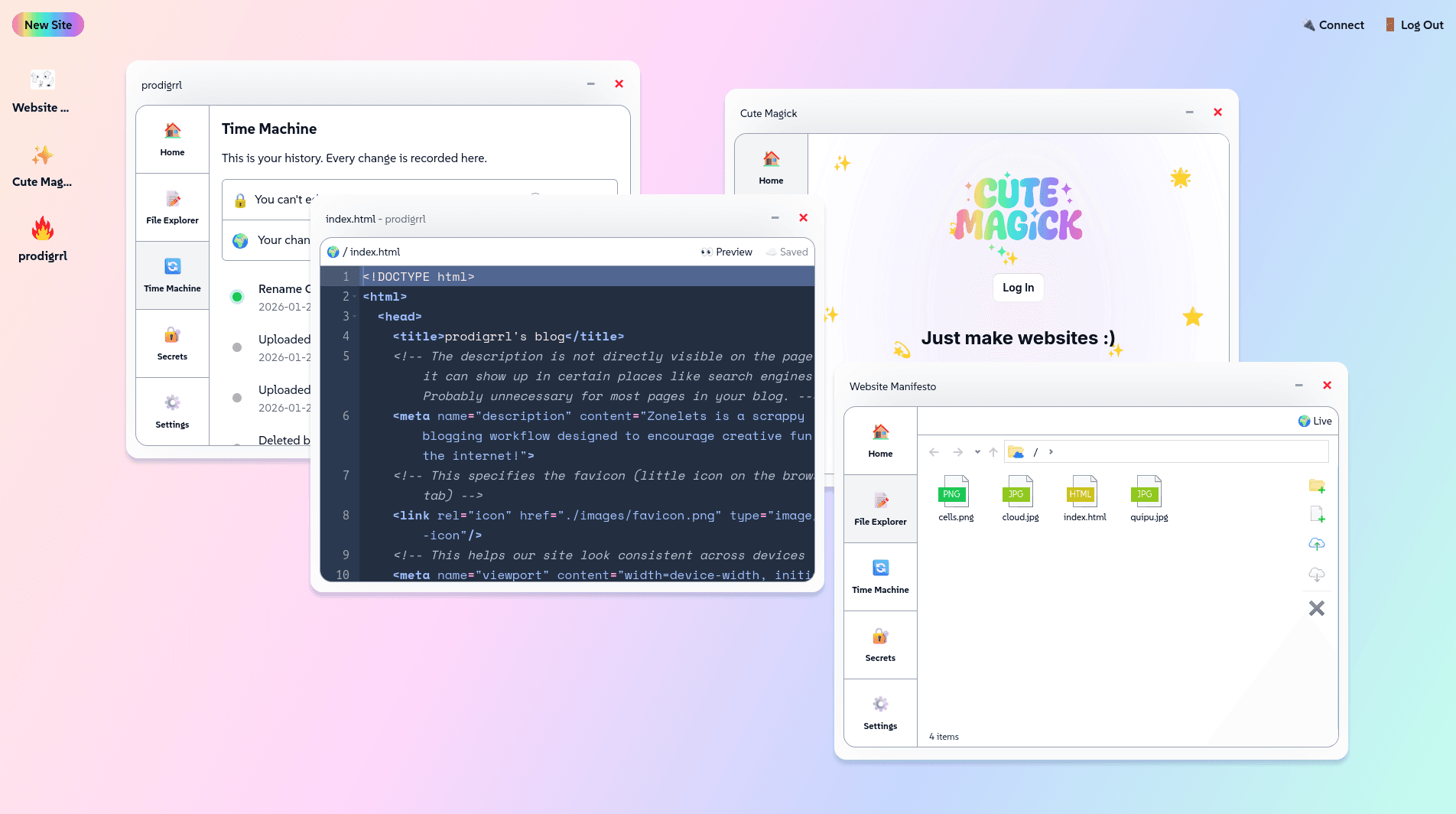
Cute Magick offers a simple yet powerful open-source web hosting solution designed for developers and creative coders. It provides an interactive workspace where users can build, preview, and publish websites using various languages like HTML, CSS, PHP, Python, Lua, and Node.js. A key differentiator is its "Time Machine" feature, which saves every file change as a snapshot, allowing users to rewind to any previous version, preview past states, and restore earlier configurations. The platform emphasizes ownership and portability, with sites stored as plain files and standard Git history, enabling easy export and self-hosting options. It caters to those who want to build real, server-powered websites without the complexities of traditional infrastructure.
-p-2600.png&w=3840&q=75)
Lunaa Cloud
Lunaa Cloud is a decentralized GPU computing platform designed to make high-performance computing accessible to everyone. It leverages a global network of GPUs contributed by users, offering unmatched scalability, cost-efficiency, and reliability for tasks like AI model training, rendering, and scientific simulations. The platform integrates seamlessly with major rendering software such as Blender, Autodesk Maya, and Unreal Engine. Key features include LunaEngine for intelligent task distribution, Quantum Cores for enhanced GPU performance, and Nexus Cache for secure, temporary data storage with automatic erasure. Lunaa Cloud aims to revolutionize decentralized GPU computing through collaborations with industry leaders like NVIDIA and Google Cloud.
FlexAI
FlexAI provides an adaptive AI infrastructure solution designed for growing AI teams, startups, and enterprises. It orchestrates AI workloads across various cloud providers and hardware, enabling faster deployment and significant cost savings, with an average of 67% reported. The platform supports inference, fine-tuning, and training, offering a managed solution that eliminates DevOps overhead and auto-scales for optimal cost and performance. FlexAI features an OpenAI-compatible API, supports any model, and includes TokenFactory for quick token generation. For system integrators and enterprises, CloudFoundry transforms GPU infrastructure into a production-ready AI platform with GPU-as-a-Service, multi-tenancy, governance, and secure deployment options.
Microsoft Azure
Microsoft Azure provides a comprehensive suite of cloud computing services for developers and IT professionals to create, deploy, and manage applications. It supports multi-cloud, on-premises, and edge deployments with scalable and cost-efficient solutions. Users can choose between a free account, offering $200 credit and free access to popular services for 30 days, or a pay-as-you-go model with free monthly amounts for over 20 popular services for 12 months and 65+ always-free services. Azure integrates seamlessly with the Microsoft ecosystem, offering advanced analytics, machine learning, and AI tools, including pre-built models and customizable options for intelligent feature integration. It's designed to help users go from idea to deployment quickly and efficiently.
gemma-3-270m
gemma-3-270m is an AI chatbot that leverages the Gemma 3 (270M) language model, running efficiently on Ollama with just a single-core CPU. This tool is designed for users who need to experiment with and deploy AI models even with limited computational resources. It supports both the google/gemma-3-270m and google/gemma-3-270m-it models, providing flexibility for different applications. Users can input text prompts and receive generated responses, with options to customize output parameters such as context length, temperature, and repetition penalty. The platform is hosted as a Hugging Face Space, making it accessible for testing and development.
Releem
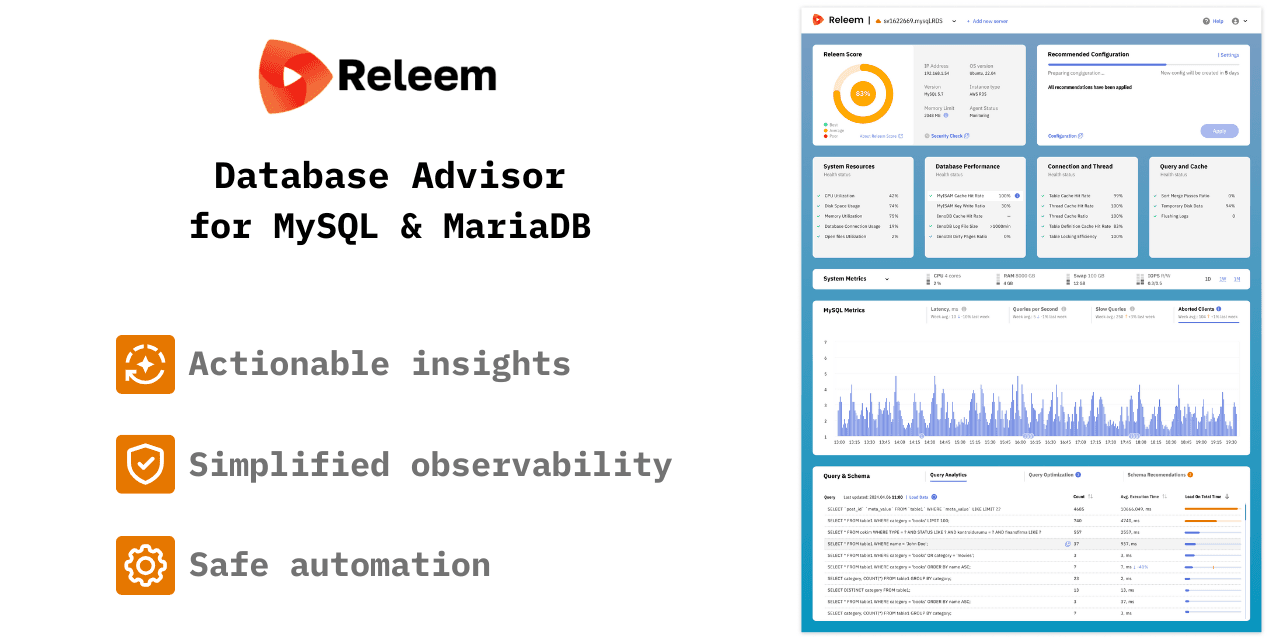
Releem is an advisory tool designed for MySQL and MariaDB performance tuning, offering automatic metrics analysis, actionable insights, and safe automation. It proactively identifies common database issues such as misconfigurations, slow queries, schema problems, and deadlocks, providing clear guidance and automation to significantly reduce manual work. The platform features continuous workload monitoring, suggesting revised MySQL server configurations, and offering recommendations for optimizing resource-intensive SQL queries and indexes. Releem also includes a time-saving dashboard for monitoring database status, displaying key performance and resource consumption metrics like CPU, memory, and disk usage in an easy-to-understand format. It supports various MySQL/MariaDB/Percona versions and cloud services like AWS RDS and GCP Cloud SQL, making it a versatile solution for database administrators, developers, and hosting providers.
Jules.Google
Jules is an autonomous coding agent designed to streamline development workflows by taking on tasks developers often don't want to do. It integrates directly with GitHub, allowing users to select repositories and branches, then provide detailed prompts for tasks such as bug fixing, version bumping, or feature building. Jules utilizes the latest Gemini 3 Pro model to develop plans, fetches repositories to a Cloud VM, and provides a diff of proposed changes for quick review and approval. Once approved, Jules creates a pull request, enabling developers to easily merge changes. This allows developers to focus on more complex or preferred coding tasks while Jules handles the routine or less desirable work.
Redirections
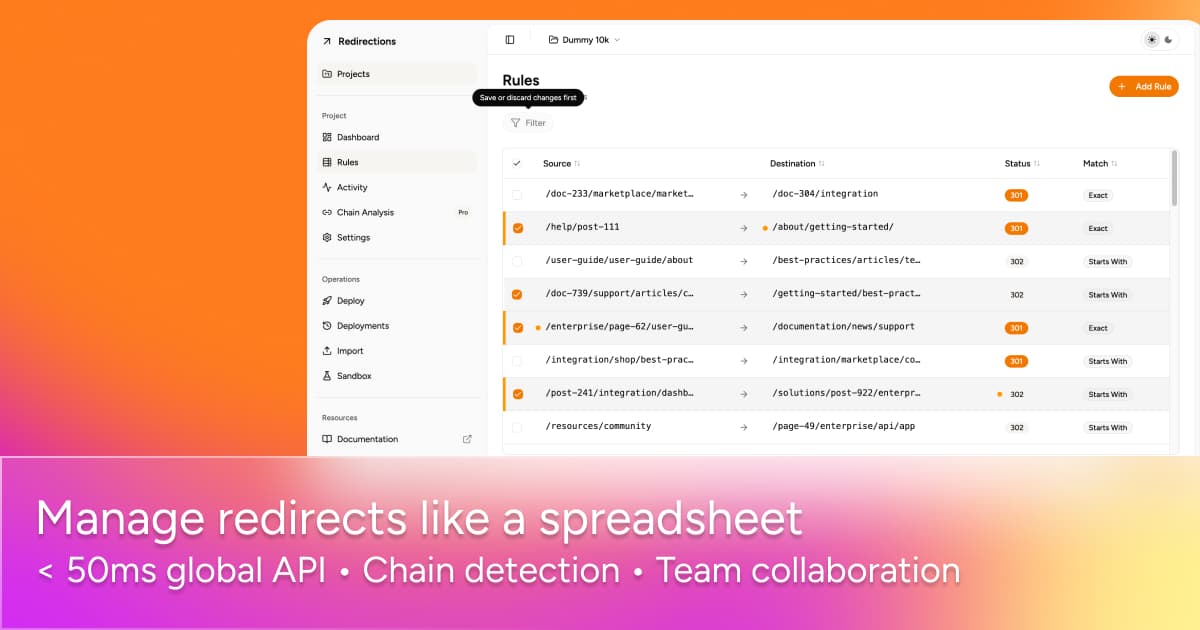
Redirections is an HTTP redirect management platform designed for developers and technical teams to deploy and manage redirect rules efficiently. It offers sub-50ms global edge lookups, ensuring blazing-fast performance with zero cold starts across 300+ edge locations. Users can create and manage redirect rules through a web dashboard, which are then queried via a simple HTTP API. A key feature is its ability to export production-ready configurations for various server types, including Nginx, HAProxy, Varnish, and Next.js, allowing for centralized rule management and server-specific config generation. The platform also includes advanced features like automatic redirect chain detection, CSV bulk import, an analytics dashboard, and a full audit trail, making it suitable for managing redirects at scale.
Checkme.dev | Ready-to-Go Geo Monitoring
Checkme.dev offers geo-distributed website availability monitoring, verifying accessibility from over 57 countries using real ISP networks, not cloud data centers. This allows it to detect regional outages, CDN misconfigurations, and ISP-level filtering that traditional monitoring might miss. The tool provides network metrics like latency and packet loss, alongside web metrics such as HTTP status, TTFB, and SSL expiry. It integrates with existing monitoring systems like Zabbix and Prometheus, acting as an additional visibility layer. Checkme.dev is designed for DevOps & SRE teams, Backend & Platform teams, and Agencies & Media Buyers who need to ensure their services are truly available to users worldwide.

DevXOps
DevXOps serves as a comprehensive news hub, offering daily curated intelligence across the critical domains of DevOps, CloudOps, SecOps, and AIOps. The platform aggregates and presents the latest articles and updates from a wide array of trusted sources, including official blogs from Kubernetes, AWS, HashiCorp, and Docker, as well as community resources. Users can stay informed on topics such as CI/CD, monitoring, architectures, and new releases, with dedicated sections for each. DevXOps aims to provide a centralized and efficient way for professionals to keep abreast of the rapidly evolving landscape in cloud-native and operational technologies.
kubetorch
Kubetorch offers a Pythonic, "serverless" interface for building, iterating, and deploying machine learning applications on Kubernetes at any scale. It integrates your cluster's compute power directly into your local development environment, enabling rapid iteration times of 1-2 seconds. The tool automatically propagates logs, exceptions, and hardware faults back to the user in real-time. With no local runtime or code serialization, Kubetorch allows access to large-scale cluster compute from any Python environment, including IDEs, notebooks, CI pipelines, or production code, much like a local process pool. This approach aims to achieve 100x faster iteration for complex ML applications and over 50% compute cost savings through intelligent resource allocation and dynamic scaling.
mlrun
MLRun is an open-source MLOps platform designed to streamline the entire lifecycle of continuous machine learning applications. It seamlessly integrates into existing development and CI/CD environments, automating the delivery of production data, ML pipelines, and online applications. The platform significantly reduces engineering efforts, accelerates time to production, and optimizes computation resources. MLRun supports various gen AI tasks, including data management, development, deployment, and live operations, with features like data lineage, versioning, and real-time serving. For MLOps, it offers project management, CI/CD automation, data ingestion and processing with a Feature Store, scalable model training, and robust model monitoring capabilities to detect drift and anomalies.
VESSL AI
VESSL AI offers a Liquid AI Infrastructure and Persistent GPU Cloud solution, providing on-demand access to a range of GPUs including A100, H100, H200, B200, GB200, and B300. Designed for researchers, AI startups, and enterprise AI teams, it allows users to spin up resources in minutes and scale on demand, paying only for what they use. The platform supports multi-node training, parallel jobs, and persistent workspaces, aiming to save users up to 80% compared to hyperscalers. It features options for spot, on-demand, and reserved capacity, with multi-cloud failover built-in and 24/7 platform monitoring. VESSL AI is SOC 2 Type II Certified and ISO 27001 compliant, ensuring secure and reliable operations for critical AI workloads.
Pangolin
Pangolin is a zero-trust remote access platform designed for IT/OT, IoT, and engineering teams, offering a secure and identity-based alternative to traditional VPNs. It provides unified access to entire infrastructures, connecting via peer-to-peer tunnels or clientless browser access across on-prem, cloud, and edge environments. Key features include an easy-to-deploy connector behind any firewall, user authentication with existing identities, zero-trust access to specific applications, and enforcement of identity and context-aware rules. Pangolin is built to be easy to deploy and scale, verifying identity and context at every step to deliver secure access without the friction often associated with VPNs. It supports various platforms including MacOS, iOS, Windows, Linux, and Android, and offers both cloud and self-hosted options.
AI-in-a-Box
AI-in-a-Box leverages Microsoft's global expertise to offer a curated collection of AI and ML solution accelerators. Its primary goal is to help engineers quickly set up their AI/ML environments and deploy solutions with minimal friction, ensuring high quality and efficiency. The platform provides various "-in-a-Box" accelerators for specific use cases like Azure ML Operationalization, Edge AI, Custom Vision Edge, Document Intelligence, Image and Video Analysis, Cognitive Services Landing Zone, Semantic Kernel Bot, NLP to SQL, and Assistants API. It aims to accelerate deployment, reduce costs by reusing existing code, and enhance reliability through validated solutions, giving users a competitive advantage in the AI/ML landscape.