
Coding & Development
Browsing page 357 of AI tools for Coding & Development. Sorted by confidence score — our independent quality rating.

AI/R
AI/R specializes in helping enterprises transform their operations through the strategic implementation of Agentic AI. Their core offering, The AI/R Algorithm, is a five-step framework designed to guide organizations from initial goal definition to large-scale AI adoption. This framework focuses on simplifying complex processes, removing non-value-adding work, and redesigning workflows to integrate intelligent agents alongside human talent. AI/R emphasizes that this is not merely about adopting AI tools, but about a fundamental reinvention of how work is done, decisions are made, and business outcomes are achieved. Their Forward Deployed Engineers work directly within customer environments to ensure practical execution and measurable results, bridging the gap between strategy and operational reality.

HF's Missing Inference Widget
HF's Missing Inference Widget is a Hugging Face Space designed to facilitate AI model inference. This application enables users to generate text responses by simply entering their queries. A key feature is the ability to select from various AI models, providing diverse responses based on the chosen model. Users can type their message, pick a model, and receive generated text. The tool aims to offer a straightforward interface for experimenting with different AI models for text generation, making it accessible for those looking to test and compare model outputs.
pytorch-template
The pytorch-template project offers a streamlined foundation for building PyTorch deep learning applications. It establishes a clear, organized folder structure and includes pre-configured settings, allowing developers to quickly set up new projects without starting from scratch. This template facilitates easy configuration management, robust checkpointing for model training, and flexible customization of training loops. By providing a ready-to-use framework, pytorch-template aims to significantly accelerate the development process for PyTorch users, enabling them to focus more on model experimentation and less on boilerplate setup.
Gemini2.5 Pro
Gemini2.5 Pro is an AI code assistant designed to help users get detailed explanations from Gemini AI based on their prompts. The tool focuses on providing well-formatted responses, making it easier for users to understand complex information or code. While the specific functionalities beyond detailed explanations are not explicitly stated, its core purpose is to leverage Gemini AI for comprehensive and structured output. The tool is currently paused, and users are directed to the community tab to request its restart.

Blackcurrant Labs Pvt. Ltd.
Blackcurrant Labs is a full-stack application development company offering comprehensive services for web, mobile, and AI products. They excel at building Cloud-based, hyper-scaled product solutions for a diverse range of customers. Their approach includes agile development methodologies, ensuring timely delivery and high-quality standards. The company provides expertise across the entire product development lifecycle, from design and frontend to backend, DevOps, and niche technologies. Blackcurrant Labs is proficient in designing and deploying truly distributed, cloud-native applications that scale seamlessly. They offer turnkey solutions, encompassing deduction, design, development, and deployment, with a team of developers, designers, analysts, system architects, and product managers.
schnetpack
schnetpack is an open-source toolbox designed for researchers and developers working with atomistic systems. It provides a robust framework for developing and applying deep neural networks to predict various properties of molecules and materials, such as potential energy surfaces and quantum-chemical characteristics. The tool includes fundamental building blocks for atomistic neural networks, simplifying the process of conducting simulations and making accurate property predictions. Its open-source nature, hosted on GitHub, encourages community contributions and provides transparent access to its codebase, making it a valuable resource for academic and industrial research in computational chemistry and materials science.
steel-browser
Steel Browser is an open-source browser API designed for AI agents and applications, offering a comprehensive browser sandbox to automate web interactions without the need for complex infrastructure management. It enables developers to build live web agents and browser automation tools with ease, providing full control over Chrome instances via Puppeteer and CDP. Key features include robust session management, proxy support for IP rotation, extension loading, and anti-detection capabilities. The tool also offers debugging tools, resource management, and APIs for quick page conversions to markdown, readability, screenshots, or PDFs. It supports both Node.js and Python SDKs, making it versatile for various development environments.
PMC-LLaMA
PMC-LLaMA offers the official code for developing open-source language models specifically tailored for the medical domain. The project emphasizes a two-phase training approach: initial pretraining with a vast medical corpus (like PubMedCentral papers and medical books) followed by instruction tuning using a specialized dataset. This methodology has been shown to improve the model's ability to follow user instructions compared to other medical LLMs. The repository provides various versions of PMC-LLaMA, including 7B and 13B parameter models, with links to their Hugging Face implementations. It also includes quick start guides, training scripts, and benchmark results against other prominent LLMs in medical QA tasks, demonstrating its competitive performance.
Laravel Shopper
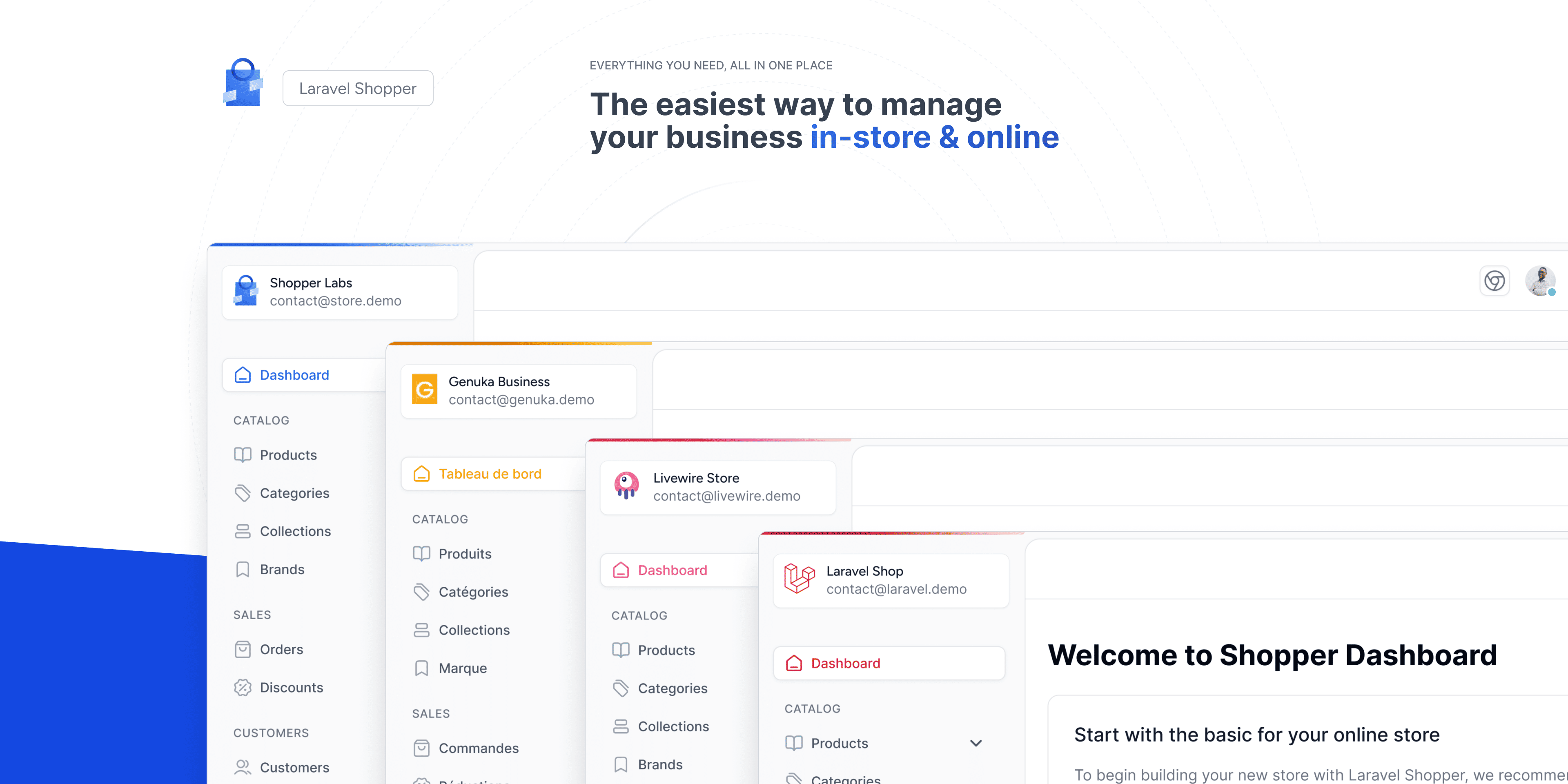
Laravel Shopper is an open-source e-commerce package designed for Laravel, offering a powerful admin panel and a headless API. This architecture provides composable building blocks, enabling developers to integrate e-commerce functionalities into existing applications or build entirely new storefronts using any frontend stack. Key features include comprehensive product management, efficient order processing, customer management, and inventory control. It empowers developers to create highly customized online stores, leveraging the flexibility of Laravel while maintaining full control over the user experience and design.
v2ray-SSR-Clash-Verge-Shadowrocke
v2ray-SSR-Clash-Verge-Shadowrocke is an open-source repository offering free, high-speed server nodes for popular protocols like v2ray, SS, sing-box, Clash, Verge, SSR, and Shadowrocket. This tool is designed to help users bypass internet restrictions and access geo-blocked content on platforms such as YouTube, Netflix, TikTok, ChatGPT, and bilibili. It provides comprehensive subscription guides for setting up these nodes across a wide range of devices, including Windows, Mac, Linux, iOS, Android, and routers. The repository also includes VPN reviews and is compatible with various client applications like Clash, V2ray, and sing-box, making it a versatile solution for scientific internet access.
Playground AI Exploration
Playground AI Exploration is a platform hosted on Hugging Face Spaces, designed for users to discover and experiment with a variety of AI models and techniques. While the current live website indicates a runtime error, the tool's intent is to provide an environment for hands-on learning and exploration within the AI domain. It aims to serve as a sandbox for individuals interested in understanding and interacting with different AI applications developed by the community. This tool is particularly suited for educational and research purposes, offering a practical way to engage with machine learning concepts and models.
PrometheanAI
PrometheanAI is an AI assistant designed for professional creative teams involved in building virtual 3D worlds. It functions as an AI engine that understands various creative assets, including images, videos, 3D models, 3D animations, PDFs, and PPTs, reasoning about them to configure novel combinations for content creation. The tool aims to significantly speed up digital art production by handling mundane tasks, allowing artists to focus on creativity. A key differentiator is that it does not require users to upload their assets to the cloud or change their existing 3D editors, ensuring data privacy and seamless integration into current workflows. PrometheanAI supports major engines like Unreal Engine, Unity, 3ds Max, Maya, and Blender, offering open-source plugins for customization.

ReadyFaucet
ReadyFaucet offers a complete no-code solution for launching a crypto coin faucet business. It is designed for individuals looking to generate passive income from the cryptocurrency market without needing any technical expertise. The platform delivers and sets up the entire business, making it accessible to a broad audience. This done-for-you service eliminates the complexities typically associated with setting up and managing a crypto faucet, allowing users to focus on earning. ReadyFaucet aims to simplify entry into the crypto business world, providing a straightforward path to passive income.

Bluechip Technologies Asia
Bluechip Technologies Asia is a leading AI development company based in Sri Lanka, specializing in building intelligent solutions for businesses across various industries. They provide a full spectrum of AI services, including strategic AI consulting to identify high-impact use cases, rapid innovation through AI accelerators, and end-to-end AI implementation. The company also offers MLOps expertise for scalable AI operations, custom AI product development from prototyping to MVPs, and enterprise AI solutions designed to integrate seamlessly into existing operations. Bluechip Technologies Asia aims to empower businesses with AI, blockchain, and emerging technologies to drive transformation, efficiency, and competitive advantage.
Animate SVG V2
Animate SVG V2 is an AI-powered tool designed to simplify the animation of SVG graphics. Users can upload their existing SVG files to the platform, which then processes the input and generates an animated SVG output. This tool is particularly useful for creating dynamic web animations and interactive elements without requiring extensive animation skills. The application aims to provide a straightforward solution for transforming static SVG assets into engaging animated visuals, making it accessible for various creative and development projects. The tool is available as a Hugging Face Space, indicating its potential for free access and community-driven development.

Color.ag
Color.ag functions as an AI router and aggregator, designed to deliver the most intelligent AI answers by dynamically routing user questions to the optimal AI model. This tool aims to simplify the process of interacting with multiple AI models, ensuring that each query is handled by the AI best suited for it. By aggregating responses, Color.ag provides a streamlined and efficient way to leverage diverse AI capabilities without needing to manage individual model interactions. It positions itself as the first true AI router and aggregator, focusing on smart answer delivery.
Pixel Perfect Depth
Pixel Perfect Depth is an AI-powered tool designed for monocular depth estimation, allowing users to generate a 3D point cloud from a single 2D image. This application predicts the depth of each pixel, providing a detailed spatial understanding of the scene. Users have the flexibility to refine the generated point cloud by adjusting denoising steps and applying various filters. The tool is hosted on Hugging Face Spaces, making it accessible for researchers and developers interested in computer vision, 3D reconstruction, and related academic pursuits. Its primary output is a 3D point cloud, which can be valuable for further analysis or visualization.
Instant App
Instant App offers pre-integrated, ready-to-use IT operational solutions, including monitoring, ITSM, ERP, and security applications, deployed instantly. Users can choose from popular tools like Wazuh, GLPI, Zabbix, Centreon, and ERPNext, all fully configured and operational within 15 minutes of ordering. The platform handles infrastructure, providing automatic HTTPS, daily backups, and SSH root access. It offers flexible hosting across three data centers (Paris, Virginia, Singapore) and a predictable monthly pricing model. Instant App is designed to help businesses, especially those without dedicated IT teams or lean IT teams, focus on their core activities by eliminating the complexities of infrastructure setup and maintenance. Bundles like GLPI + Zabbix for unified ITSM and monitoring, or WordPress + Matomo for GDPR-compliant analytics, are also available.
Pixai Tagger V0.9 Demo
Pixai Tagger V0.9 Demo is an ONNX demonstration of the pixai-labs/pixai-tagger-v0.9 model, designed to provide comprehensive image tagging and labeling. Users can upload an image to the platform and receive detailed tags and labels, which can be further refined by adjusting thresholds for various categories. The tool outputs a text-based result that includes categorized tags and IP mappings, making it useful for understanding image content and potentially for content generation tasks. This demo allows users to explore the capabilities of the Pixai Tagger model in a practical, interactive environment.
PythonNumericalDemos
PythonNumericalDemos is an open-source repository designed to provide Python demonstrations for spatial data analytics. It encompasses a range of topics, including geostatistical and machine learning workflows, making it a valuable resource for both students and educators. The repository is specifically tailored to support courses in data analytics and geostatistics, helping users overcome intellectual hurdles in data science. By offering practical, code-based examples, PythonNumericalDemos facilitates a deeper understanding of complex numerical methods and their application to real-world spatial data problems. Its open-source nature encourages collaboration and continuous improvement within the data science community.

Will AI do This?
Will AI do This? is an online gaming platform that offers a comprehensive selection of casino games, including baccarat, slots, roulette, blackjack, and more, from over 50 leading providers. The platform emphasizes direct API connections to game developers, ensuring authenticity and fairness without intermediaries. It features an auto deposit and withdrawal system with no minimum limits, making transactions easy and accessible. The service is available 24/7, supports multiple languages, and is accessible across various operating systems like Android, iOS, Windows, and macOS. The platform also highlights its high customer satisfaction scores and experienced management team in the online gaming industry.
python-is-cool
Python-is-cool is an open-source guide curated by Chip Huyen, designed to introduce Python features that are particularly useful for machine learning but might be less commonly understood or utilized. The guide covers topics such as lambda functions, map, filter, and reduce, demonstrating their application with practical code examples. It also delves into advanced list manipulation techniques, including unpacking, slicing, insertion, and flattening, alongside a comparison of lists versus generators for efficient memory usage. Furthermore, the resource explains Python's magic methods (dunder methods) for customizing class behavior, such as `__repr__`, `__eq__`, and `__slots__`, enhancing object representation and comparison. This resource is ideal for developers looking to deepen their Python knowledge for machine learning applications.
Backpack
Backpack is an AI tool demo hosted on Hugging Face Spaces by stanfordnlp. It is built using Gradio, a popular Python library for creating customizable UI components for machine learning models. The tool is duplicated from lora-x/Backpack, indicating its origin or a related project. While the live demo currently shows a runtime error, suggesting it is not operational, its intended purpose is for AI research and educational applications. It provides a platform for exploring and experimenting with AI models within a research or learning environment.
BadgeCraft
BadgeCraft is a web badge generator available on Hugging Face Spaces, designed to help users create custom badges for their projects. It offers a user-friendly interface where you can customize various aspects of your badges, including labels, messages, colors, and logos. The tool provides a live preview feature, allowing you to see your badge design in real-time as you make changes. Once satisfied, you can easily obtain the HTML code to embed the badge into your websites or projects. BadgeCraft is licensed under the MIT license, making it a flexible and accessible option for developers and designers looking to enhance their projects with visually appealing and informative badges.