
Coding & Development
Browsing page 347 of AI tools for Coding & Development. Sorted by confidence score — our independent quality rating.

ImageCaptioning.pytorch
ImageCaptioning.pytorch is a comprehensive open-source codebase designed for advanced image captioning research. It offers robust support for self-critical training, a technique crucial for optimizing caption generation. Researchers can leverage bottom-up features for more detailed image understanding and utilize multi-GPU training for efficient model development, including DistributedDataParallel with pytorch-lightning. The codebase also supports Transformer captioning models, providing a flexible framework for experimenting with state-of-the-art architectures. It includes functionalities for evaluating models on various datasets like COCO and Flickr30k, generating captions for raw images, and performing beam search for improved decoding. With detailed instructions for installation, data preparation, and training, it serves as a valuable resource for academics and developers in the field of computer vision and natural language processing.
.webp&w=3840&q=75)
Magicflow
Magicflow is an AI-powered productivity coach designed to help founders and makers achieve deep work. It measures productivity, tracks deep work sessions, and identifies context-switches and distractions. The tool provides actionable insights on what fosters productive flow and what breaks it, helping users become more productive. Key features include live flow timers for focus sessions, Pomodoro timers, distraction warnings, and a glowing flow meter. It offers automatic time tracking, real-time productivity metrics, and recommended focus actions, making it a comprehensive solution for enhancing focus and optimizing work habits.
NAX Group
NAX Group offers an enterprise AI software platform designed to streamline the development and deployment of custom AI applications. The platform focuses on leveraging automation to build, deploy, and run these applications efficiently. This approach aims to significantly reduce operational costs, accelerate the time it takes for businesses to realize value from their AI investments, and ultimately create a competitive advantage. By providing a comprehensive solution for managing the AI lifecycle, NAX Group enables organizations to integrate advanced AI capabilities into their operations without extensive manual intervention, fostering innovation and efficiency across various business functions.
VibeFlow
VibeFlow is an AI-powered platform designed for building full-stack applications and automations with both frontend and backend components. Unlike black-box builders, it offers transparent, visual backends using n8n-style workflows, allowing users to see and edit their entire application logic. The platform enables users to build backend automations, data pipelines, and approval workflows, and connect them to frontends like dashboards, forms, or customer-facing apps. It generates clean TypeScript and React code, which users own and can export to GitHub. VibeFlow supports building UIs, cloning websites, and converting Figma designs into production-ready React components iteratively. It integrates with various services like Slack, Notion, Stripe, and Gmail through pre-built connectors.
python_autocomplete
python_autocomplete is an open-source project that leverages a simple LSTM (Long Short-Term Memory) neural network to provide autocompletion for Python code. The tool is designed to predict and suggest code completions, potentially saving a significant number of keystrokes—up to 30% in most files and nearly 50% in some. It performs beam search to find predictions up to approximately 10 characters ahead. The model is trained on tokenized Python code, after cleaning comments, strings, and blank lines, and a pre-trained model checkpoint is included. While currently inefficient for direct editor integration, it demonstrates the potential of neural networks for code assistance. A simpler, maintained version is available at lab-ml/source_code_modelling.
kubewall
kubewall is an open-source, single-binary Kubernetes dashboard designed for multi-cluster management with integrated AI capabilities. It offers a rich, real-time interface for managing and investigating Kubernetes clusters, providing features like live views of cluster resources, pods, and services. The AI integration leverages models such as OpenAI, Claude 4, Gemini, DeepSeek, OpenRouter, Ollama, Qwen, and LMStudio for automated troubleshooting, configuration optimization, and smart recommendations. It supports effortless installation as a lightweight binary on Mac, Windows, or Linux, with no dependencies. Users can access it securely via any browser, with options for HTTPS setup, and benefit from in-depth resource views, powerful search and filtering, and privacy by design with zero cloud dependency. It also includes port forwarding, live refresh, and aggregated pod logs for efficient debugging and monitoring.
DenoisingDiffusionProbabilityModel-ddpm-
DenoisingDiffusionProbabilityModel-ddpm- is an open-source implementation of the Denoising Diffusion Probability Model (DDPM). This tool provides a straightforward way for developers and researchers to train a UNet model on the CIFAR-10 dataset. Users can directly run `Main.py` to initiate training and then adjust model configurations to visualize the denoising process. The repository also includes `MainCondition.py` for training with Classifier-free guidance. Pre-trained weights for CIFAR-10 are available, and the project references key papers and blogs for deeper understanding of DDPM frameworks, making it an accessible resource for learning and experimentation in diffusion models.

Redbean: AI Town, AI Gamemaker
Redbean AI is an all-in-one platform designed for creating living original characters (OCs) and interactive pixel art games without requiring any coding knowledge. Users can design characters with unique personalities, memories, and movement capabilities, then explore their stories within a game environment. The platform facilitates the building of interactive scenes and allows for roleplaying with AI-powered NPCs that understand context and emotion. Redbean AI aims to transform user imagination into a dynamic, living community, offering a no-code game builder, AI character creator, interactive storytelling features, and pixel art generation. It's available on web, iOS, and Android, making game creation accessible to a broad audience.
mlops-stacks
mlops-stacks offers a customizable, open-source solution for initiating new machine learning projects on Databricks, adhering to production best practices. It streamlines the development process by providing a pre-configured environment that includes ML project structure, ML resources as code, and CI/CD workflows (GitHub Actions or Azure DevOps). Data scientists can quickly iterate on ML code, while MLOps engineers can efficiently set up continuous integration and continuous deployment pipelines and manage ML resources. The tool supports automated model training and batch inference jobs across dev, staging, and production Databricks workspaces, facilitating an easy transition to production-grade ML solutions. It also integrates with Databricks asset bundles and offers options for Unity Catalog and Feature Store.
RepoPrompt
RepoPrompt is a native macOS context engineering toolbox designed to help developers iterate on code efficiently using AI. It allows users to build powerful AI prompts themselves or let AI agents utilize them via MCP. The tool focuses on optimizing coding workflows by structuring coding text prompts, enabling users to select specific files and estimate token usage. It supports multiple AI models, including OpenAI and Anthropic, and offers the capability for local model connections to enhance privacy. RepoPrompt is engineered for macOS-native performance, ensuring fast and responsive interactions for a seamless development experience.
XcodeLLMEligible
XcodeLLMEligible is an open-source project designed to enable Xcode LLM, Apple Intelligence, and iPhone Mirroring functionalities on macOS versions and hardware configurations that are not officially supported by Apple. The tool achieves this by overriding Darwin eligibility checks, offering two primary methods: a 'util tool' method that requires a one-time SIP disable and boot-arg modification, and an 'override file' method that does not require SIP to be disabled at all. It supports macOS 15.0 - 15.3.1 and has been tested with XcodeLLM, Apple Intelligence, and ChatGPT integration on Mac mini (M4 Pro, 2024) running macOS 15.2. The project is intended for learning and research purposes, allowing users to permanently access these features on their Macs.

Supadex
Supadex is a mobile application designed to provide a comprehensive dashboard for Supabase projects. It enables users to manage databases, track key metrics, and monitor project performance from anywhere, anytime. The tool offers real-time statistics, including requests count, authentication statistics, and storage usage. Users can browse schemas, tables, and storage buckets, explore detailed views of tables and rows, and preview files. Supadex also features a SQL Editor for writing and executing queries, along with the ability to save favorite Supabase queries. It ensures data security by storing API tokens encrypted on the user's device only, never transmitting them to external servers. The app supports managing multiple Supabase projects, allowing easy switching between them.
llama2-webui
llama2-webui is an open-source tool designed for running Llama 2 models locally through a Gradio web UI. It offers broad compatibility, supporting all Llama 2 models (7B, 13B, 70B, GPTQ, GGML, GGUF, CodeLlama) and various backends like transformers, bitsandbytes (8-bit inference), AutoGPTQ (4-bit inference), and llama.cpp. The tool can be deployed on Linux, Windows, and Mac, utilizing either GPU or CPU resources. Developers can also leverage `llama2-wrapper` as a local Llama 2 backend for generative agents and applications, and it provides an OpenAI-compatible API for seamless integration with existing clients and libraries. Benchmarking scripts are included to evaluate performance on different devices.

Sevensense
Sevensense offers Visual AI technology designed to empower mobile robots and industrial vehicles to operate effectively in complex, dynamic environments. Their core products, Alphasense Position and Alphasense Tracker, provide industry-grade Visual-SLAM (Simultaneous Localization and Mapping) for autonomous mobile robots (AMRs) and a real-time locating system (RTLS) for manually operated industrial trucks, respectively. This technology allows for unified mapping and spatial awareness across hybrid fleets, enhancing efficiency, reducing operational costs, and improving safety through collision prevention and predictive risk alerts. Sevensense's camera-based positioning eliminates the need for extensive infrastructure, facilitating quick deployment and easy fleet expansion. The system integrates seamlessly with existing FMS, WMS, and ERP systems, transforming vehicle movements into actionable data for smarter operations.
-p-2600.png&w=3840&q=75)
Lunaa Cloud
Lunaa Cloud is a decentralized GPU computing platform designed to make high-performance computing accessible to everyone. It leverages a global network of GPUs contributed by users, offering unmatched scalability, cost-efficiency, and reliability for tasks like AI model training, rendering, and scientific simulations. The platform integrates seamlessly with major rendering software such as Blender, Autodesk Maya, and Unreal Engine. Key features include LunaEngine for intelligent task distribution, Quantum Cores for enhanced GPU performance, and Nexus Cache for secure, temporary data storage with automatic erasure. Lunaa Cloud aims to revolutionize decentralized GPU computing through collaborations with industry leaders like NVIDIA and Google Cloud.
evalscope
EvalScope is a powerful and easily extensible open-source framework designed for efficient large model evaluation and performance benchmarking. Developed by the ModelScope Community, it offers a one-stop solution for developers to assess general model capabilities, conduct multi-model performance comparisons, and perform stress tests. Key features include comprehensive evaluation benchmarks like MMLU, C-Eval, and GSM8K, support for various model types including LLM, VLM, Embedding, Reranker, and AIGC, and seamless integration with multiple evaluation backends such as OpenCompass and VLMEvalKit. The framework also provides powerful tools for inference performance testing, interactive WebUI visualization for multi-dimensional model comparison, and an Arena Mode for multi-model battles. Its highly extensible architecture allows for easy addition of custom datasets, models, and evaluation metrics.
Stitchflow
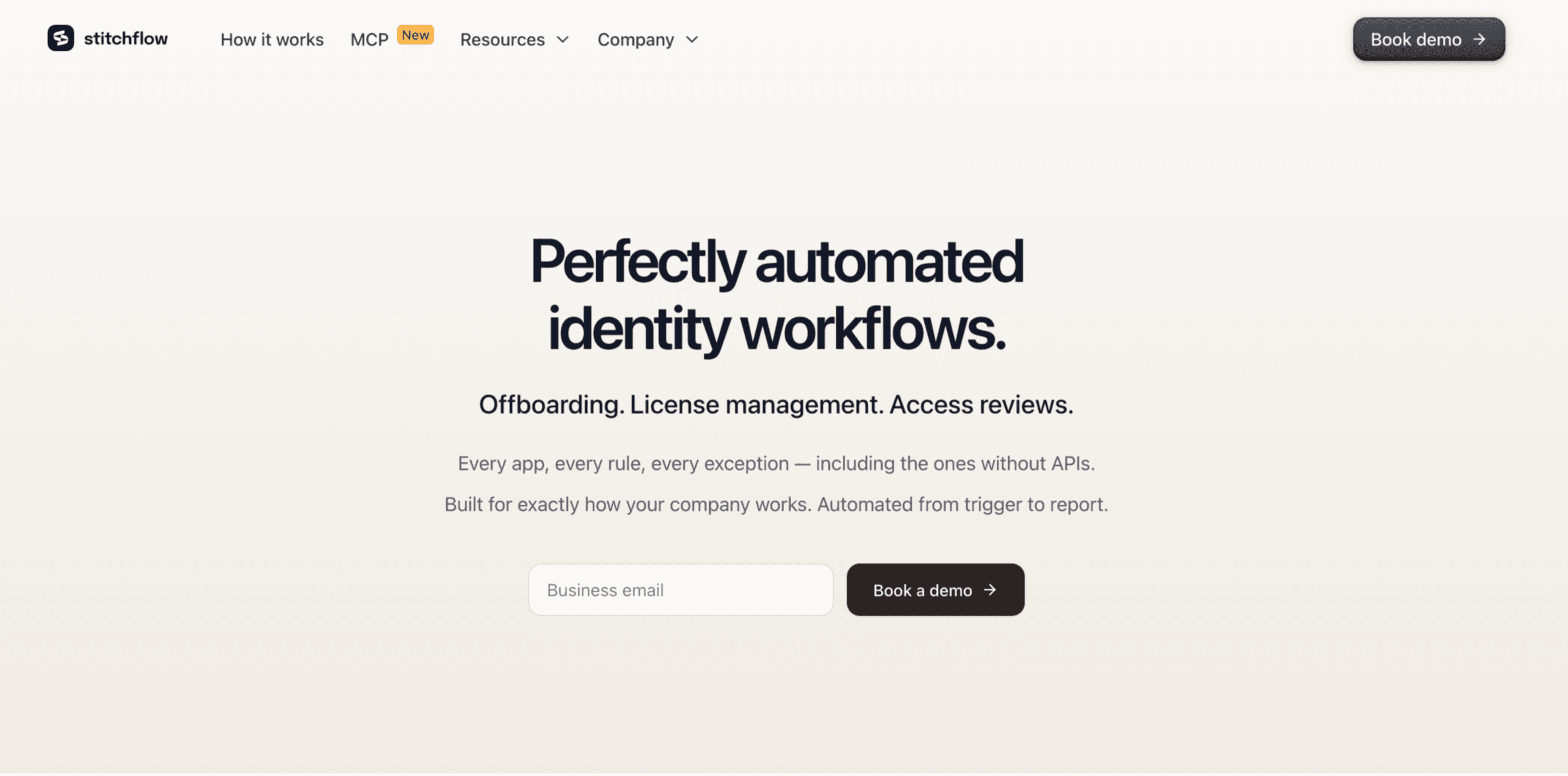
Stitchflow is a managed IT automation service designed to streamline complex IT operations like offboarding, license cleanup, access reviews, and SaaS spend management. It integrates with over 60 apps via API and utilizes a local browser agent for applications without management APIs, ensuring 100% coverage of your app stack. Stitchflow learns your specific workflows, including rules and edge cases, and builds them using AI for rapid deployment, typically under a week. The workflows then run on deterministic logic, ensuring consistent execution without AI hallucinations. The service also provides spend intelligence by mapping users and apps with financial data to identify shadow IT and optimize SaaS spend. Stitchflow handles all maintenance, monitoring, and updates for integrations, allowing IT teams to focus on strategic tasks.
PyTorchText
PyTorchText is an open-source library designed for natural language processing tasks, specifically focusing on text classification. It provides ready-to-use implementations of several popular text classification models, including CNN, RNN (LSTM), RCNN, Inception, and FastText. This library gained recognition as the 1st place solution for the Zhihu Machine Learning Challenge in 2017, demonstrating its effectiveness in real-world scenarios. Users can leverage PyTorchText for data preprocessing, model training with or without data augmentation, and testing, making it a comprehensive tool for researchers and developers working on text analysis and classification projects.
open-swe
Open-SWE is an open-source framework designed for building internal coding agents within organizations, mirroring the sophisticated systems used by elite engineering teams. Built upon LangGraph and Deep Agents, it offers a robust architecture that includes isolated cloud sandboxes for task execution, curated toolsets for focused operations, and advanced context engineering via AGENTS.md files and source context. The platform supports subagent orchestration and middleware for flexible workflow customization. It integrates seamlessly with communication platforms like Slack and Linear, allowing engineers to invoke agents directly from their existing workflows and receive real-time updates. Open-SWE also features built-in GitHub OAuth and automatic pull request creation, streamlining the development process.

Causal Foundry
Causal Foundry offers Kenkai, an adaptive AI platform designed for real-time personalization, optimization, and scalable decision-making. Built on ClickHouse, Kenkai streams and queries high-resolution data instantly, enabling enterprise-scale interventions. It leverages reinforcement learning and contextual bandits to continuously optimize engagement strategies through experimentation and adaptation. The platform also includes embedded metrics and analytics, allowing users to define governed metrics once and explore them everywhere, integrating live dashboards directly into existing systems without black boxes. Causal Foundry aims to democratize reinforcement learning for organizations worldwide, adapting to individual preferences, environments, and behaviors.
marimo app template
The marimo app template is a specialized tool designed for developers and data scientists looking to deploy Marimo applications on Hugging Face Spaces. This web application opens a Marimo notebook, enabling users to directly edit Python code cells within the browser and immediately observe the execution results. It serves as a foundational template, allowing users to supply their own Python code and any necessary data, which the app then executes and displays the outputs. This facilitates rapid prototyping, development, and sharing of interactive Python applications, particularly useful for those working with data science and machine learning models within the Hugging Face ecosystem.
Shimoku
Shimoku offers an analyst agent designed to assist users with data analysis and insight generation. While specific features are not detailed on the homepage, the tool's primary focus appears to be on leveraging AI to support analytical tasks. The platform aims to streamline the process of understanding complex data, potentially through automated reporting or intelligent data exploration. Its positioning as an "Analyst Agent" suggests a capability to act as a virtual assistant for data-driven decision-making, catering to individuals or teams who require efficient data interpretation.
LiveAvatar
LiveAvatar is an open-source implementation of the research paper "Live Avatar: Streaming Real-time Audio-Driven Avatar Generation with Infinite Length." This algorithm-system co-designed framework allows for real-time, streaming, and interactive avatar video generation of infinite length. Powered by a 14B-parameter diffusion model, it achieves 45 FPS on multi-card H800 GPUs with 4-step sampling and supports Block-wise Autoregressive processing for videos exceeding 10,000 seconds. Key highlights include real-time streaming interaction with low latency, infinite-length autoregressive generation, and strong generalization across cartoon characters, singing, and diverse scenarios. The project provides code for both multi-GPU and single-GPU inference, including a Gradio Web UI, and supports FP8 quantization for 48GB GPUs.
jetson-containers
jetson-containers is an open-source, modular container build system designed for NVIDIA Jetson and JetPack-L4T platforms. It provides a comprehensive collection of the latest AI/ML packages, facilitating the deployment of CUDA containers for edge AI and robotics applications. Users can easily combine various packages like PyTorch, TensorFlow, and ROS2 to create custom containers. The tool includes helper scripts for building and running containers, with features like `autotag` to find compatible images and a Pip server for caching wheels to accelerate builds. It supports different CUDA versions and offers detailed documentation for system setup, building, and running containers, making it a robust solution for developers working with NVIDIA Jetson devices.