
Coding & Development
Browsing page 346 of AI tools for Coding & Development. Sorted by confidence score — our independent quality rating.

serverless-ml-course
The serverless-ml-course is an open-source educational resource designed to simplify the development and operation of AI-enabled prediction services. It teaches how to build batch and real-time prediction services using Python, focusing on serverless infrastructure. The course covers essential MLOps fundamentals such as versioning, testing, data validation, and operations, enabling users to deploy features and models, train models, and run inference pipelines. A key differentiator is its emphasis on building a prediction service around a model without needing extensive operations experience, making it accessible for those who can program in Python but are not cloud computing experts. It also guides users on building serverless UIs for their prediction services.
pyannote-audio
pyannote-audio is an open-source Python toolkit designed for speaker diarization, a process that identifies 'who spoke when' in an audio recording. Built on the PyTorch machine learning framework, it offers robust capabilities for speech activity detection, speaker change detection, and speaker embedding. The toolkit includes pretrained models and pipelines, allowing users to quickly implement and experiment with audio analysis tasks. Furthermore, it supports fine-tuning of these models, enabling users to optimize performance on their specific custom datasets. This makes pyannote-audio a versatile tool for researchers and developers working with audio data.
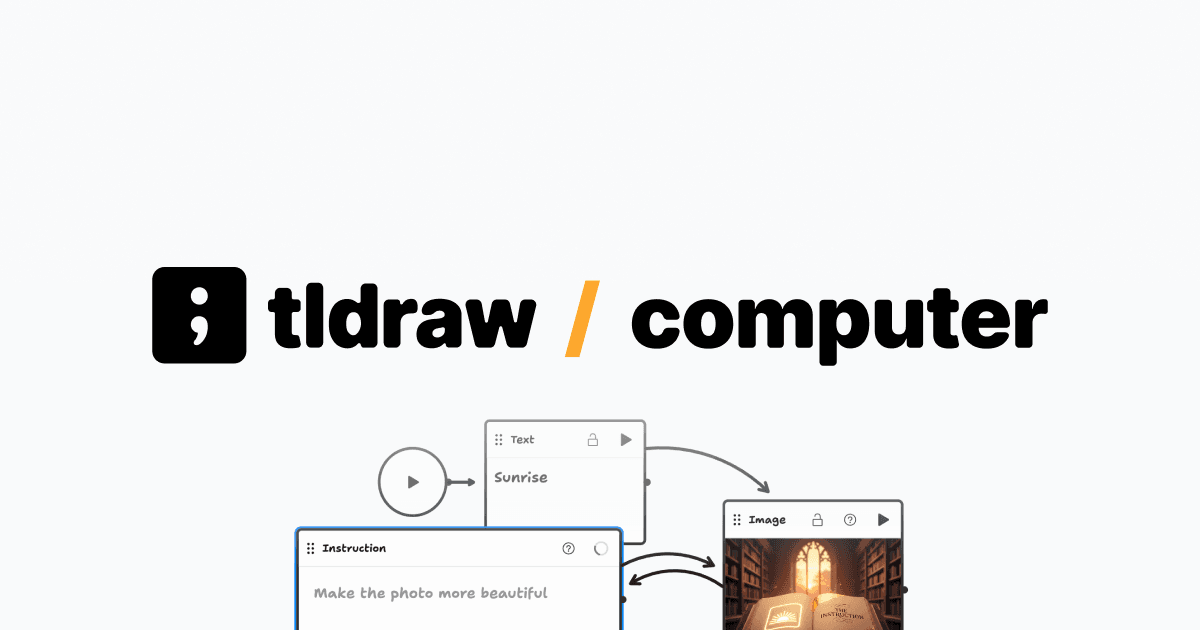
tldraw computer
tldraw computer offers a unique approach to visual computing, allowing users to create and connect interactive components on an infinite canvas. This browser-based tool integrates AI to enhance creations, providing a powerful platform for visual programming. It's designed for building visual programs, enabling users to develop interactive elements and link them together seamlessly. The free availability in the browser makes it accessible for anyone looking to explore visual programming and leverage AI in their projects, from simple interactive designs to more complex visual applications.
6thlabs
6thlabs is an AI & Tech Solutions Partner specializing in custom AI solutions and tech development for SaaS, startups, and software companies. They offer services like MVP development, rapid prototyping, scalable solutions, and user feedback integration to launch ideas quickly and cost-effectively. Their automation services streamline operations and boost productivity with intelligent automation solutions, including automating repetitive tasks and optimizing decision-making with AI. Additionally, 6thlabs provides software integrations for seamless business operations, covering CRM, custom API development, ERP system integration, and real-time data sync. They focus on empowering businesses through tailored web and mobile solutions and innovative AI technologies, driving efficiency and growth.
Aigility AI
Aigility AI is designed to help enterprises build and ship production-grade, privacy-first AI applications in minutes, not months. The platform aims to be a universal layer for fast, private, and domain-specific AI, eliminating trade-offs, data leaks, and brittle workflows. It focuses on uniting speed, privacy, domain intelligence, reliability, and reusability within a single platform. Aigility AI is currently in early access, with a focus on delivering enterprise-level AI solutions that are both efficient and secure, catering to the needs of businesses looking to integrate advanced AI capabilities without compromising data integrity or development timelines.
ai-cli
ai-cli is a command-line interface tool designed to enhance developer productivity by integrating ChatGPT directly into the terminal. Users can ask questions about CLI commands and receive instant answers, streamlining their workflow and reducing the need to switch contexts. The tool requires users to provide their own OpenAI API key, which can be easily configured using the `ai auth` command. It supports changing the default model preference, currently set to `gpt-3.5-turbo`, and offers an autocomplete feature for various shells. This makes it an efficient solution for developers seeking quick command assistance and explanations without leaving their terminal environment.

Playo
Playo is an innovative AI gameplay foundation model designed to revolutionize game development by generating full 3D games rapidly. This tool allows users to create intricate game environments and mechanics with unprecedented speed, claiming to produce a complete game in under one minute for just one dollar. Playo aims to significantly lower the barrier to entry for game development, making it accessible to a wider audience. By leveraging advanced AI, it streamlines the entire game creation process, from initial concept to a playable 3D game, enabling rapid prototyping and iteration for developers and enthusiasts alike. This focus on speed and cost-efficiency positions Playo as a powerful solution for quick game generation.

Harver
Harver offers predictive assessments and automated solutions designed to optimize the hiring process for businesses. The platform helps organizations identify and engage top talent more efficiently, reducing time to hire and improving the quality of hires. Harver's scientifically validated assessments pinpoint candidates with high potential, leading to a significant reduction in employee turnover. It also provides customizable automation to streamline candidate progression, reducing bias and saving resources. With robust business analytics, Harver delivers actionable insights at every stage of recruitment, supporting data-driven decision-making. The tool is particularly effective for volume hiring across various industries, including BPO, contact centers, retail, and tech.
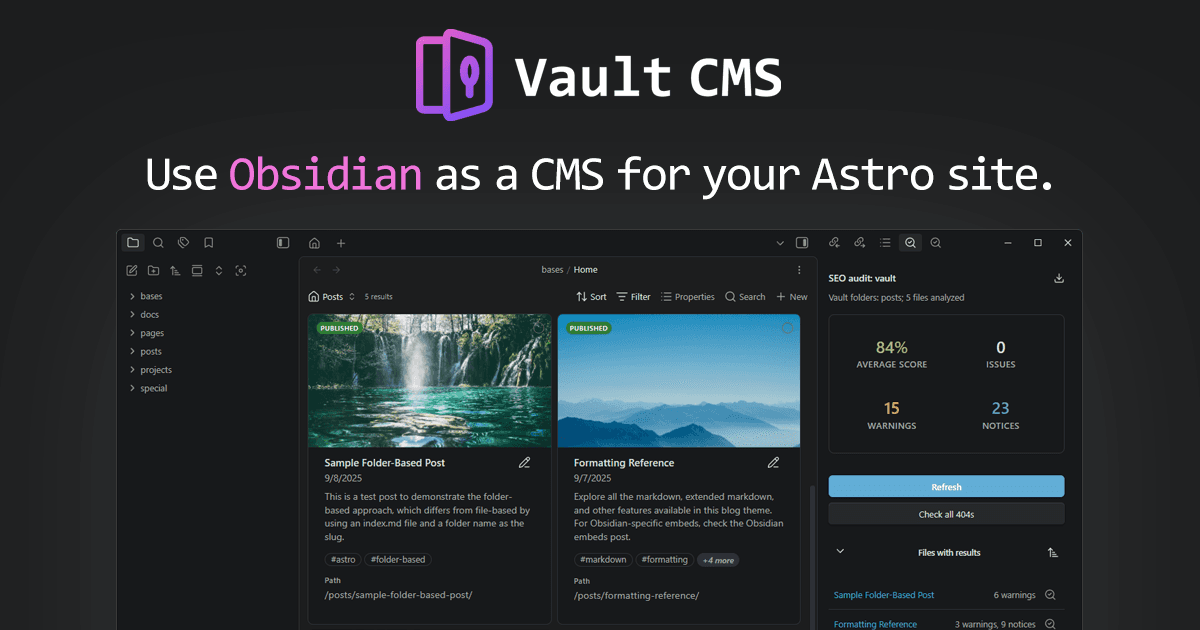
Vault CMS
Vault CMS enables developers and content creators to leverage Obsidian as a powerful content management system for their Astro websites. It allows content to remain in plain Markdown within the project's repository, eliminating the need for a separate CMS server. The system comes with preconfigured settings, plugins, and a setup wizard for quick installation. It offers a plug-and-play Astro blogging experience, emphasizing customization and modularity, and aims for visual parity between the Obsidian backend and the frontend. Vault CMS is compatible with most Astro themes, automatically detecting content types, frontmatter properties, and folder structures, and supports both flat and nested YAML properties with appropriate plugins.
SlowFast
PySlowFast is an open-source video understanding codebase developed by FAIR, designed to provide high-performance, lightweight PyTorch implementations of state-of-the-art video backbones. It supports various video understanding research tasks, including classification and detection, and is built for rapid implementation and evaluation of novel video research ideas. The repository features implementations of methods like SlowFast Networks, Non-local Neural Networks, X3D, Multiscale Vision Transformers (MViTv1 and MViTv2), Reversible Vision Transformers (Rev-ViT and Rev-MViT), and supports advanced techniques such as Multigrid Training, MAE for Video, and MaskFeat. It also includes a comprehensive model zoo with pre-trained models and baselines, along with visualization tools for analysis and inference.
swift-video-generator
swift-video-generator is an open-source library designed for developers and video creators to programmatically generate videos. It offers core functionalities such as combining individual images with audio tracks to create video segments, and the ability to merge multiple video files into a single output. This tool is particularly useful for automating video production workflows, allowing for efficient creation of video content from various media assets. Its open-source nature provides flexibility for customization and integration into existing development environments, catering to users who need a programmatic approach to video generation and editing.
TensorFlow-VAE-GAN-DRAW
TensorFlow-VAE-GAN-DRAW is an open-source collection of generative methods implemented using TensorFlow. This repository offers implementations of Deep Convolutional Generative Adversarial Networks (DCGAN), Variational Autoencoders (VAE), and DRAW: A Recurrent Neural Network For Image Generation. It allows users to experiment with and run these different generative models, providing a foundation for research and development in image generation. The project highlights that DCGANs produce decent results after 10 epochs with default parameters and outlines future enhancements like more complex data integration and replacing the current attention mechanism with a Spatial Transformer Layer.
tensorflow_template_application
tensorflow_template_application offers a versatile and generic template for deep learning projects built with TensorFlow. It is designed to streamline the development process by providing a structured foundation. The tool supports multiple data formats, including CSV, LIBSVM, and TFRecords, ensuring flexibility in data handling. Key features extend to prediction servers, leveraging TensorFlow Serving and a Python HTTP server, as well as prediction clients available in various programming languages. This comprehensive setup makes it suitable for developers looking to quickly deploy and manage deep learning models.
automagica
Automagica is an open-source project that began in 2018, aiming to make Robotic Process Automation (RPA) technologies accessible. It provides a comprehensive suite of tools for building and managing automated tasks, including Automagica Bot for runtime execution, Automagica Flow for visual automation design with Python support, and Automagica Wand for AI-powered UI element picking. The platform also features Automagica Lab, a Jupyter Notebook-based environment for automation development, and Automagica Portal for managing bots, credentials, and logs. While initially open-source, the project was acquired by Netcall plc in 2020, with existing services transitioning to commercial offerings. It supports a wide range of activities from cryptography and random data generation to browser automation, credential management, keyboard/mouse control, image processing, file operations, and integrations with applications like Word, Excel, and Outlook.
CyArt
The live website for CyArt currently displays a bot verification page, making it inaccessible to determine its core functionalities or offerings. Based on the stored description, CyArt is a center providing services in Cyber Security, Artificial Intelligence, Web Development, and Cloud Solutions. It offers industry-guided internships and aims to enhance the community by providing resources for IT sector journeys. Additionally, CyArt offers data operations services. However, without access to the live site, specific features, pricing, or target audience details cannot be confirmed.
.png&w=3840&q=75)
Remyx
Remyx AI is an experiment orchestration layer designed for AI teams, helping them systematically evolve AI applications. It integrates with existing development stacks to manage the full AI lifecycle, from observation and hypothesis generation to experimentation, analysis, and decision-making. Remyx learns from your codebase, recommends next steps, and turns every experiment result into context for future decisions. It helps AI engineers test more ideas and provides team leads with a portfolio view of all active experiments, ensuring every decision and its rationale is recorded for continuous improvement and knowledge sharing.
BMInf
BMInf (Big Model Inference) is an open-source toolkit designed to facilitate efficient inference for large-scale pretrained language models (PLMs). It enables the execution of models with over 10 billion parameters, even on low-resource hardware like a single NVIDIA GTX 1060 GPU. The tool offers significant performance improvements over existing PyTorch implementations, particularly for GPUs like V100 or A100. BMInf 2.0.0 introduced compatibility with any transformer-based model, making it a versatile solution for researchers and developers working with big AI models. It provides methods for automatic model conversion using `bminf.wrapper` or manual replacement of modules like `torch.nn.ModuleList` and `torch.nn.Linear` for optimized performance.
Codewise AI
Codewise AI is an AI tool designed to translate business requirements directly into functional code, centralizing development tools to streamline the entire workflow. It focuses on bridging the gap between high-level business needs and the technical implementation, aiming to accelerate the development process. The tool is intended to assist developers in generating code more efficiently and managing their development environment. While specific features are not detailed in the provided content, its core purpose revolves around enhancing productivity in coding by leveraging AI to understand and convert business logic into executable code.

EPROLO
EPROLO is a comprehensive, free-forever dropshipping platform designed to empower e-commerce entrepreneurs. It streamlines the entire dropshipping process, from global product sourcing across 107 niches to efficient order fulfillment with 5-15 day delivery times and a 30-day shipping guarantee. A key differentiator is its custom branding service, allowing users to add personalized labels, hangtags, and packaging with no minimum order quantity, helping build a strong brand identity from the first sale. EPROLO also offers 3PL warehousing in key global locations (US, UK, EU, China) to reduce shipping times and costs. With integrations for major e-commerce platforms and dedicated customer support, EPROLO aims to make online selling accessible and profitable for over 1.6 million dropshippers.
Picsellia
Picsellia is an end-to-end MLOps platform specifically designed for computer vision applications. It provides a comprehensive solution for managing the entire lifecycle of vision AI, from data collection and organization to model deployment and monitoring. Key features include a Datalake for centralizing visual data, advanced annotation tools with AI assistance, experiment tracking for model training, and robust deployment options. The platform supports various industries like manufacturing, agriculture, and energy, enabling teams to build and scale AI applications efficiently. Picsellia is ISO 27001 certified and offers flexible deployment options including cloud, on-premise, and hybrid configurations.
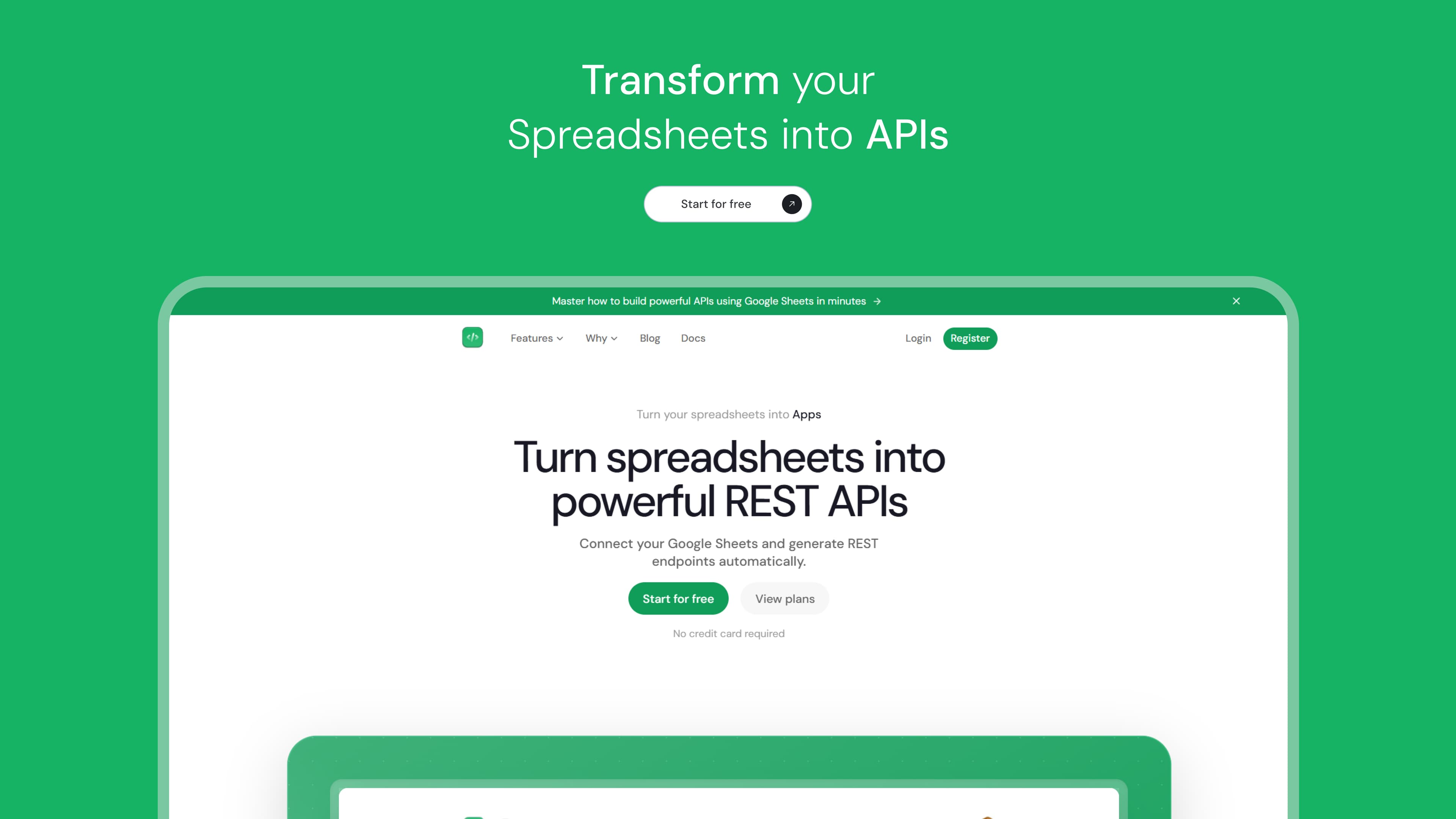
Sheetful
Sheetful is an API-as-a-Service platform designed to turn Google Sheets into high-performance REST APIs instantly. Users can connect their Google Sheets and automatically generate REST endpoints for GET, POST, PUT, and DELETE operations. This no-code solution allows spreadsheets to function as a database for web and mobile apps, no-code tools, or internal systems. Sheetful offers real-time analytics, smart spreadsheet endpoints, and live endpoint testing directly from the dashboard. It prioritizes data privacy and security, acting as a bridge to fetch data via Google's official API only when requested, and supports API Key authentication for secure access.
ViZDoom
ViZDoom is an open-source platform designed for developing AI bots that play the classic 1993 game Doom using only visual information from the screen buffer. It is primarily intended for research in machine visual learning and deep reinforcement learning. The tool offers a robust API for Python (including Gymnasium/Gym wrappers) and C++, supporting multi-platform deployment on Linux, macOS, and Windows. Key features include high performance (up to 7000 frames/steps per second), lightweight footprint, and easy creation of custom scenarios with visual editors and a powerful scripting language. Researchers can leverage its async and sync single-player/multiplayer modes, customizable rendering, access to depth and audio buffers, object labeling, and in-game data for advanced AI experimentation. ViZDoom is reinforcement learning friendly, suitable for learning from demonstration, apprenticeship learning, and inverse reinforcement learning.
CaptureKit
CaptureKit offers a robust Screenshot API designed for developers to automate website screenshots, content extraction, and AI analysis. It enables users to capture pixel-perfect images in various formats like PNG, JPEG, WebP, or PDF, with options for full-page capture, CSS selector targeting, and device emulation. Beyond screenshots, CaptureKit can extract metadata, links, clean Markdown, or HTML from any URL, and integrate AI analysis for summaries, categories, and contact signals. The platform boasts edge caching, fast response times, and a global infrastructure that handles headless browsers and scaling, allowing developers to focus on their applications rather than browser management. It integrates with popular tools like Zapier, n8n, Make, and various LLMs, making it versatile for different workflows.

AppSteer
AppSteer is a powerful low-code/no-code platform designed for building enterprise-grade applications quickly and efficiently. It integrates Agentic AI to transform data into actionable insights, automate tasks, and generate powerful dashboards, helping businesses make smarter, faster decisions. The platform offers a library of pre-customized applications and pre-built templates, along with 100 hours of free assistance to streamline development. AppSteer supports seamless integration with existing APIs and various third-party services, making it adaptable to diverse business needs. It caters to businesses of all sizes, from startups to large enterprises, providing scalable and reliable solutions for various industries including healthcare, education, FinTech, and retail.