
Coding & Development
Browsing page 336 of AI tools for Coding & Development. Sorted by confidence score — our independent quality rating.

PIRender
PIRender is an open-source tool for controllable portrait image generation, based on the ICCV2021 paper "PIRenderer: Controllable Portrait Image Generation via Semantic Neural Rendering." It allows users to synthesize portrait images by intuitively controlling face motions with fully disentangled 3DMM parameters. This model can be applied to various tasks including intuitive portrait image editing, pose and expression alignment, motion imitation, same and cross-identity reenactment, and audio-driven facial reenactment. The project provides source code for PyTorch, detailed installation instructions, and guidance on dataset preparation using VoxCeleb. It also includes scripts for inference, intuitive control, and training, making it a comprehensive resource for researchers and developers in the field of neural rendering.
gptel
gptel is a versatile Large Language Model chat client designed for Emacs, offering seamless integration with various LLM providers and backends. It functions within any Emacs buffer, enabling users to interact with LLMs for tasks like code rewriting, content generation, and more. Key features include support for multiple independent conversations, tool-use for agentic capabilities, and multi-modal input. Users can save and resume chat sessions, inspect and modify queries before sending, and leverage Model Context Protocol (MCP) integration. gptel supports a wide array of LLM services, including OpenAI, Anthropic, Gemini, Ollama, and many others, making it a flexible solution for developers and technical users who prefer to stay within their Emacs environment.
Shipixen
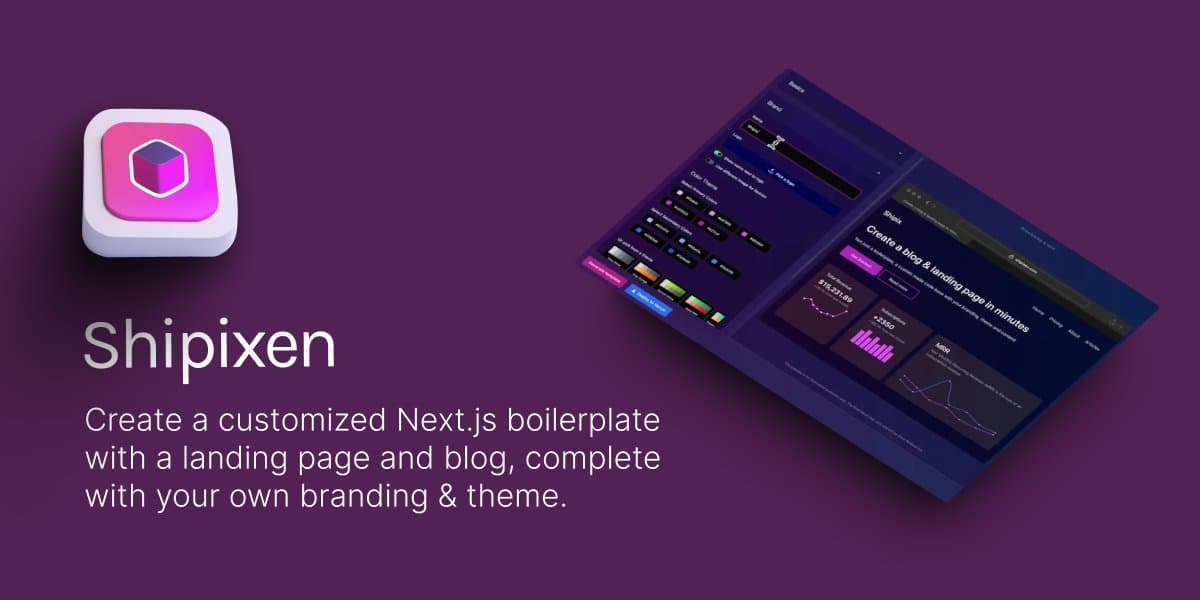
Shipixen is an application designed to streamline the development and deployment of Next.js 15 applications. It allows users to generate custom codebases, including an MDX blog, with features like TypeScript, Shadcn UI, and pre-built components. The tool focuses on providing SEO-optimized, responsive, and performant code, saving developers hundreds of hours on setup. Users can choose from various templates and components inspired by high-converting SaaS landing pages. Shipixen offers a one-time purchase model, providing unlimited codebases and free updates, ensuring users own their code without subscriptions or lock-in. It also includes AI content generation capabilities and 1-click deployment to platforms like Vercel.
alibi
Alibi is a source-available Python library designed for machine learning model inspection and interpretation. It offers high-quality implementations of black-box, white-box, local, and global explanation methods for both classification and regression models. The library supports diverse explanation techniques such as Anchor explanations, Integrated Gradients, Counterfactual examples, Accumulated Local Effects, Kernel SHAP, and Tree SHAP. It also includes algorithms for model confidence and prototype generation. Alibi can be installed via PyPI, GitHub source, or Anaconda, with options for distributed computation and SHAP support. Its API is inspired by scikit-learn, featuring distinct initialize, fit, and explain steps, making it a valuable tool for developers and data scientists seeking to understand and debug their machine learning models.
proxylessnas
proxylessnas is an open-source tool designed for direct neural architecture search, enabling efficient optimization of deep learning models on target tasks and hardware. It eliminates the need for proxy tasks, directly searching for optimal architectures. The tool is integrated into popular platforms like PytorchHub, Microsoft NNI, and Amazon AutoGluon, making it accessible for various development environments. Notably, proxylessnas achieved first place in the Visual Wake Words Challenge at CVPR 2019, demonstrating its effectiveness in specialized applications. It supports specialization of architectures for different platforms, such as CPU, GPU, and mobile devices, to fully exploit efficiency.
DenoisingDiffusionProbabilityModel-ddpm-
DenoisingDiffusionProbabilityModel-ddpm- is an open-source implementation of the Denoising Diffusion Probability Model (DDPM). This tool provides a straightforward way for developers and researchers to train a UNet model on the CIFAR-10 dataset. Users can directly run `Main.py` to initiate training and then adjust model configurations to visualize the denoising process. The repository also includes `MainCondition.py` for training with Classifier-free guidance. Pre-trained weights for CIFAR-10 are available, and the project references key papers and blogs for deeper understanding of DDPM frameworks, making it an accessible resource for learning and experimentation in diffusion models.
camel_tools
camel_tools is a comprehensive, open-source Python toolkit developed by the CAMeL Lab at New York University Abu Dhabi, specifically designed for Arabic natural language processing. It offers a wide array of functionalities including text pre-processing, advanced morphological modeling, and specialized components for Dialect Identification, Named Entity Recognition, and Sentiment Analysis. The tool is built to be accessible for researchers and developers, with clear installation instructions for various operating systems like Linux, macOS, and Windows. It also provides options for installing necessary data packages, making it a robust solution for anyone working with the complexities of the Arabic language in NLP tasks.
TPVFormer
TPVFormer is an academic project offering a Tri-Perspective View (TPV) representation for vision-based 3D semantic occupancy prediction, serving as an alternative to Tesla's Occupancy Network for autonomous driving research. It addresses the limitations of traditional bird's-eye-view (BEV) representations by incorporating two additional perpendicular planes, allowing for a more fine-grained description of 3D scenes. The tool features a transformer-based TPV encoder (TPVFormer) to effectively obtain TPV features by aggregating image features. It demonstrates that camera inputs alone can achieve performance comparable to LiDAR-based methods on LiDAR segmentation tasks. The project also includes resources for semantic scene completion and comparisons with Tesla's Occupancy Network.
eli5
eli5 is a Python package designed to help debug and inspect machine learning classifiers, providing explanations for their predictions. It supports a wide range of machine learning frameworks, including scikit-learn, Keras (for Grad-CAM visualizations), xgboost, LightGBM, CatBoost, and lightning. The library can explain weights and predictions of linear classifiers, print decision trees, show feature importances, and debug scikit-learn pipelines. Additionally, eli5 implements algorithms for inspecting black-box models, such as TextExplainer for LIME-based explanations and permutation importance for feature importances. Explanations can be formatted for console display, HTML embedding, pandas DataFrames, or JSON for custom rendering.
SwanLab
SwanLab is an open-source, modern-design AI training tracking and visualization tool built for AI model training teams. It provides comprehensive features for experiment analysis, metric observation, and collaboration. Researchers can track key metrics, record hyperparameters, and visualize training processes through an intuitive UI, helping to identify issues and accelerate model iteration. SwanLab supports a wide range of data types including scalar metrics, images, audio, text, video, 3D point clouds, and biochemical molecules, along with various chart types like line, media, bar, and custom ECharts. It offers both cloud and self-hosted deployment options and integrates with over 50 mainstream frameworks, including PyTorch, Transformers, and Keras. Key functionalities include experiment comparison, multi-person collaboration, hardware monitoring, and an open API for extended capabilities.
Dev AI-Code Editor & Generator
Dev AI, offered by iTech Gemini, serves as a comprehensive coding companion designed to enhance developer productivity and efficiency. This tool assists users in various coding tasks, including generating code snippets, debugging existing code, and providing answers to programming questions. It aims to help developers grow their skills by offering expert assistance and troubleshooting capabilities. While the primary focus is on coding, iTech Gemini also specializes in connecting businesses with remote AI developers for staff augmentation, generative AI development, LLM fine-tuning, and OpenAI/Claude API integration, indicating a broader expertise in AI solutions beyond just the Dev AI tool.
Tempo new
Tempo is an AI-powered platform designed to accelerate React application development by fostering collaboration between designers and developers. It enables users to visually edit React code using a drag-and-drop interface, similar to a design tool, while also providing direct code access and customization. The platform supports building and maintaining design systems by allowing import from Storybook or generating custom libraries. Developers can integrate their existing React codebases, edit locally with VSCode, and push changes to GitHub, ensuring full control over their projects. Tempo offers various plans, including a free tier, and an Agent+ plan where human engineers and designers build features for users.
WeDLM
WeDLM is an open-source diffusion language model developed by Tencent, designed for high-speed inference. It uniquely reconciles diffusion language models with standard causal attention, enabling native KV cache compatibility with technologies like FlashAttention and PagedAttention. This approach allows for direct initialization from pre-trained autoregressive models such as Qwen2.5 and Qwen3, delivering significant real speedups compared to vLLM-optimized baselines. WeDLM achieves 3-6x speedup on tasks like math reasoning and up to 10x on sequential/counting tasks, while maintaining competitive accuracy. It includes an inference engine, evaluation suite, and a fine-tuning framework, making it a powerful tool for developers and researchers focused on efficient language model deployment.
prompt-layer-library
PromptLayer is a robust AI development tool designed for prompt engineers and developers working with large language models. It functions as middleware, seamlessly integrating with the OpenAI Python library to log and manage all API requests and prompts. Users can track, debug, and replay past completions, offering a comprehensive solution for prompt versioning, testing, and monitoring. The library provides convenient access to the PromptLayer API, allowing for prompt template retrieval, listing, publishing, and cache invalidation. It also includes features for manual request logging, request annotation with metadata, prompt linkage, scores, and groups, and even a decorator for tracing custom functions. With support for both synchronous and asynchronous operations, PromptLayer streamlines the development workflow for AI applications.
ralphy
ralphy is an open-source autonomous bash script engineered to automate the completion of Product Requirements Documents (PRDs) by leveraging various AI agents. It integrates powerful AI models such as Claude Code, Codex, and Qwen, running them in a continuous loop to iteratively refine and generate code based on the PRD specifications. This tool aims to streamline the development workflow by automating significant portions of the coding process, reducing manual effort and accelerating project timelines. Developers can install ralphy via npm or by directly cloning its repository, making it accessible for integration into existing development environments. Its core functionality revolves around continuous AI iteration, ensuring that the generated code aligns closely with the evolving requirements outlined in the PRD.

JetBrains
JetBrains AI offers a suite of intelligent coding assistance and AI solutions designed to transform software development. It integrates seamlessly into JetBrains' popular IDEs, providing developers with advanced tools to improve code quality, accelerate development workflows, and enhance overall productivity. The platform leverages AI to offer features such as smart code completion, debugging assistance, and refactoring suggestions. JetBrains AI aims to empower developers with cutting-edge technology, enabling them to write better code faster and more efficiently. This includes a focus on intelligent features that adapt to individual coding styles and project requirements, making it an invaluable asset for modern software teams.
dask-ml
Dask-ML is an open-source Python library designed for scalable machine learning, leveraging the power of Dask for parallel computing. It allows data scientists and machine learning engineers to efficiently process large datasets and execute complex ML tasks across distributed environments. The library seamlessly integrates with established machine learning frameworks such as Scikit-Learn and XGBoost, extending their capabilities to handle larger-than-memory datasets and distributed computations. This makes Dask-ML an invaluable tool for developing and deploying machine learning models in scenarios requiring high scalability and performance, facilitating robust and efficient data science workflows.
dalai
Dalai is an open-source AI development tool designed to simplify running LLaMA and Alpaca large language models directly on a local machine. It eliminates the need for cloud services, making it accessible for developers and AI enthusiasts to experiment with these powerful models. The tool is cross-platform, supporting Linux, Mac, and Windows, and includes a hackable web application. Dalai ships with both JavaScript and Socket.io APIs, allowing for programmatic installation, model requests, and server management. It provides clear instructions for installation and usage, including memory and disk space requirements for various model sizes, making it a practical solution for local LLM deployment.

Ludo.ai
Ludo.ai is an AI-powered platform designed to assist game developers in every stage of game creation, from ideation to asset generation and market analysis. It offers a comprehensive suite of AI tools including a Sprite Generator, Image Generator, 3D Asset Generator, Audio Generator, Video Generator, and Playable Generator, enabling users to quickly create visual and audio assets, and even interactive prototypes. The platform also features tools like the Game Ideator, Ludo Score, Market Trends, and Idea Pathfinder to help validate concepts and discover market opportunities. With its Project tool and Ask Ludo AI companion, it facilitates collaborative game design and research, making it an all-in-one solution for indie developers and studios alike.
Kane AI
Kane AI, developed by TestMu AI (formerly LambdaTest), is a pioneering GenAI-native testing agent designed for high-speed Quality Engineering teams. It empowers users to plan, author, and evolve end-to-end tests using natural language, eliminating the need for complex coding. The tool supports testing across various layers including databases, APIs, and accessibility, and can generate structured test cases from diverse inputs like text, JIRA tickets, PRDs, PDFs, images, audio, and spreadsheets. Kane AI also features real-time network checks, pixel-perfect validation, and built-in accessibility testing. Its 'human in the loop' functionality allows for manual interaction recording and plan approval, ensuring AI-created tests align with user intent. It also offers intelligent and modular test building, adapting to different environments and real-world conditions.
sleap
SLEAP is an open-source deep learning framework specifically designed for multi-animal pose tracking. It allows researchers to accurately track and analyze the movements and interactions of various animals in video footage. The tool features an intuitive graphical user interface (GUI) that supports active learning and proofreading, significantly speeding up the labeling process for large datasets. SLEAP offers both single- and multi-animal pose estimation with flexible training strategies and customizable neural network architectures. It boasts fast training times, typically 15-60 minutes on a single GPU, and rapid inference speeds of up to 600+ FPS for batch processing, with less than 10ms latency for real-time applications. The framework also includes a flexible developer API for building integrated applications and customizations, and supports remote training/inference workflows without requiring GPUs.
feathr
Feathr is a scalable, unified data and AI engineering platform widely used in production at LinkedIn and now an open-source project under the LF AI & Data Foundation. It allows users to define data and feature transformations using Pythonic APIs, register these transformations, and share them across teams. Particularly useful for AI modeling, Feathr automatically computes and joins feature transformations to training data with point-in-time correctness to prevent data leakage. It supports materializing and deploying features for online production use, offers native cloud integration with scalable architecture, and has been battle-tested for over six years. Feathr handles billions of rows and petabyte-scale data with built-in optimizations, providing rich transformation APIs including time-based aggregations and sliding window joins. It also features a built-in registry for feature reuse and an intuitive UI for searching and exploring features and their lineages.
tensorflow_template_application
tensorflow_template_application offers a versatile and generic template for deep learning projects built with TensorFlow. It is designed to streamline the development process by providing a structured foundation. The tool supports multiple data formats, including CSV, LIBSVM, and TFRecords, ensuring flexibility in data handling. Key features extend to prediction servers, leveraging TensorFlow Serving and a Python HTTP server, as well as prediction clients available in various programming languages. This comprehensive setup makes it suitable for developers looking to quickly deploy and manage deep learning models.
VividTalk
VividTalk is an open-source project designed for one-shot audio-driven talking head generation. It leverages a 3D hybrid prior to produce realistic facial animations directly from audio input. This tool is particularly suitable for researchers and developers working in AI-driven video synthesis and deepfake creation, offering a foundation for exploring advanced animation techniques. As a GitHub repository, it provides the code and resources for users to implement and experiment with the technology, making it a valuable asset for those interested in the technical aspects of generating dynamic talking head videos.