
Coding & Development
Browsing page 339 of AI tools for Coding & Development. Sorted by confidence score — our independent quality rating.

QR Code Scanner & AI Generator
QR Code Scanner & AI Generator is a versatile mobile application designed for both scanning and creating QR codes and barcodes. Users can easily scan codes by pointing their camera, with features to help optimize scanning conditions like distance and lighting. The app also supports scanning codes from images stored in the phone's gallery. For creation, users can generate new QR codes by selecting a format and filling in the necessary details, which remain static and active indefinitely. The app includes a history section to view all scanned codes and offers options to delete or export scan history in CSV format. It also provides settings for managing sound notifications during scanning and subscription management.

Dog Identifier
Dog Identifier is an AI-powered mobile application designed to enhance the experience of dog owners and enthusiasts. It utilizes advanced AI, trained on thousands of dog images, to accurately identify purebred and mixed-breed dogs from photos. Beyond breed identification, the app includes a 'Dog Voice Translator' (Beta) feature that analyzes dog vocalizations to interpret their mood, such as 'excited' or 'anxious'. An intelligent assistant called 'Diffy AI' is also integrated, providing answers to questions about dog behavior, nutrition, and health, even supporting image-based queries. The app fosters a community through its 'Dog Feed' feature, allowing users to share photos, identification results, and connect with other dog lovers globally. It is available on both Android and iOS devices.

Lumie: AI Reading Tutor
Lumie is an affordable AI reading tutor designed to help children in grades K-5 learn to read and enjoy the process. It leverages artificial intelligence to craft personalized stories around a child's favorite interests, such as Minecraft or Spidey, and then adapts the reading level as they progress. The app provides daily 10-minute lessons, with most families seeing measurable improvement in just two weeks. Lumie also features an AI reading buddy that reads alongside the child, assists with difficult words, and celebrates their achievements, making reading feel like play. Built by alumni from leading educational institutions, Lumie aims to address the national reading crisis by making learning engaging and accessible.
speech
Speech is an open-source Python package designed to facilitate research and development in end-to-end models for automatic speech recognition (ASR). It provides implementations of various ASR architectures, including sequence-to-sequence models with attention mechanisms, Connectionist Temporal Classification (CTC), and the RNN Sequence Transducer. Built on PyTorch, this tool allows researchers and developers to experiment with and build advanced speech-to-text systems. The software is specifically tested for Python 3.6 and does not provide backward compatibility for Python 2.7, ensuring a modern development environment. It includes examples for model configurations and datasets, making it easier to get started with training and evaluating ASR models.

Iconify
Iconify is a comprehensive ecosystem designed to simplify icon management for both developers and designers. It offers access to over 275,000 open-source vector icons from more than 200 icon sets, all meticulously cleaned, optimized, and regularly updated. The platform provides a unified framework, allowing users to integrate icons seamlessly into web projects using SVG + CSS, HTML, Vue, React, Svelte, and other frameworks. For designers, Iconify offers plugins for popular UI design tools like Figma, Penpot, and Sketch, enabling easy browsing and import of icons. Beyond just providing icons, Iconify includes robust tools for importing, exporting, processing, and organizing icon sets, along with a public API for on-demand icon data and SVG/CSS generation.
Upscale-A-Video
Upscale-A-Video is an open-source, diffusion-based model designed for real-world video super-resolution, enhancing video quality with temporal consistency. Developed by S-Lab at Nanyang Technological University and presented at CVPR 2024, this tool takes low-resolution videos and text prompts as inputs to generate high-resolution outputs. It provides inference code for various video types, including AIGC videos, old movies, and animations. Users can also address color discrepancies with options like "AdaIn" or "Wavelet" color fixes. The project includes the YouHQ dataset, comprising over 38,000 videos for training and 40 for evaluation, making it a valuable resource for researchers and developers in the video processing domain.

Redbean: AI Town, AI Gamemaker
Redbean AI is an all-in-one platform designed for creating living original characters (OCs) and interactive pixel art games without requiring any coding knowledge. Users can design characters with unique personalities, memories, and movement capabilities, then explore their stories within a game environment. The platform facilitates the building of interactive scenes and allows for roleplaying with AI-powered NPCs that understand context and emotion. Redbean AI aims to transform user imagination into a dynamic, living community, offering a no-code game builder, AI character creator, interactive storytelling features, and pixel art generation. It's available on web, iOS, and Android, making game creation accessible to a broad audience.

Promptly - AI Prompt Generator
Promptly - AI Prompt Generator is an iOS mobile app designed to simplify and enhance the creation of AI prompts. This tool assists users in generating optimized prompts for a wide range of creative tasks, making AI interaction more efficient and effective. Featuring 'Lee,' a personal robot translator, the app transforms user ideas into powerful and precise prompts suitable for various AI models. By streamlining the prompt engineering process directly from a mobile device, Promptly aims to unlock limitless imagination and creativity for its users. It provides a convenient way to refine and optimize AI inputs, ensuring better and more relevant outputs from AI systems.
NAX Group
NAX Group offers an enterprise AI software platform designed to streamline the development and deployment of custom AI applications. The platform focuses on leveraging automation to build, deploy, and run these applications efficiently. This approach aims to significantly reduce operational costs, accelerate the time it takes for businesses to realize value from their AI investments, and ultimately create a competitive advantage. By providing a comprehensive solution for managing the AI lifecycle, NAX Group enables organizations to integrate advanced AI capabilities into their operations without extensive manual intervention, fostering innovation and efficiency across various business functions.

Launchpad Stack
Launchpad Stack is a full-stack development tool designed to streamline the process of generating custom code for web applications. Users answer questions about their preferred technologies, project goals, and configuration preferences. The tool then custom-generates a suite of inter-operable code packages covering infrastructure, application, CI/CD pipeline, monitoring, and security. This code is 100% owned by the user with no restrictive licenses. Launchpad Stack aims to provide the flexibility and savings of Infrastructure as a Service (IaaS) with the speed and experience of a Platform as a Service (PaaS), offering a one-time payment model rather than recurring subscriptions. It sets secure, best-practice defaults for various tech stack components, including authentication, alerting, and a modern UI.
pipelines
Kubeflow Pipelines is a core component of the Kubeflow platform, designed to simplify and scale machine learning (ML) workflows on Kubernetes. It provides end-to-end orchestration capabilities, making it easier to build, deploy, and manage complex ML pipelines. The service focuses on enabling easy experimentation, allowing users to quickly iterate on ideas and manage various trials. Furthermore, it promotes re-use of components and pipelines, accelerating the development of ML solutions without constant rebuilding. Kubeflow Pipelines leverages Argo Workflows for orchestrating Kubernetes resources and offers a Python SDK for defining pipelines, along with comprehensive API documentation.

Tessl
Tessl is an agent enablement platform designed to help teams build reliable AI-native software. It functions as a package manager for agent skills and context, allowing developers to find, install, version, and evaluate the skills their coding agents rely on. This ensures agents behave consistently across various tools and projects. Tessl enables organizations to turn internal APIs, libraries, and conventions into agent-usable skills, documentation, and rules, reducing retries and review cycles. The platform also provides evaluation capabilities to test skills against structured best practices and real-world scenarios, preventing regressions as systems evolve. By offering a single source of truth for skills and context, Tessl promotes reusability across agents, models, and development environments, avoiding lock-in and ensuring consistent behavior.
Cosine AI
Cosine AI is an advanced AI software engineering agent designed to streamline complex coding tasks without compromising maintainability or visibility. It operates across desktop, cloud, and terminal environments, integrating seamlessly into existing workflows. Cosine AI utilizes its proprietary Lumen models, optimized for production-first coding, focusing on maintainable, readable, and production-quality outputs rather than bloated code. It excels at reasoning across intricate architectures, legacy infrastructure, and diverse codebases, including enterprise and niche languages like COBOL, Fortran, Verilog, Rust, and complex SQL. The platform supports the entire SDLC, from work scoping and development to testing and deployment, offering flexible deployment options including public cloud, dedicated tenant, and fully air-gapped solutions for stringent security requirements.

The9 AI-Generate Games with AI
The9 AI-Generate Games with AI is an innovative platform that revolutionizes game development by making it accessible to everyone, regardless of technical background. Users can simply describe their game idea in natural language, and the AI will generate a complete, playable game in seconds, eliminating the need for coding. The platform also fosters a global community where creators can publish their games, share them with millions of players worldwide, and receive feedback. Additionally, users can discover, clone, and modify games created by others, promoting learning and collaborative creativity. Powered by cutting-edge AI models, The9 AI delivers stunning visuals and engaging gameplay experiences, transforming ideas into reality instantly.
text-to-image
text-to-image is an experimental TensorFlow implementation for synthesizing images from captions. This open-source tool leverages Skip Thought Vectors to understand the textual input and the GAN-CLS (Generative Adversarial Network - Conditional Latent Space) algorithm to generate corresponding images. It allows users to create images based on descriptive text, with the model currently trained on the flowers dataset. The implementation provides options for data processing, training with customizable parameters like noise dimension, batch size, and learning rate, and generating images from user-provided captions. It's a valuable resource for researchers and developers interested in the mechanics of text-to-image synthesis.
Lintrule
Lintrule is a command-line interface (CLI) tool designed to leverage large language models (LLMs) for automated code reviews. It allows developers to define custom rules in plain language, written as Markdown files, to enforce coding policies, identify potential bugs, and ensure compliance standards like SOC2. The tool integrates with Git, running checks on diffs by default, and can be configured to run on specific branches or commit ranges. Lintrule supports parallel rule execution for speed and offers flexibility in configuring rules to apply only to certain file types. It aims to enhance code quality and efficiency by automating aspects of the code review process that traditional linters or manual reviews might miss.
TensorLayer
TensorLayer is a powerful, open-source deep learning and reinforcement learning library built for scientists and engineers. It offers an extensive collection of customizable neural layers, enabling rapid development of advanced AI models. Inspired by PyTorch, TensorLayer provides transparent and flexible APIs, making it easier to build and train complex AI models compared to other TensorFlow wrappers. It supports multiple backends including TensorFlow, PyTorch, MindSpore, PaddlePaddle, OneFlow, and Jittor, allowing deployment on various hardware like Nvidia-GPU and Huawei-Ascend. The library is recognized for its simplicity, flexibility, and high performance, with comprehensive documentation and a large community.

Mojo AI
Mojo AI offers an AI-powered safety management platform designed for the construction and oil & gas sectors. Its flagship product, Safety Mojo, streamlines safety processes by unifying risk, compliance, and frontline data across projects, trades, and crews. Key features include AI-scored Pre-Task Plans (PTP/JSA) for quality and risk coverage, conversational AI tools like Ask Mojo, and multilingual support. The platform automatically generates OSHA 300/301/300A logs, TRIR, DART, and lost-time reports from submitted forms and field data. It also provides real-time dashboards for visibility across sites, allowing users to prioritize audits and identify high-risk work. Mojo AI helps meet OCIP data requirements and integrates with other software via API.
XcodeLLMEligible
XcodeLLMEligible is an open-source project designed to enable Xcode LLM, Apple Intelligence, and iPhone Mirroring functionalities on macOS versions and hardware configurations that are not officially supported by Apple. The tool achieves this by overriding Darwin eligibility checks, offering two primary methods: a 'util tool' method that requires a one-time SIP disable and boot-arg modification, and an 'override file' method that does not require SIP to be disabled at all. It supports macOS 15.0 - 15.3.1 and has been tested with XcodeLLM, Apple Intelligence, and ChatGPT integration on Mac mini (M4 Pro, 2024) running macOS 15.2. The project is intended for learning and research purposes, allowing users to permanently access these features on their Macs.
speech-to-text-wavenet
Speech-to-Text-WaveNet is an open-source project offering an end-to-end sentence-level English speech recognition system. Built upon DeepMind's WaveNet architecture and implemented with TensorFlow, this tool provides a robust foundation for researchers and developers in the field of audio processing. It allows users to train and test speech recognition models using datasets like VCTK, LibriSpeech, and TEDLIUM. Key features include pre-processing audio data into MFCC features, training with CTC loss, and transforming speech wave files into English text. The project also highlights areas for future development, such as integrating language models and supporting polyglot recognition, making it a valuable resource for advancing speech AI.
Fewsats
Fewsats is a serverless platform designed to simplify the monetization of digital services. It allows users to easily deploy paywall offerings and monetize various digital assets such as storage, data, and functionalities. The platform prioritizes security and efficiency by utilizing industry-standard cryptography and the Lightning Network for secure, instant payments. Additionally, Fewsats is built with an AI-friendly infrastructure, making it suitable for integrating and monetizing AI-powered services and applications. This focus on secure, instant transactions and AI compatibility positions Fewsats as a robust solution for developers looking to monetize their digital creations.
GhostCoder
GhostCoder is an AI-powered coding assistant designed to help users excel in technical interviews and solve LeetCode problems. It offers discreet, undetectable assistance during live coding sessions, ensuring privacy by running locally with user-supplied AI API keys. The tool features click-free interaction and global hotkeys, eliminating the need for key presses or mouse clicks, making it invisible during screen sharing. It supports major AI platforms like OpenAI, Google Gemini, and Anthropic Claude, allowing users to leverage their own API keys and only pay for their AI usage. GhostCoder is offered as a one-time purchase, providing unlimited use on a single device with no subscriptions or hidden fees, and includes one year of free updates.
SolidGPT
SolidGPT is an AI searching assistant specifically designed for developers, facilitating efficient code and workspace semantic search. It helps developers quickly find relevant information within their codebase and Notion documents, eliminating the need for constant context switching. The tool is available as a VSCode Extension, offering a seamless integration into the development workflow. Users can onboard their codebase and Notion pages, then ask questions to get instant answers, saving time on hunting for code or documentation. SolidGPT emphasizes data safety, stating it does not collect user data and uses OpenAI series models, requiring users to agree to OpenAI's terms of use.
Supadex
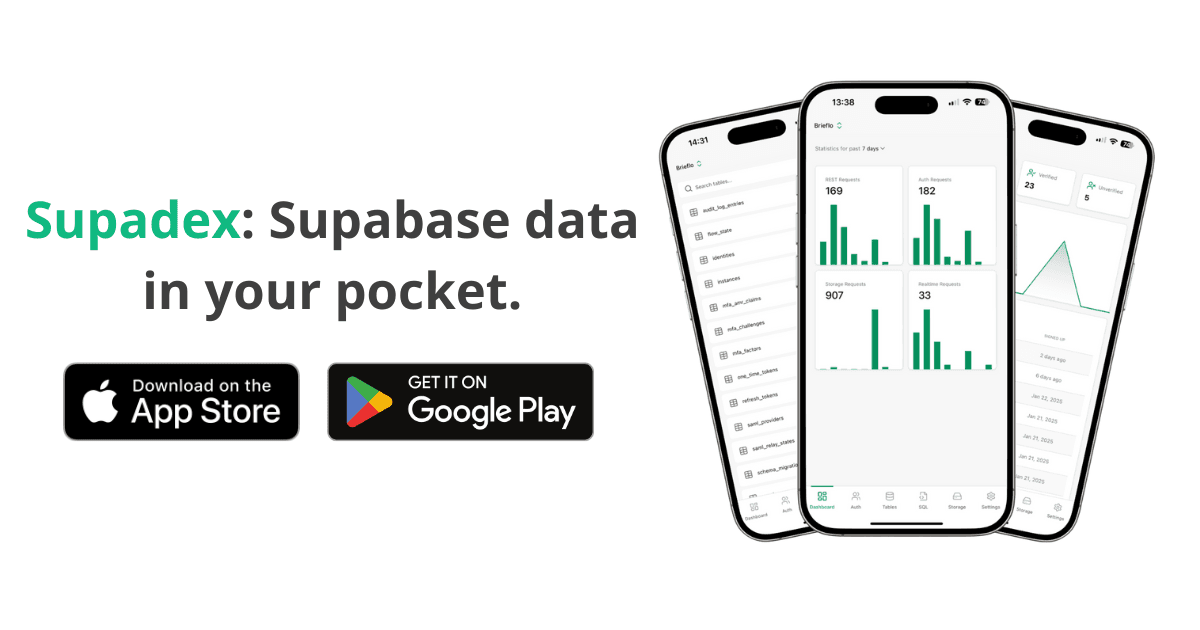
Supadex is a mobile application designed to provide a comprehensive dashboard for Supabase projects. It enables users to manage databases, track key metrics, and monitor project performance from anywhere, anytime. The tool offers real-time statistics, including requests count, authentication statistics, and storage usage. Users can browse schemas, tables, and storage buckets, explore detailed views of tables and rows, and preview files. Supadex also features a SQL Editor for writing and executing queries, along with the ability to save favorite Supabase queries. It ensures data security by storing API tokens encrypted on the user's device only, never transmitting them to external servers. The app supports managing multiple Supabase projects, allowing easy switching between them.