
Coding & Development
Browsing page 344 of AI tools for Coding & Development. Sorted by confidence score — our independent quality rating.

candle-vllm
candle-vllm offers an efficient and easy-to-use platform for inference and serving local Large Language Models (LLMs), featuring an OpenAI-compatible API server. Its highly extensible trait-based system allows for rapid implementation of new module pipelines, and it supports streaming during generation. Key capabilities include efficient management of key-value cache with PagedAttention, continuous batching for incoming requests, and in-situ quantization (including GPTQ/Marlin 4-bit formats). The platform supports various hardware, including Mac/Metal devices, and offers multi-GPU and multi-node inference. It also features chunked prefilling, CUDA Graph support, and an OpenAI-compatible tool calling API, making it a versatile solution for deploying and managing LLMs.
MM-EUREKA
MM-EUREKA is a cutting-edge project exploring the frontiers of multimodal reasoning through rule-based reinforcement learning. It introduces powerful models such as MM-Eureka-Qwen-7B and MM-Eureka-Qwen-32B, which significantly advance performance in multidisciplinary K12 and mathematical reasoning tasks. The project has iterated on model architecture, algorithms, and data, moving from InternVL to the more robust Qwen2.5-VL base models. Key improvements include enhanced online filtering, adaptive online rollout adjustment (ADORA), and novel RL algorithms like Clipped Policy Gradient Optimization with Policy Drift (CPGD). MM-EUREKA also open-sources a comprehensive pipeline, including self-collected MMK12 datasets, to foster further research and development in multimodal AI.
ai-reference-models
Intel® AI Reference Models is a repository that provides Intel optimizations for running deep learning workloads on Intel® Xeon® Scalable processors and Intel® Data Center GPUs. It includes links to pre-trained models, sample scripts, best practices, and step-by-step tutorials for popular open-source machine learning models. The project aims to quickly replicate complete software environments that demonstrate the best-known performance of various model/dataset combinations, showcasing the AI capabilities of Intel platforms. While the project has reached the end of its active development, with v3.4.0 being the last release with new features, it will be archived in March 2026, with critical vulnerability fixes until then. Users can refer to Intel® Extension for PyTorch* and Intel® Extension for OpenXLA* projects for alternatives.
sentencepiece
SentencePiece is an unsupervised text tokenizer and detokenizer primarily designed for Neural Network-based text generation systems where the vocabulary size is predetermined. It implements subword units such as byte-pair-encoding (BPE) and unigram language models, uniquely allowing direct training from raw sentences. This eliminates the need for language-specific pre-tokenization tools like Moses or MeCab, making it purely data-driven and language-independent. SentencePiece treats sentences as sequences of Unicode characters, including whitespace as a basic symbol, which ensures reversible tokenization and detokenization. It also supports subword regularization and BPE-dropout to enhance the robustness and accuracy of NMT models, and offers fast, lightweight segmentation with direct vocabulary ID generation.
TurboTransformers
TurboTransformers is an open-source, fast, and user-friendly runtime environment designed for transformer inference on both CPU and GPU. Developed by WeChat AI, it supports various transformer models including BERT, ALBERT, GPT2, and Decoders. A key feature is its ability to handle variable length inputs without requiring time-consuming offline tuning, allowing for real-time changes in batch size and sequence length. It offers excellent CPU/GPU performance and includes smart batching to minimize zero-padding overhead for requests of different lengths. TurboTransformers provides both Python and C++ APIs, and can be integrated as a plugin for PyTorch, enabling end-to-end acceleration with just a few lines of code. It has been successfully applied in Tencent's online BERT service scenarios, demonstrating significant acceleration for services like WeChat FAQ and QQ recommendation systems.
suiron
Suiron is an open-source project dedicated to applying machine learning principles to RC cars, offering a platform for developing and testing autonomous navigation and control systems. The project provides a comprehensive set of tools and scripts for collecting data, training neural networks, and visualizing predictions. It supports Python 2.7 and integrates with libraries like TensorFlow for model training. Users can collect data from their RC cars, train models based on this data, and then visualize how the trained models predict car behavior. This makes Suiron an excellent resource for robotics enthusiasts, machine learning students, and researchers interested in practical applications of AI in autonomous systems.
deepgaze
Deepgaze is an open-source computer vision library designed for human-computer interaction, providing advanced capabilities for analyzing human behavior through visual data. It leverages Convolutional Neural Networks (CNNs) for precise head pose and gaze direction estimation, which is crucial for understanding a person's focus of attention, even when eyes are obscured or far from the camera. Beyond CNN-based estimation, Deepgaze incorporates features like skin detection via backprojection, robust motion detection and tracking, and saliency map generation using the FASA algorithm. Built on OpenCV and TensorFlow, it offers optimized, state-of-the-art algorithms, making complex implementations accessible with just a few lines of code for both beginners and advanced users in computer vision and machine learning.
text-summarization-tensorflow
text-summarization-tensorflow is an open-source project providing a TensorFlow implementation of text summarization. It utilizes a seq2seq library with an encoder-decoder model, incorporating an attention mechanism for improved performance. The tool initializes word embeddings using Glove pre-trained vectors and employs LSTM cells for both encoding and decoding processes. It supports training with custom datasets and offers options for configuring hyperparameters such as network size, depth, beam width, and learning rate. Users can also test the model with pre-trained weights and evaluate performance using ROUGE metrics. This tool is ideal for researchers and students looking to understand and experiment with text summarization techniques.
DeepGamingAI_FIFA
DeepGamingAI_FIFA is an open-source project that provides a deep learning-based AI bot specifically designed to play the football simulation game FIFA 18 on the Windows platform. This tool offers a unique opportunity for developers and AI enthusiasts to explore and experiment with artificial intelligence in a complex gaming environment. It demonstrates how deep learning techniques can be applied to automate gameplay, providing insights into building AI for simulations. The project includes various components for training and playing, making it a valuable resource for understanding AI in gaming.
susi_gassistantbot
susi_gassistantbot is an open-source project designed to integrate SUSI AI with Google Assistant, enabling developers to create custom voice-controlled applications and AI agents. The project provides a framework for building functionalities on Google Assistant using the SUSI AI platform. It requires setting up a project on Google's Actions console, configuring API.AI (now Dialogflow) with intents and webhooks, and deploying the application to a platform like Heroku. This tool is ideal for developers looking to extend Google Assistant's capabilities with custom AI logic from SUSI, offering a flexible way to build interactive voice experiences.
self-attention-cv
Self-attention-cv is an open-source repository offering implementations of diverse self-attention mechanisms specifically tailored for computer vision applications. Built in PyTorch, it leverages `einsum` and `einops` for efficient and flexible module creation. The repository serves as an ongoing collection of building blocks, enabling developers to integrate advanced attention models into their projects. It supports a range of computer vision tasks, including image recognition and segmentation, with examples for Multi-head attention, Axial attention, Vision Transformers (ViT), and TransUnet. It also includes various positional embedding implementations.
torchMoji
torchMoji is an open-source PyTorch implementation of the DeepMoji model, designed for advanced sentiment, emotion, and sarcasm analysis in text. Trained on 1.2 billion tweets with emojis, it excels at understanding nuanced emotional content. The tool provides capabilities for extracting emoji predictions, converting text into 2304-dimensional emotional feature vectors, and fine-tuning the model for transfer learning on new datasets. It's ideal for researchers and developers looking to integrate sophisticated emotional intelligence into their applications, offering a robust foundation for various text modeling tasks. The project includes examples and scripts to facilitate easy adoption and experimentation.

Penify.dev
Penify.dev offers automated documentation generation, creating human-like docstrings and documentation for various programming languages. It supports Python, Java, TypeScript, JavaScript, and Kotlin, making it a versatile tool for developers working across different tech stacks. The platform seamlessly integrates with popular version control systems like GitHub, GitLab, and Bitbucket, streamlining the documentation process directly within existing development workflows. Penify.dev focuses on intelligent tracking and smart generation to ensure real-time and privacy-focused documentation, enhancing code maintainability and collaboration without compromising data security.

AppStudio-Android App Builder
AppStudio is an all-in-one Android app builder that empowers users to create functional Android applications directly from their device without needing to write code. It provides over 50 templates, including AI-powered options, eCommerce, radio, and business profiles, allowing for quick app development. Users can modify the full source code (Java/XML), customize package names, logos, colors, and versions, and generate a signed APK or AAB in just three minutes. The platform also features an AI Playground for generating layouts and modules, a Website2App converter, and live admin support, making it accessible for both beginners and those needing more control.
Federated-Learning-PyTorch
Federated-Learning-PyTorch provides an open-source implementation of the vanilla federated learning paradigm, as described in the paper 'Communication-Efficient Learning of Deep Networks from Decentralized Data'. This tool is built using PyTorch and allows researchers and developers to conduct experiments on popular datasets such as MNIST, Fashion MNIST, and CIFAR10. It supports both independent and identically distributed (IID) and non-IID data distributions, with options for equal or unequal data splits among users. The implementation focuses on simple models like MLP and CNN to illustrate the effectiveness of federated learning, making it a valuable resource for understanding and experimenting with this distributed machine learning approach.
proxylessnas
proxylessnas is an open-source tool designed for direct neural architecture search, enabling efficient optimization of deep learning models on target tasks and hardware. It eliminates the need for proxy tasks, directly searching for optimal architectures. The tool is integrated into popular platforms like PytorchHub, Microsoft NNI, and Amazon AutoGluon, making it accessible for various development environments. Notably, proxylessnas achieved first place in the Visual Wake Words Challenge at CVPR 2019, demonstrating its effectiveness in specialized applications. It supports specialization of architectures for different platforms, such as CPU, GPU, and mobile devices, to fully exploit efficiency.
Stately
Stately is a visual software modeling platform designed to help developers and teams build and deploy application logic using state machines and statecharts. It provides a drag-and-drop editor that allows users to design complex systems, generate code, and create documentation. The platform integrates with XState, an open-source library for managing state in JavaScript and TypeScript applications, ensuring no vendor lock-in. Stately supports bidirectional updates between code and visualization, allowing users to work in their preferred environment. It can also visualize existing Redux or Zustand code and offers an IDE extension for VS Code. Key features include AI-assisted flow generation, test generation, and the ability to export code in JavaScript or TypeScript, making it a comprehensive solution for robust logic development.
DenoisingDiffusionProbabilityModel-ddpm-
DenoisingDiffusionProbabilityModel-ddpm- is an open-source implementation of the Denoising Diffusion Probability Model (DDPM). This tool provides a straightforward way for developers and researchers to train a UNet model on the CIFAR-10 dataset. Users can directly run `Main.py` to initiate training and then adjust model configurations to visualize the denoising process. The repository also includes `MainCondition.py` for training with Classifier-free guidance. Pre-trained weights for CIFAR-10 are available, and the project references key papers and blogs for deeper understanding of DDPM frameworks, making it an accessible resource for learning and experimentation in diffusion models.
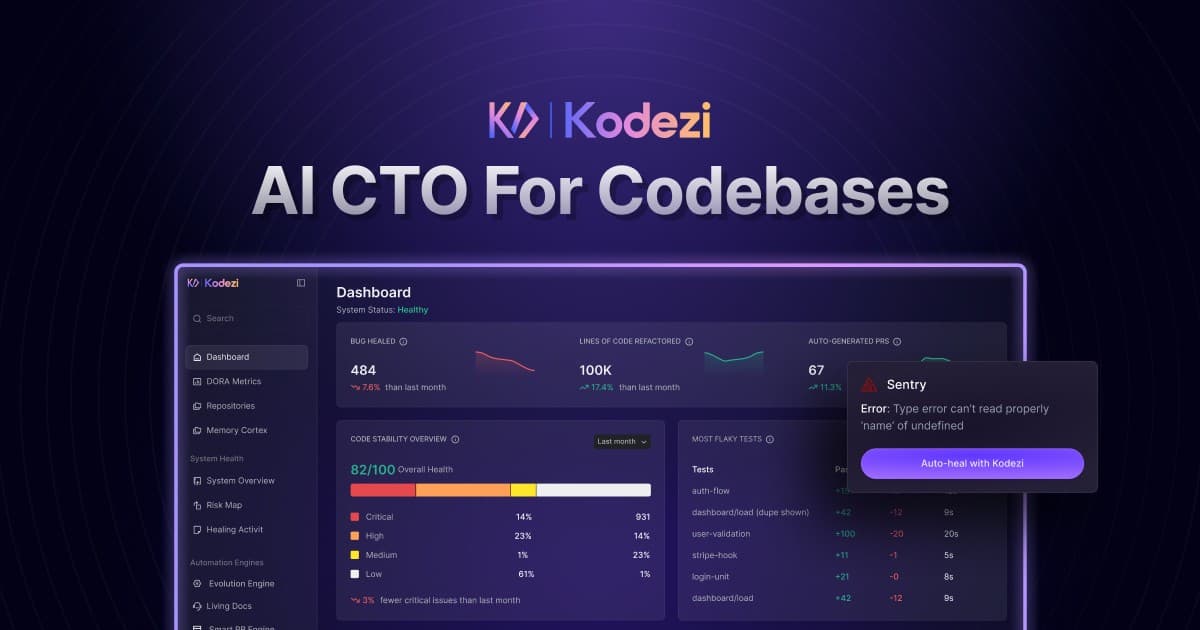
Kodezi
Kodezi functions as an AI CTO, providing an autonomous operating system for modern codebases. It is designed to maintain, evolve, and govern software, ensuring it remains healthy, scalable, and always ready to ship. The platform seamlessly integrates across your development stack, offering features like autonomous bug fixing, real-time code refinement, and automatic enforcement of best practices. Kodezi also includes vulnerability detection and error recovery, proactively identifying and healing security risks before code reaches production. Additionally, it intelligently generates code, API definitions, and test coverage, ensuring every update is complete and reliable. This comprehensive approach helps developers streamline their workflow and improve code quality.

Vzy
Vzy is an AI-powered website builder designed to simplify website creation for everyone, regardless of their coding or design expertise. Users can quickly generate stunning websites by simply describing their business, with AI handling content, style, images, forms, and SEO. The platform supports easy customization on any browser, including mobile devices, allowing for on-the-go editing. Key features include custom domains, multiple site management, built-in analytics, SEO readiness, and email signup forms. Vzy also provides essential tools like SSL, CDN for faster load times, and reliable hosting on AWS & Google Cloud, making it ideal for freelancers, small businesses, and portfolios.
DeepBench
DeepBench is a project by Baidu Research designed to benchmark fundamental deep learning operations across different hardware platforms. It aims to answer which hardware provides the best performance for the basic operations used in deep neural networks, such as dense matrix multiplies, convolutions, and recurrent layers. The tool specifies these operations at a low level, making it suitable for hardware simulators and those building new processors for deep learning. DeepBench includes benchmarks for both training and inference, covering various sizes and precisions. It utilizes vendor-supplied libraries like NVIDIA's cuDNN and Intel's MKL to ensure representative user experience and helps identify bottlenecks in deep learning training and inference.
Bugzy AI
Bugzy AI acts as an autonomous QA agent, running comprehensive quality assurance on every pull request and deployment. It connects to development tools like repositories, ticketing systems, and documentation to build a knowledge graph of your project. Using this context, Bugzy generates and executes end-to-end tests, triages failures, and reports bugs with full context, including reproduction steps, severity, and suggested fixes. The tool integrates with modern tech stacks, supporting popular languages and frameworks, and hooks into GitHub, GitLab, and CI services. Bugzy focuses on outcome-based pricing, charging for triages and test case creations rather than compute time, making it a cost-effective solution for maintaining high coverage without increasing headcount.
Roark
Roark is a comprehensive QA and observability platform specifically designed for Voice AI agents, ensuring reliability and performance. It enables teams to proactively catch issues before customers encounter them by offering robust monitoring and evaluation capabilities for live voice interactions. Users can track over 40 built-in metrics, analyze multi-speaker conversations, and run best-in-class evaluators on demand or automatically. The platform also facilitates pre-deployment testing through end-to-end simulations, allowing users to stress-test agents across real-world scenarios and automatically generate test cases from failed live calls. With one-click native integrations for popular voice platforms like VAPI, Retell, LiveKit Cloud, and Pipecat, Roark offers quick setup and real-time insights.
OpenML
OpenML is a collaborative online machine learning platform designed to facilitate the sharing and organization of data, machine learning algorithms, and experimental results. It aims to create a frictionless, networked ecosystem where scientists and practitioners can easily integrate their existing processes and tools to collaborate globally. The platform provides significant benefits for science by enabling rapid building upon others' results, answering complex questions quickly through prior experiments, and making larger studies feasible. For scientists, it saves time on routine duties, compares new experiments to the state of the art, and offers potential for new discoveries and publications. OpenML also serves as a valuable learning environment for students and citizen scientists, allowing them to explore state-of-the-art methods and contribute their own work.