
Research & Education
Browsing page 41 of AI tools for Academic Research in Research & Education. Sorted by confidence score — our independent quality rating.

DeepSeek-LLM
DeepSeek-LLM is an advanced open-source language model, available in 7B and 67B parameter versions, including both base and chat models. It has been trained from scratch on a massive dataset of 2 trillion tokens, encompassing both English and Chinese languages. The model demonstrates superior general capabilities, outperforming Llama2 70B Base in areas such as reasoning, coding, and mathematics. DeepSeek LLM 67B Chat also excels in coding (HumanEval Pass@1: 73.78) and math (GSM8K 0-shot: 84.1), and shows remarkable generalization abilities, achieving a score of 65 on the Hungarian National High School Exam. Furthermore, it surpasses GPT-3.5 in Chinese language proficiency. The project provides access to intermediate checkpoints for research and commercial use, with models available on HuggingFace and AWS S3.
DataCebo
DataCebo is an AI company specializing in solving data availability challenges through AI-generated synthetic data. It is the creator of the Synthetic Data Vault (SDV), an open-core platform trusted by numerous F500 companies and data scientists. DataCebo's SDV Enterprise offers a leading synthetic data platform for complex enterprise data, capable of generating structured, language, semi-structured, timeseries, and geospatial data. The platform includes advanced features like Constraint Augmented Generation, Differential Privacy, Targeted Sampling, and XSynthesizers to boost synthetic data quality and ensure privacy compliance. It also provides tools for evaluating synthetic data quality and benchmarking generators, making it ideal for software testing, simulating scenarios, training AI models, and secure data sharing.

Liner - AI search assistant
Liner is an AI search assistant designed to streamline academic and professional research by providing trusted, citable sources. It offers advanced search capabilities, outperforming models like ChatGPT and Perplexity Pro in accuracy tests. Users can leverage 'Deep Research' to gather comprehensive, organized information on any topic, which is particularly valuable during early research stages. Liner also allows users to upload their own documents, such as research papers or PDFs, to receive clear summaries and focused insights. The platform integrates across Liner, Liner Scholar, and Liner Write, offering a unified research experience. It supports various AI agents for tasks like hypothesis generation, literature review, and citation recommendation, making it a powerful tool for academics and researchers.

iLoF
iLoF is a digital health company at the forefront of personalized medicine, leveraging a breakthrough AI-platform to accelerate drug discovery and development. Their cloud-based library utilizes optical fingerprints, powered by photonics and AI, to provide non-invasive tracking, screening, and stratification for clinical trials. This innovative approach allows for efficient, flexible, and patient-centric drug development, requiring only microliters of blood and taking less than 10 seconds per sample. The platform aims to reduce costs by 40% and screening time by 70%, while improving the quality of candidate pools. iLoF is currently focusing on Alzheimer's, COVID-19, and Ovarian Cancer, building out its virtual fingerprint library to expand its applications to other diseases.

Zelma
Zelma is an AI-powered tool developed by the Education Data Center (EDC) designed to provide clear and timely access to education data, specifically focusing on student test datasets. It offers the most comprehensive student test dataset in America, allowing researchers and education stakeholders to make evidence-based decisions. Users can explore, graph, and filter this extensive data using plain English queries, making complex data accessible without specialized technical skills. The platform's State Assessment Data Repository is a leading database in the United States, providing detailed information on summative assessments, student subgroups, and various school years and grades. Zelma aims to support informed decision-making on how to best support students nationwide.
Deep Dive Research Assistant
ModularMind, powered by Maia, is an AI assistant designed to automate complex tasks without requiring any coding. Users can describe their task to Maia, which then plans actions, designs automated workflows, and executes solutions. The tool excels at intelligent web research, browsing thousands of web pages in parallel to extract relevant content and links. It also allows users to orchestrate a virtually infinite number of AI agents, save team prompts, and import data from various sources. ModularMind can search the web, analyze web pages, understand documents like PDFs and images, and automate a wide range of complex tasks, making it suitable for professionals looking to enhance productivity.

TIMIO News
TIMIO News is a research and education tool designed to deliver concise and clear information on current news events. It aims to provide users with a quick and confident understanding of complex topics by distilling extensive research into easily digestible reports. Each report generated by TIMIO News features a comprehensive summary, a chronological timeline of events, identification of primary sources for verification, and a comparison of different opinions to offer a balanced perspective. This approach helps users to rapidly grasp the essence of news stories and gain clarity without spending significant time on in-depth research, making it an efficient resource for staying informed.
Brain Diffusion
Brain Diffusion is an AI image generation tool hosted on Hugging Face Spaces, developed by Warvito. It provides a platform for users to explore and experiment with diffusion models, which are a class of generative models capable of producing high-quality images from various inputs. While the current live website indicates a build error, the tool's purpose is to facilitate image generation through AI. It is designed to be accessible to a broad audience interested in artificial intelligence and creative image synthesis, offering a free environment for experimentation.
CHARRED
CHARRED is presented as a Hugging Face Space dedicated to character-aware diffusion, indicating its purpose in generating images with an understanding of character features. The tool is built using Gradio, a popular framework for creating machine learning web apps. While the intention is to provide advanced image generation capabilities, the current live website indicates a runtime error, preventing its functionality. This suggests that the tool, when operational, would be suitable for researchers and developers interested in the nuances of AI image generation and character-specific diffusion models. The project is licensed under CC-BY-SA-4.0, promoting open use and modification.

Artificial Intelligence Center Hamburg (ARIC)
The Artificial Intelligence Center Hamburg (ARIC) is the official AI initiative for Northern Germany and the city of Hamburg, dedicated to shaping the AI ecosystem in the metropolitan region. ARIC promotes Responsible AI, emphasizing ethical, fair, secure, transparent, and beneficial deployment of AI for humanity. It achieves this through diverse approaches, including interactive showroom tours, individual consulting, educational initiatives, AI roundtables, online learning formats, and active project participation. ARIC brings together stakeholders from technology, law, economy, and society to collaboratively advance AI transformation and strengthen Hamburg as an economic hub. The center is actively involved in various projects aimed at sustainably fostering society, research, and the economy.
Corpus Creator
Corpus Creator is an AI tool designed to streamline the process of generating text corpora for various NLP tasks. Users can upload their text files and then customize chunking parameters to structure the data according to their specific needs. This flexibility makes it suitable for preparing datasets for training machine learning models. Once processed, the structured datasets can be directly uploaded to the Hugging Face Hub, facilitating easy sharing and integration with other NLP tools and workflows. It is available as a Hugging Face Space, making it accessible for researchers and developers in data science.
Artificial Neural Computing
Artificial Neural Computing (ANC) is a research platform dedicated to bridging the gap between natural and artificial intelligence. The organization focuses on developing a unified framework by advancing theoretical understanding, conducting rigorous experiments, and creating practical, real-world applications. ANC aims to build advanced neural computing systems, drawing inspiration from the vast number of neural computers found in nature. Their work explores the intersection of various sciences to innovate new computing architectures, with a stated goal to build one more neural computer.

Qeios
Qeios is an Open Science platform dedicated to transforming scholarly communication through an innovative approach to peer review. It provides a publishing process designed to be trustworthy, constructive, and unbiased across all research fields. The platform supports rapid review cycles by using AI to identify and invite reviewers, with reviews published alongside articles. Researchers can publish for free if their articles attract spontaneous reviewers and meet standards, or opt for a Pro plan at $4.99/month. The Pro plan includes an AI-assisted Reviewer Recruitment Service, unlimited revisions, grammar correction, custom cover images, and social media promotion to amplify scholarly reach.

FAU Chair for Dynamics, Control, Machine Learning and Numerics - AvH
The FAU Chair for Dynamics, Control, Machine Learning and Numerics - AvH is a prominent research institution within Friedrich-Alexander-Universität Erlangen-Nürnberg, dedicated to cutting-edge advancements in applied mathematics. The chair's research encompasses several key areas, including dynamics, control theory, machine learning, and numerical methods. It plays a crucial role in fostering academic research and education, contributing significantly to the university's reputation for excellence in science and engineering. The institution supports a wide range of academic activities, from fundamental research to interdisciplinary collaborations, aiming to generate impactful knowledge and solutions in complex scientific and engineering challenges. Its work is integral to the university's broader mission of 'Moving knowledge' and driving innovation.

ELLIS Unit Jena
ELLIS Unit Jena is a research unit dedicated to advancing AI and machine learning applications within Earth system, climate, and environmental research. The unit's core motivation is to explore how these technologies can enhance the understanding of Earth's dynamic systems. Their research agenda includes fundamental work on evaluating climate change impacts on society and the economy, aiming to inform regulatory bodies, policymakers, and the public. The unit emphasizes integrating scientific knowledge into machine learning methods, focusing on challenges like interpretability, physical consistency, handling complex and uncertain data, addressing limited labels, and managing computational demands. They combine fundamental ML development with applied challenges concerning spatio-temporal dynamics in the Earth system.

Goover
Goover is a personalized AI research agent designed to enhance the research experience by providing domain-specific knowledge and advanced search functionalities. The tool aims to assist users in efficiently navigating worldwide insights and conducting in-depth research across various fields. By leveraging artificial intelligence, Goover streamlines the process of information gathering and analysis, offering a more tailored and effective approach to academic and professional inquiry. It focuses on delivering relevant and precise information, helping users to save time and improve the quality of their research outcomes.
Hillbot
Hillbot is at the forefront of embodied AI, specializing in the development of general-purpose robots through advanced skill learning. The platform utilizes both real-world data and infinite synthetic data generated from simulations to train robots for a wide array of tasks. Its core technologies include ManiSkill, an open-source platform for robot simulation that enables the use of synthetic training data, and Sapien, a unified framework for robot simulation and scalable synthetic data generation. Hillbot's approach allows for the incremental development of robotic capabilities, as demonstrated by examples like learning to reach for objects, open drawers, or maintain balance.
HyNote End-to-End Publish
HyNote is a comprehensive AI note-taking and knowledge management product designed to capture, summarize, and organize information from diverse sources. It supports recording and transcribing meetings and audio, uploading text, PDFs, images, and even YouTube videos. The tool offers features like AI-powered summarization, flashcard and quiz generation, and smart organization with tags and folders. HyNote aims to transform raw data into actionable insights, functioning as a 'second brain' for students, professionals, and content creators. It provides various templates for different use cases, from meeting minutes to study plans, and supports publishing content as blogs, podcasts, or slides.
Lit Mind Maps
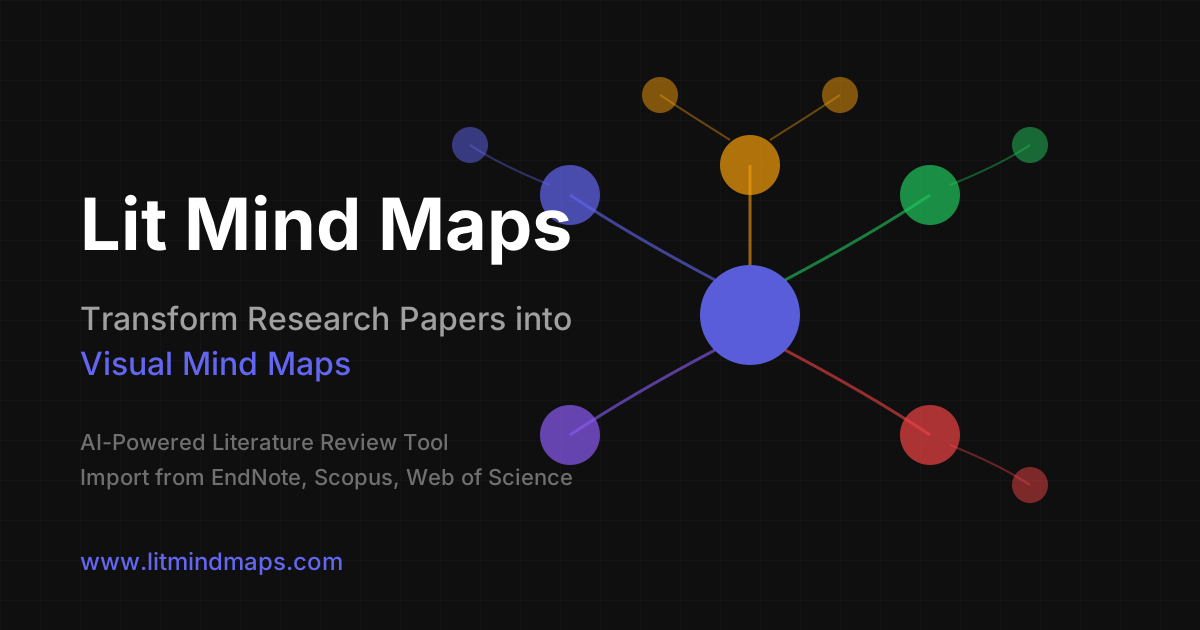
Lit Mind Maps is an AI-powered tool designed to streamline academic research by instantly generating interactive mind maps from research papers, abstracts, and PDFs. It helps researchers visualize complex academic literature, making systematic reviews and literature analysis more efficient. Users can import abstracts from sources like EndNote, Scopus, or Web of Science, or upload full PDF documents for deep analysis. The AI processes the content to create structured visual summaries, highlighting key concepts such as objectives, methodology, findings, and implications. This interactive mind mapping technology allows for quick screening, tagging, and organization of research papers, significantly speeding up the literature review process.
CoCoCap Beta
CoCoCap Beta is an AI-powered application designed to transcribe spoken Japanese audio into text. It offers a straightforward interface where users can either record their voice directly using a microphone or upload an existing audio file. The tool then processes the audio and provides a textual transcription. While the current live website indicates a build error, its intended functionality is to serve as a speech-to-text converter specifically for the Japanese language, making it useful for various applications requiring Japanese audio transcription.
PokerRL
PokerRL is an open-source framework designed for multi-agent deep reinforcement learning in poker games. It facilitates research into solving imperfect information games by combining Deep Reinforcement Learning with conventional methods like CFR and Fictitious-Play to learn approximate Nash equilibria. The framework includes components for building algorithms with interacting workers, evaluating performance using metrics like Best Response and Head-To-Head, and offers scalability through integration with Ray for local, multi-core, or cluster deployments. It supports both 2-player and N-player games, providing a robust environment for developing and testing AI agents in complex strategic scenarios.
pytorch_geometric_temporal
PyTorch Geometric Temporal is an open-source Python library designed for spatiotemporal signal processing using neural machine learning models. Built as a temporal extension for PyTorch Geometric, it provides a comprehensive collection of dynamic and temporal geometric deep learning, embedding, and spatio-temporal regression methods from published research. The library features an easy-to-use dataset loader, train-test splitter, and temporal snapshot iterator for dynamic and temporal graphs, with natural GPU support. It includes benchmark datasets across domains like epidemiological forecasting, sharing economy, energy production, and web traffic management. Key advancements include index-batching for improved spatiotemporal memory efficiency and support for distributed data parallel training with Dask-DDP, making it scalable for larger datasets. It also integrates well with PyTorch Lightning for flexible training environments.
Minecraft Landscape Demo
Minecraft Landscape Demo is an AI-powered tool available on Hugging Face that specializes in generating Minecraft landscape images. While the live website currently shows a runtime error, the tool's purpose is to provide users with the ability to create unique Minecraft-themed visuals using artificial intelligence. This type of tool is often utilized for creative projects, game design inspiration, or simply for fun by enthusiasts of the popular game. Its availability on Hugging Face suggests it is part of a community-driven effort to explore AI applications in various domains.
Allen Institute for AI
The Allen Institute for AI (Ai2), founded by Paul Allen and led by Ali Farhadi, is a non-profit research institute focused on high-impact AI research and engineering. Ai2 aims to tackle key problems in artificial intelligence, with a strong emphasis on open models and collaborative principles. Their work spans various domains including AI for science (Asta, AutoDiscovery), AI for the planet (OlmoEarth, EarthRanger), and embodied AI for robotics. They develop open-source language models like Olmo and provide platforms for scientific discovery and environmental challenges, partnering with institutions like the University of Washington and Google.