
Research & Education
Browsing page 41 of AI tools for Scientific Computing in Research & Education. Sorted by confidence score — our independent quality rating.

EBRAINS
EBRAINS is an open research infrastructure designed to support brain-related research, spanning from molecular and cellular levels to the entire organ. Originally built by the EU-funded Human Brain Project, it continues to advance with support from the European Commission and a network of National Nodes. The platform provides a comprehensive suite of data, tools, and services, including detailed brain atlases, medical analytics for human imaging, and advanced modeling and simulation capabilities. Researchers can access high-performance computing and neuromorphic platforms, find and share data, and collaborate through a dedicated platform. EBRAINS aims to revolutionize neuroscience by fostering integrated platform research and overcoming fragmentation of efforts.
Tailor Bio
Tailor Bio is at the forefront of developing targeted therapies for cancers characterized by chromosomal instability. Leveraging an advanced AI-driven drug discovery platform, the company aims to accelerate the identification and development of precision medicines. This innovative approach addresses a significant genomic phenomenon present in a large percentage of cancers, offering the potential for more effective and personalized treatment options. By focusing on specific genetic markers, Tailor Bio seeks to improve patient outcomes and revolutionize cancer treatment.
Siftlink SA
Siftlink SA is a sophisticated Data & Analytics tool designed to bridge the gap between scientific data and business insights, specifically within the biology and chemistry sectors. It integrates advanced analytics and AI capabilities to provide strategic business intelligence. The platform assists clients in developing market-leading products by offering precise insights and impactful data analysis. By combining scientific rigor with commercial understanding, Siftlink aims to deliver a comprehensive solution for product development in the life sciences, enabling informed decision-making and fostering innovation.
UnifierAI
UnifierAI is an AI-based research and development company dedicated to fostering innovation through strong research competence and creative collaborations. The company's core mission is to advance technology by leveraging AI-driven research initiatives. While specific features and services are not detailed on their public website, their focus on R&D suggests they are involved in developing cutting-edge AI solutions and potentially offering research services or platforms to other organizations. Their emphasis on innovation and collaboration indicates a forward-thinking approach to AI development.
OpenProtein.AI
OpenProtein.AI offers a sophisticated cloud platform for AI-driven protein design and optimization, leveraging advanced models like PoET-2, AlphaFold2, ESM2, and Clustal Omega. The platform helps users reduce costs, accelerate projects, and achieve better results in fewer rounds by eliminating guesswork and streamlining workflows. It allows for the design of optimized variant libraries, comparison of library outcomes, and visualization of predicted protein structures. OpenProtein.AI supports projects of all sizes, from 96-well plates to high-throughput pipelines, and can optimize any protein for various properties like activity, expressibility, and thermo stability. The technology learns from natural protein sequence databases and user-specific data to generate novel, functional proteins.
Facial-Expression-Recognition
Facial-Expression-Recognition is an open-source deep learning project built with TensorFlow, designed for real-time facial detection in video streams and subsequent recognition of emotional expressions. The tool leverages trained models that have achieved 65% accuracy on the fer2013 dataset, making it a valuable resource for researchers and developers in the field of computer vision and emotion AI. It is primarily tested on Ubuntu and macOS Sierra, offering a robust solution for these environments. Users can easily run a demo to capture faces via webcam and recognize expressions, or train their own models from scratch by downloading and integrating the fer2013 dataset. The project is dependent on Python (>= 3.3), TensorFlow (>= 1.1.0), and OpenCV, providing a clear pathway for installation and usage.
soft-nms
Soft-NMS is an open-source algorithm designed to enhance the accuracy of object detection models. It works by intelligently re-scoring bounding box predictions, providing a more robust alternative to traditional Non-Maximum Suppression (NMS). The tool is integrated with popular object detectors such as R-FCN and Faster-RCNN, allowing users to easily incorporate Soft-NMS into their existing pipelines. It supports both linear and Gaussian weighting schemes, with configurable parameters for fine-tuning. Soft-NMS has demonstrated significant performance improvements in challenges like COCO 2017, where it was adopted by many top-performing submissions. The repository provides code for testing models and includes updated ROI Pooling layers for improved interpolation.
SpectralCluster
SpectralCluster is a Python-based open-source library that re-implements advanced spectral clustering algorithms, particularly those used in Google's speaker diarization research. It provides functionalities for speaker diarization, including refined Laplacian matrix calculations, constrained spectral clustering, and multi-stage clustering. The tool allows users to customize various parameters such as minimum and maximum clusters, Laplacian type, refinement operations, and distance metrics for K-Means. It also supports auto-tuning for optimal performance and offers fallback clusterers for smaller datasets or specific conditions. SpectralCluster is designed for researchers and developers working on speech recognition and audio analysis, offering both standard and streaming prediction capabilities.
transformer-time-series-prediction
Transformer-time-series-prediction is an open-source project offering a proof of concept for transformer-based time series prediction models. It features two distinct PyTorch models: one for single-step predictions and another for multi-step predictions. While designed as a demonstration, the repository highlights the models' ability to learn long-term trends from training data, as shown with the daily minimum temperature dataset. Users interested in serious applications are directed to the flow-forecast package, indicating this tool is primarily for research, experimentation, or understanding the underlying concepts of transformer models in time series forecasting rather than production-ready deployment. The project is available on GitHub under an MIT license.
torchio
TorchIO is a Python package designed for medical imaging processing within deep learning applications, particularly those built with PyTorch. It offers a comprehensive set of tools for efficiently handling 3D medical images, covering tasks such as reading, preprocessing, sampling, and augmentation. A key differentiator is its inclusion of both typical computer vision operations, like random affine transformations, and domain-specific transformations. These specialized transforms simulate real-world artifacts such as intensity inhomogeneities in MRI or k-space motion artifacts, which are crucial for robust AI model training in medical contexts. The package aims to streamline the development of AI solutions in healthcare by providing robust data handling and augmentation capabilities.
Novaflow
Novaflow is an AI-driven bioinformatics tool designed to automate data analysis for life science researchers, labs, and biotech teams. It eliminates the need for coding, allowing users to turn raw data into publication-ready results quickly. The platform uses natural language interfaces for experiment upload and analysis, automatically selecting and executing appropriate workflows like RNA-seq or ATAC-seq. Key features include automated pipeline generation, interactive data visualization for creating figures like volcano plots and UMAPs, and fully traceable results. Novaflow aims to reduce costs, accelerate research, and free up scientific talent by streamlining complex bioinformatics workflows, making advanced analysis accessible and reproducible.
Syncthreads Computing Solutions Private Limited
Syncthreads Computing Solutions Private Limited is an AI solutions provider that focuses on delivering advanced data analytics and comprehensive end-to-end solutions. The company specializes in serving the defense sector, providing customized and performance-driven analytics tailored to specific operational needs. Syncthreads actively collaborates with universities and various industries to integrate cutting-edge technologies such as AI, High-Performance Computing (HPC), and graphics into their offerings. Their primary objective is to provide innovative solutions and contribute to research advancements in these fields, ensuring clients receive state-of-the-art analytical capabilities.
TrainLoop
TrainLoop is a post-training research and product lab dedicated to advancing AI capabilities. They specialize in developing algorithms, methods, and tooling to reliably train, steer, and deploy specialized AI systems. Their work focuses on training reasoning models that are aligned with specific organizational goals, offering expertise in areas like Life Sciences for biological reasoning, Continual Training to prevent catastrophic forgetting, Information Theory for stable reasoning, and Evaluation & Interpretability tools. TrainLoop collaborates with organizations possessing unique data to train state-of-the-art reasoning models, frequently achieving state-of-the-art or pareto-optimal performance. They offer a structured research-to-production workflow to co-define objectives and sustain performance.
PandionAI
PandionAI transforms Earth Observation (EO) data into actionable insights using advanced AI/ML algorithms for object detection and analysis of satellite images. The platform offers customizable analysis tailored to specific customer needs, ensuring efficient information flow and direct integration into existing decision-making systems. PandionAI's AlertSat system provides timely alerts for diverse applications, including wildfire fighting, infrastructure monitoring, maritime surveillance, and forestry management. Users can receive notifications via email, SMS, or push notifications, set custom alert thresholds, and integrate alerts through an API or a dedicated GIS Plugin. The AlertSat Portal serves as a user-friendly command center for managing and modifying applications, offering reduced lead times and higher performance.

Oro Muscles, Inc
Oro Muscles offers actionable muscle intelligence through its premier sEMG technology, designed for elite sports and rehabilitation. It provides real-time muscle insights within existing workflows, enabling physiotherapists and trainers to make faster decisions, reduce injury risk, and enhance impact. The system quantifies muscle activity to guide exercise selection, adjusts to compensation patterns in real-time, and tracks progress over time with clinically validated, reliable insights. Trusted by leaders in rehabilitation, Oro Muscles helps detect compensation, overcome inhibition, select personalized exercises, and track muscle progress, bridging the gap between return to play and return to performance.
waymax
Waymax is a lightweight, multi-agent, JAX-based simulator specifically designed for autonomous driving research. Built upon the Waymo Open Motion Dataset, it supports various aspects of behavior research, from closed-loop simulation for planning and sim agent development to open-loop behavior prediction. The simulator represents objects like vehicles and pedestrians as bounding boxes, simplifying behavior research. Its JAX-based architecture ensures easy distribution and deployment on hardware accelerators such as GPUs and TPUs. Waymax includes libraries for data loading, visualization, metric computation, intelligent sim agents, and adapters for common RL interfaces like dm-env, allowing for both standalone module use and full closed-loop simulation.
BinaryNet
BinaryNet is an open-source project designed for training deep neural networks where weights and activations are constrained to either +1 or -1. This tool allows researchers and developers to reproduce the experimental results detailed in the associated BinaryNet article. The repository is structured into two main sub-repositories: 'Train-time' for replicating benchmark results and 'Run-time' for showcasing XNOR and baseline GPU kernels. It serves as a valuable resource for those interested in the specifics of binary neural network implementation and performance, offering both theoretical reproduction and practical demonstration aspects.
osim-rl
osim-rl offers a robust platform for reinforcement learning environments, specifically designed with musculoskeletal models. It allows researchers and developers to create and train AI agents to control complex human movements, such as walking and running, with minimum effort. The environment leverages OpenSim, a biomechanical physics simulation engine, to provide physiologically plausible 3D human models. Key features include support for experimental data to accelerate learning, the introduction of a third dimension for sideways falls, and the inclusion of a prosthetic leg model to address medical challenges in prosthetic design and tuning. This tool is ideal for advanced biomechanics simulations and deep reinforcement learning research.
tez
Tez (तेज़ / تیز), meaning sharp, fast & active, is a super-simple and lightweight Trainer for PyTorch, aiming to simplify the deep learning training process. It offers a clean code base, faster prototyping, and is designed to be production-ready. Tez supports CPU, single GPU, multi-GPU, and TPU training, making it versatile for various deep learning projects. The library emphasizes simplicity and customizability, allowing users to leverage PyTorch's full power while streamlining specific aspects of training. It comes with many utilities that can be used to tackle over 90% of deep learning projects, making it a valuable tool for developers and data scientists working with PyTorch.
Wheel Outcome Predictor
The Wheel Outcome Predictor is a sophisticated AI Chrome extension designed to provide insights into the potential outcomes of wheel-based games like Dream Catcher. Utilizing advanced algorithms and Monte Carlo simulations, it generates thousands of random outcomes based on given parameters. This comprehensive approach helps users understand potential scenarios, assess risks, and develop tailored strategies. While it aims to enhance understanding and maximize chances of success, it is explicitly stated to be for educational purposes only and does not guarantee 100% success. It's an invaluable tool for anyone looking to explore probability and game mechanics in a simulated environment.
PaddleVideo
PaddleVideo is an open-source video understanding toolkit built on PaddlePaddle, designed to assist developers in academic research and industrial applications within the video domain. It offers a rich set of features including video data annotation tools, lightweight RGB and skeleton-based action recognition models like PP-TSM and PP-TSMv2, and practical applications for video tagging and sport action detection. The toolkit supports the entire workflow from data production to model training, compression, prediction, and deployment. It also incorporates advanced features such as knowledge distillation and transformer-based models like TokenShift, along with skeleton-based models like 2s-ACGN and CTR-GCN. PaddleVideo provides comprehensive documentation and tutorials for quick starts, model training, compression, and deployment, making it a versatile solution for various video-related tasks.
LuckyRobots
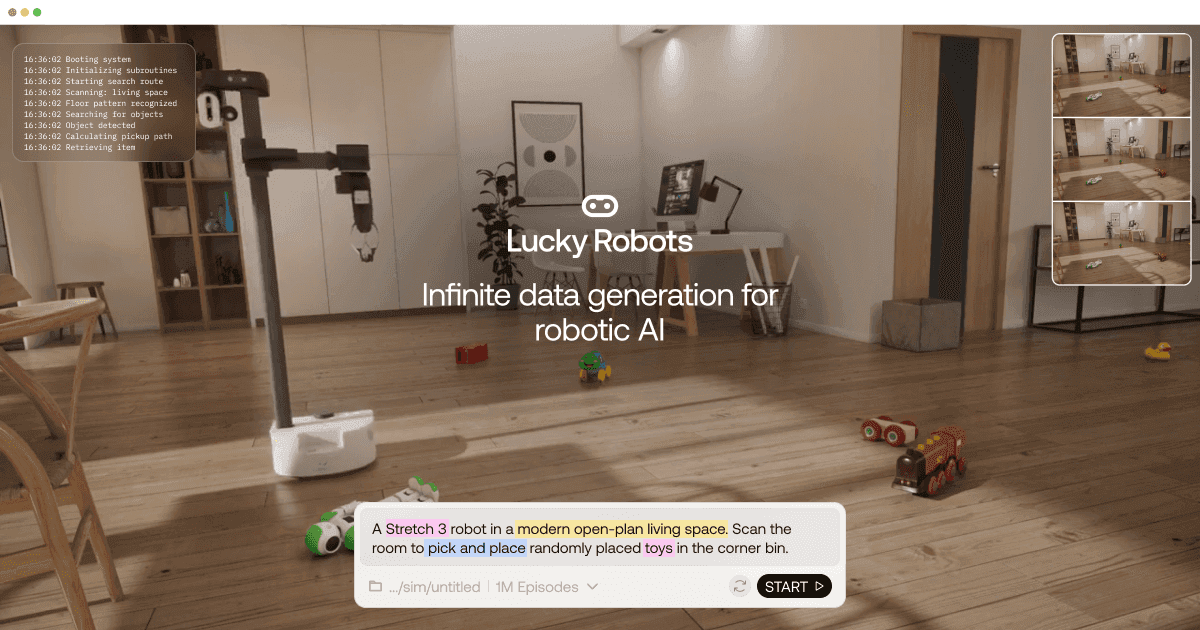
LuckyRobots provides a platform for generating infinite synthetic data to train end-to-end robotic AI models. It allows users to seamlessly iterate, train, and test models in simulation before deploying them to the real world, significantly reducing development time and cost. The platform offers hyper-realistic simulations with precise physics and environments, enabling the generation of millions of randomized, labeled training episodes on demand. Users can control scenes with natural language using RobotGPT and collaborate, share models, and manage training workflows via LuckyHub. It supports commercially available robots and custom models, making it a versatile solution for robotic AI development.
Fluidize
Fluidize is an AI platform designed to transform modern-day science by accelerating research and development for scientists and engineers. It achieves this by leveraging AI to run simulations and experiments, significantly speeding up development pipelines. The platform automates critical stages including setup, execution, validation, and scaling, allowing users to focus on scientific discovery. Fluidize offers flexibility, capable of wrapping over existing simulation stacks or providing an end-to-end solution. Key capabilities include integrating open-source or licensed software, auto-scaling pipelines with cloud compute, and automatically handling dependencies and versioning. It also facilitates instant collaboration through shared dashboards, making it a comprehensive solution for scientific computing.
NOBURN
NOBURN is a citizen science initiative dedicated to bushfire prediction and prevention. The project leverages a mobile application that enables users to actively participate by recording and submitting evidence of potential forest dangers. This crowdsourced data is crucial for researchers, providing valuable insights into forest fuel conditions and aiding in the development of more accurate fire likelihood predictions. By engaging the public, NOBURN aims to enhance our understanding of environmental factors contributing to bushfires, ultimately supporting better preparedness and response strategies. The app serves as a direct link between citizen observers and scientific research, fostering a collaborative approach to environmental monitoring.