
Coding & Development
Browsing page 322 of AI tools for Coding & Development. Sorted by confidence score — our independent quality rating.

REST API with Gradio and Huggingface Spaces
REST API with Gradio and Huggingface Spaces provides a platform for developers to create and deploy REST APIs, particularly useful for machine learning applications. Hosted on Hugging Face Spaces, this tool simplifies the process of building web interfaces for AI models. It is designed for prototyping AI applications, allowing users to quickly set up an API endpoint for their models. The platform leverages Gradio for creating user-friendly web interfaces, making it accessible for developers to share and test their AI projects.

Redbean: AI Town, AI Gamemaker
Redbean AI is an all-in-one platform designed for creating living original characters (OCs) and interactive pixel art games without requiring any coding knowledge. Users can design characters with unique personalities, memories, and movement capabilities, then explore their stories within a game environment. The platform facilitates the building of interactive scenes and allows for roleplaying with AI-powered NPCs that understand context and emotion. Redbean AI aims to transform user imagination into a dynamic, living community, offering a no-code game builder, AI character creator, interactive storytelling features, and pixel art generation. It's available on web, iOS, and Android, making game creation accessible to a broad audience.
Stately
Stately is a visual software modeling platform designed to help developers and teams build and deploy application logic using state machines and statecharts. It provides a drag-and-drop editor that allows users to design complex systems, generate code, and create documentation. The platform integrates with XState, an open-source library for managing state in JavaScript and TypeScript applications, ensuring no vendor lock-in. Stately supports bidirectional updates between code and visualization, allowing users to work in their preferred environment. It can also visualize existing Redux or Zustand code and offers an IDE extension for VS Code. Key features include AI-assisted flow generation, test generation, and the ability to export code in JavaScript or TypeScript, making it a comprehensive solution for robust logic development.

JackChat AI
JackChat AI is an innovative iOS mobile application designed to facilitate voice-based interactions with advanced AI models. It provides a user-friendly push-to-talk interface, ensuring seamless and natural communication. This tool allows users to engage with AI hands-free, making it convenient for accessing AI assistance and information while on the go. The focus on voice interaction aims to provide a more intuitive and efficient way to leverage AI capabilities, moving beyond traditional text-based interfaces. It's built to offer quick and intuitive interaction for various AI-powered tasks.
Pet classifier!
Pet classifier! is an AI-powered tool hosted on Hugging Face Spaces, designed to identify pet breeds from uploaded images. This free application allows users to quickly determine the breed of their pets, making it a useful resource for pet owners, animal enthusiasts, and anyone curious about animal identification. While the live website currently indicates a runtime error, the tool's core functionality is to provide an accessible and easy-to-use platform for pet breed classification. It leverages machine learning models to analyze visual data and offer insights into different pet breeds.
3D-convolutional-speaker-recognition
3D-convolutional-speaker-recognition is an open-source project providing a TensorFlow implementation of 3D Convolutional Neural Networks for text-independent speaker verification. The project leverages a 3D convolutional architecture to simultaneously capture speech-related and temporal information from speaker utterances, leading to more robust speaker models. It outlines a three-phase Speaker Verification Protocol (SVP) including development, enrollment, and evaluation stages. A key differentiator is its approach to direct speaker model creation, which is shown to significantly outperform traditional d-vector verification systems. The code uses MFECs (Mel-Frequency Energy Coefficients) as input features, discarding the DCT operation of MFCCs to preserve locality for convolutional operations. The implementation details for the 3D convolutional operations using TensorFlow Slim are provided, making it a valuable resource for researchers and developers in the field.
Roark
Roark is a comprehensive QA and observability platform specifically designed for Voice AI agents, ensuring reliability and performance. It enables teams to proactively catch issues before customers encounter them by offering robust monitoring and evaluation capabilities for live voice interactions. Users can track over 40 built-in metrics, analyze multi-speaker conversations, and run best-in-class evaluators on demand or automatically. The platform also facilitates pre-deployment testing through end-to-end simulations, allowing users to stress-test agents across real-world scenarios and automatically generate test cases from failed live calls. With one-click native integrations for popular voice platforms like VAPI, Retell, LiveKit Cloud, and Pipecat, Roark offers quick setup and real-time insights.
Midjourney: AI App Guidance
Midjourney: AI App Guidance is an unofficial companion app designed to help users unlock the full potential of AI art generation with Midjourney. It addresses common challenges like crafting effective prompts and understanding complex parameters. The app features a Prompt Builder that allows users to construct detailed prompts by selecting subjects, styles, lighting, and camera angles from dropdown menus, automatically formatting the syntax. An interactive Image Weight Balancer visually demonstrates the effect of the --iw parameter, helping users balance text prompts and reference images. For creative blocks, the Inspiration Slot Machine generates unique subject and style combinations. Additionally, an Aspect Ratio Visualizer helps users choose the best frame for their creations, and a Prompt Cleaner & Optimizer refines messy prompts by removing filler words and adding quality boosters.
Haechi AI
Haechi AI offers free, AI-powered fraud protection specifically designed for elderly Americans and their families. The platform screens incoming phone calls in real-time, detecting spoofed numbers, impersonation attempts, and high-pressure tactics before a user answers. It also allows users to photograph suspicious physical mail for instant analysis, identifying lottery scams, fake government notices, and fraudulent checks. Haechi AI provides ongoing fraud education through weekly briefings and real-time alerts, empowering users to recognize new scam techniques. A family dashboard feature enables adult children to monitor a parent's protection status, review flagged threats, and receive notifications, offering peace of mind. The service emphasizes data privacy with 256-bit encryption and a strict no-data-selling policy.
WenetSpeech Yue
WenetSpeech Yue is a text-to-speech application developed by ASLP-lab, hosted on Hugging Face Spaces, specifically designed for generating Cantonese audio. Users can input any text and then select from available models and speaker prompts to customize the generated speech. While the tool's primary function is to convert text into粤语 audio, the live website currently indicates a runtime error, suggesting it may not be fully operational at this moment. Despite the current technical issues, its intended purpose is to provide a platform for Cantonese speech synthesis, likely leveraging a large-scale Cantonese speech corpus as described in its metadata.
AIShader
AIShader is a proof-of-concept tool designed to generate shaders for Unity using natural language prompts, powered by ChatGPT. This innovative solution allows developers to describe the desired shader effect in plain English, and the AI translates it into functional Unity shader code. To utilize AIShader, users must obtain an API key from OpenAI and configure it within the Unity Project Settings. A crucial consideration for users is that the API key is stored in `UserSettings/AIShaderSettings.asset`, necessitating its exclusion when sharing projects to maintain security and prevent unauthorized access to the OpenAI API. This tool streamlines the shader creation process, making it more accessible for developers who may not be deeply familiar with shader programming languages.
hasktorch
Hasktorch is an open-source library designed for tensors and neural networks, specifically tailored for the Haskell programming language. It leverages the core C++ libraries that power PyTorch, enabling Haskell developers to engage in AI and deep learning tasks. The project is under active development, with its second major release (0.2) available on Hackage and Nixpkgs. Hasktorch provides comprehensive documentation, including introductory videos and detailed getting started guides for various environments like Linux, macOS, and Docker, supporting both CPU and CUDA configurations. It also addresses known issues such as MPS support on macOS and tensor movement to CUDA, offering solutions and workarounds for common challenges.
catalyst
Catalyst is a high-performance C# Natural Language Processing (NLP) library inspired by spaCy's design, offering a robust solution for developers working with .NET. It provides pre-trained models, out-of-the-box support for training word and document embeddings, and flexible entity recognition models. Key features include non-destructive tokenization, efficient RegEx-free processing at over 1M tokens/s, and cross-platform compatibility across Windows, Linux, macOS, and ARM. Catalyst also supports part-of-speech tagging, language detection, and efficient binary serialization. Developers can leverage pre-built models for various language packages and easily integrate them via NuGet, with lazy loading from disk or an online repository.

AI QR Code Art Generator Pro
AI QR Code Art Generator Pro is an iOS mobile application developed by Storecho LLC that allows users to create visually appealing and functional QR codes using advanced AI technology. The app transforms standard QR codes into artistic designs, making them more engaging for various applications. It is designed to simplify the process of generating custom QR codes and unique AI QR art, suitable for enhancing business, marketing, social media, and personal use. Storecho LLC, based in Sharjah Media City (Shams), United Arab Emirates, focuses on high-performance mobile applications with a commitment to data privacy and user experience.
Shimoku
Shimoku offers an analyst agent designed to assist users with data analysis and insight generation. While specific features are not detailed on the homepage, the tool's primary focus appears to be on leveraging AI to support analytical tasks. The platform aims to streamline the process of understanding complex data, potentially through automated reporting or intelligent data exploration. Its positioning as an "Analyst Agent" suggests a capability to act as a virtual assistant for data-driven decision-making, catering to individuals or teams who require efficient data interpretation.
gaidme
gaidme is an AI-powered command-line interface (CLI) tool designed to simplify terminal interactions. It generates relevant terminal commands by understanding user questions and leveraging command history, significantly reducing the need to memorize complex syntax. This tool aims to enhance productivity for developers and technical users by providing instant access to necessary commands, making command-line operations more intuitive and efficient. By streamlining workflows, gaidme helps users execute tasks faster and with greater accuracy, minimizing errors often associated with manual command entry.
gptel
gptel is a versatile Large Language Model chat client designed for Emacs, offering seamless integration with various LLM providers and backends. It functions within any Emacs buffer, enabling users to interact with LLMs for tasks like code rewriting, content generation, and more. Key features include support for multiple independent conversations, tool-use for agentic capabilities, and multi-modal input. Users can save and resume chat sessions, inspect and modify queries before sending, and leverage Model Context Protocol (MCP) integration. gptel supports a wide array of LLM services, including OpenAI, Anthropic, Gemini, Ollama, and many others, making it a flexible solution for developers and technical users who prefer to stay within their Emacs environment.
DeepBeliefSDK
DeepBeliefSDK is an open-source framework developed by Jetpac for deep belief image recognition, specifically designed to run efficiently on mobile and low-power devices. It implements a convolutional neural network architecture, similar to that described by Alex Krizhevsky, Ilya Sutskever, and Geoffrey Hinton. The SDK is highly optimized, capable of analyzing an image in under 300ms on an iPhone 5S and around 650ms on a Samsung Galaxy S5. It supports various platforms including iOS, Android, Linux, and OS X, and can be integrated with OpenCV. The framework allows for retraining networks for custom object recognition, making it adaptable for specific applications like identifying logos or distinguishing scene types.
I got tired of switching between Postman, curl, and my editor so I built a terminal AI agent that does all three.
Charm offers a terminal-based AI agent designed to streamline development workflows by combining API testing, command-line execution, and code editing into a single interface. This tool aims to reduce the need for developers to switch between different applications like Postman, curl, and text editors. By wiring into your LLM of choice, Charm brings AI assistance directly to your terminal, making coding more glamorous and efficient. It supports macOS, Linux, Windows, and BSD, and is built on open-source technologies, emphasizing a commitment to the open-source community. Charm also provides various open-source libraries and tools for building terminal user interfaces and applications.
dalai
Dalai is an open-source AI development tool designed to simplify running LLaMA and Alpaca large language models directly on a local machine. It eliminates the need for cloud services, making it accessible for developers and AI enthusiasts to experiment with these powerful models. The tool is cross-platform, supporting Linux, Mac, and Windows, and includes a hackable web application. Dalai ships with both JavaScript and Socket.io APIs, allowing for programmatic installation, model requests, and server management. It provides clear instructions for installation and usage, including memory and disk space requirements for various model sizes, making it a practical solution for local LLM deployment.

Ludo.ai
Ludo.ai is an AI-powered platform designed to assist game developers in every stage of game creation, from ideation to asset generation and market analysis. It offers a comprehensive suite of AI tools including a Sprite Generator, Image Generator, 3D Asset Generator, Audio Generator, Video Generator, and Playable Generator, enabling users to quickly create visual and audio assets, and even interactive prototypes. The platform also features tools like the Game Ideator, Ludo Score, Market Trends, and Idea Pathfinder to help validate concepts and discover market opportunities. With its Project tool and Ask Ludo AI companion, it facilitates collaborative game design and research, making it an all-in-one solution for indie developers and studios alike.
Codewise AI
Codewise AI is an AI tool designed to translate business requirements directly into functional code, centralizing development tools to streamline the entire workflow. It focuses on bridging the gap between high-level business needs and the technical implementation, aiming to accelerate the development process. The tool is intended to assist developers in generating code more efficiently and managing their development environment. While specific features are not detailed in the provided content, its core purpose revolves around enhancing productivity in coding by leveraging AI to understand and convert business logic into executable code.
AI Repository Search
AI Repository Search is a community-curated directory designed to help users discover open-source GitHub repositories. It leverages AI to allow users to search for repositories by describing their ideas in plain English, with the AI ranking results by relevance. Users can also browse repositories using various filters such as language, license, topics, activity, release cadence, issue health, documentation, built with, form factor, issue load, category, maintainer, model maturity, persona, platform, release pattern, security posture, use case, ecosystem, stack, status, features, and license. The platform also offers curated searches and the ability to save findings, making it a valuable resource for developers and researchers looking for specific open-source projects.
Sheetful
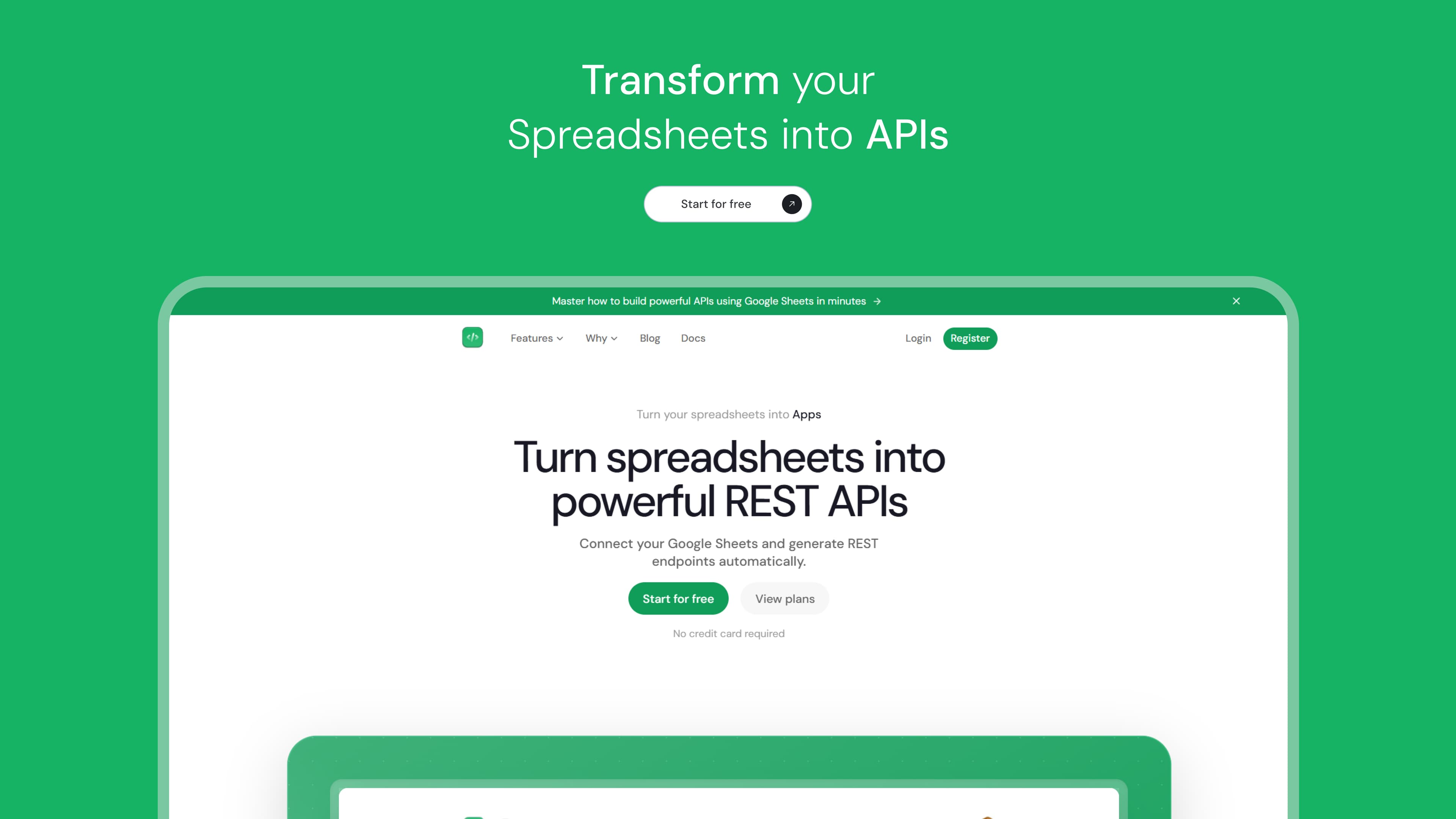
Sheetful is an API-as-a-Service platform designed to turn Google Sheets into high-performance REST APIs instantly. Users can connect their Google Sheets and automatically generate REST endpoints for GET, POST, PUT, and DELETE operations. This no-code solution allows spreadsheets to function as a database for web and mobile apps, no-code tools, or internal systems. Sheetful offers real-time analytics, smart spreadsheet endpoints, and live endpoint testing directly from the dashboard. It prioritizes data privacy and security, acting as a bridge to fetch data via Google's official API only when requested, and supports API Key authentication for secure access.