
Coding & Development
Browsing page 324 of AI tools for Coding & Development. Sorted by confidence score — our independent quality rating.

md
md is a highly streamlined and elegant WeChat Markdown editor designed to simplify content creation for the platform. It supports a comprehensive range of Markdown syntax, including mathematical formulas, Mermaid charts, GFM warning blocks, and PlantUML diagrams. Users can customize themes and CSS styles, and the editor features built-in local content management with automatic draft saving. For advanced functionality, md offers integration with various image hosting services like GitHub, Alibaba Cloud OSS, Tencent Cloud COS, and more, making image management effortless. Additionally, it incorporates AI assistants from leading models such as DeepSeek, OpenAI, and Tongyi Qianwen to intelligently aid in content generation, making it an ideal tool for anyone looking to produce polished WeChat articles efficiently.

Abnormal - Cloud Email Security
Abnormal - Cloud Email Security is an AI-native security platform designed to protect organizations from advanced email threats such as credential phishing, business email compromise, and account takeovers. Leveraging a unique Behavioral AI, the platform develops a superhuman understanding of normal human behavior within an organization to detect and neutralize anomalies in milliseconds, without human intervention. It offers comprehensive, multi-layered security for cloud email platforms, including inbound email security, email account takeover protection, and security posture management for Microsoft 365. Additionally, Abnormal provides AI Security Agents to automate repetitive SOC workflows and offers SaaS security for applications like Slack and Zoom. The platform integrates easily via a one-click API, ingesting thousands of behavior signals to power its detection engine.
aider-desk
AiderDesk is an open-source, AI-powered development platform designed for professional software engineers, offering transparent and steerable AI orchestration. It goes beyond a simple GUI for Aider, providing a comprehensive orchestration layer that allows users to control AI behavior, review every change, isolate experiments, and extend functionalities. Key features include managing multiple codebases simultaneously with project and task management, utilizing isolated Git worktrees for parallel task development, and advanced task and history control to refine AI context. The platform also boasts a smart context and memory engine, rich review and approval gates for proposed changes, and multi-model orchestration supporting various LLM providers. AiderDesk emphasizes flexibility, integrating seamlessly with existing IDEs and Git workflows, and is highly extensible through custom logic injection and a Model Context Protocol (MCP).
Tray
Tray is an AI orchestration platform designed for business automation, agent building, and enterprise integration. It provides a unified platform to run governed AI agents, deploy secure MCP (Multi-Cloud Platform) servers, and infuse intelligence into existing business processes. With over 700 pre-built connectors, Tray helps consolidate point-to-point integrations, reduce integration sprawl, and accelerate development. The platform offers centralized observability, security, and access control across agents, MCP, automation, and integration, making it suitable for global businesses looking to scale their AI initiatives and automate complex workflows.
kubewall
kubewall is an open-source, single-binary Kubernetes dashboard designed for multi-cluster management with integrated AI capabilities. It offers a rich, real-time interface for managing and investigating Kubernetes clusters, providing features like live views of cluster resources, pods, and services. The AI integration leverages models such as OpenAI, Claude 4, Gemini, DeepSeek, OpenRouter, Ollama, Qwen, and LMStudio for automated troubleshooting, configuration optimization, and smart recommendations. It supports effortless installation as a lightweight binary on Mac, Windows, or Linux, with no dependencies. Users can access it securely via any browser, with options for HTTPS setup, and benefit from in-depth resource views, powerful search and filtering, and privacy by design with zero cloud dependency. It also includes port forwarding, live refresh, and aggregated pod logs for efficient debugging and monitoring.

Ludo.ai
Ludo.ai is an AI-powered platform designed to assist game developers in every stage of game creation, from ideation to asset generation and market analysis. It offers a comprehensive suite of AI tools including a Sprite Generator, Image Generator, 3D Asset Generator, Audio Generator, Video Generator, and Playable Generator, enabling users to quickly create visual and audio assets, and even interactive prototypes. The platform also features tools like the Game Ideator, Ludo Score, Market Trends, and Idea Pathfinder to help validate concepts and discover market opportunities. With its Project tool and Ask Ludo AI companion, it facilitates collaborative game design and research, making it an all-in-one solution for indie developers and studios alike.
jetson-containers
jetson-containers is an open-source, modular container build system designed for NVIDIA Jetson and JetPack-L4T platforms. It provides a comprehensive collection of the latest AI/ML packages, facilitating the deployment of CUDA containers for edge AI and robotics applications. Users can easily combine various packages like PyTorch, TensorFlow, and ROS2 to create custom containers. The tool includes helper scripts for building and running containers, with features like `autotag` to find compatible images and a Pip server for caching wheels to accelerate builds. It supports different CUDA versions and offers detailed documentation for system setup, building, and running containers, making it a robust solution for developers working with NVIDIA Jetson devices.
bnb-my-repo
bnb-my-repo is a Hugging Face Space designed to simplify the process of quantizing AI models. Users can select a model from Hugging Face, apply desired quantization settings, and then upload the reduced-size model directly to their personal Hugging Face account. This tool is particularly useful for developers and researchers looking to optimize model performance and reduce storage requirements without extensive manual configuration. It provides a straightforward interface for managing and deploying quantized models within the Hugging Face ecosystem.
AI SEO Tools: Rank & Grow
AI SEO Tools: Rank & Grow is an AI-powered mobile application designed to assist content creators, bloggers, YouTubers, marketers, and small business owners in enhancing their digital growth. The app simplifies content optimization by providing instant, AI-driven suggestions for keywords, titles, content, and tags. It features a user-friendly interface that combines powerful SEO tools like Keyword Generator, Title Generator, Content Generator, Viral Video Ideas, Description Generator, and Tag Generator. This eliminates the need for complex tools or lengthy research, allowing users to save time and grow their online presence faster. It's ideal for generating optimized ideas for blog posts, videos, and social media captions.
T-MAC
T-MAC is an open-source AI Frameworks & Infra tool specifically designed for efficient low-bit Large Language Model (LLM) inference on CPU/NPU architectures. It utilizes a lookup table approach to accelerate the execution of LLMs, making it suitable for deployment on resource-constrained devices. The tool supports models like BitNet and offers a significant advantage over traditional dequantization-based methods by providing faster inference speeds. T-MAC aims to optimize the performance of AI models in environments where computational resources are limited, making advanced AI capabilities more accessible and practical for a wider range of applications.
simple_dqn
simple_dqn is an open-source deep Q-learning agent developed to replicate the results from DeepMind's paper "Human-level control through deep reinforcement learning." While the repository is noted as outdated with better codebases available, it serves as a foundational tool for understanding the basics of deep Q-learning. It is designed for simplicity, speed, and extensibility, utilizing the ALE native Python interface and supporting training and testing with OpenAI Gym. The project also integrates with the Neon deep learning library for fast convolutions and minimizes array conversions for efficient minibatch sampling. It includes scripts for training, testing, visualizing filters, and recording gameplay videos.

BentoML
BentoML offers a comprehensive inference platform designed for speed and control, enabling users to deploy any AI model anywhere. It provides tailored inference optimization, efficient scaling, and streamlined operations for various models, including LLMs and custom architectures. The platform simplifies inference infrastructure while offering full control over deployment, supporting open-source models and custom models alike. Key features include deployment automation, CI/CD, comprehensive observability, and fine-grained access control. BentoML also offers intelligent resource management with cross-region scaling, elastic auto-scaling, and cold-start acceleration, ensuring optimal compute utilization across various cloud environments or on-premises Kubernetes.
codespaces-jupyter
codespaces-jupyter offers a ready-to-use development environment within GitHub Codespaces, specifically tailored for machine learning and data science projects. It comes pre-configured with Python and Jupyter notebooks, allowing users to immediately dive into their work without extensive setup. This tool provides a blank canvas for new projects, enabling users to explore and experiment with data science concepts. The environment is self-contained within a single codespace, offering flexibility for development. Users can choose to publish their work to a GitHub repository when ready or simply delete the codespace if it was for exploration, making it ideal for quick prototyping and learning.

OpenRAIL-M v1
OpenRAIL-M v1 is an Open Responsible AI License (OpenRAIL) developed by the BigCode project, specifically for its AI models. This license facilitates free and open access, reuse, and redistribution of AI artifacts, including derivatives, for both research and commercial purposes. It promotes responsible AI practices by incorporating use restrictions that apply to all uses, including derivative works. The CodeML OpenRAIL-M 0.1 is an interim version of the license, designed to address potential harms from code generation models. It is not an Open Source Initiative-approved license due to its use restrictions, but it allows broad use as long as these restrictions are respected. The license also mandates clear disclaimers for AI-generated code.
OpenMLOps
OpenMLOps is a production-focused, open-source machine learning framework designed to streamline the MLOps lifecycle. It provides a carefully selected suite of open-source tools, packaged as Terraform modules, for deployment into a Kubernetes cluster. Key components include Prefect for data flow automation, Jupyter Hub for collaborative experimentation, Dask for distributed computing, Feast for feature store and serving, MLFlow for model registry and experiment tracking, and Seldon for model deployment. The framework supports multi-user environments with customizable Jupyter servers, robust authentication options, and advanced API gateway capabilities via Ambassador for exposing services and managing traffic.
Enclap
Enclap is an AI Agents & Automation tool available on Hugging Face Spaces, designed to showcase and facilitate interaction with machine learning applications developed by the community. While the specific functionalities of the 'enclap' application itself are not detailed, the platform serves as a hub for discovering and engaging with diverse AI agents. The project is managed by the EnClap Team and is categorized as an AI Application. It operates as a web-based tool, making it accessible to a broad audience interested in exploring community-driven AI innovations. The current status indicates a runtime error, suggesting it may be under development or experiencing temporary issues.

Zenvault
Zenvault is a CLI-first project control plane designed to streamline developer experience by centralizing repositories, environment variables, and resources. It allows for one-command onboarding to any project, eliminating the need for manual setup documentation and fragile .env files. Zenvault ensures that code runs correctly and consistently across all environments and machines, improving team productivity and reducing setup friction. Key features include secure secrets management with AES-256 encryption, environment variables per service, and audit logging. It integrates seamlessly into existing workflows, providing a single source of truth for project configuration and enabling secure team collaboration with granular access control.
Calk AI
Calk AI empowers marketing agencies to build custom AI agents that automate a wide range of tasks using their internal knowledge and tools. Users can connect platforms like Notion, Slack, Intercom, HubSpot, Gmail, and Google Analytics to allow agents to access real data instantly. The platform simplifies agent creation, requiring only a description of the desired task, and the agent then plans, orchestrates, and executes steps autonomously without complex workflows or code. Calk AI agents can automate reporting, manage client accounts, streamline operations, and scale marketing output, helping agencies handle more clients without increasing headcount. It offers pre-built agent examples across productivity, sales, marketing, product, customer support, and data categories.
Keel Studio
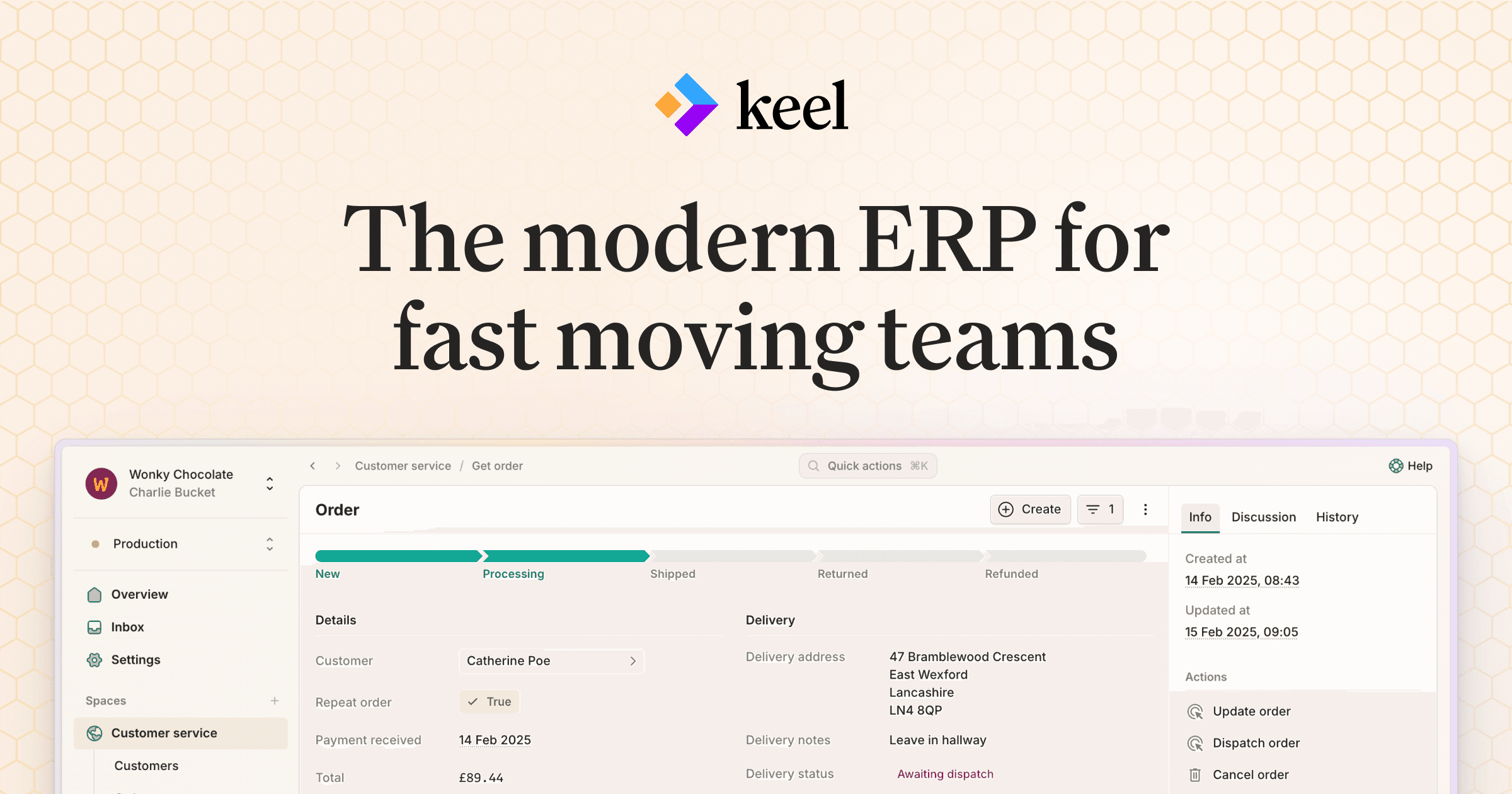
Keel Studio provides a comprehensive solution for rapidly building and deploying production-ready backends. Users can describe their system with a prompt and receive a complete backend featuring a database, APIs, authentication, permissions, observability, and internal tools. The platform is built on a code-first approach, utilizing the Keel Schema as the source of truth for data models, API endpoints, authentication, and secrets. It supports collaboration by instantly creating tools that allow entire teams, including customer service, marketing, and logistics, to interact with data securely. Keel Studio is designed for fast-moving operations teams, enabling them to build custom operational systems like CRM, inventory, and procurement without the complexity of traditional ERPs.
arcadedb
ArcadeDB is a high-performance Multi-Model Database Management System (DBMS) created by Luca Garulli, the founder of OrientDB. Built from scratch with a new engine, ArcadeDB is designed to process millions of records per second with minimal resource usage. It reuses and heavily modifies OrientDB's SQL engine, leveraging low-level Java APIs for advanced mechanical sympathy and reduced Garbage Collector pressure. ArcadeDB is a fully transactional DBMS supporting ACID transactions, structured and unstructured data, a native graph engine, full-text indexing, geospatial querying, and advanced security. It supports various models including Graph, Document, Key/Value, Search Engine, Time Series, and Vector Embedding, and understands multiple languages like SQL, Neo4j Cypher, Apache Gremlin, and MongoDB Query Language. It can be used embedded, remotely via HTTP/JSON, or with Postgres, Redis, and MongoDB drivers.
REST API with Gradio and Huggingface Spaces
REST API with Gradio and Huggingface Spaces provides a platform for developers to create and deploy REST APIs, particularly useful for machine learning applications. Hosted on Hugging Face Spaces, this tool simplifies the process of building web interfaces for AI models. It is designed for prototyping AI applications, allowing users to quickly set up an API endpoint for their models. The platform leverages Gradio for creating user-friendly web interfaces, making it accessible for developers to share and test their AI projects.
candle-vllm
candle-vllm offers an efficient and easy-to-use platform for inference and serving local Large Language Models (LLMs), featuring an OpenAI-compatible API server. Its highly extensible trait-based system allows for rapid implementation of new module pipelines, and it supports streaming during generation. Key capabilities include efficient management of key-value cache with PagedAttention, continuous batching for incoming requests, and in-situ quantization (including GPTQ/Marlin 4-bit formats). The platform supports various hardware, including Mac/Metal devices, and offers multi-GPU and multi-node inference. It also features chunked prefilling, CUDA Graph support, and an OpenAI-compatible tool calling API, making it a versatile solution for deploying and managing LLMs.
stable-diffusion-prompt-reader
stable-diffusion-prompt-reader is a simple, standalone viewer designed for extracting, editing, and removing prompts from images generated by Stable Diffusion and other AI tools. It supports a wide range of formats including PNG, JPEG, WEBP, and TXT, from various generators like A1111's webUI, Easy Diffusion, ComfyUI, and more. Available for macOS, Windows, and Linux, it offers both a graphical user interface (GUI) with drag-and-drop functionality and a command-line interface (CLI) for advanced users. Key features include copying prompts to the clipboard, exporting to text files, and editing metadata, making it an essential tool for managing and understanding AI-generated image data.
llama2-webui
llama2-webui is an open-source tool designed for running Llama 2 models locally through a Gradio web UI. It offers broad compatibility, supporting all Llama 2 models (7B, 13B, 70B, GPTQ, GGML, GGUF, CodeLlama) and various backends like transformers, bitsandbytes (8-bit inference), AutoGPTQ (4-bit inference), and llama.cpp. The tool can be deployed on Linux, Windows, and Mac, utilizing either GPU or CPU resources. Developers can also leverage `llama2-wrapper` as a local Llama 2 backend for generative agents and applications, and it provides an OpenAI-compatible API for seamless integration with existing clients and libraries. Benchmarking scripts are included to evaluate performance on different devices.